
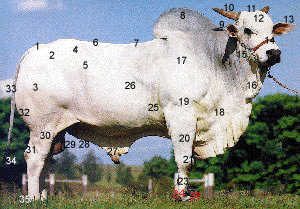
| 1 - Tail Head | 10 - Horn | 19 - Arm | 28 - Sheath |
| 2 - Plate | 11 - Forelock | 20 - Forearm | 29 - Scrotum |
| 3 - Hip | 12 - Forehead | 21 - Elbow | 30 - Hip |
| 4 - Hook | 13 - Ear | 22 - Shank | 31 - Hock |
| 5 - Flank | 14 - Chamfer | 23 - Fetlock | 32 - Twist |
| 6 - Loin | 15 - Lower Jaw | 24 - Pastern | 33 - Tail |
| 7 - Dorsum | 16 - Dewlap | 25 - Cincher | 34 - Tail Broom |
| 8 - Hump | 17 - Shoulder | 26 - Ribs | 35 - Toe |
| 9 - Neck | 18 - Chest | 27 - Prepuce | 36 - Hoof |
Cattle breed originary of India, distinguished by presenting big, large
and pending ears; short and narrow neck; well-developed hump; wide and
pendulous dewlap; thin barrel; long, solid structurated well covered limbs;
thinner, well-pigmented, short-smoot haired skin. The
gestational period is bigger than the european cattle, with a mean of 292
days.
Its origin is very controverse. Wilford & Johnson (1951) and other
researchers consider that the Zebu is provenient from the area comprised
by India-Pakistan-Birmania-Malaca. Others believe this breed is derived
of Africa.
The zebuine cattle is found worldwide in the tropical zones -
India, Pakistan, China, Mongolia, Tibet, Iraq, Australia, many countries
of Africa, United States, Central and South Americas (mainly in Brazil)
- performing one of the biggest cattle contingent
of the world.