
TITLE OF EXPERIMENT: Which plastic wrap works best?
GROUP MEMBERS: Person A (What they did), Person B (What they did), Person C (What they did), and Person D (What they did), in Global Science period XYZ, Group Q.
PROBLEM: Which brand of plastic wrap is the most effective at keeping foods from drying out? Do all brands have the same capacity to keep air out? This could be tested by putting wet paper towels in the plastic overnight, then checking to see which retained the most moisture.
PURPOSE: Which plastic wrap does the best job holding in moisture?
HYPOTHESIS: Our group thinks Iris brand will work best. It will lose the least amount of water overnight.
MATERIALS: 3 different kinds of plastic wrap, material to tie the plastic, 4 paper towels, balance, plate or tray for packets and control.
PROCEDURE:
1. Choose three different brands of plastic wrap and follow steps 2-5 for each brand. Be sure to identify the brand for each set of packets.
2. Soak one paper towel with water and place it on one of the pieces of plastic wrap.
3. Wrap the towel and plastic tightly. Squeeze the air out of the packet and tie it tightly with string.
4. Soak a fourth paper towel in water, but do not wrap it in plastic. Place this towel with the other packets.
5. Mass each of the packets and the control. Make a chart and record the weight of each item.
6. Put the packets in a dark area at room temperature and let them sit overnight or longer.
7. Return and repeat step 5.
8. Calculate the amount of moisture lost for each item.
9. Write your conclusion.
10. Answer text/Analysis questions.
11. Finish writing up lab for presentation.
OBSERVATION:
We (Person A, Person B, Person C and Person D) began working on this experiment on Tuesday, Month, Day and Year. Each of us spent 30 minutes doing research on the Internet regarding plastics. Abstracts and link addresses are listed in our bibliography. We chose Reynolds Blue, Stretch-Tite and Iris Plastic Wrap as our test brands of plastic wrap.
Person A wet 4 paper towels. Persons B and C did the massing; person D wrote down the data. The mass of each towel BEFORE wetting was 3 grams. We then wrapped each towel and massed each packet and the control. The mass of each packet and the control towel is found in the �Data� section of the report. We labeled each packet and placed them on a styro tray. We put the tray and packets/control in the next-to-the-bottom drawer of the cabinet @ the front of the science classroom at 3:00 P.M. The temperature in the room was 27 degrees C.
On Wednesday, Month, Day and Year at 9:00 A.M., we took the tray out of the cabinet. Person A, Person B, and Person D were present to do this. We massed each packet. Numbers are listed in the �data� section of this report. Person A typed the information for the report, Person B created the graphs and Person D typed the bibliography.
DATA/TABLE(S)/GRAPH(S):
Here is where we recorded data obtained as we conducted our experiment:
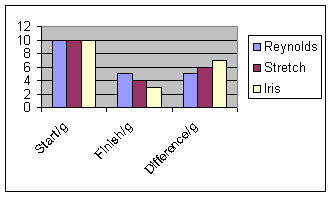
Graph for whole experiment:
Data table for ending mass:

Graph for ending mass:
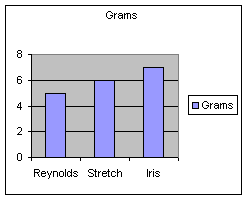
CONCLUSION: We predicted incorrectly. Iris brand lost the most moisture during the 15-hour test period. Stretch-Tite performed second best, Reynolds Blue plastic wrap finished first.
QUESTIONS/ANSWERS:Book questions (Analysis): 1. What hypothesis were you testing in this experiment? Which plastic wrap will do the best job retaining moisture? 2. Which brand of plastic wrap left the paper towel the wettest? Iris brand worked the best. 3. What was the purpose of the fourth towel? The fourth towel was the control in the experiment. 4. How could you make this experiment quantitative? The paper towel packets could be weighed before and after�and we did weigh them!
Our questions: 1. What would the results be if we left the packets in the dark longer? 24 hours? 1 week? 1 month? 2. What would happen if we used food instead of water/paper towels?
EXTENSIONS: What additional experiment(s) could you do as an extension of this study? Sample: mini carrots could be massed and compared for moisture loss.
BIBLIOGRAPHY/RESEARCH: Using Prospect Education Center bibliography guidelines, list your research. Include abstracts and links.