Badge Requirements

Badge Requirements (page 2)
It's Important to Me
Complete any six of the following requirements to earn this badge:
- The Girl Scout Law in Action
The Girl Scout Law contains important values for girls to live by. Let the
words of the Girl Scout Law inspire you daily. Make a Girl Scout Law plaque
or wall hanging that highlights the parts that mean the most to you. Use
paint, fabric, contact paper, poster board, or other materials to make your
plaque or wall hanging sturdy and attractive.
- Values-Based Approaches
Values help you find ways to solve problems. Write a story about how you
solved a problem using your values. Or write a short story that shows how a
girl your age uses on of f her values to solve a problem. If you like, you
may draw an illustration for your story. Note: Did you know that you can
submit this or another one of your original stories to GSUSA's "Just for
Girls" web site? Go to
www.girlscouts.org/girls and click on "Girl Space" and the "Stories" to
learn how.
- Discover Your Values
Check out the section about values in the "It's Great to Be a Girl" chapter
of your Junior Girl Scout Handbook. Do one of the activities in that section
with your family or friends.
- Values Vote
With your troop, group, or family brainstorm a list of five values. Have
everyone copy the list and play "20 Votes". Everyone has 20 votes to cast
for the values she thinks are most important. You can use your votes all on
one value or spread them out any way you like. Without talking, everyone
records her votes. Then each girl puts a star by the value she thinks will
get the most votes for the group as a whole. Now tally the votes. What was
the most popular value? How many people guessed it would be? Discuss with
your group why you think people feel it is the most important.
- Values in the News
Find a news report in the newspaper, or on the internet, radio, or TV that
tells about problems people have because they made poor decisions. Decide
what value or values could have helped them avoid their problems and why.
- Debate It
When you make decisions, you often have to weigh two competing values. Fro
example, you may wonder: Do I stay loyal to my friend or tell the teacher
that she has been cheating on a test? Choose two competing values and have a
values debate. With a group, divide into two sides. One group should take
one side of the issue and the other group should take the other side. Meet
with your group for a few minutes to discuss the major points you want
to make and then let the debate begin. Have your troop leader or adult
family member serve as moderator.
- Other People's Values
Holidays often reinforce the values of a country or culture. With your
troop, group, or family, learn about an important holiday in another
country. Learn about some of the traditions of that holiday and the value or
values that are a part of that holiday.
- Secret Sister
A Girl Scout is a sister to every other Girl Scout. Show how you value the
sister Girl Scouts in your troop or group. Have a "Secret sister" party.
Have each person draw a name, and then make something special at home for
your secret sister. Bring the gift to your next meeting and give it to her.
Remember, don't tell who your secret sister is until it is time to reveal
her name at the party. OR you could choose a secret sister at school or in
your neighborhood and do something special for her.
- Women of Courage
With your troop, group, or family name eight courageous women. Discuss what
they did and why they were or are courageous. Write the names of the women
on slips of paper and put them in a cup. Divide into two teams. Each team
takes a turn pulling a slip of paper. The other team may ask 5 yes/no
questions and then guess who they think the courageous woman is.
- Valuing Service
Put the Girl Scout Promise into practice by giving service individually or
with your family, troop, or group. Join in a community service project such
as a clean-up activity, healthy fair, or other event. Or volunteer to give
service to a community organization such as your school, religious
organization, or other non-profit group. Remember: When giving service, Girl
Scouts are not permitted to raise money for other organizations.
Jeweler
Complete any six of the following requirements to earn this badge:
- Jewelry from Everyday Objects
Make a piece of jewelry using materials that are not precious metals or
gems. You might make a pin, a necklace, a bracelet, or a hair ornament. Some
ideas for materials are:
- Handmade beads
- Hardware (such as screws, nuts, washers, wire and chains)
- Paper (paint or draw designs on pieces of paper. Several pieces can be
joined with cord or thread or glued together)
- Macram�
Knot string and other cords into decorative patterns. Interweave beads,
sanded pieces of wood, and shells to create unique macram� jewelry. See the
"Create and Invent" chapter in your Junior Girl Scout Handbook.
- Jewelry from Other Lands
Learn about the jewelry of 4 different cultures (fro example, from an
American Indian culture or a culture from Europe, South America, or Africa).
Or look at an ancient culture, such as early Egypt or Asia. Describe the
materials and styles used, and their customs and traditions for wearing
jewelry. If possible, find pictures of the type of jewelry worn in each
culture.
- Jewelers' Skills
Learn about the different jewelry-making techniques of soldering, casting,
hammering, and molding. Can you describe a situation when each might be
used, or find a picture showing an example? If possible, visit an artist who
uses one or more of those techniques to make jewelry.
- Take a Tour
Visit a museum or gallery exhibit of jewelry. Take an organized tour of the
exhibit or ask someone knowledgeable to explain the work. Be sure to bring a
notebook and sketch any designs you'd like to remember!
- Something Natural
Make a piece of jewelry out of organize material (something found in
nature). You can combine a variety of colors, shapes, and textures by using
shells, stones, seeds, and other materials you could find on an outdoor
scavenger hunt. Look at the section about swaps in the "Adventures in Girl
Scouting" chapter in your Junior Girl Scout Handbook for ideas about jewelry
made from rocks and from flowers.
- Triple Up
Make an item of jewelry that combines at least 3 different elements. For
example, you can combine leather laces with wire and stones. Come up with
other interesting combinations.
- Store Your Gems
Make a box for your jewelry. You can decorate a small cardboard, metal, or
wooden box with decoupage, or decorate a small basket. Add decorative
touches with pieces of discarded jewelry, pearls, beads, or shells. See the"
Create and Invent" chapter in your Junior Girl Scout Handbook for
information about decoupage.
- True Gemstones
Learn about one type of stone or mineral used in jewelry. For example, you
might choose to learn more about your birthstone. Does the stone or mineral
have any special meaning Are there any legends or myths about its special
power?
- Get the Message?
Find out about ht symbolism of different kinds of jewelry, such as wedding
bands or friendship bracelets. Make a piece of jewelry to give to someone
else as a symbol of your friendship.
Lead On
Complete any six of the following requirements to earn this badge:
- Talk Show Star
Create an imaginary TV show in which you are the host. Interview a pretend
leader - a mayor, for example. Ask at least five questions about her
leadership role. Provide time for your "studio audience" to ask questions as
well.
- Let's Welcome . . .
Choose a female leader whom you have read or heard about. Write or tape
record what you would say about her if you were introducing her to an
audience of Junior Girl Scouts and their families.
- Choose Your Leaders
List at least 5 leaders, including leaders from your school, community,
state, nation, and the world. Choose your favorite leader from the list.
With your troop, group, or family, discuss what personal qualities make that
person a good leader. Which qualities do you have that are similar to hers?
- Play a Leading Role
A leader should be a role model - someone who practices habits that provide
a good example for others to follow. Do an activity with your troop, group,
or family in which you practice being a role model in one of the following
areas: safety, sports, or friendship.
- Leading Qualities
One quality that all good leaders have is a sense or responsibility. Make a
list of the tasks that you are responsible for on a typical weekday. Ask
yourself if you do each of these things without being prompted (without
having someone remind you to do them). If you don't, make tomorrow a
"Responsibility Day." Keep your list close by and check items off as you do
them. Try to finish the entire list without your family reminding you. For
more advice on getting things done, check out the time management skills
section of the "Be Healthy, Be Fit" chapter Junior Girl Scout Handbook.
- Follow the Leader
Many games build leadership skills in a fun way. "Follow the Leader" "Simon
Says and "Red Rover" are some examples. Hold an event in which games
emphasizing leadership skills are played. Invite younger Girl Scouts,
friends, and neighbors to attend. Include games that make players follow
directions, such as scavenger hunts and relay races.
- More on Leadership
In a group, identify a community problem and brainstorm actions you could
take to deal with it. To guide your planning, use the action plan in the
"Adventures in Girl Scouting" chapter of your Junior Girl Scout Handbook.
- Team Leadership
Playing sports often provides a good chance to test and improve your
leadership skills. Pick a skill you are really good at - such as throwing,
batting, volleying, or somersaulting - and volunteer t o spend some time
teaching it to another girl.
- What Did You Say?
Good communication is important to leadership. Read about communication in
the "Family and Friends" chapter of your Junior Girl Scout Handbook. Test
your communication skills with friends, family, and other Girl Scouts.
- Set a Goal
Decide on one leadership quality you are going to improve over the next
month. Write out your commitment, and take at least 3 actions a week to meet
your goal.
Let's Get Cooking
Complete any six of the following requirements to earn this badge:
- Keeping It Clean
When preparing and eating food, keep your hands squeaky-clean! Believe it or
not, bacteria can cling to the natural oil on your hands. Want to see? Take
two apple pieces. Wash one apple piece and then wipe it with dirty hands and
place it in a sealed jar. Label the jar "dirty hands. " Now wash your hands.
Take a second apple piece and wash it, then wipe eat with your clean hands.
Label this jar "Squeaky-clean." after one week, look at both apple pieces.
Are there any Difference? How does this experiment demonstrate the
importance of washing your hands?
- When in Doubt, Throw It Out
Talk with a dietician, a health educator, or a restaurant owner and find
out: How long can you keep different kinds of leftovers before they become
dangerous to eat? How long can you keep a picnic lunch out of
refrigeration's? What actions can you take to keep your food safe?
- Have It Your Way
With a group of friends, create your own healthy fast-food restaurant.
Develop a menu, set the prices, and design the look of the restaurant. Don't
forget to give it a great name. Assign jobs like hostess, waitress, or chef.
Decide where people will be able to find this restaurant. Then stage your
"Grand opening." Invite people to come to your "restaurant" and try some of
your creative dishes.
- Something for Everyone
Not everyone has the same access to healthy food. Tragically, more than one
billion people worldwide are underfed. Collect food that can be donated to
shelters or to another organization the could benefit from additional food.
Make sure you include nutritious food that won't go bad, such as canned
goods, juice boxes, dried fruit or fruit rolls, packaged cereals, and
pastas.
- The Perfect Egg
Eggs are a great source of protein and can be prepared in many different
ways. Create a recipe in which eggs are used. Need inspiration? You might
look at cookbooks with recipes from other countries. Note: Although eggs
taste good and are good for you, they can be dangerous if you don't cook
them properly. you can limit the threat of these harmful bacteria by masking
sure that eggs are fully cooked. Uncooked eggs are one reason not to taste
cookie dough or cake batter before it's been baked!
- New Wave Chef
Microwaves, electric grills, rotisseries, and other appliances help make
cooking fast and fun. Select an appliance and, with an adult's help, try out
a recipe that lets you use it.
- Tasty Treats: Fruit Surprise
Here is great way to make tasty treat fro you and your friends that doesn't
involve cooking.
What You Need:
- 1 cup container of fruit-flavored yogurt
- 1 cup of whipped cream or whipped cream substitute
- 4 mini pie crusts (pre-cooked)
- Fresh berries or other fruit
What You Do:
- in a bowl, mix the fruit-flavored yogurt and the whipped cream.
- Scoop the mixture equally into each of the four pie crusts.
- Decorate the pies with the fresh berries or other fruit.
- Refrigerate for 15 minutes. then, devour!
Now it's your turn: Create your own no-cook recipe!
- Mix It Up
Blender drinks are fun, quick, and easy to make. When you use healthy
ingredients, the drinks can also boot your energy. Invite each guest at your
"blender party" to bring a recipe for a vegetable or fruit drink and all the
ingredients it requires. Be sure to plan ahead, so you'll have everything
you need. Experiment with combinations of fruit, milk, yogurt, juice, hone,
and natural flavorings to create a variety of drinks. Select fruits such as
blueberries, strawberries, melon slices, peaches, pineapple, or bananas.
such try tropical fruits such as kiwi, mango, and papaya. For vegetable
juices, try combining carrots, celery and tomatoes.
- Food Around the World
With your Girl Scout troop or group, eat your way around the world. Start in
the US and trace a path around the globe - in any direction. Each girl
chooses a country on the "trip". Then she finds a healthy recipe from that
country to share with the troop. What can you learn about a culture from a
recipe and its ingredients?
- The Big Change
With the help of an adult, take a recipe that you find in a cookbook and
make it healthier. For example, you can change the ground beef in a meat
sauce to ground turkey or chicken. If you are baking, try substituting a
half cup of applesauce for a stick of butter. Try tofu in your cooking as a
healthy source of protein. be creative and have fun!
Local Lore
Complete any six of the following requirements to earn this badge:
- Word of Mouth
Find out about a story, legend, monument, or landmark in your community.
Older residents or your librarian can help. Share your fangs with others.
- It�s all on the Map
how has your community changed? Locate a map of your town that�s at least 25
years old. Your library, chamber of commerce, or planning commission should
have one. Compare that map with one from today. What has changed? What has
remained the same? Are all the changes for the better? Which ones would you
like to undo? Why?
- From Above
Ask someone from the Soil Conservation Service, the U.S. Geological Service,
or a local college or real estate agency if you can see aerial photos of
your community made over a period of time. What story do these photos tell
you about changes in your community?
- Tour Your Community
Take part in a tour of your community. Look for 3 different examples of
architecture from different historical periods. When and why were the
buildings or houses built? What types of materials were used? Try sketching,
photographing, or writing down information about the buildings.
- Extra, Extra, Read All About it!
Create a one-page poster, newspaper page, or flyer that describes a past
period of your community. Include news, ads, or editorials that might have
appeared at that time. Share your item with others.
- Sing Someone� Praises
Create a story, song, or poem about the efforts of one person who has had a
major impact on your city or town.
- Take a Trip
Visit a local museum, historical society, library, or town hall to learn
more about the history of your city or town. What new things did you learn?
- Take Pride
Volunteer at an event, fair, or special occasion in your area. Find an event
that brings people together in celebration of the past; for example, one
that highlights important dates in history, or one that recognizes the past
contributions of different cultures.
- Walk the Talk
Pitch in on a project that will help preserve the history of your community
or something unique about it. Examples would be replanting native plants, or
cleaning or fixing up an historical site.
- Focus on the Future
given how your community has changed in the past 25 years, how do you think
your community will change in the next 20, 50, or 100 years? Share your
prediction of the future I a creative way- you might use charts, maps,
drawings, or a skit.
Looking Your Best
Complete any six of the following requirements to earn this badge:
- Collect Tips
Create a �looking Your Best� booklet, poster, video, or collage that
includes the most important tips girls your age need to know to look their
best. Get ideas from current fashion and health magazines, from the
internet, and by interviewing people who have information to share. Include
health, fashion, hygiene, and nutrition tips.
- A Personal Hygiene Routine
Create a personal hygiene routine that you can follow daily or weekly. Your
routine should include caring for your skin, teeth, and hair. Consider how
other each action, such as washing your hair, should be done. Learn about
products that can help you, such as sunscreen, dental floss, and hair
conditioner. Your plans should also include a schedule for washing and
mending your clothes. Put your routines on paper and stick to them.
- Aerobic Activities
select a couple of aerobic activities that you enjoy. Walking, running,
jumping rope, biking, skating, and dancing are examples of aerobic
activities. For 2 weeks or more, with a fiend, do an aerobic activity of
your choice at least 3 times a week for 20 or 30 minutes. DO different types
of activities so you won�t become bored. You can substitute a favorite
sport, as long as you are moving for at least 20 minutes.
- Skin Care Secrets
Talk to women of different ages and find out about their skin care routines.
Do they use just soap and water? Lotions and potions? Have their routines
changed as they got older? What secrets can they share for keeping your skin
healthy?
- Color Party
Experiment with color. With fiends, collect sizable pieces of fabric or
pieces of paper in different colors. Take turns holding different colors up
to your face. Decide which colors look best on each of you: lavenders and
plums, corals, pinks, reds, blues and greens, or beiges and peaches.
- Organize
Rearrange the clothes in your dresser and closet so you�ll have an easier
time finding just the right outfits or combinations, no matter how rushed
you are. For example, you might pair tops and bottoms or organize by season
or color.
- Experiment with Hairstyles
Get together with a group of friends and try different hairstyles on each
other. Get ideas from magazines, form the �It�s Great to Be a Girl� chapter
of your Junior Girl Scout Handbook, from older girls or adults � or dream up
new hair creations yourselves. Each girl should bring her own hair
accessories like clips, headbands, and decorative combs. Experiment with
intertwining g ribbons, beads, and other decorative items in your hair.
Remember not to share brushes, combs, and other hair appliances, so there
will be no problems with hygiene. If you can, take instant pictures or shoot
video of your new styles!
- Create Healthy Snacks
Host a troop meeting by preparing a healthy snack to share. Here�s a recipe
you can try for making Pita Chips. Have an adult around to supervise.
Pita Chips
�
Separate pit bread rounds into their tow
halves.
�
Cut each half into six to eight pieces.
�
Spray a cookie sheet with cooking oil for
your pita bread.
�
Bake the pita piece at 350* for 20 to 30
minute, until crispy.
�
Sprinkle with garlic powder, cinnamon
sugar, chili powder, or grated cheese.
�
Use them as dippers for a low-fat dip!
9.
Circle of Friends
With a group of friends, possibly girls in your troop, sit in a circle with one
girl in the center. Each person will take a turn and give an honest compliment
to the person in the center. The person in the center listens without saying
anything. After everyone has given a compliment to her, she returns to the
circle and the person on her left goes into the center. The activity continues
until everyone has had a chance to be in the center.
10.
Accessory Party
Experiment to see how accessories highlight your features and your outfit. Try
different earrings and necklaces � long or short, big or delicate, unusual
shapes or colors. How do different belts or the addition of a scarf change your
look?
"Making" Hobbies
Complete any six of the following requirements to earn this badge:
1. Choose Your Craft
Before starting any hobby you need to see if it will fit into your
lifestyle. Ask your self these questions and discuss the answers with an
adult family member or your troop or group leader.
- Is this hobby fun?
- Can I afford it?
- Do I have time for it?
- Do I have room for it?
- Are there any environmental concerns?
2.
Practice your Craft
Check with experts and in craft books, or surf the web for ideas and
instructions. Go to craft and variety stores or check around the house for
supplies. With adult help if needed make at least 3 examples of your craft
3.
Re-Craft
Practice your craft using a material you�ve never used before. Make at least
1 example of the new craft. Show your new craft item to others and explain
what you have learned about using different materials.
4.
Where and When
learn more about your craft by looking at global and historical examples.
Try finding global examples at craft fairs and museums, in books, and by
surfing the web. Look for historical examples at antique shows, flea
markets, and museums, and in books. Discuss what you learned with your trop,
group, or family members. If possible, show some examples of global and
historical crafts to others.
5.
Make a Recycled Craft
try making craft items from things you normally throw away. Look in craft
books or on the web for ideas on how to use egg cartons, juice lids, packing
peanuts, or other items. You can make a craft that you are familiar with or
choose a new craft entirely.
6.
Make a Craft with a Nature Theme
Many crafts have nature themes. Learn how to use nature in crafts. Make a
craft item with a focus on plants and animals. Here are some examples:
- A print made with leaves
- A mosaic made from eggshells
- A basket made of plant materials
7.
An Honor
Your craft project is being placed in the �Museum of Modern Crafts.� Write a
description of the piece that will appear in the museum. Include details of
tools, materials used, and other interesting information;
8.
Your Own Gift Wrap
After you have made several craft items, you might want to give some away as
gifts. Design your own gift wrap and wrap up your homemade gifts.
9.
Crafty Cash
find out more about people involved in the crafts business. Visit a crafts
person where she works or have her come to your troop or group meeting to
share information about her job. If that is not possible, find information
about professional crafts people in books or magazines or on the web. Share
the information that you learn with your troop, group, of family.
10.
Safe Crafts
help protect yourself and others while you are practicing your craft by
making a Craft Safety Checklist. Think about the tools and supplies involved
in making crafts. Brainstorm with others to come up with a list of at least
8 to 10 safety guidelines. Start your list with these 2 safety rules:
- Store sharp tools in a safe place.
Never leave them on the floor.
- Use aerosols in a well-ventilated area,
never in a small, closed room.
- Write down your Craft Safety Checklist
and keep it for future reference.
Types of Crafts:
v
Knitting
v
Crocheting
v
Embroidery
v
Sketching
v
Photography
v
Weaving
v
Sewing
v
Jewelry Making
v
Painting
v
T-Shirt Design
v
Pottery
v
Basket weaving
v
Tole painting
v
Macram�
v
Decoupage
v
Wreath Making
v
Mosaics
v
Woodworking
Making It Matter
Complete any six of the following requirements to earn this badge:
- Making a Polymer
many of the products you use every day are made of plastics. Plastics are a
type of material called a polymer � a chemical compound of chain-like
molecules. Parts of cars, clothes, CD�s, sneakers, and many, many other
things are made of polymers. Here�s a chance to make your own polymer.
a)
What You Need:
i.
Borax (available in the laundry section of grocery store
ii.
Water
iii.
A measuring cup
iv.
A tablespoon
v.
White glue
vi.
A plastic cup
b)
What to Do:
i.
Dissolve 1 tablespoon of borax in � cup of water.
ii.
Put 1 tablespoon of white glue and 1 tablespoon of water into a plastic
cup and stir. When the glue and water are mixed well, add 1 tablespoon of the
borax solution and stir. What happens?
- Polymer Possibilities
By adding different ingredients, engineers can change the look, feel, and
behavior of a polymer. Here�s how you can make different polymers with
different properties. You need the same materials as in activity 1, plus:
salt, sugar, baking powder, coarse corn meal, and a � teaspoon measuring
spoon.
a)
What You Do
i.
Dissolve 1 tablespoon of borax in � cup of water.
ii.
Put 1 tablespoon of white glue and 1 tablespoon of water into a plastic
cup and stir. Add � teaspoon of salt and stir until the salt is dissolved. Then
add 1 tablespoon of the borax solution and stir. What happens?
iii.
Repeat step 2 using sugar, baking powder, and corn meal instead of salt.
How do the polymers compare?
Find other plastic objects.
Compare their different properties � hard, soft, stretchy, bouncy, textured or
clear.
- Making Connections
Electrical engineers work with circuits and electricity. From light switches
to electrical generators, engineers keep the juices flowing. Here�s your
chance to wear an engineer�s hat � find out how a doorbell works by making
your own.
a)
What You Need
i.
Each of these items can be found at any electronics store:
a)
A 9-volt battery
b)
A 24 or 26 gauge copper wire
c)
A push-button switch
d)
A 9-volt buzzer
b)
What You Do:
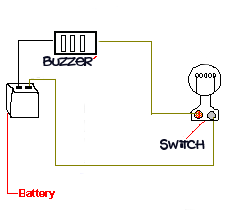
Follow the diagram below to attach the wire to the buzzer, switch, and battery,
making an electrical circuit. When you push he button, you should hear your
doorbell �ring�. Can you think of other things in your home that work like this?
- Moving Parts
Find out the role of bearings in machines (such as your family car or a pair
of roller skates / blades) by doing this simple experiment.
a)
What You Need
i.
A coffee can or similar type of can (empty or full)
ii.
A lid that fits over the bottom part of the can
iii.
A pencil (preferably without a point)
iv.
Plasticene clay (available at toy and hobby shops)
v.
Marbles
b)
What You Do
i.
Make a dumbbell-like object by placing equal-sized balls of clay on each
end of the pencil.
ii.
Center one end of the pencil on the lid, and then attach it to the lid
with the clay.
iii.
Place the lid on the bottom of the can. Can you make the lid turn on the
end of the can? How well does it turn?
iv.
Now, remove the lid from the can. Place the marbles on the top of the
can.
v.
Put the lid back on top of the can this time over the marbles. Try making
the lid turn on the end of the can. What happens? Why? Can you find an example
of using bearings to help something turn in a �machine?�
- Materials and Structures
Civil engineers design highways and bridges. Knowledge of building materials
is needed in order to meet the load demands. Here�s an engineering challenge
� try to build a structure from which you will hang a cup, using the
following materials:
a)
Old newspaper (if rolled up tightly, it can become a surprisingly strong
building material)
b)
Tape
c)
String
d)
A plastic Cup
e)
A cupful of small rocks or gravel
Can you fill the cup with rocks or
gravel without it tipping over?
- Engineering In Action
Visit a factory, water or sewage treatment plant, recycling center,
waste-to-energy incinerator, power plant, or construction site. Do engineers
work there? If so, interview someone about her job. Find out what role
engineers played in the design of the facility.
- Label Check
Look at 10 different products around your house � check the kitchen
cupboard, the cleaning supplies, and perhaps your craft supplies. What
chemicals can you find, listed as ingredients of the products? Which
products require you to take special safety precautions when handling and
disposing of them? What are those precautions?
- Base-ic Facts
Is it an acid or a base? Find out by making your own pH tester. First you�ll
want to read the section about pH I the �Explore and Discover� chapter of
your Junior Girl Scout Handbook.
What You Need
a)
A radish (or red cabbage juice)
b)
Baking Soda
c)
A measuring cup
d)
A tablespoon
e)
Vinegar or lemon Juice
What You Do
a)
Scrape the skin of the radish into a glass of water. Use your fingernail
or a dull knife edge. Scrape enough to turn the water into a pinkish color. (Or
add enough cabbage juice to turn the water pinkish). The pinkish water is the
�tester�.
b)
Dissolve 1 tablespoon of baking soda in about 2/3 cup of water.
c)
Put 1 tablespoon of this solution into a clean cup.
d)
Put 1 tablespoon of vinegar or lemon juice into another cup.
e)
Add a few drops of the pH tester into each cup.
f)
What happens? Gently pour the contents of one cup into the other cup.
What happens then?
- Reverse Engineering
Reverse engineering is when you take something apart to see how it works.
Find an old simple appliance (such as a hair dryer, toaster, blender or
clock) that is ready for the scrap heap. (Check with the owner for
permission to use it). Carefully take the appliance apart, keeping track of
what part came from where. Try to explain how you think the appliance might
work. Then, try to put it all back together again. Note: An adult should be
present during this activity. Do NOT plug the machine in to see if it works
after taking it apart and putting it back together again.
- Use Computers to Design
Engineers use CAD (computer-assisted design) to test how things they have
designed will work before they actually build them. Find out more about
computer-assisted design by talking to people who use it in their jobs or by
doing online research. See if you can find a website or software that allows
you to build a model on the computer and test it.
Making Music
Complete any six of the following requirements to earn this badge:
- A Family Affair
All instruments belong to different family groups. For example, a clarinet
is made of wood, so it belongs to the woodwind family. Choose an instrument
family and learn what the family the members of the family do.
- A New Sound
Design a brand new instrument. How is it played? What does it sound like?
- Practice, Practice, Practice
The best way to master any instrument is to practice. However, practicing
the same thing over and over can be boring. Keep things interesting. Not
sure how to start? Try learning two new songs. Or play a song � or scales �
backwards. Another idea would be to create your own silly song.
- Compose Yourself
Write a simple melody of at least eight measures for an instrument. Write
down your piece using symbols for notes, key tempo, and dynamics. Try to
teach someone to play your newly composed piece.
- Musical Roots
many pieces of music have interesting stories behind them. Pick a piece of
music and find out about the following: What was the composer like? What
other pieces did she or he compose? When was the music composed? Why was it
written? Does the piece of music tell its own story?
- Be a Conductor
one of the most celebrated musicians on the stage is the conductor � and she
or he doesn�t even play an instrument! A conductor guides the musicians
through the music by keeping the count, telling various sections when they
start or stop and telling the musicians if they should play softly or
loudly. Choose a piece of your favorite music, and learn how to conduct the
piece. Use something for a baton, such as a wooden spoon or chopstick, and
keep the beat. When should the piece be played loudly? When should it be
played more softly?
- Music with a Theme
Select one of these themes and play music that matches it, for an audience
of friends or family: the sea, a river, a busy urban area, a forest, a
mountain range, a field or meadow, a circus or festival, a march or parade.
- On Stage
Using your musical skills, take part in a performance in a Girl Scout
ceremony, an individual recital, a group performance, or a community musical
event.
- Opera, Anyone?
Watch an opera or operetta on television, or attend an opera in person.
Listen for the story. How much of it is sung? How much is spoken and in what
language? How are the voices related to the characters (for example, why
does a soprano sing a certain role rather than a bass)? Who composed the
opera, and when did she or he live?
- The World and Its Influence on Music
Throughout history, composers have written songs about significant world
events. Some of these pieces were written in celebration. Find out about 2
pieces of music that were influenced by historical events. Play or sing them
for your troop or group and explain what influenced the composers to write
them.
Math Whiz
Complete any six of the following requirements to earn this badge:
- Math Hunt
How many daily examples of math can you and your friends think of? There are
checkbooks to balance, measurements to use for recipes, tips to calculate,
grocery charges to add. Set a timer for 3 minutes. Who can think of the most
math-related daily activities?
- Your Numbers Are�
Measure yourself in five different ways. The length of your arm or leg, the
length of your stride, and the amount of cereal you put in your bowl are
just a few of the ways you add up. Come up with your own!
- Shape Up
Look for geometric shapes around your home, school, playground, or other
area. You can check floors, walls, doors, windows, leaves, flowers, or other
items. Find out the names of the shapes you don�t already know.
- Calculate Your Flight Time
Choose a destination that you would like to visit anywhere in the world.
Using a world map with a distance key, figure out how far the place is from
your hometown. How long would it take you to drive there? Fly there?
- Make It Count
Can you tell how many jelly beans are in a jar without counting every one?
Have an adult or older friend fill a jar with jelly beans or other small
candies. Make sure she carefully counts how many are put in, records the
number, and keeps it somewhere safe (no peeking). Then you and your fiends
try to guess the number in the jar. How did each of you come up with your
number? What�s the correct answer? Who was the closest?
- Make a Math Puzzle
Draw a square divided into nine equal spaces (3x3). Put a penny on each
square (9 pennies, Two players take turns removing 1 penny at each turn. A
player must always leave at least one penny in each row or column. The last
person to play wins. If a player takes a penny that makes a column or row
empty, she loses. Play at least 10 games. Try to discover a strategy for
winning the game.
- Predictions
Make a prediction, such as, �I think that between 2:00 and 3:00 p.m., one
out of every 5 people walking down the street will be wearing jeans.� Make a
plan to check your prediction. Then carry it out. Compare your predication
with the results.
- Make Your Own Code
Assign the letter:�A� a number value. If A=7, B would equal 8, E would equal
11, and so on. Write out a �secret message� for a friend, using equations to
substitute for each letter. For example: If A= 7, E = 11, L = 18 and P = 22,
you could spell out the word �apple� by writing: 3+4 , 10 +12 , 2 x 11, 23 �
5, 10 +1. Send your friend the message and see if she can unravel your
meaning. Don�t forget to share the key to your code with her!
- Scale It
Visit a playground and measure or estimate the height, length, and width of
several pieces of equipment. Then, using what you have learned, create a
model, or drawing of it. Decide what your scale will be and note it on your
model
- Just the Stats
Pick your favorite sport and find 5 examples of how math principles are used
in the game.
Milky Whey Badge
Great Blue Heron Council Own Try-It Only (Badge and IPP have been discontinued)
Only available to girls from the Great Blue Heron Council.
http://www.girlscoutsgbh.org/patches.html
http://www.girlscoutsgbh.org/pdfs/2005/Milky%20Whey%20Try-It.pdf
(requirements)
Model
Citizen
- A Good Neighbor
Citizenship begins at home and in your community. What is a good neighbor?
Make a list of ten things that you think make being a good neighbor. Pick
one and take action on it.
- Rights and Responsibilities
Rights, as well as responsibilities, are associated with being a citizen of
a country. What do you think are some of the rights and responsibilities
that come with being a citizen of the United States? Ask different members
of the community what they think and compare and discuss the answers that
you get.
- Global Citizen
Talk with someone who has been a citizen of another country or who has lived
or worked in another country. Ask the person what it was like to live in
that country as compared to living in the United States.
- Lawmaker
Design rules, regulations, or laws that might be needed for two of these
situations:
v
You are the mayor of the first town on the moon
v
An amusement park is being built next to your school
v
A toxic waste dump is being built next to a farm
v
There is a town where everyone owns boats and no one has a car
v
There is a five-story building with no elevators. It has only
one inside staircase and one outside staircase
v
A busy highway is built near an elementary school
- Create a Government
Many board and computer games involve creating a country or city from
scratch. They often ask you to make rules for governing the city or country.
Try one of these games.
- In Person
Visit a branch of the city, town, or county government that makes policies
or laws for your community, or visit a branch of government that enforces
the laws of your community. While you are there, find out the names of your
state representatives and how they voted on an issue that is of concern to
you.
- News Flash
News Flash: The town board approved building a mega=shopping center
instead of a park on the last bit of open green space in town. News Flash:
The city is cutting your favorite after-school program to save money.
News Flash: Your County has approved a new chemical treatment plant. As
a model citizen, how do you voice your support or your disapproval of such
types of mews? Ask adults to tell you three ways that people can legally and
peacefully protest in the united Sates.
- Red, White, and Blue
The American flag is one of the symbols that represents our nation. Read
about ceremonies in the �Girl Scout Basics� chapter of your Junior Girl
Scout Handbook and participate in a flag ceremony.
- Help Out
Design and carry out a small project to show that you are a model citizen in
your community. You can do the project on your own or with others.
- Paperwork
Help your family keep their identification documents organized and
up-to-date. These documents could be residency records. Social Security
cards, passports, copies of driver�s licenses, birth and marriage
certificates, school records, or others. Offer to file or photocopy these
important documents. Store them in a color-coded or alphabetized set of
folders. You may want to transfer some information to a computer file. Make
sure the documents are stored securely � in a fire-proof safe, perhaps � and
are ready when needed.
Money Sense
- Troop Budget
With your troop, develop a trop budget. Include your expenses, such as
equipment, supplies, and the cost of trips and other activities. Also
include your income, or sources of money, such as troop dues, proceeds from
cookie sales, and money earned through special projects. Then plan for a fun
activity. Determine the cost, and figure out how long it will take to earn
the money. See the section about managing money in the �Adventures in Girl
Scouting� chapter of your Junior Girl Scout Handbook for information.
- Best Investments
Find out about the different ways to invest and save money. Learn about 3 of
the following:
- Mutual Funds
- Money market accounts
- Certificates of deposit
- Saving accounts
- U.S. savings bonds
- Stocks
- Corporate bonds
- Invest Together
With a group of friends, form the �investment club�. Ask an adult for
advice. Choose two different stocks or mutual funds. With �pretend� amounts
of money, invest equal amounts of money in each. Follow your investments for
three months, and then compare how they did.
- Cash or Credit
Sometimes people prefer to use a credit card instead of cash when they buy
something. Talk to a banker, an accountant, a financial planner, or another
knowledgeable adult about how credit cards work. What are credit card
interest rates? Find out how long it would take you to pay for a $250
bicycle if you used a credit card that charged 9 percent interest, 122
percent interest, and 18 percent interest. An adult can help you with the
calculations.
- Ups and Downs of the Market
With the help of an adult follow a stock as it is reported in the newspaper
or online for a month. Pretend you own 100 shares of that stock. Have you
made a profit? If so, how much? If not, how much did you lose? Think about
why you would or would not buy stock in this company, and explain your ideas
to your troop or group.
- Careers in Finance
Find out about jobs in the finance industry. Invite someone who works in one
of the following jobs to talk about her work. Ask her to explain what her
day is like, the training necessary for her job, and what advice she has for
someone interested in this type of job:
- Accountant
- Financial planner
- Bookkeeper
- Financial analyst
- Insurance agent
- Stockbroker
- Credit counselor
- Portfolio or mutual fund manager
- Learn about comparison shopping by spending an
afternoon at the nearby mall. In small groups, head for the mall to check
for best buys. Abe sure to bring a calculator and a notebook. Try to compare
the same brand or similar items in various stores. Look for sale, coupon
items, discontinued merchandise, and seconds (items with minor flaws). Were
there big differences in prices at different stores?
- Reality Check
how much money do you think it takes for an adult or family to live today?
With the help of your family, write down all the types of expense you can
think of, including rent or mortgage payments, heat, taxes, electricity,
cable television, insurance, phone, water, car payments, food, clothes,
entertainment, and gifts. How much would you need to earn to pay these
bills?
- Money Doesn�t Always Matter
Talk about some good things in life that money can�t buy, and make a
scrapbook of pictures or drawings of these things. Then have fun for free �
take a nature walk, attend free community events, visit a city council
meeting, go window shopping with sister troops, or have a picnic.
- How Much Is A Dollar Worth?
That depends on where you are in the world. If you travel to a foreign
country, most likely you will have to exchange your American Dollars into
the currency used by that particular country. In China, it�s yuan; in
Mexico, it�s pesos; in Italy, it�s lira; and in India, it�s rupees. If
someone says there is a �good exchange rate� it means you get more for your
dollar. Pick two countries and, with the help of an adult, check the
newspaper or internet and keep track of the exchange rates for the American
dollar in those countries for one month.
-
Ms. Fix-It
- Call for Help
find out what you should do when faced with each of these emergencies. Learn
when you can help and when it is best to call for help and leave the area
until the emergency is over.
- You smell gas
- The smoke alarm or security system turns on
accidentally or won�t shut off after an emergency is over
- A toilet or sink gets clogged
- The thermostat won�t shut off or fails to turn
on the furnace
- A washing machine is overflowing
2.
It�s Electric!
Learn more about how to handle and fix electrical problems properly. Do at least
three of the following:
�
Have someone show you what to do if the lights go out while you
are home alone
�
Show that you know how to follow three or more safety rules
when using electricity
�
Look at the electrical panel box where you live
�
Find out about fuses and circuit breakers and how to change or
reset them
�
Find out how to turn off the electricity in cased of flood,
storm, or other emergency
�
Know how and whom to call in your community or in your building
(owner, superintendent) in case of an emergency
3.
Flash
Keep a flashlight in your repair kit or in an easy-to-reach spot in your home.
Learn how to change the battery and the light bulb.
2.
Fix a Faucet
A washer is a small disk with a hole in the middle. It can be made of metal,
rubber, or plastic. A washer is placed beneath a nut or at a joint. Its main job
is to prevent leaking. A common place to find a washer is in a faucet. Find out
what fixtures in and around your home require washers. Then, learn how to
replace a washer that is broken or worn out. Keep some spare washers in your
repair kit for future use.
3.
A Simple Fix-It
Call a plumber for major plumbing problems, but you can solve some common
problems involving a toilet yourself. Review the inner workings of the toilet
tank. With the lid off, flush the toilet and watch how everything works. Learn
the names of the parts, some of the common problems, and how to do the repairs.
4.
Conserve Energy
conserving energy not only helps your parents reduce the cost of utilities, but
it is also good for the environment. Do at least one of the following to help
conserve energy in your home:
�
Find out what changes you could make in your home that would
help save water.
�
Learn how to weather-strip your windows and doors.
�
Find out about energy-efficient light bulbs an install them in
the lights of your home.
- Hang It Up
Show your ability to hang an item on a wall. Learn about he different types
of walls and what types of fasteners are best used for each.
- Out and About the Home
There are things inside and outside your house or apartment that may require
some repair work. Ask an adult for assistance and do two or three of the
following:
- Help paint or refinish a piece of furniture
- Tighten the screws to the handles of your
kitchen cupboards and drawers
- Help fix a crack or hole in a wall, sidewalk,
or driveway
- Help with some painting, papering, or other
repair to your walls
- Help re2wire a lamp or replace the cord on an
electrical appliance
- Repairs Within Your Community
Use your knowledge of basic repairs to help others. Find a community
organization that could benefit from your �fix-it smarts� or help a senior
citizen who needs to make some repairs at home.
- Read All About It
Read the operating instructions that came with a major appliance. What are
three common problems that appliance may have? How do you fix them? Hint:
Look at the troubleshooting section in the instruction booklet.
Music Fan
- Express Yourself
Design your own music awards. With a group of friends, decide on at least 5
categories you want to recognize. You can make up your own, such as the best
single female singer. Ask at least five people to come up with the best in
each category. Play the winning selections at a party.
- Listening to Something New
Listen to at least two types of music that are new to you � either live or
recorded.
- Sharing Music
Perform! Sing, play an instrument, or produce a performance for others to
see. Stage your performance for an audience of at least ten people.
- Found Music
Make your own simple musical instrument, using common objects found around
the house. Your instrument might be one that produces a sound if you move it
through the air, shake it, or hit it with another object. Pick one favorite
song that you can accompany with your instrument.
- What�s a Song Made Of?
Choose a recorded song that you like and listen to it several times What
instruments do you hear: drums, bass, guitar, violin, saxophone, others? How
many singers are there? Do some of them sing backup?
- Folk Songs from Afar
Every culture has its own folk songs. Some have been translated into
English; others are widely sung in their native languages. Learn a folk song
from two different cultures.
- Careers in Music
You don�t have to know how to play an instrument to find a job where music
is important. Interview someone with a career that involves music, such as a
sound engineer, a music critic, a composer, or a music teacher. Find out why
that person chose music as a career. How did she learn her job? What does
she enjoy about her career? Write up your interview and share it with your
troop, friends, or family.
- Music: Insight to History
It�s fun to look back and listen to music that was popular in another time.
Find two songs that were written during another period of history. What does
this music tell you about that period? Is that music still sung or played
today?
- Nature�s Call
Not all music is made with instruments or human voices. There�s nature�s
Music � for example, a frog croaking, the wind in the trees, rain falling on
the roof, birds chirping. These sounds, when strung together with no
talking, can be very relaxing �music�. Go for a hike through the woods, or a
walk in the park. Bring along a hand-held tape recorder and make your own
recording of the sounds of nature. Be careful not to talk while you are
taping.
- Dance Time
Create a dance to a tape or CD that you�ve chosen.
My Community
- Show and Tell
Plan a 20-minute walking or bicycle tour of your neighborhood. What are the
most interesting, beautiful, or unusual things that people should see? Tape
your tour, making sure to give directions to follow as well as the
descriptions of the neighborhood features.
- My Favorite Things
What are the best things about living in your community? Write an
advertisement, draw a poster, or make up a song that could be used in a
commercial that promotes your community.
- Questions and Answers
Have a question or problem in your community? Who do you go to for help>
Find out the right places to get information about:
- Sports programs for girls your age
- Reporting a dangerous intersection or road
hazard
- Neighborhood clean-up projects
- Services for senior citizens
- Reporting a dangerous animal
- Take A Trip
With your troop or group, visit a community service agency. Find out about
the work it does in the community.
- Who�s Around
What are some of the businesses in your neighborhood or community? What do
they manufacture, or what services do they provide? Choose one that
interests you and find out more about it. Arrange to visit the business or
to speak to some of the employees.
- Lights, Camera, Action!
Choose one unique thing about your community � such as a beautiful
waterfront, a very old cemetery, or an historical event � and make a
videotape about it. Get your family and fiends to help out by being in the
movie. Premier your movie at your Girl Scout troop meeting, or at your next
family get-together.
- Make It Beautiful
work with others on a weekend to improve, restore, or beautify a
recreational or cultural center for children or adults in your community.
Once it�s redone, show it off to your friends and family.
- Helping Hands
Everyone needs a little help now and then. Find out what�s needed in your
community. Toiletry kits for the homeless? Stuffed animals for a children�s
hospital? For the next couple of weeks, ask store owners and community
members to donate materials to whatever cause you decide needs help. Then
put the materials together and deliver them to a group that is working with
people in need.
- One Small Step
Volunteer to make one improvement in your school or religious community. Can
you help with the morning announcements at school or help to watch young
children during religious services? What else can you offer to do?
- How It Works
Read in the �Adventures in Girl Scouting� Chapter of your Junior Girl Scout
Handbook about the different types of troop and group government that Junior
Girl Scouts can choose. What type of government does your community, town,
or city have? How do decisions get made in your community? How would you
improve the process?
My Heritage
- Create a Heritage Scrapbook
Find out more about your heritage. Do you know your family history or the
history of other people who share your heritage? Display what you find out,
perhaps through a char, a time line, a family tree, journal entries, a
story, or a scrapbook of photographs or mementoes.
- What�s In a Name?
See if you can discover the meaning of your first name, your middle name, or
your family name. Find out about other people who have the same name. Do
they have a heritage similar to yours, or are there other reasons or sources
for the name?
- Broaden Your Background
Find out about famous people who share your heritage. What did they
accomplish? Why are they famous? Think about an accomplishment that you
would like to make someday. Then think of a way you could accomplish this
dream, and write a simple plan or time line with your dream as a goal.
- Celebrate Your Heritage
Find a way to celebrate your heritage. What have you inherited that makes
you the person you are? How can you sow that you are proud of your heritage?
- From Yesterday to Today
Make a toy, cook a special dish, or learn a game, song, or dance that one of
your ancestors might have enjoyed.
- Who Said It?
Begin a �wisdom list� of quotations, sayings, and advice that your parents,
grandparents, and other older people have shared with you. Put together a
booklet that includes your favorite ones.
- Get Together
Ask older people to tell you about their lives, interesting events they
remember, or special stories. Can you discover something about your heritage
from their stories?
- Your Personal Heritage
Start a diary or scrapbook of your own memories. Write about some important
events from your childhood and include important recent happenings. Try to
write in your diary at least once a week.
- Memorably Yours
Look around your room or your home and choose one object that you believe
you would want to keep with you as you grow up. Why did you choose this
object? Why is it important to you? Next, ask older fri3ends or relatives to
show you and tell you about an object that they have had for a long time.
Why have they kept it? Why is it important to them?
- Host a Heritage Night
Turn one of your Girl Scout troop meetings or events into a heritage
celebration. Each girl can share three things about her heritage. Show
pictures, read poetry, display artwork, or prepare food that reflects your
heritage. You can also teach a game, song, or dance from your heritage.
Now and Then
Stories
http://www.girlscouts.org/program/gs_central/insignia/online/junior/now_then_stories.asp
(click here for requirements)
-
How nature works
-
The trickster
-
Once upon a time
-
Moral of the story
-
Latest tall tales
-
Stereotype myths
-
Telling stories for a living
-
Care for the Earth
-
Stories in the family
-
Keeper of the past
Oil Up
- A Day�s Work
Learn what rescue workers or scientists do to try to save animals that have
been affected by an oil spill. Read a story, watch a TV show or videoed, or
use the internet to get information.
- Fossil Facts
Create a display that shows how plants and animals from millions of years
ago became the oil used today.
- Where In The World?
Design a map that shows where most major oil deposits around the world are
located.
- Around the World
Pick one country other than your own that supplies the world with oil. Find
out about the people who live there. What are their customs? What languages
do they speak? If you were to visit there, what would you want to see?
- Make and Clean Up an Oil Spill
Oil is often prepared and shipped thousands of miles (or kilometers) before
it reaches your home, school, or local gas station. An oil spill is always a
risk. Find out why oil spills can be so difficult to clean up. To see what
it�s like to make and clean up an oil spill, pour some cooking oil in a bowl
or pan of water. Try different ways of getting the oil out of the water.
- Try to gather it all in one place using a
string.
- Try to skim it off with a spoon.
- Try to soak it up with paper towels or cotton
balls.
What else can you use?
What works best?
- How Does An Oil Spill Affect A Beach?
Use sand and water to build a �beach� in a foil pan. Put a block of wood,
rock, feather, furry fabric, leaf, or twig in the sand. Pour vegetable oil
in the water and make waves to wash the oil up onto the beach. What happens?
Try removing the oil from the objects on the beach using the techniques
listed in activity 5 for an oil spill.
- Ten? Twenty?
How many careers are involved in finding oil, getting it out of the earth,
moving it fro place to place, making fuels from it, producing chemicals and
other products from it, and preventing and cleaning up oil spills? Read an
article or web page, or watch a TV show or video about jobs in the fields of
geology, engineering, ship building, or environmental protection.
- Oil Drop
Pretend you are a drop of oil. Create a comic book or skit that explains
what happened to you after you were removed from the earth. How were you
transported? Where were you taken? What changes did you go through? Where
are you now?
- Come Clean
Visit a service station when it�s not very busy. How many spots of oil or
grease do you see on the ground? Ask the service station manager how he or
she cleans up oil and gasoline spills. How does the person dispose of the
used oil when the oil in a car is changed? What does the service station do
to prevent spills?
- It�s In What?
If fewer petroleum products were used, the chances of oil spills would be
reduced. Below is a list of products that are made from petroleum. Keep a
log for one week of which petroleum products you use and why you are using
them. At the end of the week, look at your chart. What can you personally do
to cut down on petroleum usage?
- Fabrics made of synthetic fibers
- Most �wrinkle-free� clothes
- Plastic bags, containers, pails
- Food packaging
- Vinyl house siding
- Interior and exterior paints
- Toys
- Video and audio tapes
- CDs (music and computers)
- Costume jewelry
- Detergents
- Rugs, carpets
- Methane for heating
- Propane for camp lighting, barbecue grills
- Automotive gasoline and aviation fuel
- Diesel fuel
- Home heating oil
- Finished lubricating oils
- Wax
- Varnishes, alcohols, solvents
- Prescription drugs, plastic intravenous (IV)
bags, and sterile syringes
- Computers, cellular phones, and fax
- Asphalt
- Baby oil
- Lip gloss
- Skin lotion
- Jet fuel
- Petroleum jelly
- Charcoal lighter fluid
- Paraffin wax
- Paint thinner
On My Way
- Create a Travel Postcard
Choose a place that you would like to visit, and look at pictures of tourist
attractions located there. Create two or more postcards about this place
that you could send to a friend. Add messages on the back describing the
places you have drawn.
- What Would You Do?
With your troop, friends or family, brainstorm ideas for problem situations
in which travelers often find themselves. For Example, you might begin you
list with �asking for directions when you�re lost� and �arriving at a hotel
and finding out your reservations have been lost.� Put the situations into a
haft and take turns acting out the problem, and finding the solution.
- Travel Bug
Choose a spot away from your hometown that you would like to visit for a
weekend. Decide how you will get there, the people and places you will want
to visit, what you will wear, and what you will take with you. Figure out
how much this trip will cost. Then, if possible, go to the place you have
chosen.
- International Cooking
Choose a food specialty from a different region of the United States or from
a country you would like to visit. Find a recipe for this dish in a cookbook
or magazine. Prepare this food and have a tasting party.
- Girl Scouts Statewide
Find out about places Girl Scouts can travel together within your state.
Check out camps and other council resources. How would you arrange your
visit? What permissions are required? What costs would be involved? How far
ahead would you need to plan?
- Plan for a Day
Plan a day trip by completing the Travel Action Plan in the �Adventures in
Girl Scouting� chapter of your Junior Girl Scout Handbook. If possible, take
the trip. After the trip, evaluate what you did. Discuss what went well and
what you would do differently on the next trip.
- I�d Take�.
Imagine spending a weekend away from home. Make a list of 10 things that you
would take on this trip. Not sure where to go? You could go to a cabin in a
snowy mounts in the winter, an alligator farm in a swamp in the spring, a
city hotel in the fall, or a rafting trip on a river in the summer.
- Life Travel
Check out travel careers. Visit a travel agent or tour guide, or have one
visit your troop or group meeting. Find out who she plans trips and tours,
what an itinerary looks like, how she uses a computer in her job, how trips
and tours are packaged to be more affordable, and what training is needed
for this type of career.
- Travel Safe
Be prepared for emergencies when traveling. Review the safety tips found in
the �How to Stay Safe� Chapter of your Junior Girl Scout Handbook. Make up a
�Travel Safety Quiz� game. Apply the safety tips that you reviewed to travel
situations and use them as questions for your game. Play your game with your
troop, friends, or family.
- Pack Up!
Pack suitcase or backpack for a weekend trip. Make sure that:
- Nothing will leak or spill on your clothes.
- What you need first will be easy to find.
- Your clothes won�t wrinkle too much.
- Your shoes won�t get your clothes dirty.
- You have all your �personal stuff� �
toothbrush, toothpaste, soap, etc.
- You can carry the bag!
Outdoor Cook
- Bon Appetite!
With a group, help plan, prepare, and serve an outdoor meal. Help do at
least one of the following: plan the menu, make shopping and equipment
lists, shop, and pack, take care of food at the site, prepare and serve
food, or clean up.
- Bean There, Done That
Find three recipes that use a common food such as beans, rice, or potatoes.
Prepare at least one of those recipes during a cookout. Save the other
recipes for future trips.
- Cook It
find out how to use at least two different cooking methods from the list
below:
- Propane stove
- Butane stove
- Gas stove
- Charcoal
- Canned heat
- Solar energy
- Don�t Let the Fire Go Out
Show your ability to maintain a cooking fire in windy or wet weather.
- Cooking on a Camp Stove
Show how to use a backpacker�s stove or camp stove safely by preparing a
meal on it for yourself and your group.
- Keep It Clean
On one of your cookouts; take a lead role in the clean-up process. Show that
you can do two of the following:
- Put out a fire
- Remove the ashes
- Extinguish the camp stove
- Wash, sanitize, and store the dishes
- Dispose of the trash, wet garbage, tin cans,
and glass without endangering or damaging the environment
- No Cooking Tonight
Help plan and prepare a tasty, easy-to-pack, lightweight, high-energy dinner
for hot weather or emergency use that requires no cooking or refrigeration.
- Mix It Up
Experiment with making and packaging your own dry mixes for use on your next
camping trip.
- All Dried Up
Sun-dry or oven-dry some fresh fruit, vegetables, or seasonings to use on a
cookout.
- Test the Waters
In camping areas where the water has not been tested and approved by the
local health department, you will need to know how to purify the water
before using it for drinking or cooking. Show your ability to purify water
using one of the following methods:
- A commercial water purification kit
- Water purification tablets
Outdoor Creativity
- Many Ways to Be Creative
use nature as your inspiration and create a drawing, painting, sculpture, or
other work to share with others. Talk about why your subject appealed to you
and what you hoped to show in your work.
- It�s Famous
Find a famous creative work that was inspired by the natural world. You can
choose a piece of music, a painting or sculpture, a poem or story, or
another work. Learn a little bit about your choice and the person who
created it. Share the work and your knowledge with others.
- Nature in Three Lines
Try writing the kind of poem known as a haiku. Haiku is a form of poetry
that originated in Japan. A haiku doesn�t rhyme, and has 17 syllables � five
in the first line, seven in the next, and five in the last. A haiku usually
mentions one of the four seasons � either by name (winter) or by reference
(snow). Tow examples are:
- Girls in a circle
Summer campfire glowing
Sparks stories and song.
- Snow falls softly swift
Flakes swirling and dancing like
Tiny ice skaters.
- Capture a Piece of Nature
Capture a season in full bloom by pressing flowers.
- What You Need:
i.
Two sheets of cardboard
ii.
Sheets of newspaper
iii.
String or rubber bands
iv.
A flat, heavy weight (a large, thick book would do nicely)
v.
Flowers (Do not pick wildflowers � use flowers that you have permission
to pick from a garden or yard. Flowers that are flat dry better than flowers
that are very round and dense.)
- What You Do:
i.
Lay out your flowers. You can keep the stems and leaves or remove them.
ii.
Put down a sheet of cardboard and top with two sheets of newspaper.
iii.
Place some of your flowers on the newspaper. Make sure they don�t touch
each other.
iv.
Place two more sheets of newspaper on top of your flowers.
v.
Continue to layer flowers and 2 sheets of newspaper.
vi.
Top with the other piece of cardboard.
vii.
Carefully tie string or put rubber bands around your stack of flowers and
papers.
viii.
Place your stack in a cool, dry place where it can remain undisturbed for
2 � 3 weeks.
ix.
Place a weight on top of the stack.
In 2 � 3 weeks, very carefully
check your top layer of flowers to se if they have dried. If they have not,
leave them alone for another week. After the flowers are dry, you can use them
for many types of artistic creations.
- Celebrate Nature
Plan a creative outdoor event � on your own or with a group. Include
activities in which the audience can participate, such as songs, or skits.
You can have poetry readings, readings of traditional legends about nature
and the environment, and other activities. Include an activity that
particularly celebrates the natural environment in the spot you are holding
the event.
- Your Own Garden
Plant a garden of your own. If you don�t have space for a large garden, you
could participate in a community garden or you could use a large planter.
You could choose plants that fit a special color scheme, plants that flower,
plants that are mentioned in a favorite book, or herbs that you could use to
make lotions or bath oils. Get advice in choosing plants and caring for
plants.
- A Garden Tour
Gardening can be a very creative pastime. Take a tour of a community garden,
a botanical garden, or a number of gardens in your neighborhood. You can
also tour gardens online. Look at the plants that are growing when you visit
and ask about the succession of plants that will bloom the rest of the
season. Notice the arrangement of the plants, the plants that need sun and
those that need shade, those that are scented and those that aren�t, and
those that have other uses (such as herbs for medicine or cooking). Decide
what you would plant in a garden of your own.
- A Girl Scout�s Own
Plan a Girl Scout�s Own ceremony that takes place outdoors, celebrating the
special relationship Girl Scouts have with the outdoors. Make sure each
person attending has an opportunity to participate.
- Starry, Starry Night
Participate in a night watch when you are on a camp-out. Choose a special
spot outdoors. Arrange for one-hour shifts through the night, signing up in
pairs. Let yourself become part of the outdoors at night by keeping silent.
How is the night world different from the day? What happens to your senses?
- Diversity in Nature
Find 2 very different outdoor spots in which to express your creativity.
Choose the same medium in which to be creative � writing, painting, or song,
for example � and create two works that represent your feelings about the 2
different places.
Outdoor Fun
- Get Going
Help your trop, group, or family plan and carry out 2 outings. They should
each be one half-day or longer. Plan activates specific to the sites you
choose to visit. Find out what types of equipment and facilities are already
on each site. Then make a list of additional group and personal equipment
you will need to take.
- Outdoor Emergencies
Do you know what to do during outdoor emergencies? People can get lost or
hurt. A bad storm can come up � anything can happen. Pick 3 emergencies and
role-play what you should do.
- Eating Out
With others, help plan, buy, pack, carry, prepare, and serve a different
meal or snack for two outings. You may plan one that requires no cooking,
one that requires each person to cook her own food, or one that requires you
to cook for the group. Prepare a menu and kaper chart � remember to include
clean-up chores.
- Build A Fire
Show that you can build a basic fire, prepare food on it, put it out, and
leave the fire site �without a trace� of use. Use only enough wood or
charcoal to get your job done.
- A First Aid Kit
Help plan, assemble, and pack a first aid kit that is appropriate for your
outdoor activities. Demonstrate your knowledge of the uses of the items in
the kit. Know first aid and prevention practices for burns, cuts, and cold
or hot weather-related illnesses.
- Protect the Environment
Know how to dispose of waste water and garbage without damaging the
environment. Learn how to sanitize and keep your dishes clean in the
outdoors.
- Sing Around the Campfire
Plan songs, games, and activities for each of your outings that are suitable
to the season and the site.
- Tied Up In Knots
Demonstrate how to tie a square knot and several ways it may be useful when
on an outing. Learn another know as well, like a bowline and its outdoor
uses.
- Clean Up
Help unpack, clean, and store your group�s equipment after each outing.
Discuss the trip, what you learned, and what you would do differently next
time.
- Looking Ahead
Make plans for the next trip outdoors. Figure out how to make the next trip
different from the last one � maybe you will stay overnight instead of going
on a day trip, or camp in a tent or a cabin.
Outdoors in the
City
- What Can You Do?
Find out about 3 outdoor activities your city has available for kids your
age. Not sure where to begin? Try these for starters:
- Call or visit your city�s Parks and Recreation
Department to find out about programs offered year round.
- Find out about recreation sites that are free
and those that cost money to sue.
- Find out about sports programs, gardening, or
urban ranger programs.
- Find out about day camps or other activities
offered by schools, youth-serving agencies, government organizations,
and houses of worship.
- Safety on Wheels
Organize a safety clinic for younger kids on roller-skating, in-line
skating, or scooter or bicycle riding. Help younger kids improve their
skills and learn basic safety rules.
- Urban Wildlife
Find out what kinds of animals are in your city and where they live. Look
for different habitats and spend some time observing wildlife in more than
one habitat. Check out parks, trees, rood gardens, and schoolyards. Is there
wildlife that lives year round in your city? Are there birds that pass
through your city during fall or spring migration? Is there wildlife in your
city that can be harmful to your health?
- Do the Double �Dutch?
Learn how to play an outdoor game that kids living in the city have been
playing for generations. Try:
- Double-dutch jump rope
- Hopscotch or potsy
- Stick or stoop ball
- Handball or punchball
- Group Walk
Plan a guided walk with a group. Look for interesting sites in your city.
Map a route that includes these sites and some rest stops. Organize a group
to follow your route.
- Cook with City Sun
Use the city sun to make sun tea and / or sun jam.
|
Sun
Tea
What You Need:
�
A clear gallon jar with a lid
�
Four tea bags
�
Cool water
What You Do:
- Fill the jar with the water.
- Drop in the tea bags (you could use herbal
tea or bags of different teas to create a unique flavor).
- Close the lid and let the jar sit in a
sunny spot all day or until the water darkens and the tea is brewed.
- Pour your sun tea over ice and enjoy!
|
Sun
Jam
What You Need:
- 1 � pounds of ripe strawberries,
blueberries or blackberries
- 1 cup of sugar
- 2 teaspoons lemon juice
What You Do:
- Wash the fruit well
- Remove stems and mash slightly.
- Mix all ingredients in a pan and boil for
five minutes without stirring.
- Remove and let cool for 30 minutes.
- Pour into a 9� x 9� baking pan.
- Cover with plastic wrap.
- Place outside in a sunny spot for 3 to 8
hours so the mixture will thicken.
- Pour your jam into a sterilized jar and
keep refrigerated or use it right away spread on bread or as a
topping for ice cream or frozen yogurt! Yum!
|
- Urban Art
Find a spot outdoors in your city that you think is especially beautiful.
Create a piece of art that reflects your feelings about this spot.
- Tackle a Community Service Project
Participate in a community service project that tackles a community
environmental problem or help with a community event that involves outdoor
recreation. For example, you could help spruce up a city park or work at an
aid station at a city-sponsored marathon.
- A City Garden
Become involved in a city garden. Help with an established community garden
plot or start one. Plant a rooftop garden, window boxes, or planters. Share
the fruits of your gardening labors with a neighborhood food bank, community
center, or senior center. (You can supplement the meals if you are growing
vegetables or decorate tables if you are growing flowers).
- Kites and Frisbees
Find an open spot and practice flying a kite or tossing a Frisbee. Invite an
expert in kite flying or Frisbee tossing to speak to or perform a
demonstration for your group, friends, or family.
Pet Care
- To Have or to Have Not?
Identify 4 animals that would make good pets for you. Then identify 4
animals that would not make good pets. Consider each animal�s daily needs,
how well it would fit in with your home life, the cost of keeping it, and
how long it generally lives.
- Be Responsible
Take responsibility for a pet � yours or someone else�s � for two weeks.
Provide shelter, food, exercise, water, and grooming. Did you spend more or
less time caring for the pet than you thought you would? Which tasks were
fun? Which ones weren�t so much fun?
- Add It Up
What�s the cost of owning a pet? Figure this out for a pet you have now, or
for an animal you�d like to have as a pet. What does the pet eat? How much
does it eat? Does it need a special place to live? What will that space
cost? What are its medical needs? Does it require special equipment, like a
leash (dogs), a litter box (cats), a saddle (horse), or an air pump
(tropical fish)? Does your community have any laws regarding that animal?
Are there fees? Figure out the daily, monthly, and yearly costs for that
animal.
- Facts of Life
Is your pet male or female? If female, how many young could your pet produce
at a time? How many pregnancies would be possible in a lifetime for your
pet? Would you be able to take care of that many animals? Or find good homes
for them? What does a vet or an animal shelter recommend?
- Staying healthy
Find out about illnesses that are common for your pet. How can you prevent
them? What are their warning signs? How can they be avoided or treated?
Learn how to give medicine to a pet, if possible, and how to seek emergency
treatment for your pet.
- Don�t Pass It On
Identify two diseases that pets can get or spread, such as tick-borne Lyme
disease, tularemia (rabbit fever), or rabies. Find out what is being done to
control these diseases and what you can do to prevent your pet from getting
them. Do something that will help educate people about a pet disease or help
prevent a common pet disease.
http://www.medicalnewstoday.com/medicalnews.php?newsid=18560 (read about
the first person ever to survive rabies without a
vaccine)
- Healthy Diet
What is a good diet for your pet? Collect ads for pet food. What information
do they give you about the nutritional needs of your animal? Read labels on
pet food containers and compare them for food values.
- Animal Talk
How do you communicate with a pet? How do you show a pet what you want it to
do? How does your pet communicate what it wants? Describe some specific
behaviors that your pet uses to communicate anger, fear, hunger, and
loyalty.
- Book It
Create a scrapbook about your pet. Include pictures from when it joined your
family until the present. Write about how you felt when you got your pet.
Keep licenses, vaccination forms, and other emergency information in the
scrapbook, too. If you don�t own a pet, create a scrapbook for the type of
animal you�d like to have.
- Other Ways to Be Around Animals
Find out about groups and places that care for pets in your area. Are there
rescue societies? A foster care program at an animal shelter? A zoo
mentorship program? A bird rehabilitation clinic? Is there a group that fits
your interests and abilities where you could volunteer? Share what you�ve
discovered with a parent or guardian.
Plants and Animals
- Plants Here, There, and Everywhere
Play a game in which you try to find as many plant products as you can in
your local market. For safety, play this game in teams. Here�s how:
Using a certain amount of time, each team must find (and write down) as many
things that are made with or of plants. The team with the longest list wins.
- Garden Gifts
Gardeners use different plant parts to propagate (make more) plants. Grow
your own greenery from one of the following:
- Seed, such as avocado, orange, or sunflower
seed
- Root, such as a sweet potato or ginger root
- Leaf, such as a jade plant or African Violet
- Stem, such as daffodil bulb or crocus corm
- Creature Teacher
Are you cut out to be an animal trainer? Find out by teaching a dog, a cat,
or a bird a trick or a new behavior. Always work with an animal you know is
friendly, and ask an adult to help. Figure out how to get the animal to do
what you want without making it feel scared or uncomfortable. It might take
a while for the animal to catch on, so be very patient. Remember to reward
the animal each time it does what you want.
- Wild Relatives
Animals such as dogs, cats, pigs, and chickens were domesticated (tamed)
long ago. How are they different from their wild relatives? Find out by
observing the same domesticated animal at least twice to see how it behaves.
Next, watch a TV program or video, or read a book or a magazine about one of
its wild relatives. Note the things these �cousins� do that are the same and
those that are different.
- Creature Clusters
Scientists like to group things according to the characteristics that they
have in common. Create your own animal groupings by cutting out 15 to 25
pictures of different animals. Group the animals in at least two ways such
as: how they look, what they eat, where they live, how they move, or how
they bear their young. Explain your reasons for the groupings.
- Veggie Voyagers
Pick one fruit and one vegetable grown in another country that you have
never tasted. Prepare a dish with each one for your friends, family, or
troop. Get recipes from a cookbook, a magazine, the web, a relative, or a
friend.
- Seed Art
People around the world use seeds to make decorative items, such as jewelry
and mosaics. Use at least two kinds of seeds that people eat to make your
own work of art.
- Living Sculpture
Imagine being able to make sculptures that are alive! Gardeners do just that
when they train and trim plants into shapes such as baskets, balls, hearts
or even giraffes! This is called topiary. Create your own plant sculpture by
using bushy, trailing, or flowering plants. Try using thick wire, metal
clothes hangers, wooden sticks, or plastic strawberry containers to create
your topiary frame. Tie the plant to the frame with plastic covered twist
ties or string. Use a hand pruner to shape your plant, but ask an adult to
help with this.
- What a Pest!
Some plants and animals are considered pests because they damage crops,
cause diseased, and harm other plants and animals. Learn about one plant and
one animal that are considered pests in your community. Find out why they
are considered harmful and how they are being controlled. Here are some
examples of pests you might investigate: deer tick, rat, cockroach, Mormon
cricket, flea, kudzu, poison oak or ivy, and leafy spurge.
- Go on Safari
At a zoo or using your favorite animal books, go on a �world wildlife
safari� Find the name of animals that:
- Have thick fur coat for a cold climate
- Have long fingers for grasping branches
- Have bright colors for attracting a mate
- Have long legs for wading
- Have a dark color for living in shadows
- Have a tongue that reaches in hard-to-get
places
- Have big ears that help to cool their blood in
hot climates
Prints and
Graphics
- Rubbed the Right Way
Make 3 different rubbings � you can use anything that�s got a raised or
engraved design. Place a blank sheet of paper over the surface. Rub back and
forth with a piece of crayon, chalk, or pencil. Experiment. Repeat patterns
and make designs with different objects.
- Stamp Designs
Make your own stamp. Cut a design into a soft object like a potato, eraser,
or sponge. Press the design into a shallow plate of water-based paint or an
ink pad and then stamp it onto paper.
- Nature�s Prints
Find a natural object, such as a leaf or a piece of bark. Press one side of
the object into an ink pad, or paint one side with water-based paint, and
place it on a piece of paper. Place another sheet over the object and press
on it firmly with your fingertips. Lift the top sheet of paper and the image
of the object will be revealed. Use paint, markers, or colored pencils to
complete your design.
- Stencil Fun
Create a stencil. Draw a design on a piece of stiff paper and then cut out
the design. Place your stencil onto another piece of paper. Using paint,
markers, or colored pencils, color over the design. Overlap your designs or
try this on other materials like fabric or wood.
- Silk Screening
Learn about silk screening. Create a design that can be easily
silk-screened. Print your design.
- Graphic Design
Try your hand at using graphic design software. Create a design and print it
up.
- Eye For Design
Use one of the print o design techniques in this badge to create some
stationary, cards, or wrapping paper.
- Help By Design
Use your print-making skills in a service project. You can make note cards
or stationary for an organization, programs for an event, or posters for a
community center.
- Decorating with Prints
Create a suitable mat and frame for one of your prints to use in your home
or give as a gift. Or use one of your print designs as a wall hanging.
- Book Design
Design the page of a book, including choosing the font, creating an
illustration, and adding a border.
Puzzlers
- A Maze With A Theme
Design your own maze on paper. Give your maze a theme, such as �Help the
Bird Find Her Next� or �Show Sue How to Get to The Beach.� Add pictures to
make it more interesting. Make copies of your maze and ask at least two
other people to solve it. Ask them what they think could make the maze
easier or harder.
OR
Create a walking maze on the ground, using tape or chalk, for others to test
their skills. Or visit a garden or cornfield that has a maze you can
investigate.
- Crossword Puzzler
Pick a topic and make up your own crossword puzzle. Be sure you have at
least five clues across and five clues down. You can use graph paper or a
computer software program to help lay out your puzzle. Have a friend or
family member try to solve your crossword.
- Do You See It?
Optical illusions �trick� your eyes. You may see one thing, while someone
sees another, or something may seem to be something that it is not. Look at
the optical illusion above. What did you think when you looked at it? Try
out optical illusions on your family or friends.
- Picaria
Picaria is a game played by the Zuni people of the southwestern part of the
United States. It is thought that the first form of this game was created by
Arabian people who lived in Northwestern Africa. They introduced the game to
people who lived in Spain hundreds and hundreds of years ago. Spanish
travelers brought the game with them to the United States more the 400 years
ago.
What You Need:
a)
A game board. The board may be drawn on the ground, stone or on wood.
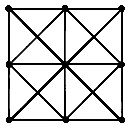
b)
Six counters (pebbles, bottle caps, leftover game pieces, buttons) three
for each player
What You Do:
�
You need 2 players. Each player has 3 counters of one color.
You move your counters on the diagonal lines attempting to make �three-in-a-row�
where the lines intersect.
o
Players take turns putting counters on the game board.
o
Neither player can put a counter in the center spot until all
six counters have been put on the board.
o
When the players have taken turns getting all 6 counters onto
the game board, the next player may move a counter along a line to the next
empty intersection to try to make a row of three.
o
Jumping is not allowed.
o
The first person to get 3 in a row wins!
There are 8 ways to do this.
Set a time limit. If no one makes a row of 3 in the given time, the game ends in
a tie. Play another version of this game from Ghana and Nigeria called Achi,
with each player using 4 counters instead of 3.
- It�s in the Cards
Learn and perform 3 card tricks that use mathematical or logical thinking.
See if your audience can figure out how you did your tricks.
- It�s Magic
Become an amateur magician. Learn 3 magic tricks. You can refer to a book or
a kit, or ask someone to help. Practice each trick and then perform them for
others. Ask if anyone can solve the trick. Or attend a magic show and learn
how at least one of the tricks is done.
- The Game of Nim
Play the game of Nim, described below, several times with another person. If
you are playing with a group, change partners after each game. Figure out
strategies that might help you win. Here�s how to play:
a)
Put 9 pennies in 3 rows, with four pennies in one row, three in the next,
and two in the last row.
b)
The two players take turns removing pennies using these rules: A player
can take away pennies from only one row during a turn. The player can take as
many pennies as she likes from the row, but must take at least one.
c)
The player who takes the last penny is the winner.
- Scramble
Word scrambles are a type of puzzle. For example, the letters �nanaba� can
be unscrambled to spell the word �banana�. Choose a topic, such as sports,
books, or Girl Scouts. Scramble the letters of 5 � 10 words on that topic.
Try out your puzzle on your family, friends, or troop. See who
can unscramble the most words in 2 minutes.
- Word Search
Make up a word search using a piece of graph paper or a grid that you
create. Chose a theme and a title that reflects the words that can be found,
such as weather, school, or seasons. Include at least 10 words in your
search. Ask friends or family to find the hidden words.
- One Dollar Words
In this math puzzle, each letter of the alphabet represents an amount of
money. A = 1 cent, B = 2 cents, C = 3 cents, and so on. Find at least three
words that are worth exactly $1.00. Ask your friends and family members to
join in the fun, and see who can come up with the largest number of $1.00
words in a week.
Ready for Tomorrow
http://www.girlscouts.org/program/gs_central/insignia/online/junior/ready_for_tomorrow.asp
(click here for requirements)
-
Global product hunt
-
Cooking with the sun
-
Using resources wisely
-
Penny power
-
Wildlife in danger
-
Plant a tree, help it grow
-
Global tree action
-
A credo
-
Local issues
-
Get political
-
Take action
Rocks Rock
- Be a Rock Hound!
Start a rock collection. Go exploration hike to see how many different kinds
of rocks and minerals you can find. Before you go, consider what equipment
you might need. Take safety Precautions! And don�t collect any samples from
an area where collecting stones is prohibited. If removing a rock will make
an impact on the environment, don�t take it home! Instead, photograph or
observe the stone where you found it, so others will get to see it later.
- Geo Hunt
Search for clues in your community or in a place you visit that shows one or
more of the following:
- Where a glacier had been
- Where a volcano had erupted
- Where erosion had happened
- Where water once covered the area
- Where the earth has shifted
Discuss, describe, or show
others what you have found.
- What Type Is It?
Each rock you collect will fall into one of three major categories: igneous,
sedimentary, or metamorphic. Which types are yours? Use books, web sites, or
maps to help you figure out which types of rocks you�ve gathered.
- Soil Sense
Discover what makes up soil. Collect two soil samples, each sample from a
very different spot. Spread each soil sample out on a light-colored sheet of
paper, and use your senses.
- Look: Are the grains large and easy to see?
Medium? Or small? Are there any stones in the soil? Is the overall color
of the soil light, medium, or dark?
- Smell: What does it smell like? Wet some of the
soil and rub it between your fingers and smell it again.
- Touch: What does it feel like? Sandy soil feels
rocky or pebbly. Clay soil feels sticky. A loamy soil feels gritty.
- �Geo� Careers
Can you imagine yourself working with dinosaur bones? How about with
precious stones? Or have you ever pictured yourself being an expert on
volcanoes, the ocean floor, or far away planets? Believe it or not, all of
these careers have backgrounds based in geology (the study of rocks). To
learn more about possible geology-related career choices, complete the
match-up activity below. Pick one career that you�d like to learn more
about.
|
Career Choice: |
Definition: |
- ____
Lapidarist
- ____
Hydrologist
- ____
Geological oceanographer
- ____
Paleontologist
- ____
Astrogeologist
- ____
Seismologist
- ____
Vulcanologist
- ____ Mining
engineer
|
a.
Studies where water is found on earth and the effects of water on
or below the surface.
b.
Studies and creates maps for other bodies in the solar system.
c.
Cuts, polishes, and engraves precious stones.
d.
Studies how to extract natural resources such as gold, coal,
diamonds, and oil from the earth.
e.
Investigates the shape and the material of the sea floor and the
history of the sea sediment and rocks.
f.
Studies fossils (forms of life from the past)
g.
Studies earthquakes
h.
Studies Volcanoes |
- Wipe Out Erosion!
Erosion is the wearing away of rocks and soil by air, wind, and water. Hook
up with a group that is trying to fight the effects of erosion in your area.
Some activities to look into could be:
- Planting dune grass to help keep the sand along
the shore from being blown out to sea. Small, wooden fences can also be
used to create artificial sand dunes. These methods keep the beach where
it should be � on the beach!
- Maintaining trails, which could include helping
to build terraces or steps along steep paths. Terraces and steps make it
harder for rainwater to wash straight down a hill, so less soil is
removed when it rains.
- Helping to build a walkway over marshy wetland
areas.
- Around the Globe
Volcanic eruptions, geysers, earthquakes, and tsunamis (tidal waves) have
had tremendous impact on people around the world. Pick one of these
phenomena, and find out a place where it affected people and what those
effects were.
- The View From Above
Find photographs of the earth taken from a high altitude. Photos that were
taken from a plane or satellite would be best. Use these photos to locate:
- Major oceans
- Land areas
- Mountain ranges
- Fault lines
- Volcanoes
- Farmland
- Rivers, lakes, and other inland waterways
- Other features of interest
- Fossil Fun!
Fossils can be formed in different ways. A fossil may be the image
(impression) that an object leaves in stone, which becomes the �mold� for
that object. Make your own �fossil� by pressing a leaf, rock, skeleton,
bone, or dead insect into some soft plaster of Paris and allowing it to
harden. Look carefully to see the details made in the impression when the
item is removed. If you can, go on a fossil hunt.
- Weathered or Not�
To discover firsthand the effects of weather on the land, do one of the
following:
- Go for a walk in your neighborhood and look for
chips, cracks, and rough areas in a sidewalk. Think about how these
might have happened. How has nature helped cause these changes in the
sidewalk?
- Discover what happens when water gets into
cracks and spaces in rocks and then freezes. Fill a small plastic
container with water, put the top on it, and then freeze it. What
happens to the container? What does this mean for areas where there is
water that freezes?
- Acid rain affects different types of stone in
different ways. Visit a cemetery and notice the different types of stone
used to make the headstones. Or walk around your neighborhood and check
out buildings made from different types of stone. Notice how the
lettering, statues, carvings, and/or corners are worn away. What
conclusions can you draw from your observations?
Safety First
- Safe at Home
Conduct a safety check of your home with your family. Do you have the proper
number of smoke detectors? Are they all working? Are all electrical wires
safe and out of the way/ correct any hazards that might be dangerous for an
infant, a toddler, someone who has a disability, or an elderly person. Then
list the following information and post it in a handy spot: pone numbers for
the fire department, police, poison control center, doctor, and an
ambulance.
- Safe at Any Age
Do an informal survey to find out the most common types of injuries for
people your age. Are they from bicycle falls, sports, or just plain
carelessness? Write a 30 second or 60 second public safety announcement
about how to help prevent these injuries and see if it can be aired at your
school.
- Sports Safety
Create a large cardboard cutout of a person wearing a variety of protective
gear and equipment for a particular sport or activity. If you created an
in-line skater, for example, include kneepads, elbow pads, wrist pads, and a
helmet. Use this figure to teach sports safety to your troop, group, or
family.
- Create a car safety poster, videotape, or some
other form of media. Include information about ht importance of using a seat
belt every time people ride in a car, the proper way for infants and
toddlers to be buckled into car safety seats, and why children should not
ride in the front seat of a car equipped with airbags.
- Fall Safe
Help prevent one of the most common causes of injuries and deaths in the
United States: falls. Point out where falls can happen easily, such as in
bathrooms or on stairs, and show how they can be prevented.
- Look Out!
Take a �hazard identification hike� along a bike path, foot trail, horse
trail, compass course, or similar place. As you go along:
- Identify places where you could get hurt or
that could cause you trouble.
- Set up some way to warn others of the hazards,
or work to remove them.
- Out and About in Public
The 4th. of July � and holiday celebrations like it � can be
loads of fun. But don�t forget about safety. Choose an upcoming holiday or
event, such as a parade, a trip to the state fair, or a local carnival. Talk
to the adult you are going with and make a safety plan. What should you do
if you get separated? What are the hazards you might prepare for ahead of
time, such as: doing activities on water, being in unfamiliar places, being
around strangers, having no clean drinking water or shade, being in a sudden
storm, traveling in cars or other vehicles, being in crowded places, or
being out in the dark.
- It�s Not Just a Ride
Learn the basics of bike safety and develop a bike safety checklist. Include
topics such as protective gear, how to see if your bike is in proper working
order, and rules for riding on the road. Talk to a local bike shop employee,
police officer, or other resource person for help.
- Show the Way
With your troop, friends or family; plan a way to help younger children
learn about safety. Include topics like crossing the street, safety in the
kitchen, and getting help in an emergency. You can use the �Safety Sense�
Brownie Girl Scout Try-It to help you plan.
- Fire Safety
Knowing what to do in case of a fire saves lives. Plan, talk about, and
practice fire escape routes fro your home, troop meeting place, or school.
Learn what to do by checking out the information in your Junior Girl Scout
Handbook, going online to find resources about fire safety, or talking with
a firefighter.
Science Discovery
-
Chemical Appearing Act
Discover how you can use a chemical reaction to make an artistic design.
Sometimes, when chemicals react with each other, colors change.
What You Need:
- White Paper
- Newspaper
- A wide paintbrush
- An artist's thin paintbrush
- Starch solution (see the directions)
- Iodine/alcohol solution (see the directions)
What You Do:
1. Dip the thin brush in the starch solution and do a simple drawing of an
animal or flower.
2. Tape the corners of your paper to newspaper to keep it from curling.
Starch solution is colorless, so when it is dry, nothing will show up on the
paper. (The sun or a hair dryer can make it dry more quickly.)
3. Dip the wide brush into the iodine/alcohol solution and, taking care not
to rub, gently stroke over the original painting. Observe what
happens. Why do you suppose there is a change?
Try some other activities using this chemical reaction: send a secret
message, make a treasure map, put on a magic show for younger children or
your family.
As with all science experiments, use caution with chemicals and the heating
process.
Starch Solution:
Mix 4 tablespoons of cornstarch into 1 cup of lukewarm water. Or
save the cooking water from boiled potatoes or pasta and let it
cool. |
Iodine / Alcohol Solution:
Mix 1 tablespoon of tincture of iodine in 1 cup of rubbing alcohol.
This solution will have a yellowish-brown color. |
-
Light and Reflection
Make a simple kaleidoscope.
What You Need:
- A shiny picture postcard
- Tape
- Colored cellophane
- White Tissue Paper
- Scissors
What You Do:
1. Fold the postcard, with shiny side in, lengthwise into three equal
sections.
2. Tape the postcard (now a triangular tube) so the seam doesn't leak light.
3. Cut small pieces of colored cellophane. Cut two pieces of the tissues
paper 2 inches larger that the end of the tube.
4. Place the cut cellophane between the two pieces of tissue paper and tape
the layers around the tube.
A kaleidoscope relies on reflected light to create its special effects. Hold
it up to the light and shake. What do you see?
-
Water Tricks
Try these water tricks:
- Make a needle float on water. You will need a source of clean water, a
bowl, and a needle. You might need a few tries. Why do you think the needle
floats?
- How many drops of water can you get to stay on the top of a penny? You
will need a penny and an eyedropper. Try this activity a second time and put
a dab of soap on your finger. Then touch the water. What happens when the
soap meets the skin of water molecules on your penny? Any idea why?
-
Can't Live Without It
Using newspapers, magazines, telephone books, or the Web, search for people,
things, places, and issues that are science-related. Make a collage of what
you find. Turn your collage into a poster, a book cover, or an illustration
for a special event having to do with science.
-
Act Like A Scientist:
Do two of the following things that an archaeologist, botanist, or geologist
might do in her work:
- Make a drawing of something you find outdoors - either natural or people
made - and record your observations about it, as well as where and when you
found it.
- Identify at least five different kinds of trees, flowers, or animals.
- Classify five rocks as to whether they are igneous, metamorphic, or
sedimentary.
-
Become a Scientist
More men enter the fields of science and technology than women do. Interview
or visit with a woman who is a scientist and find out how she got interested
in her field, who encouraged her to pursue science, where she gets
information, and which people are most supportive to her in her job.
-
It's a Hands-On and Happening Place
Visit a hands-on-science or natural history museum, participate in a museum
sleep-in, or participate in a science fair or event sponsored by your
school, Girl Scout council, or community.
-
Environmental Observer
The Stream Health Checklist tells you what to look for, smell, and touch to
determine how healthy a stream is. Use the checklist to make an
environmental report card for a stream or to develop your own checkpoints
for an area you want to explore.
|
Stream Health Checklist
G = Good
F = Fair P =
Poor
_______ Variety of stream animals
(fish, snails, insects, worms,
and other living creatures).
The greater the number of
types, or species, the healthier
the stream.
_______ Available
Shade
Shade is good for water
temperature.
_______ Stability (lack
of erosion)
of stream bank
_______ Turbidity of
water
(amount of stuff suspended
in the water) Does water appear
cloudy or clear? Clear is good.
_______ Smell of water (smell can indicate
pollution).
_______ Signs of runoff from surrounding
land - runoff can pollute and take
away oxygen.
_______ Amount of garbage along the
stream.
|
See What?
How is your brain challenged by optical illusions? Look in your library or
on the Web for some optical illusions that you can share with your troop or
your family.
Here's the Rub
Discover how speed is affected by friction by trying this experiment.
What You Need:
- A cookie sheet, plastic tray, or piece of wood that is at least 18 inches
long.
- A small toy car with wheels
- Different substances that can be put on the surface of the sloping track
you will create, such as water, oil, sand, or carpeting. (This could get
messy, so do it outdoors or somewhere else that can be easily cleaned up).
- A stopwatch
What You Do:
- Tilt your ramp (example: cookie sheet) with your hands.
- Time your car's descent, without anything on the slope, and record the
results.
- Now put something on the ramp such as the water or oil. Predict whether
you think the car will move more slowly or more quickly down the ramp. Run
the time trial again and record the results.
- Continue testing with each of your substances. Share your findings with
other people. How could you use this information when riding in a car or
riding your bike?
Science in Action
http://www.girlscouts.org/program/gs_central/insignia/online/junior/science_in_action.asp
(click here for requirements)
-
Emergency science
-
Got to communicate
-
Technology-ables
-
I'll jet right over
-
Science in Manufacturing
-
Science in agriculture
-
Engineering 101
-
Bridge building
-
Slurping plant
Science in
Every Day Life
- Tools of the Trade
Interview a doctor or dentist and find out about the different ways science
and math are used in her work. Ask for a demonstration of science at work.
For example, have your blood pressure taken or find out how tooth decay can
be prevented.
- Catch the Beat
Your heart flexes as many as 100,000 times a day pumping blood throughout
your body. What a machine! Learn to take your pulse when you are sitting and
at rest. (Ask someone to show you the arterial pulse points on your wrist or
on either side of your neck.) Figure out the beats per minute (count the
beats for 15 seconds and multiply by 4) to determine your resting heartbeat.
Now, find what your heartbeat is after doing two of the following: jumping,
standing, dancing, or running in place for 30 minutes each. Be sure to bring
your heartbeat back down to resting between each activity.
- Natural Geometry
Spiders are some of nature�s best weavers, and the thread they use is
remarkably strong. Observe some webs outdoors. Look for differences in the
patterns done by different spiders. Sketch a web or capture a spider-web
print on black paper. Use a gentle mist of glue or silver spray paint (under
adult supervision) to spray the web. Then, �capture� the web against the
paper and snip the threads that are holding it in place.
- Forces of Nature
Try to imagine how long it took the Colorado River to carve out the Grand
Canyon. Combine the time and powerful forces, such as water and gravity, to
create erosion by doing one of the following:
- Build a �mountain� with soil outdoors or
observe a pile of earth at a construction site over a period of time.
What are some of the patterns of erosion that develop?
- Experiment with water flow as a force or
erosion at the beach, in a sandbox, or at a �stream table� in a science
museum. What are some patterns that develop? Can you change them by
diverting the water?
- Soak some bean seeds overnight and place them
in a plastic c film canister with a moist cotton ball (or a piece of a
cotton T-Shirt.) Put the lid on and leave it for a week. What happens?
How does the result exhibit a force of nature?
- Science Fiction?
Authors of science fiction have often correctly anticipated new technology
and social changes in their writings about the future. Write a science
fiction short story, skit or musical about life in the year 2075. What will
life be like? What will have become better? Worse? Below, can you match the
writer to her or his prediction or plot device?
|
Author
(Book):
Prediction: |
|
_____ A. George
Orwell (1984) 1). Satellites
_____ B. Isaac
Asimov (Foundation) 2). Submarines
_____ C. Jules
Verne (20,000 Leagues Under the Sea) 3). Interactive television
_____ D. Mary
Shelly (Frankenstein) 4). Heart
transplants
_____ E. Ray
Bradbury (The Martian Chronicles) 5). Telepathy
_____ F. Arthur
C. Clark (2001 Space Odyssey) 6). Communicating with
dolphins
_____ G. Marion
Zimmer Bradley (the darkover series) 7). Mechanical body parts
_____ H.
Madeleine L�Engle (A Ring of Endless Light) 8). Robotic ethics |
- Color Mixing
Is mixing different-colored lights different from mixing different-colored
paints? Tape some squares of white paper up in a dark hallway. Use
flashlights with red, blue, and green cellophane (the primary colors of
light) taped over them, and shine different combinations of light on the
paper. Record the secondary colors you get with each combination. You can
also experiment by shining the lights through different-colored water in
clear glasses, or through colored glass or marbles. What happens when you
combine a primary color of light, such as blue, and a secondary color like
pink? Now do the same thing mixing the primary colors of red, yellow, and
blue on paper using paint. What happens when you mix secondary and primary
colors?
Continue experimenting with paint colors, and create a picture or
design that contains at least 15 or more colors that you have mixed. Which
of these predictions have come true?
- Rockin� Along
Go on a geology walk! Find evidence of a changing earth brought about by
water, wind, weather, plants, animals, and gravity. Look for:
- Crystals in stone or soil
- Decaying plant life
- Erosion on a hillside
- Evidence of changes brought about by people
- Examples of weathering on buildings or statues
- Loose rocks at the bottom of a hill
- Material deposited by water
- Rocks formed by compression
- Rocks smoothed by water
- How Much Time?
Time has always been an important unit of measurement. People have invented
many different ways to measure time> Find out about early time-keeping
tools. Create your own simple instrument that marks the passage of time.
- Here Today, Still Here Tomorrow?
Pick an item that you use often. Find out how it has changed since the time
it was first invented. Draw or design a model of what you would like to see
it become in another 25 years, or create a replacement for its functions.
Some items to think about are a radio, a wristwatch, a computer, a book,
money, medicine, or a fast food.
- The Key, Please
Choose a group of living things you can observe, such as birds, mammals,
reptiles, amphibians, flowers, or trees. Use a simple identification book or
field guide to find the names off 7 different species in that group. Learn
the key characteristics of each species that can help to identify it. These
might include what it looks like, where it lives, and how it behaves.
Science Sleuth
- What�s Vibration Got to Do With It?
Make a simple musical instrument that you can tune. Here are some ideas:
bottle pipes (blowing across the top of water bottles), glass chimes (using
a spoon against water glasses), comb kazoo (using tissue paper), drum (using
plastic stretched across a cup), shaker (a container with dried beans),
maraca (using a shaker with a handle), or idiophone (using your fingers to
rub around the rim of crystal wine glasses). Listen to the pitches of the
sounds and experiment with ways to change the pitches and add more notes.
Then, try to explain how the sound is created using vibration, or play a
simple melody.
- The Science of Papermaking
How many kinds of paper can you find around your house? Compare the
differences in color, texture, absorption, and composition. Create a
paper-testing lab and choose different types of paper that are best for
wiping up spills, painting, writing in ink, and writing in pencil.
- Crystal Quest
What do ice, diamonds, rock candy, quartz, and snowflakes have in common?
Crystals, of course! Grow your own crystals by following the recipe below:
What You Need:
- Epsom salts
- Water
- Small saucepan
- Large spoon
- Pipe cleaner
- Food coloring
- Pencil
�
Clear Plastic Cup
What You Do:
- With the help of an adult, boil the water in
the saucepan, take the pan off the burner, and place it on a hot pad.
- Using the spoon, slowly add the Epsom salts a
little bit at a time, stirring constantly. Keep adding the salts until
no more will dissolve or mix in.
- Pour the solution into the plastic cup, almost
up to the top.
- Wrap the pipe cleaner around the pencil so that
it hangs over and into the cup. Curl the end so that the crystals will
have a good place to grow and suspend it in the solution
- When Is Silver Green?
Fin out what happens to different kinds of metals when they are exposed it
air (oxidation) and weathering. Compare iron, silver, copper, and brass.
Find at least five examples of metals, indoors or outdoors, that have
undergone some kind of surface changes.
- You Can�t Escape Your Identity
With the help of a police officer, private investigator, or other
professional, dust for and lift a fingerprint. Try comparing your
fingerprints to someone else�s and note the differences and similarities.
Find out what other evidence, such as DNA from hair or skin samples, can be
used to identify a person or a vehicle. The FBI uses seven main
characteristics in fingerprint identification: the loop, arch, whorl, tented
arch, double loop, central pocket loop, and accidental.
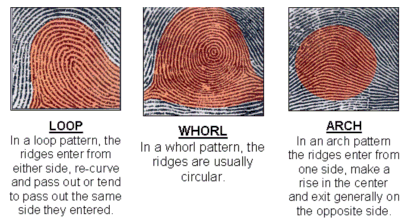
WebPages to see samples:
http://www.cornwallis.kent.sch.uk/intranet/elearn/science/crime/1crime.html
http://www.ridgesandfurrows.homestead.com/fingerprint_patterns.html
- Water Questions
Have you ever seen a bug walking on water and wondered how it does it?
Sometimes things look impossible to do, but if you know your science, there
might be an answer. Here are some challenges to try with your friends,
family, or troop members. Do at least two of the following:
- Move water from one container to another
without pouring it.
- Use water to show how that air exists, exerts
pressure, and takes up space.
- Make something heavier than water float.
- Cause a plant to drink water indoors without
watering it, as shown in the �Incredible Slurping Plant� activity in the
Explore and Discover� chapter of your Junior Girl Scout Handbook.
- Read the Directions � But How Does It Work?
Find out how to hook up a computer to the Internet, a VCR to your
television, or a music system to speakers. Demonstrate to another person how
all the parts and pieces link to each other and what each piece of equipment
does.
- Seeing the Light
Your eyes can only see a portion of the light that is there � the white
light. With technology you can see other kinds of light on the spectrum,
such as infrared or X-ray. Each type of light has its own signature pattern
that can be seen when it is separated with a prism. Try separating light.
Use a crystal or prism to separate natural light. Then separate light that
is created by technology. Can you record the signature of a regular light
bulb? The sun? A fluorescent bulb? Are there any differences?
- It�s in the Genes
Genes �tell� each cell in your body how to develop. In the future,
scientists may be able to anticipate and cure illnesses by mapping
individuals� genes. Find out about a disease or condition that is believed
to be linked to genes. Discuss the following with your troop, family, or
another adult:
- In what situations would you want to know about
your genes? In what situations would you not want to know? Why or why
not?
- Do you think others should have access to
information about your genes? Why or why not?
- What Is a Simple Machine?
A machine is a device that helps use a force to move something and do work.
See the six simple machines below. Do one of the following:
Sew Simple
1 Hands Down
Try your hand at sewing: running stitch, hemming stitch, slip
stitch, catch stitch.
2 A Stitch in Time
Explore machine stitching on a sewing machine. Try basting,
zigzag stitching or seam stitching.
3 Foot Fun
Decorate your socks by stitching lace/fabric to the upper cuff or
embroidering on them!
4 Program It
Many sewing machines contain mini-computers. Learn how to program a
design on a machine, then sew it!
5 Pick a Pattern
Look at different patterns and decide on an item you'd like to
make. Look at the number of pieces, what notions (zipper, thread, buttons, etc.)
are needed, the type of fabric recommended and the amount of fabric.
6 A Perfect Fit
Use the diagram on a pattern envelope to figure your size.
You can use this
handout to determine your bust, waist and hips measurement. Then look at a
pattern envelope to determine your size.
7 Sew for Service
Choose some items to make for people in need, such as baby quilts,
"ditty" bags, warm scarves or lap robes.
8 Hospital Helpers
Make "cancer caps" for kids going through radiation and
donate them to a hospital in your area.
9 Find the Fabric
Explore fabrics - they can have different widths, textures,
colors and designs. Decide which fabric would be appropriate for an item you
wish to make.
10 Sew a Puppet
Make a puppet according to the directions in the book,
or make your own item!
Sky Search
- Mapping the Skies
Learn how to use a star map. Obtain or make such a map for your stargazing
location that adjusts to the time and season when you are observing stars.
- Constellations
Constellations are stars that appear to be groups when looked at from Earth.
If you were to travel in a spaceship, you would find that most stars that
look close together are actually millions of miles apart. Learn to identify
at least five of the constellations seen from Earth.
- Direction, Please
Learn about the North Star and why it has been used for navigation
throughout history. Help others locate the North Star. Use the North Star to
find two constellations or asterisms (part of a constellation).
- Planets
Learn which of the nine planets are visible to the naked eye. Try to locate
at least one of these during a stargazing adventure. If possible, use a
telescope to help you see better detail. Write down what you discover.
- Connect the Dots
Learn stories from two or more ancient cultures - such as Greek, Norse,
American Indian, Pacific Islander, or Chinese - that were used to explain
what was seen in the sky.
- Tools of the Trade
Learn the parts of a telescope and how to use one. If possible, use a
tracking telescope or look through telescopes with different magnifications.
OR
Visit a large observatory and learn what kinds of telescopes are used there.
What do astronomers learn by using telescopes?
- Time for the Moon
Learn more about the moon - its phases, age, names of features - and then
take a closer look. The best time to observe the moon is when it is full, or
almost full. Use binoculars or a small telescope to help you see the
valleys, ridges, mountain ranges, and craters on the moon.
- The Sky is Falling!
Learn about meteors, meteorites, meteor showers, and comets. Find out when
meteor showers may be visible in your area. With an adult, arrange a
meteorite-watching party and count the number you see in an hour.
- Star Stamps
Address an envelope to yourself or a friend; include your solar system and
galaxy address. Draw a stamp on your envelope that celebrates an event in
space exploration. Write a letter and include a map to your favorite planet.
- Mission: Space
Learn about a current mission in space. What is the purpose of the mission,
and how is information recorded and sent back to Earth? If possible, follow
the mission over a period of time and visit a Web site that describes the
mission and shares pictures or data.
Small Craft
- Staying Afloat
Show that you can select, use, and care for a PFD (personal flotation
device). Be able to:
- Adjust a life jacket or life vest to fit
- Know if a PFD is in good condition
- Throw a buoyant cushion or life ring
- Float, swim, and do HELP (Heat Escape Lessening
Position) and huddle in a PFD
- If you are a swimmer, put on a PFD while in
water that is over your head
- All Hands On Deck
Be ready for boating emergencies. With a knowledgeable adult, talk about
what to do if three of the following things happen:
- You fall overboard
- Someone else falls overboard
- The wind rises (or, if sailing, dies)
- You see a storm approaching
- The boat swamps or capsizes
- It gets dark or foggy
- There is a fire on board
- From Bow to Stern
Learn nautical terms for the major parts of a boat and use them correctly.
Identify three kinds of water craft.
- Permission to Board
Be able to trim your craft (maintain a balanced position of a boat in the
water by moving around passengers and gear). Show that you can:
- Board properly
- Stow things and move weight around safely
- Change places safely
- Shove Off
Show that you can handle a small craft safely. Demonstrate in a rowboat,
rowing shell, kayak, or canoe that you can:
- Stow the paddle(s) or oar(s)
- Get underway
- Make turns and go straight
- Speed up, slow down, and stop
- Dock or land
- Secure the craft
- Hoist the Sails!
Show that you can handle a sailboat. Demonstrate that you can:
- Get underway
- Raise and lower the sail(s)
- Sail straight ahead
- Tack and come about
- Speed up, slow down, and stop
- Dock or land
- Secure the craft
- Full Speed Ahead!
In a boat with a motor, show that you know how to:
- Get underway
- Start the engine, change speed, and stop
- Use the oars, if the boat has them
- Make turns and go forward and backward
- Dock or land
- Secure the engine and the craft
- Thar She Blows!
Learn to keep a sharp lookout. Show that you practice rules of the water by
knowing how to:
- Keep away from swimmers, divers, and people
fishing
- Look out for other craft, floating objects, or
hazards under the surface
- Spot landmarks or navigational aids such as
buoys or lights or read a navigational map
- Help someone in distress, and signal for help
yourself
- Cross wakes correctly
- Red Sky in the Morning, Sailors Take Warning
Be a water and weather watcher. Check to see if it is safe to be out on the
water by keeping track of the following:
- Wind direction and speed
- Waves, tides, and currents, or water releases
from dams
- Cloud formations
- Weather signals and reports
- Swab the Deck!
Do your share to keep a boat shipshape. Do at least 3 of the following:
- Unload or stow gear or rigging
- Wash down, bail out, or sponge off
- Sand, scrape, or chip
- Paint, patch, or fix up
- Tie knots, splice, or whip lines
Sports Sampler
- Stretch It Out
A proper warm-up before you take part in sports and fitness activities will
help reduce your chances of getting hurt by increasing the blood flow to
your muscles and preparing them for exercise. Create a five minute warm-up
and a five-minute cool-down. Learn three stretches for your upper body and
three for your lower body. Do them before and after you play � every time!
- Practice Makes Perfect
Choose a sport that you want to learn or improve on. Pick three skills that
you want to practice, either with a friend or on your own. With a coach,
teacher, or parent, set some improvement goals. Then spend at least an hour
a week practicing the m for the next three weeks.
- Play Time
Participate in a sport by taking part in a tournament or play day, or become
a member of a club, team, or intramural program. Discover two ways you can
improve your play.
- Try Something New
Playing the same sport over and over again can stress your body out. So try
a new sport in addition to your regular favorite. In-line skating,
volleyball, tennis, snowboarding, cycling�. You make the choice. Spend at
least six sessions at the sport. Decide if you like it or not.
- Safety First
Safety awareness is vital when you play a sport. Still, accidents can
happen. Learn how to treat tow of these basic injuries that might happen
when you are learning or practicing a new sport: skinned knees, nosebleeds,
blisters, ankle sprains, and muscle strains. Can you think of ways to avoid
these injuries in the future?
- See and Tell
For one week, look through the sports sections of your local newspaper.
Compare articles about sports with male players and sports with female
players. The sports can be played by professional, high school, or college
teams. Write a letter to the sports editor of your newspaper complaining if
sports weren�t covered equally or congratulating them it they were.
- You Go Girl!
You can almost feel like you are participating in a sport by cheering for
someone else. Write a cheer � with at least two verses � for your troop or
favorite team. If you want, you and a friend can make up a movement routine
to go along with it. Show your cheer to your troop and encourage them to
perform it with you at a local girls� or women�s sports event.
- �Her Story� of Sport
Pick a sport you would like to know more about. Trace the role of women in
the sport�s history. When did women start playing it? Were the rules changed
for women? How did it become popular among girls and women? Do many girls
and women play this sport? Do famous women athletes compete in this sport?
- Spread the Word
Some people can�t play certain sports because they don�t have the proper
equipment. With some friends, find a group in your community that needs help
with its sports program. Ask what the group needs and what you can do to
help. For example, you could start a sports equipment drive for the group.
You might need to work with someone from a sporting goods store, or another
adult, to collect equipment. Make sure the equipment is safe and in good
working order.
- Sport Search
Find out about two sports that
are new to you. Are they played or taught in your community? Check out the local
Parks and Recreation Department, community centers, or the yellow pages. Collect
the following information about these sports. Where can you play them? How do
you start learning? What are the fees? What equipment do you need? How many
people do you need to play? Share your findings with your troop and see if
anyone wants to learn a sport with you!
Stress
Less
- Create a Personal Stress Kit
Let your personal �stress less� kit rescue you from stressful events! Make
an attractive container. Carefully stock it with things that will help you
relax, laugh, dream, or put you at ease. Be sure there are at least six
items in your kit. You might include books, cartons, photographs, music, a
card or letter from a friend or relative, or a picture from a magazine of a
place that looks peaceful. Think about how each item helps you relieve
stress. Remember to pull out your kit when you need to de-stress.
- Stess Less Writing
One way to let go of feeling s that are stressful is to write in a journal
or notebook about what�s on your mind. Start a �stress less� journal for
those times when you need to release some tension.
- What Are You Feeling?
Learning how to identify and describe your different moods and feelings is
an important part of dealing with stress. Keep a feeling s diary for a day.
How many different moods did you experience?
- Do For Others
One of the best ways to lessen your stress is to focus on someone else. For
one afternoon or evening help someone with a project or problem.
- Move That Stress Away
Physical motion can release the tension in your body. (Make sure your
motions aren�t harmful to you or anyone or anything else.) Make a list of
ten actions you can take to reduce stress. Some examples are running up and
down stairs a few times, dancing around to your favorite song, or jumping
rope. Look at your list when tension starts to rise. Do one of your motions!
- Listen to Music
Listen to five of your favorite songs. Decide which one is most relaxing to
you and why. Play your song for two other people and see if they think it is
relaxing. Find out what music they would choose to relax to!
- Pass It On
Ask three of your friends or classmates how they deal with stress. Collect
the five best techniques. Remember to try one of them yourself the next time
you�re feeling stressed!
- Read and Relax
Read a book. Following a character�s adventures can help you forget about
your stress. With other girls, come up with a list of especially relaxing
books.
- One At A Time
Are you stressed because you are trying to do too much in too little time?
Maybe you need to practice some time management. Read about time management
in the �Be Healthy, Be Fit� chapter of your Junior Girl Scout Handbook.
- Practice Elevator Breathing
Deep, focused breathing can refresh your mind. Imagine that breathing in and
exhaling out is like an elevator moving up and down the floors of a
building. Practice these exercises:
- Inhale slowly through your nose. Feel your
breath travel all the way to the basement (the bottom of your spine).
- Exhale slowly through your mouth.
- Put your hands on your belly and inhale, taking
your breath up one floor to your navel. Exhale.
- Put your hands on your ribs and inhale, taking
your breath up a second floor, to your chest. Exhale.
- Put your hands on your face and inhale up to
the attic � your throat, cheeks, and forehead. Feel your head fill with
breath. Exhale and feel all your tension and worries leave your body and
go out the elevator door.
Swimming
- Know Water Safety
Show that you know when and how to:
- Select and wear a PFD (personal floating
device)
- Keep afloat using clothing and other flotation
devices
- Cooperate with someone who is trying to rescue
you
- Use good sense in cold water, in deep water, in
a current, and in rough water
- Thread water
- My Buddy and Me
Swimming with a buddy is more fun than swimming alone, and it helps keep you
safe. Create and practice a �buddy check call� so that you and your buddy
know if either of you need help. Use it every time you swim.
- Like a Fish
Learn to snorkel. Show that you can choose a mask that fits your face, put
it on so it won�t fog, breathe through it, and clear the mask. Practice your
snorkeling skills by swimming 25 yards along the surface parallel to the
shore. Show that you can surface � dive, swim 15 feet underwater, resurface
and clear your snorkel and mask.
- Go Swim!
Show that you can swim by doing each of the following:
- Glide six feet
- Kick 25 yards
- Swim the crawl 25 yards
- Do two of these strokes for 50 yards: crawl,
elementary backstroke, sidestroke, or breaststroke
- Helpful Swimmer
Show that you can help another swimmer who:
- Has a cramp
- Is shivering with hypothermia
- Has a sunburn or heat exhaustion
- Is tired
Read the first aid section in the �How to
stay safe� Chapter of your Junior Girl Scout Handbook for more information.
- Check it Off
Make a water safety checklist that includes ways to avoid:
- Underwater hazards
- Falling through ice
- Falling in water accidentally
- Overestimating your swimming ability
- Polluting the water that you swim in
- Swift currents
- Underwater Swimmer
Swim under the surface of the water. Show that you can do a surface dive, a
deep dive, or a jump, and then swim underwater and bring up something from
the bottom.
- Diver
Perform two different dives from a low board, platform, or deck. First, be
sure an adult who is present has checked the water depth and hazards, and
they have said it is safe to dive.
- Going for the Gold!
Get involved in a swimming competition.
- Join a swim team to build your speed and
endurance.
- Learn about swimming stars and their records
- Be able to follow the rules in competitive
swimming for starting, turning, timing, and scoring.
- Water Moves
Look at ways other living things move through the water. Watch for creatures
that have tails that act as rudders, feet that paddle, or finds that
flutter. Imitate animal actions in a water game you make up.
Theater
1 Make a Mask
Create a mask to be used in a skit. We made masks for the Aesop fable skits the
girls will perform. Have construction paper, glue sticks, glue, scissors, yarn,
buttons, paint stir sticks, white paper, poster board, tape, etc. on hand.
2 Character Traits
Choose a character from a play you've read and show you understand that
character by his or her personality, behavior or what others think of that
character.
3 Character Charades
Act out different characters that are written on papers selected from a bowl,
like skier, clock, elephant, detective, etc.
4 Mirror Mimic
Try to "mirror mimic" with someone else: one does the action, the other copies
it in mirror image. Try making large circles, combing your hair, opening a door,
dancing, etc.
5 How You Say It
Say "I did it" five times, using different emotions each time: pride, guilt,
fear, happiness, surprise and horror.
6 Mix It Up, Make It Up
Design your own costumes and scenery for a performance.
7 Changing Faces in Theater
Visit a make-up counter in a store or at a theater and watch make-up being
applied. Use this
fun sheet to teach the girls about stage
directions!
8 Belt It Out
Practice being the right volume. While inhaling, your waist should expand; while
exhaling your waist should deflate. Say "Ahhhh" while breathing correctly
and incorrectly.
9 Theater Around the World
Learn about a style of theater from another part of the world. Draw or make a
copy.
10 See It Live!
Attend a play or theatrical performance.
Toymaker
- It�s Your Design
Create a toy of your own design in one of the following categories: rolling
toy, spinning toy, balancing toy, stuffed toy, mechanical toy, musical toy.
- Toys Around the World
Find out about toys in other countries or in several cultures in the United
States. Check out library books and Internet sites for information. Create a
simple toy that you discovered.
- Toys Through History
Investigate the history of toys. What were some of the earliest kinds of
toys? What kinds of toys did your grandparents and great grandparents play
with? If possible, visit a museum or historical society to see a collection
of toys. What kinds of materials were they made from? Learn how to make one
of these toys and make it.
- Make a Doll House
Make a doll house for yourself or a younger child. Use wood, foam board, or
heavy cardboard. You can make furniture from wood, clay, cardboard, plastic
or papier-m�ch�. Decorate the walls and floor of your house with wallpaper,
paint, or other materials.
- Make a Board Game
Find out what makes a good board game by playing several different kinds.
Then decide upon a theme for a game of your own. Decide how players will
move, make up rules and create the board. Try your game out with friends and
family.
- Challenge the Imagination
Create a brainteaser game, toy, or puzzle. It could be a mechanical puzzle,
a mathematical game, a string game, a computer-created puzzle, or a trivia
game. Play it with family or friends.
- Design an Educational Game
Many games help you learn while you are having fun. Create a game that helps
someone learn something new.
- Toy Safety
Talk to an adult about toy hazards. Do toy hazards check at home, at a
nursery school, or at a day care center. Share your findings with adults and
children and help develop a plan to eliminate toy hazards.
- Toy Recycling
help collect toys and fix them up for kids who would benefit from them. You
could help out with an existing toy drive in your community or start one in
a group.
- Trash It!
A �trash toy� is made from anything that might be thrown away. Ask your
family to save some things they would usually toss out. Boxes, milk cartons,
cans, egg trays, string, buttons, shells, and newspapers are just a few of
the things you might use. Let your imagination run wild and see what kind of
trash toy you can create. Will it be a set of musical instruments? A wheeled
toy? Stilts? Share your toy with your group, troop, or others.
|
10 Toy Hazards to Avoid
- Toys left on stairs.
- Toys with small parts for children under
three.
- Toys for an older child in the hands of a
younger child.
- Toys with sharp points or rough edges.
- Inflated or broken balloons for children
under eight.
- Toys with heating elements for children
under eight.
- Sports equipment without protective gear.
- Broken toys.
- Toys not played with properly (hitting,
throwing, etc)
- Any toy used without sensible supervision.
|
Traveler
- Stay Safe on the Road
Staying safe is an important part of traveling. With your Girl Scout troop
or your family, brainstorm a list of at least eight things you can do to be
safe while you are in a new place. Your list might include things like
always carrying change for a phone call or remembering not to pull out large
sums of money in public.
- Promote a Place
Send away for travel brochures and information on places you want to visit.
You can often get information for free by going online or phoning a
visitor�s bureau or chamber of commerce. Share your brochures with your
troop or family. Do they want to go?
- Culturally Curious?
Pick a country or culture, then make or learn about two of the following:
- A traditional article of clothing
- A puppet or toy related to a folk tale
- A traditional craft or folk art
- A musical instrument
- A typical song or dance
Share what you�ve made or
learned with a group of younger children. Tell them about the county or culture,
and show them how to make or do something similar.
Document the Days
Plan and take a trip that lasts a weekend or more. On your trip, keep a diary or
log, collect postcards, take photographs, make a video or slide show, or make
drawings of your travels. Share them with others when you return.
- Dream Vacation
Create an itinerary for a week-long trip to a country you would like to
visit. What is the country most well-known for? How will you get there? What
famous sights will you want to see? How will you travel from place to place?
What type of money is used in the country? Did finding out about the country
make you want to visit it more? Share your dream vacation with a friend.
Does she want to come, too?
- Who? What? Where? When? How?
Pretend you are a travel agent or a tour director. Help one of the groups
listed below plan a trip to your town or state. Include the transportation
they�ll need to use, the places they will stay and visit, activities they
can do once they get there, and how much you think the trip will cost.
- A sixth-grade class, with four accompanying
adults, who want to visit two historical sites in a weekend.
- Two people who enjoy the out of doors and do
not want to damage the environment or wasted fuel.
- A Junior Girl Scout troop, including two girls
in wheelchairs, who want to visit an amusement park in a nearby state.
- Careers in Travel
Find out about two of the following careers: conference planner, hotel
manager, pilot, flight attendant, train conductor, cruise director, or
cruise ship captain. What education or training would you need for the
career? What are the average salaries? What other requirements or skills are
needed? Invite someone who has worked in one of these careers to talk with
your troop. Share your information with others who might be interested in
these career areas.
- Girl Scouts Far and Wide
Talk with an older Girl Scout who has participated in a national or
international wider opportunity. Find out how she applied and prepared for
it, and what her experiences were.
- Entertaining and Alien
Say a representative from a friendly distant planet is visiting the Earth
for the first time and you have been chosen to be her host, and you will
decide what she will see during the two-week visit. If you could take her
anywhere on Earth, what would you take her to see? What are your reasons for
h the sights and activities on your itinerary?
- Girl Scout Travel Spots
Take a trip to a Girl Scout site: the Juliette Gordon Low National Center in
Savannah, Georgia; the Girl Scout national headquarters in New York City;
Camp Andr�e Clark in Briarcliff Manors, New York, or visit a Girl Scout
sister in another city.
United We Stand
http://www.girlscouts.org/program/gs_central/insignia/online/junior/united_we_stand.asp
(click here for requirements)
-
Show the colors
-
Write on
-
Express yourself
-
Roots
-
Pledge of Allegiance
-
Sing out
-
For which it stands
-
Check it out
-
Days gone by
-
Lend a Hand
Visual Arts
- Color Wise
Find out about primary and secondary colors. Make a color wheel and explain
it to others. What are complementary colors? Practice mixing colors to make
new ones. Create a picture using all the colors on a color wheel and some of
the new colors that you created.
- Color Your Mood
Using color; create a picture that shows a feeling or emotion. You can try:
- Happiness
- Sadness
Surprise
- Joy
- Calm
- Black and White
Make a design or picture using only black and white. Look for examples of
drawings, advertisements and photographs that are in black and white instead
of color. Share some of these with others. See if you can figure out why the
artist or photographer chose to use black and white instead of color.
- One Color, Many Shades
You can make many shades of the same color. Look at something that is mostly
one color. Notice that light and shadow can change the basic color into
different shades. Make a picture of something that is mostly one color. Some
examples are a hill full of trees that are many shades of green, buildings
in a city that are many shades of brick red or gray, or snow on fields that
are many shades of gray and white.
- Still Life
Collect a variety of objects with unusual an interesting shapes, such as
shells, rocks, or jewelry. Place them on a blank piece of paper and trace
around them using a pencil or black ink pen. Remove the objects and complete
your design, adding more black, white, or color
- Art Bridges
Have you ever thought about art as a way to build bridges across cultures?
Each country or culture has its own history and style of art. Find examples
of artwork you like from other cultures and try to make an example of your
own.
- Design It
Look for design in everyday objects. Find different designs in nature (such
as a spider web) and different designs that are made by people (such as a
skyscraper). Make a drawing of one of the designs you see.
- On the Move
Draw or paint a person, an animal, or an object in motion, perhaps a boat
sailing or a dog running. What did you do to show movement?
- Tour It
Visit one or more places where you can see many types of visual arts. You
could visit a museum, an art exhibit, an art gallery, a gift shop, a
department store, a card shop, an art collector�s home, an artist�s studio,
or an advertising agency, or a graphic design studio. If possible, visit a
place where you can see the artist at work.
- Put It In Perspective
See how perspective works by looking at a few works of art that show things
looking smaller in the distance. Then draw your own picture using the first
rule of perspective: As two parallel lines move away from you � as in
railway tracks or highways � the lines get closer and closer together.
Eventually, the lines may touch at a point in the distance. After that
point, you can�t see the lines any further.
Walking for
Fitness
- Warm Up
Learn three stretching exercise to do before and after waling. Practice
warming up before you walk, and cooling down after.
- Make A Plan
Develop a personal walking program and follow it for three weeks. Each week,
try to increase your speed and distance. Need help developing a realistic
plan? Talk with a coach or a fitness instructor.
- Best Foot Forward
Visit a store that sells walking shoes. Ask a sales person what to look for
in a walking shoe. Compare several brands of shoes. Be able to explain which
brand you would buy and why.
- Keep Track
Make a list of interesting sites within walking distance of your troop
meeting place, school, or home. With a family member, friend or Girl Scout
troop, walk to at least two of these sites.
- Be Prepared!
Create a simple first aid kit to take on walks. Learn how to care for
sunburn, insect bites, heat exhaustion, heat stroke, and blisters.
- Fast Food
Plan and pack a well-balanced, easy-to-carry snack for an extra-long walk.
Don�t forget to take along a filled water bottle.
- Weather It Well
Put on a walker�s fashion show with your friends. Show that you would know
the right ways to dress for the weather when you walk in cold or hot
weather. Be sure to explain the importance of dressing in layers.
- Lend a Hand
Take part in a weekend project to clean up a walkway or trail in or near
your community.
OR
Help at a charity walk by cheerleading, passing out water or snacks, or
giving directions.
- Add It Up
Keep track of your car or bus trips for one week. Write down the mileage and
the time it took to travel that distance. Could you have walked any of your
trips instead of riding?
- Find the Way
On a walk, use a street or road map to arrive at a new destination. Know
which side of the road to walk on and how to safely walk in groups.
Water Fun
TO EARN THIS BADGE, YOU MUST COMPLETE ACTIVITY 1.
1.
Safety First
Show how to use a PFD (personal flotation device). Refer to the American
Red Cross Web site
www.redcross.org.
�
Put it on, adjust it to fit, and fasten it securely.
�
Jump into the water with a PFD on.
�
Float and swim with a PFD on.
�
Practice the HELP (Heat Escape Lessening Position) and the
huddle position to keep warm.
2.
Picture It
Increase your awareness of different water habitats by doing three or more
of these activities:
�
Listen to the sounds of moving water by the ocean, along the
shores of a lake, or by a swiftly funning stream.
�
Watch waves in salt or fresh water.
�
Watch a leaf float in running water.
�
Smell the air near salt water, running water, or a swamp or
bog.
�
Look for signs of life on a beach walk.
�
Feel a breeze while on the water or fly a kite along the
shoreline.
�
Watch a sunset or sunrise reflected in a large body of water.
Find a way to express your feelings about your experience through the arts or
participate in a Girl Scout�s Own ceremony that celebrates water as your theme.
3.
A Balancing Act
Show how to get in and out of a small craft safely. Keep the boat in trim
(balance) as you:
�
Load gear
�
Stow things
�
Sit down and stand up
�
Move around and change places
NOTE: This can be done in a small boat, sailboat, canoe, or two-person
kayak.
4.
Get in the Swim of Things
On a swimming trip to a pool, pond, or lake, show an adult how you can:
�
Float on your back for one minute.
�
Tread water for two minutes.
�
Do two different swim strokes.
�
Use your best stroke and swim 50 Yards.
REMEMBER: Use the buddy system at all times.
5.
Water Games
Make up and play a game in the water to show you understand and can use
the buddy system.
6.
A Sailor�s Life
Do at least two of the following:
�
Tie a fancy knot.
�
Sail a model boat.
�
Learn a song about the sea and sing it.
�
Learn something about life on the water or under it.
7.
Precious Water
Brainstorm ways that you can conserve water. Also think of how not to add
to water pollution in your community, or in an area that you are visiting with
your family or group. Then, start the habit of being a clean water saver.
8.
Look Closely
Plan a discovery trip to a lake, stream, or salt-water environment. See
how many exciting discoveries you can make about this aquatic habitat. Find out:
�
What plants and animals live in the water and on the land
nearby.
�
Whether the water is warm or cold, clear or murky.
�
What the bottom surface is like under the water.
9.
Let the Games Begin
With a friend or family member, attend a water event, such as a canoe or
kayak race, swim meet, surfing competition, fishing derby, parade of sail,
synchronized swimming event, or water polo game. Learn the rules of the event.
10.
Jobs on the Water
Tour a place where people go to have fun on the water, such as a marina,
pool, cruise ship, party boat dock, or boat landing. Talk to someone who works
there and find out what they do that helps others enjoy and be safe on the
water.
Water Wonders
1.
It�s in a Cycle
Water is the ultimate in recycling. Show your understanding of the water
cycle. What happens to each step of the cycle � evaporation, transpiration,
condensation, and precipitation? Hint: Don�t forget the role of the sun
in providing energy.
2.
The Water you Drink
Find out where your drinking water comes from. Is it from an aquifer,
spring, river, reservoir, or another source? What is done to the water to make
it safe to drink?
3.
Not Enough?
Find out about an area of the country or world that has too little water.
Learn why the area is so dry, how the people who live there are affected, and
what is being done about the problem?
4.
Life Underwater
Visit a place like an aquarium, fish hatchery, zoo, or pet store and look
closely at the aquatic animals. Find three different animals that live all or
part of their lives underwater � like fish, frogs, turtles, snails, sea lions,
or beavers � and learn how their adaptations allow them to live in water.
�
How do they move?
�
How do they breathe?
�
How do they protect themselves?
5.
Water Food Chain
Find out about a water ecosystem�s food chain by doing one of the
following in a body of fresh water or salt water.
�
Drag a plankton net in the water and observe what you capture,
using a magnifying glass or a microscope.
�
Take a bottom sample from a marsh. Place it in a white dish or
pan. Look for signs of life.
�
Look under rocks, in a pool, in a stream, or in a tide pool.
What do you see?
In each case, find out what would make a food chain that would include the
animals you observed. Would you have a place in such a food chain?
6. A Balanced Life
Set up a fresh- or salt-water aquarium. Balance the numbers
and kinds of living things with a healthy food and water supply.
7.
Water Work
Visit a place where water has been
put to work, such as a sewage- or water-treatment plant, an irrigation control
center, a mining operation, a power plant, a fish hatchery, or a physical
therapy center. Find out where the water comes from, how it is used, and what
happens to it afterwards. What kinds of jobs can you observe at the facility?
What things do the people do? How did they lean how to do them?
8.
Fixing It Up
Help with a project to improve a water-related habitat. You might
participate in a shoreline clean-up, do plantings to filter water, fill gabions
(a wire basket that holds rocks) along banks to prevent stream erosion, or
construct and put up birdhouses or nesting platforms. The water�s the limit!
9.
Just Add Salt
Find out how salt water and fresh water are different. Do at least two
experiments to find out which:
�
Boils first
�
Freezes first
�
Yields crystal
�
Makes better soapsuds
�
Makes floating easier
**Recipe for
Salt Water � Mix 1 cup of water with 1 tablespoon of salt until the salt is
completely dissolved, or dip a bucket in the ocean!
10.
Water Comparisons
Conduct a water taste test with others. Taste several different kinds of
water (tap water and different brands of bottled spring and mineral water) and
rate each on a scale of 1 to 5 (5 is the best tasting). What did you find?
Weather Watch
1.
Weather Maps
Learn to read a weather map printed in a newspaper. Look for places where
it�s raining, or places where it�s hot or cold. Predict the weather in your area
using the maps and information given.
2.
Visit a Weather Station
Visit a weather station, or interview a weather reporter or meteorologist
about weather forecasting. Find out what kinds of equipment are used to watch
and predict weather, why weather stations are useful, how the data about weather
are interpreted, and how accurate weather predictions usually are.
3.
Become a Cloud Watcher
Pay special attention to clouds for a week. Find out what kinds of clouds
you are watching and what kinds of weather usually go with them. Then, make a
cloud chart by drawing pictures or gluing magazine photos of cloud types on a
piece of paper. Label each type of cloud (such as cirrus, cumulus, nimbus, and
stratus) and use your chart to help predict the weather for a week. How accurate
were you?
4.
Build a Weather Instrument
Find directions for building an instrument that helps you predict the
weather, such as an hygrometer (measures changes in humidity), a barometer (see
Junior Girl Scout Badge Book), an anemometer (measures wind speed), or an
alcohol thermometer (measures temperatures). Then build it.
5.
Weather Smarts
Find out about weather-related emergencies that your community might face,
such as hurricanes, tornadoes, flash floods, or lightning storms. Create a
family plan for each emergency situation that could occur in your area. Include
an emergency number to call for local or state weather reports. Then do one
thing that will help your family be better prepared for a weather emergency.
6.
Weather Trends
What�s all the talk about global warming, La Ni�a, El Ni�o, and holes in
the ozone? Find out more about one of these major weather trends. How is it
affecting the climate and quality of life in your part of the world? What, if
anything, can you or your community do to learn to live with the changes in
weather cycles?
7.
Weather Games
Make a game about weather. You can make a card or board game, a word game,
or an active game. Share this with others.
8.
Help Others Be Weather-Prepared
Help to run a weather-safety booth at a community event. You can make
posters or distribute safety tips for weather emergencies common to your area.
At your booth, include some hands-on learning for kids. OR
Help an older neighbor prepare a kit for use in a weather emergency.
9.
Paper Spirals and Frontal Systems
How do you make a paper spiral spin without blowing on it? Cut a spiral
out of paper using the pattern on page 219 of the Junior Girl Scout Badge
Book. Put a small hole through the center using a large needle. Tie a knot
in a 6- to 8-inch-long piece of string and thread it through the hole. *Hold the
spiral very still above a lamp. Be patient and wait a few minutes. What does the
spiral do? Do you know why? A front has come through. When two air masses of
different temperatures meet, the boundary between them is called a front. The
colder air sinks and the warmer air rises. This movement often causes rainy
weather storms.
10.
Make Your Own Weather
With the help of an adult, try making your own rain cloud.
What You Need:
�
Very hot (but not boiling) water
�
A large piece of plastic wrap
�
Matches
�
Ice cubes
�
A clear liter plastic bottle cut down to be about 6 � 8 inches
tall
What You Do:
1. Cut a piece of plastic wrap large enough to drape
over the top of the bottle.
2. Put several pieces of ice on the plastic wrap and set
it aside.
3. Fill the bottle 1/3 full with the hot water.
4. Light a match and throw it into the bottle.
5. Quickly place the plastic wrap with ice on top of the
bottle.
6. Wait and watch to see a rain cloud appear.
What is the cloud that is formed? It isn�t smoke. It�s
water droplets forming on the smoke particles. The water vapor rises from the
hot water and when it gets to the cool air near the ice, the vapor cools and
begins to sink, condensing into water droplets. This forms a cloud. Droplets
that form on the underside of the plastic may become so heavy that they fall as
rain.
Wildlife
1.
Wildlife Symbol Party
Every state in the USA has a
state bird, flower, and tree to represent it. Which were chosen by your state?
Why? Have a wildlife symbols �party� at which each person chooses an animal or
plant that best represents her. Everybody then takes turns trying to figure out
why the other person chose her symbol.
2.
It�s All in the Details
Field scientists often sketch, draw,
or photograph the plants and animals they study. Try your hand at drawing or
taking pictures of a plant or an animal you can easily observe. Use your pencil
or camera to capture details, such as the shape of a flower, the color of a
bird�s eye, or the design on a butterfly�s wing.
3.
Creature Feature
All birds have a beak, but the shape
and size of it depends on what the bird eats. For each of the following, choose
something from your kitchen or from a toolbox that best matches how each bird
uses its beak as a tool to eat its food.
�
Hawk (tears meat)
�
Flamingo (strains water for tiny creatures)
�
Hummingbird (drinks nectar from long flowers)
�
Woodpecker (picks larvae hiding under tree bark)
�
Goldfinch (cracks seeds)
4.
We Are Family
Scientists group all organisms
(living things) according to characteristics that they share. Pick two of the
wildlife groups listed here and learn what characteristics all of its members
share: amphibians, birds, fish, insects, mammals, reptiles, plants.
5.
Touch-Me-Not!
Have you ever touched poison ivy or
seen a scorpion use its stinger? If so, you know firsthand how plants and
animals use poison to protect themselves or catch a meal. These poisons can hurt
or even kill people. Learn to identify one or two poisonous plants or animals in
your area. Where are you likely to run into them? What should you do if you
touch, or a bitten by, one of them?
6.
Staying Alive
Find two animals or plants in your
state or region that are considered endangered (in danger of dying out). Why are
they endangered? What�s being done to protect them? Participate in a project
that helps wildlife in your community.
7.
Take a Closer Look
People use different tools to help them get a closer look at plants and
animals. Use two of the following items to see a plant or animal up close:
binoculars, magnifying lens, microscope, spotting scope, zoom camera.
8.
Animal Watcher
Scientists and nature lovers use
field markings (special patterns, marks, or shapes found on the animal�s body),
behaviors, and the song or call of that animal to identify animals and birds.
Use these three things to identify at least three kinds of birds or other
animals in your neighborhood.
9.
Nature�s Remedies
Many medicines, home remedies, and beauty aids are made with plants. Find out
the healthful properties of three of the following: aloe, ginger, chamomile,
peppermint, ginseng, hot pepper, garlic, coriander, foxglove, and chocolate. Ask
a librarian, a pharmacist, or someone at a health food store, or go online if
you need help.
10.
How Was Your Day?
Field biologists learn a lot about
animals by observing them doing everyday things, such as eating. Pick a wild
animal that you can easily observe in your backyard, a neighborhood park, a zoo,
an aquarium, or a wildlife preserve. Watch the animal for a while to try to
discover three of the following: what it likes to eat, where it spends most of
its time, how it gets around, how it keeps clean, how it communicates, and how
it cares for its young.
Winter Sports
1.
Material Girl!
Winter fun can make you sweat! Which fabrics will keep you warm and dry? Try
this experiment to find out Take one wool sock and one cotton one. Soak them
both in water and then wring out the water. Hang the socks to dry. After one
hour, check on your socks. Which feels drier? Which sock would you rather wear
in the cold? Got something made out of a wonder-wicking fabric? Repeat the
experiment using that item, too.
2.
Get Ready for Skiing or Snowboarding
Prepare for skiing before you hit the
trail or slopes! Learn about the difference between snowboarding and
cross-country or downhill skiing. Learn how to clip into and out of bindings.
Compare different types of equipment. Find out what works best for you. Learn at
least two different exercises to help you get ready for using those ski and
snowboarding muscles!
3.
On the Slopes
On the slopes, learn how to turn,
stop, walk uphill on your skis, and recover from a fall. Learn how to safely and
properly get on and off a ski lift. Learn how to get back into your bindings if
your boots pop out. Don�t forget: Warm up your muscles first so they are ready
to ski. Remember � never ski alone.
4.
Distance Traveling
People have used cross-country skis,
snowshoes, and sleds to travel long distances in snowy climates. Use a winter
form of transportation to follow a marked trail or path. Learn how to use the
equipment, including how to stop and start. Travel with a well-trained adult and
winter survival gear.
5.
In-Line Skating
Downhill and cross-country skiers,
speed skaters, figure skaters, and hockey players train all year round. You can,
too. In-line skating uses and develops the same muscles used for winter sports!
First, learn about in-line skating safety gear that is necessary to wear �
helmets, wrist guards, kneepads, and elbow pads. Next, learn the basic skills of
in-line skating (how to start, stop, turn, and most important, how to fall and
get back up). Practice for at least one-half hour.
6.
Don�t Forget Your Sled!
Plan a sledding outing with a group.
Learn what makes a good sled hill and what is involved in safe sledding,
including what protective gear to wear. Find out about the different types of
sleds available and which ones are the safest. Learn to steer, slow down, and
stop.
7.
First Aid for Cold
Learn how to recognize the signs of
wintertime health hazards, such as windburn, hypothermia, and frostbite. Learn
what to do about each.
8.
The Winter Olympics
Visit the library or the United
States Olympic Committee Web site
www.usoc.org to find out about one of the following sports:
�
Bobsled
�
Curling
�
Luge
�
Speed skating
�
Ski jumping
�
Biathlon
9. Balance, Coordination, and Agility
�
Practice these moves on ice skates, or do them wearing in-line
or roller skates on a smooth surface. Remember to wear protective gear and to
skate with a buddy.
�
Glide while balancing on one foot. Alternate balancing on your
right foot, then your left. See how far you can glide while balancing.
�
Skate backwards.
�
Cross over. Crossing one skate over the other lets you turn
quickly. Start skating slowly. Pick up your right skate and take a giant step
over and across your left skate.
�
Skate an obstacle course. Set up several cones or plastic soda
bottles filled with sand. Skate around these as quickly as you can. Try crossing
over or even skating on one foot.
10. Ice Hockey Anyone?
If you are attracted to the ice,
learn the basics of ice hockey and become a team player. Discuss the importance
of playing fair. Learn why protective gear is so important. If possible,
attend a women�s ice hockey game.
Women's Stories
http://www.girlscouts.org/program/gs_central/insignia/online/junior/womens_stories.asp
(click here for requirements)
-
Read all about it
-
Talk about
-
Display it
-
In your own family
-
Oral history
-
Creative control
-
A New Game
-
Moments in history
-
Women in the news
-
Women's issues
World in My
Community
http://www.girlscouts.org/program/gs_central/insignia/online/junior/world_in_my_community.asp
(click here for requirements)
-
Map it out
-
What's in a name
-
Getting around
-
Celebrate
-
Let's dine out
-
Welcome wagon
-
Let's get together
-
Culture sleuth
World Neighbors
- Global Games
Play one new game from another country. Where can
you find games that children play around the world? One way is to ask someone
whose relatives came from another country. Or look through books like Games
for Girl Scouts, look on the Internet, or check out information at your
local library.
- The Love of Language
Choose two
languages, other than your own, and for each one learn:
- To count to ten
- To say "hello"
- To say "goodbye"
- To say "thank you"
- To say "you�re welcome"
- Traditions
Find out how one of your favorite holidays is
celebrated in another country. What�s the same? What�s different? Include a
different tradition in you next celebration of the holiday.
- World Hunger
Remember a time when you felt hungry. How did it
feel? About one billion people in the world are always hungry. Many of these
people are children. Try to imagine what it is like to eat just one cup of
boiled rice and some water � or even less � all day. Read in newspapers,
magazines, or books about some countries where many of the people are hungry.
Talk with your troop, group, or friends about world hunger. Think of some ways
you can help the hungry, either at home or abroad, and follow through on one
idea.
- The World Next Door
Your neighbors (or their ancestors) probably came
from all over the world. Find out about groups of people who came to your town,
city, or state from different parts of the world. What countries are
represented? Why did they come? What social or economic contributions have these
people made to your community?
- Without a Home
Many people in the world do not have a home. A
lot of these people live in the United States. With your Girl Scout troop or a
group of friends, think of some ways you could help the homeless.
- There�s No Place Like Home
Different countries have different climates, as
well as different local materials to build with. What do houses in another
country look like? Pick another country and find out:
- What are the houses made of?
- How big or small are they?
- Why are they made the way they are?
- It�s a Small World
Learn more about the history, customs, and
heritage of an ethnic group different from your own that is represented in your
community.
- Kids Helping Kids
Find out about an organization that helps kids in
other countries. Not sure of where to start? UNICEF, Habitat for Humanity
International, and Save the Children are just three of them. Find out what you
and your friends can do to help one of these organizations. Is there a local
project or event you can help with? (Remember: As a Girl Scout you cannot raise
money for another organization. But you can help out in other ways.)
- Clothing All Over the World
Find out about the typical or traditional type of clothing that is worn by
girls and women in several different countries.
Write All
about It
1.
Write from the Start
Writers watch
and record what they see and hear in the world. And the more they practice
writing, the better they become. Start your own writer�s notebook. For one
week, write at least five minutes every day. Record conversations, ideas, and
images that surround you. You can describe people you see, places you go, and
events that happen.
2. Story
Starters
Create three different story starters � opening lines of a
story, play, or poem that help writers get going. Then, pick one of the story
starters and continue! Write for 15 minutes or more. Can�t think of any of
your own? Try one of these:
�
Aisha and her best friend hadn�t spoken for days�
�
�Did you see what Shawna brought to school?� Kim asked Johanna as the
ran to their next class�
�
She was home alone when she heard a strange tapping at her window�
3. Memoirs
Are Memories
Memoirs are people�s written memories of their lives. Try
your hand at writing a memoir. Think about an event that meant a great deal to
you. It can be something that happened a long time ago, or last week. Use your
words to capture the sounds and smells of the event, as well as what happened.
What characters (people or animals) were involved? Having trouble getting
started? Try starting with �The day I�� or �How I�� or �When I was ___ years
old�� Even �I remember�� will get you started.
4. How
to How-To
How-to writing explains how to do something. Pick a skill or
hobby you are good at and write instructions that tell someone else how to do
it. It can be a cooking recipe, how to operate a video player, how to fold your
sleeping bag � anything! Give your how-to to a friend and ask her to follow
your instructions. Did you forget anything important?
5.
True Fiction
Fiction is writing that comes from your imagination. Many
fiction writers use a real event as a starting point then make up the rest. Use
these hints to write your own story:
�
Figure out what things happen in your story (this is called the plot).
Your story needs to have a beginning, middle, and end. Usually the actions build
to a climax (the high point of a story), which is usually near the end.
�
Before you start writing your story, describe your main characters in
a notebook. Jot down ideas or make sketches of them. Include details so that
your characters seem different from each other. (Remember, characters can be
animals, too.) When you start to write your story, look at your descriptions to
help you figure out what a character might do or say.
�
Describe your setting. Does your story take place on a farm? In a
city? On a beach?
�
Make your story have a point. Why should someone bother to read it?
Will the characters change? Will they learn something important?
6.
Group Writing For Laughs
With a group of friends, write a fun story. The first
person writes down one sentence and shows it to the second person. That person
writes one sentence and shares only that sentence with a third person. When
everyone has had a turn, read the whole story aloud.
7.
Play It Out!
Playwriting takes special skills. Not only do you write
down the words the characters will speak, but you also have to remember to
describe the people�s actions! Look at a play or script to learn about the
format for playwriting. Then, write a short play using that form as a guide.
Perform your play or read it aloud, asking friends to play each part.
8.
Author! Author!
Some writers write ads, news stories, reports for
companies, even handbooks for Girl Scouts! Try to talk to writers in your
community about their work. What type of training did they have? What is their
typical day like? How much are they paid? What do they like least about their
writing jobs? What do they like most?
9.
A Pocket Full of Poems
Free verse or rhymed poetry. Haiku or concrete poetry.
Limericks or sonnets. There are many different kinds of poems. Find out how to
write three different types of poems. Then pick one and try your hand at two or
three examples.
10.
Good News
To write a news article, reporters must cover the �five
W�s�: Who, What, When, Where and Why. Some would also add �How.� Practice
using the five W�s to write a news story about something that�s happening in
your community or Girl Scout troop. If you like, see if your local newspaper
will publish your story.
Yarn and Fabric Arts
- Dye It
Use dyes or tints to decorate a small object like a scarf, T-shirt, or
pillowcase.
- Weave On
Learn how to weave and do one of the following: Weave something on a
cardboard loom; weave a tapestry on a cardboard or other type of loom;
make and thread a simple loom (such as back-strap or flat frame), then
demonstrate how to use it and weave something on it; make a belt with
finger weaving, tube weaving, or some other type of narrow weaving;
create a basket in a woven, coil, braided, or twining technique.
- Famous Fabric Masterpieces
Find examples of fabric arts displayed in a museum in your area or in a
virtual museum online.
- Knots
Learn how to make the following knots:
- Overhand
- Square
- Granny
- Half hitch
- Sheepshank
- Clove hitch
- Knot Project
Do a simple macram� project: belt, plant hanger, bookmark, or place mat.
- Knit On
In knitting, learn how to cast on, knit, purl, and cast off. Make a
scarf, cap, afghan square, or other small item.
- Crochet On
In crocheting, learn to start a chain, single crochet, double crochet,
tie off, or end. Crochet a scarf, cap, afghan square, or other small
item.
- A Stitch in Time
Learn how to do each of the following embroidery stitches:
- Chain stitch
- Cross stitch
- Satin stitch
- French knot
- Blanket stitch
- Back Stitch
Complete a small
embroidery project.
- Fabrics of the Past
Find out about a fabric art that was traditionally done by women in
earlier times.
- Fabrics �Round the World
Find out about fabric arts that are traditional to a particular culture
or country.
Your Outdoor
Surroundings
Complete any six of the following requirements to earn this badge:
- What Would I Need If..
Find out about the best fabrics and products for different types of
weather conditions. Find out about the various types of equipment used
in camping, trekking and traveling. Visit an outdoor store, look through
an outdoor catalog, or visit an outdoor equipment company�s Web site.
- Pack It Up
Plan a trip to an imaginary site. What equipment would you absolutely
need to bring to survive? What would you bring to make your travels more
comfortable?
- What Does Minimal Impact Mean?
What is the definition of minimal impact? Read about it in the "Let�s
Get Outdoors" chapter of you Junior Girl Scout Handbook. How
could you practice this on one type of outdoor trip, like backpacking,
troop camping, a day trip, or a trip to a park?
- To Protect the Environment
In a troop, group, or with other girls, brainstorm a list of ways you
can help the environment. Look in your Junior Girl Scout Handbook
for ideas.
- An Outdoor Hobby
Learn about an outdoor activity that can become a lifelong hobby. You
could learn to ski or hike, do outdoor photography, try orienteering,
backpacking, or bird-watching. Find someone who is an expert in the
hobby to teach you the basics.
- Classifying Outdoor Objects: the Artist and the Scientist
Art and science are often related when you are outdoors. Look around a
park, backyard, or other outdoor space and find a number of Different
objects.
Then use the following list of words to describe how each object looks:
- Shape � circular, square, oval, cone-shaped
- Size � inches, feet, meters, centimeters
- Texture � rough, smooth, slick, gritty
- Directions � right, left, up, down, in the middle, bottom left
- In relation to � parallel to, horizontal to, smaller than, wider
than
- Color � shaded, intense, lighter, darker
- An Outdoor Career
Learn about a career that is spent mostly outdoors. Find a woman who is
working in that career. Invite her to speak with your troop, friend, or
family. Or see if you can visit her at work. Don�t know anyone who works
outdoors? Check out the "Just for Girls" section of the Girl Scouts Web
site.
- What Do You See? (Do this activity with a group.)
- Each person collects an assortment of natural objects that can be
held in the hand. For example, a pine cone, a shell, a feather, a leaf,
a rock, a twig or a flower. Each person does not show her objects to
anyone else. Each person also has a pad and a pencil and chooses a
partner.
- Partners sit back-to-back � one is the artist and one is the
scientist. The scientist holds one of her objects and describes it to
the artist without saying what the object is. The artist tries to draw
the object from the scientist�s description.
- Compare the drawing with the object. How well was the object
described? How accurate was the drawing?
- Take a Nature Hike!
There are tons of hikes you can take! Try a color-palette hike where you
look for as many colors a you can while you hike. Or hike to find shapes
in nature. At night, go for a spider-eye hike where you shine your
flashlight beam parallel to the ground in grassy places and look for
those red spider eyes.
- Outdoor Fun and Games
Collect different outdoor games to play with other Girl Scouts or
friends and family. Plan an "Outdoor Fun and Games Day" in which each
person gets a chance to lead some of the games and play in others.
Create wild and wacky prizes and have healthy snacks on hand to keep
your energy up.
"Our Own Troops" Badge
As a troop, you can create your own troop's badge. You can name the
badge, come up with the activities needed, and design what the badge will
look like. This badge becomes special for your troop.
What Do You Do?
- Check that the subject of your new badge is not
the same as that of any other Junior Girl Scout badge.
- Make sure that the topic you've chosen is in
keeping with the Girl Scout Promise and Law.
- Find out if the topic you want to explore can
support at least eight different activities. Even though only six are
necessary, you need at least eight activities so girls can find
activities to fit their own talents, abilities, and interests.
- Make sure all the girls in your troop want to do
the badge.
How Do You Create Your Activities?
With other girls in your troop and your leader, brainstorm a list of
possible activities. Then look over your list. Ask each other:
- Are the activities safe?
- Are the activities original? They should not
repeat ones in other badges.
- Can all the girls in the troop do the activities?
If not, can the activities be altered so all the girls can do them?
- Are there people in the community who can help
with the activities?
- Are the activities fun and interesting?
- Are there enough options so that everyone�s
interests and talents can be explored?
- Are the activities free or easily affordable?
- Are the activities challenging enough to be
interesting?
- Will all the girls have enough time to complete
them?
- Do the activities show respect for all kinds of
people?
- Will the girls learn or do something new?
- Is the community service activity included?
Once you can answer �yes� to all these questions,
you�re ready to design your badge!
Then What Happens?
Your Girl Scout Council must approve your badge topic. After your troop
chooses a topic and designs the badge, your leader sends a copy to the
council. Some councils may ask to see the activities you want to do. Once
you�re �Our Own Troop�s� badge is approved, have fun doing it!
"Our Own Council's" Badge
The �Our Own Council Badge�
An �Our Own Council�s� Badge reflects a special quality or resource in your
community. Your leader can find out from your Girl Scout council office if
it has its own badge. If not, consider creating one and recommending it to
your council.
Topics for an �Our Own Council�s� Badge would take advantage of something
unique located in your council�s area, like a science museum, a space
center, or an historical or geographical site.
An �Our Own Council�s� Badge is different from a participation patch you
might get for attending a council event like a skating party, fitness walk,
or holiday celebration. An �Our Own Council�s� Badge should follow the
guidelines of an �Our Own Troop�s� Badge, but should be broader in scope and
opportunities so that all girls in your council can earn it.