

Celebrity Text
-Star soccer player (formerly of the English club Manchester United) currently of the Spanish club Real Madrid, and England's National Team
-Known on the field for his right foot's powerful free kicks and bending crosses
-Considered among the sexiest men alive
-The prototypical metrosexual for his fashion and hair
-Famously married to Victoria Adams (a.k.a. Posh Spice of "The Spice Girls")

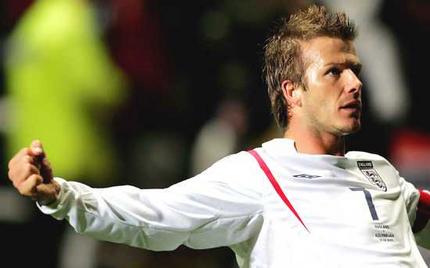
espnsoccernet.com
read more...
11/1/06
David Beckham: The Real Madrid Transfer(mation)
In the summer of 2003, the world of football was rocked as fans from all across the globe followed the saga of English football star and international celebrity David Beckham�s transfer from English club Manchester United to Spanish club Real Madrid. However, in a celebrity culture, the game takes a back seat to the player. Accordingly, it has been far more noticeable that the celebrity of David Beckham was rocked by the transfer. Only devoted football fans will recognize, for example, differences in tactics because Manchester no longer field Beckham and Madrid now do. But anyone who comes into contact with the sport will recognize the stark contrast in the primarily positive way David Beckham was perceived as a football celebrity for Manchester United and the primarily negative way David Beckham is now perceived as a football celebrity for Real Madrid.
In order to understand the nature of this transformation in the celebrity of David Beckham, it is important to first grasp the nature of sporting celebrity and its unique tie to the issue of celebrity transformation. Sporting celebrity is, more so than most other entertainment celebrity, an unstable status in a number of defining ways. First, the length of one�s effectiveness in the field of sports is dependent on youth (Petersen). The sports star only has a short time to prove he/she is effective in his/her field. Thus, in order for a celebrity to last in the field after his/her career is over, required of the celebrity is either a hyper-successful career--for example, hall of fame players in American professional sports such as basketball forward Kareem Abdul-Jabbar or American football quarterback Joe Montana--or a hyper-controversial career--for example, baseball pitcher Dwight Gooden had a very short stint with success but his well-publicized battle with drug abuse etched his name into the pantheon of sporting celebrity. Another reason sporting celebrity is so unstable is that, again perhaps more so than in the entertainment business, fans are so fickle. Depending on performances or public behavior, athletes in the spotlight could be loved one moment and hated the next. Only the very highest tier of sporting celebrity--the Michael Jordans or Wayne Gretzkys--boast of reputations that fans can�t change with the wind. Furthermore, the fan�s fickleness is reinforced by a sports media whose very job is to scrutinize everything and foster that frequent change in opinion.
This instability helps explain why the potential for celebrity transformation is particularly rampant in sporting celebrity. And these transformations most often manifest themselves in the form of changes of scenery. In American professional sports, this is generally carried out through trades in which teams swap players. In international football, this is generally carried out through (ever-so aptly named) transfers in which a team pays an agreeable sum to another team for a player. A new fan base or a different city can be just what a struggling player needs to break out of a slump and reestablish a fan base, or it can turn an up-and-coming no-name into a superstar household-name, or it can have the opposite effect and hinder or ruin a career of an already established star. Unfortunately, it seems that Beckham�s Real Madrid transfer has turned out to be a case of the latter.
In short, the June 2003 transfer of David Beckham from England�s Manchester United to Spain�s Real Madrid has transformed views of the celebrity from: a respected figure, a sports hero, an English patriot, and a brilliant right-foot; to: a criticized figure, a �brand name� rather than an athlete, and an overrated and over-payed-for player. How could all of this happen just as the result of a transfer? How can a celebrity�s fame go from so positively charged to so negatively charged? A chain of explanations is needed to answer the questions brought about by this �transfer(mation)�. First, there is the cause of the transfer. During his final years at Manchester United, Beckham and the club�s manager Sir (yes, he is knighted) Alex Ferguson began to fall out of favor with each other. Mostly due to Beckham�s increasingly �showy� lifestyle, highlighted by his marriage to Victoria Adams (formerly �Posh� Spice of the Spice Girls), Ferguson frequently voiced his opinion that Beckham did not have his priorities straight and was compromising football for the lure of celebrity (Foer). By the end of Manchester�s 2002-2003 campaign, with tempers flaring on both sides and Beckham�s contract close to finishing, the seeds for a transfer were planted as Ferguson and club management figured they could sell him before his contract ran out to get some money for him as opposed to just letting him go with no payoff at contract�s end. The result of all of this was a transfer agreement of over $40 million between Manchester and Spanish club Real Madrid.
Next, how the transfer in turn caused Beckham�s celebrity transformation must be investigated. The answer here lies in the different resources the two clubs on either side of the transformation bring to the table. For a team-sports athlete, one of the most important resources in reaching and maintaining celebrity is the team he/she is on. Teams serve as potential �star-vehicles� for sporting celebrities that can make--or remake--a career. �Star-vehicle� is a term referring to a resource that most effectively mediates a celebrity to his/her public (M�kel�). They maximize media coverage, increase familiarity, and secure a positive reputation. For Beckham, Manchester United was such a �star-vehicle� and his transfer to Real Madrid lost him that resource. Even worse, the transfer replaced it with a resource in Real Madrid that has seemed to serve as a �restricting-vehicle� or �anti-star-vehicle.� Beckham�s celebrity transformation was caused by this exchange of a �star-vehicle� for a �restricting-vehicle.�
An analysis of the effect of Manchester United as a �star-vehicle� and Real Madrid as a �restricting-vehicle� on Beckham provides the content to illustrate the differences in his pre- and post-transformation celebrity text: In his pre-transformation days playing for the English club, Beckham was a sentimental favorite as he grew up a ManU fan dreaming of once playing for his beloved team. He excelled on the right side of the midfield in a role made for him playing alongside speedy players that he could pick out at his leisure with his wonderful long passes. Later, during ManU�s glory years in late-1990s, he would become an English symbol of patriotism as the best English player on the best English club received the honor of captaining the English National team. Above all else, ManU�s success as a world-class team propelled Beckham to world-renown. The red, long-sleeved, ManU #7 shirt was as familiar in most of Asia as it was in the UK (O�Conor).
Yet, as much as Manchester United was a perfect fit for Beckham�s celebrity is as much as Real Madrid has seemed to be a dangerous fit. A bit of history on the club is required here to understand why. Real Madrid is as storied a club in Spain as ManU is in England. They have been either the or very-close-to-the premier club in the world (not just in Spain) just about every year since the 1950s, underlined by an unparalleled 32 consecutive European Cup appearances (O�Conor). Recently, however, although the club is chock-full of talent as always, they have struggled and have not won a domestic (in-Spain) or international trophy in quite some time. Leading up to the 2003-2004 season, management looked to change the low public opinion of the team by spending money on players that will revitalize the team and the Beckham signing was part of that plan. Unfortunately, the management was too focused on revitalizing the image of the team and not focused enough on the revitalizing the play of the team. Hoping to capitalize on Beckham�s celebrity and his desire to play for someone other than Ferguson, Madrid took the $40 million gamble. But, as previously outlined, much of the reason Beckham excelled
at ManU was that the club served as �star-vehicle� resource for him.
Playing for Madrid, Beckham was no longer a sentimental favorite, but a recognizable face thrown into the burdensome position of being the �brand name� of revival for a struggling team. With all of Madrid�s other stars, there was no room for Beckham as the rock on the right side of the midfield where he flourished for ManU. He was even at times put in an uncomfortable, more central midfield role playing alongside different players following tactics different from what he was used to. He was even no longer wearing #7, instead it was #23. It�s not difficult to speculate what has happened: Beckham�s play has suffered, and Real Madrid hasn�t broken out of their slump either. The result on Beckham�s celebrity is seen most clearly in media coverage of the celebrity since the transfer. To many, Beckham�s missed penalty-kick against Portugal in the Euro 2004 tournament has become one of his defining moments. In the recent World Cup 2006, Beckham�s play was continually criticized (despite a marvelous game-winning goal in a game against Ecuador). He is portrayed for the most part simply as the �brand name� for revival Real Madrid bought him to be, rather than the talent and beloved face he was for the successful ManU. Even in off-the-pitch coverage of the celebrity since the transfer, stories are dominated by allegations of adultery. Whether such allegations are true or not is not the issue. The issue is that such stories would never have been (or, more appropriately, been far less) publicized if Beckham were still ManU�s darling.
The case of David Beckham is a classic example of celebrity transformation. It is also an extreme illustration of the profound effect resources like �star-vehicles� can have on a celebrity when around and when taken away. As a result of his transfer from Manchester United to Real Madrid, Beckham�s celebrity text went from characterized by the positive to characterized by the negative.
Bibliography
Foer, Franklin. �Why England�s soccer god got shipped out.� Slate Magazine. 18 June
2006. Online, Internet at <http://www.slate.com/id/2084564/> (24 October 2006).
Petersen, Bob. �Becks and Posh and all that: Reflections on Sporting Celebrity.�
Australian Society for Sports History Bulletin. August 2003.
O�Conor, Sean. �Into the Fire of Real: Review of �When Beckham Went to Spain,� by
Jimmy Burns.� Soccerphile. 2004. Online, Internet at <http://www.soccerphile.
com/soccerphile/news/sean/beckham-to-spain.html> (24 October 2006).