THIS ARTICLE COMES FROM AN IMPRESSIVE INCREDIBLE HULK ANNUAL FROM 1979
TRANSFORMATION
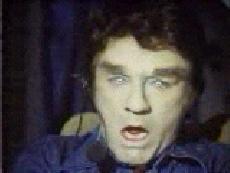
The big switch---- from an angry David Banner into an angrier still Hulk--- is one of the finest transformation scenes produced by the Hollywood make--up special effect magicians since the days of Frederic March and Spencer Tracey turning from Jekyll into Hyde. In one sense, it was more simple in their case. That was one actor only being used in The Incredible Hulk, Bill bixby has to turn-- churn-- from his slim, svelte self into the massive muscularity of Lou Ferrigno. And changing body color en route. It was during an experiment on the effect of gamma rays on human strength, that Banner was accidentally injected with an overdose of the dangerous rays. The result is his terrifying schizophrenic personality that he cannot control. The pilot film explained it all. How an adenine thymine combination, when triggered by an outside source, produces super human strength. And in every episode, Universal's crack special effect boys work that magic before our eyes, as the mild mannered medico twists and turns, groans and finally growls into the shape as the quite Hulk figure. He's a beast reminiscent of our most basic concepts of primitive humanity: seven feet tall with massive hands, a greenish hue, and super extra ordinary strength. (No wonder Lou Ferrigno used to prefer reading The Hulk than to Superman!) Mentally, the Hulk is pure, primitive emotion.... running wild. Unchecked; unstoppable! On our TV screens, the transformation is also approached scientifically. The imagery of superhuman strength arriving is crystallised by the use of a stop motion optical process, as first suggested by the series' producer (and often times writer-director) Kenneth Johnson. Stop motion photography is more simple than it sounds. You operate the camera; stop it; start it again; stop it and so on. When the camera isn't running, your experts are-- flashing in and out adding make up to the star being photographed. And so we see Bill Bixby getting angry about something. Anything. Well no, not just getting angry. Thats too small a word for the emotion involved. Bill is matching the expression of Peter Finch in the Network film: I'm madder than hell... I can't take it anymore. Bill's eyes take on an extra glow (Cut! Stop the camera. Put in the contact lenses... okay, action begin!) His face begins to change from West Coast Pacific tan to (Cut! Stop the camera! On with the make up. okay and.....action!) to light green. The face grimaces, distorts the eyebrows thicken (Cut again! Stop the camera back come the make up boys with bristles. Action!!!) The hairline begins to change (Cut! make up team return with a Hulk wig, in stages. Action!). The hair gets thicker-- and then bixby's face begins dissolving into the previously shot footage of Lou's Hulk face in close up, wakening as it were... Then, of course, it's look out! All hell is about to break loose. Lou Ferrigno takes over where Bill bixby's pent-up anger left off, and the Hulk leaves no building unturned. In common with his world audience, Bill Bixby feels the transformation works as superbly as the show. "When I read the Kenny's script-- the first pilot movie-- I realized I had the opportunity of doing a series in the genre of the creature films of the 40's, that featured Frankenstein, the Wolfman, Jekyll and Hyde. But all those characters were evil-- the Hulk is not evil. He is the personification of anger. He is anger brought to a physical sense. Power! Something we wish we all had. All of us who, having sand kicked in our faces by the bully, wish that we could turn into The Hulk to defend ourselves. Very interesting to explore anger. It's a passion in all of us." To add extra dimensions to the transformation sequences, neither Bill nor Lou grab a chair and watch each other's scenes. It works better that way for the actors, they both agree, because Banner never knows what the Hulk has done-- and vice-versa. "The Hulk," explains Bill Bixby, "does know he's motivated towards an object, because it has transferred itself from my conscious mind to his conscious mind. But the awareness of my existence is not there in his mind at all. And, after all the confusion and anger is over, he finds himself like a fish out of water. he looks around and doesn't understand at all why he is there." Bixby laughs. "Talk about minority groups," he says. "The hulk is a minority group of one!" At the Universal Studios, in Universal City, Hollywood, the whole transformation sequence has it's own nickname. An expression which has quickly entered into American slang language. Hulk-out. "Thats when I become The Hulk," says Bill. "I Hulk-out! that means there is going to be a lot of action going on!" Continuing to keep the shows feet on the ground, by avoiding the comic-book type of story, Bill and Lou invariably Hulk out against the normal, average annoyances of life in their series. Lou beat one car into scrap for one show-- and every driver with car troubles must have applauded for that one. Better still was the even more common failing in life-- prissy telephone operators. "I had to call information," recalls Bill. "I get put on hold, and when I finally get an operator I said this is an emergency, you've got to get me the police. She answers 'I'm not equipped to do that.' I get more and more angry until I become The Hulk who goes berserk during the course of an argument with this telephone operator. Someone may be being murdered, and they will not help, so I Hulk-out and he rips the phone and destroys the entire phone box." And every nation running the show stood up and cheered. It's moments of sheer gratification like that that makes The Incredible Hulk believable.