
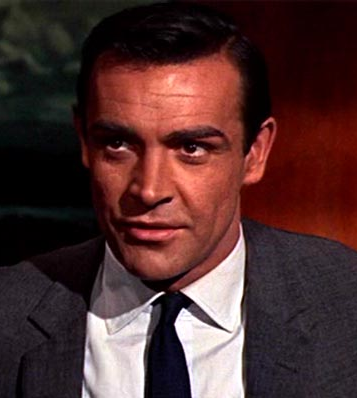
The Times
Commander James Bond,
C.M.G., R.N.V.R.
M. writes:--
As your readers will have learned from earlier issues, a senior officer of
the Ministry of Defence, Commander James Bond, C.M.G., R.N.V.R., is missing,
believed killed, while on an official mission to Japan. It grieves me to have
to report that hopes of his survival must now be abandoned. It therefore falls
to my lot, as the Head of the Department he served so well, to give some account
of this officer and of his outstanding services to his country.
James Bond was born of a Scottish father, Andrew Bond of Glencoe, and a Swiss
mother, Monique Delacroix, from the Canton de Vaud. His father being a foreign
representative of the Vickers armaments firm, his early education, from which
he inherited a first-class command of French and German, was entirely abroad.
When he was eleven years of age, both his parents were killed in a climbing
accident in the Aiguilles Rouges above Chamonix, and the youth came under
the guardianship of an aunt, since deceased, Miss Charmian Bond, and went
to live with her at the quaintly-named hamlet of Pett Bottom near Canterbury
in Kent. There, in a small cottage hard by the attractive Duck Inn, his aunt,
who must have been a most erudite and accomplished lady, completed his education
for an English public school, and, at the age of twelve or thereabouts, he
passed satisfactorily into Eton, for which College he had been entered at
his birth by his father. It must be admitted that his career at Eton was brief
and undistinguished and, after only two halves, as a result, it pains me to
record, of some alleged trouble with one of the boys' maids, his aunt was
requested to remove him. She managed to obtain his transfer to Fettes, his
father's old school. Here the atmosphere was somewhat Calvinistic, and both
academic and athletic standards were rigourous. Nevertheless, though inclined
to be solitary by nature, he established some firm friendships among the traditionally
famous athletic circles at the school. By the time he left, at the early age
of seventeen, he had twice fought for the school as a light-weight and had,
in addition, founded the first serious judo class at a British public school.
By now it was 1941 and, by claiming an age of nineteen and with the help of
an old Vickers colleague of his father, he entered a branch of what was subsequently
to become the Ministry of Defence. To serve the confidential nature of his
duties, he was accorded the rank of lieutenant in the Special Branch of the
R.N.V.R., and it is a measure of the satisfaction his services gave to his
superiors that he ended the war with the rank of Commander. It was about this
time that the writer became associated with certain aspects of the Ministry's
work, and it was with much gratification that I accepted Commander Bond's
post-war application to continue working for the Ministry in which, at the
time of his lamented disappearance, he had risen to the rank of Principal
Officer in the Civil Service.
The nature of Commander Bond's duties with the Ministry, which were, incidentally,
recognized by the appointment of C.M.G. in 1954, must remain confidential,
nay secret, but his colleagues at the Ministry will allow that he performed
them with outstanding bravery and distinction, although occasionally, through
an impetuous strain in his nature, with a streak of the foolhardy that brought
him in conflict with higher authority. But he possessed what almost amounted
to "The Nelson Touch" in moments of the highest emergency, and he somehow
contrived to escape more or less unscathed from the many adventurous paths
down which his duties led him. The inevitable publicity, particularly in the
foreign press, accorded some of these adventures, made him, much against his
will, something of a public figure, with the inevitable result that a series
of popular books came to be written around him by a personal friend and former
colleague of James Bond. If the quality of these books, or their degree of
veracity, had been any higher, the author would certainly have been prosecuted
under the Official Secrets Act. It is a measure of the disdain in which these
fictions are held at the Ministry, that action has not yet -- I emphasize
the qualification -- been taken against the author and publisher of these
high-flown and romanticized caricatures of episodes in the career of a outstanding
public servant.
It only remains to conclude this brief in memoriam by assuring his friends
that Commander Bond's last mission was one of supreme importance to the State.
Although it now appears that, alas, he will not return from it, I have the
authority of the highest quarters in the land to confirm that the mission
proved to be one hundred per cent successful. It is no exaggeration to pronounce
unequivocally that, through the recent valorous efforts of this one man, the
Safety of the Realm has received mighty reassurance.
James Bond was briefly married in 1962, to Teresa, only daughter of Marc-Ange
Draco, of Marseilles. The marriage ended in tragic circumstances that were
reported in the press at the time. There was no issue of the marriage and
James Bond leaves, so far as I am aware, no relative living.
M.G. writes:
I was happy and proud to serve Commander Bond in a close capacity during the
past three years at the Ministry of Defence. If our fears for him are justified,
may I suggest these simple words for his epitaph? Many of the junior staff
here feel they represent his philosophy:
"I shall not waste my days in trying to prolong them. I shall use my time."
