|
ALGEBRA 1 GLOSSARY |
|
Click on the first letter of the term you want to define. |
| A B C D E F G H I J K L M N O P Q R S T U V W X Y Z | |
| Absolute Value | the absolute value of a number is the distance the number is from the zero point on the number line. The absolute value of a number or an expression is always greater than or equal to zero (i.e. nonnegative). |
| Addition | a mathematical process to to combine numbers and/or variables into an equivalent quantity, number or algebraic expression |
| Adding integers | To ADD
integers with the same sign, add their absolute
values. Give the result the same sign as the integers.
To ADD integers with different signs, SUBTRACT the lesser absolute value from the greater absolute value. Give the result the same sign as the integer with the greater absolute value. |
| Addition (and Subtraction) Property for Inequality |
For all numbers a, b, and c, the following are true: 1. If a > b,
then a + c > b + c 2. If a < b,
then a + c < b + c |
| Additive Identity Property |
For any number a, a + 0 = 0 + a |
| Additive Inverse Property |
For every number a, a + (-a) = 0 e.g. 5 + ? = 0 5 + (-5) = 0 -17 + ? = 0 -17 + 17 = 0 |
| Algebraic Expression | an expression consisting of one or more numbers and variables along with one or more arithmetic operations. |
| Arithmetic Operation | a mathematical process of addition, subtraction, multiplication or division. |
| Axes | Two perpendicular number lines that are used to locate points in a coordinate plane. The x-axis is the horizontal line and the y-axis is the vertical line. |
| A B C D E F G H I J K L M N O P Q R S T U V W X Y Z | |
| Best-Fit Line |
A line drawn so it is close to most or all of the data points in a graph. A best-fit line is
described as strong or weak
depending on how close the data points are on average. |
| Binomial | The sum of two monomials. |
| Boundary | A boundary line of an inequality is a line that separates the coordinate plane into half-planes. |
| A B C D E F G H I J K L M N O P Q R S T U V W X Y Z | |
| Coefficient | The numerical factor in a term. In the term 4x, 4 is the coefficient. In the term 4x/5 ; 4/5 is the coefficient. Note that 4x/5 can also be written as ( 4/5 )x. |
| Complex fraction | A fraction that has one or more fractions in the numerator or denominator. |
| Compound Event | A compound event consists of two or more simple events (i.e. the tossing of two or more coins). |
| Compound Inequality | Two inequalities connected by AND or OR. |
| Consistent | A system of equations is said to be consistent when it has at least one ordered pair that satisfies both equations. |
| Constants | Monomials that are real numbers. |
| the plane containing the x- and y- axes. | |
| A B C D E F G H I J K L M N O P Q R S T U V W X Y Z | |
| Degree of a monomial | The degree of a monomial is the sum of the exponents of its variables. |
| Degree of a polynomial | The degree of a polynomial is the degree of the term of the greatest monomial degree. |
| Dependent (equations) | A system of equations that has an infinite number of solutions |
| Dependent Event | An occurrence or outcome that is affected by previous occurrences or outcomes. The probability of drawing a red or black card from a deck of cards is affected by the colors of cards previously drawn. see independent event |
| Dependent Variable | When solving an equation for a given variable, that variable becomes the dependent variable. That is, its value depends upon the domain values chosen for the other variable. The dependent variable represents the range and is graphed on the y-axis (see independent variable). |
| Difference of Squares | Two perfect
squares separated by a subtraction sign, i.e. a2 - b2 = (a + b)(a - b) |
| Division Property for Inequality | |
| Domain | the set of all first (x-) coordinates from the ordered pairs in a relation. |
| A B C D E F G H I J K L M N O P Q R S T U V W X Y Z | |
| Element | A member of a set. |
| Elimination | The elimination method of solving a system of equations is a method that uses addition or subtraction to eliminate one of the variables to solve for the other variable. |
| Equal (also Equivalent) |
a term used to indicate that two or more quantities are of the same value. |
| Equation | a mathematical sentence that contains an equals sign (=). |
| Evaluate | To find the value of an expression when the value of the variables are known. |
| Exponent | In an expression of the form xn, the exponent is n. The expression xn is called a power. |
| Expression | see Algebraic Expression |
| A B C D E FG H I J K L M N O P Q R S T U V W X Y Z | |
| Factors | In
a multiplication expression, the quantities being multiplied are
called factors.
In the expression 3bc, there are three factors: 3, b and c. In the expression 3(m+5) there are two factors: 3 and (m+5). |
| FOIL Method | To
multiply two binomials, find the sum of the
products of:
F
the first terms, |
| Formula | an equation that states a rule for the relationship between certain quantities. The formula for distance-rate-time problems is d=rt. |
| Function
(see vertical line test) |
a function is a relation in which each element of the domain is paired with exactly one element of the range. |
| A B C D E F G H I J K L M N O P Q R S T U V W X Y Z | |
| Graph | To draw or
plot the points named by: 1) certain numbers on a number line or 2) certain ordered pairs on a coordinate plane. |
| A B C D E F G H I J K L M N O P Q R S T U V W X Y Z | |
| Half-Plane | The region on a graph on one side of a boundary is called a half-plane. |
| A B C D E F G H I J K L M N O P Q R S T U V W X Y Z | |
| Inconsistent | A system of equations is said to be inconsistent when it has no ordered pair that satisfies both equations. |
| Independent (equations) | A system of equations is said to be independent if the system has exactly one solution. |
| Independent Event | An occurrence or outcome that is not affected by previous occurrences or outcomes. The probability of tossing a coin heads or tails is an independent event. see dependent event |
| Independent Variable | The domain contains values represented by the independent variable. The domain values are graphed on the x-axis (see dependent variable). |
| Inequality | A mathematical sentence containing the symbols <, <, >, or >. |
| Integer | The set of numbers represented as {..., -3, -2, -1, 0, 1, 2, 3,...}. |
| Intersection (of sets) | The intersection of two sets A and B is the set of elements common to both A and B. |
| Inverse of a Relation | Relation Q is the inverse of Relation S if and only if for every ordered pair (a,b) in S, there is an ordered pair (b,a) in Q. For example, the inverse of (2, 5) is (5, 2). |
| Irrational number | A number that cannot be expressed in the form (a/b) where a and b are integers and b <> 0. |
| A B C D E F G H I J K L M N O P Q R S T U V W X Y Z | |
| Like Terms | terms that contain the same variables, where the corresponding variables also are of the same power (exponent). |
| Linear Equation | An equation whose graph is a line. |
| A B C D E F G H I J K L M N O P Q R S T U V W X Y Z | |
| Mathematical Sentence | a statement
in which numbers, variables,
arithmetic operations and other
symbols (i.e. =, <, |
| Monomial | A monomial is a number, a variable, or a product of a number and one or more variables. |
| Multiplication (and Division) Property for Inequality |
For all numbers a, b, and c, the following are true: IF c is POSITIVE: 1. If a > b,
then ac > bc the same holds true for DIVISION where c is not equal to zero. + + + + + + + + + + + + For all numbers a, b, and c, the following are true: IF c is NEGATIVE: 1. If a > b,
then ac < bc the same holds true for DIVISION where c is not equal to zero. |
| Multiplicative Identity Property |
For
any number a,
a .
1 = 1 . a = a |
| Multiplicative Inverse Property |
For
every nonzero number a/b, there is exactly one number b/a such that
(a/b) . (b/a) = 1 |
| Multiplicative Property of Zero |
For
any number a,
a . 0
= 0 . a = 0 |
| A B C D E F G H I J K L M N O P Q R S T U V W X Y Z | |
| Negative Correlation | There
is a negative correlation between x and y if the values are related in
an opposite way - i.e. as x increases, y decreases or as x decreases,
y increases. see lesson |
| Negative Exponent | For any
non-zero number a
and any integer n: a-n = 1/an |
| Negative Number | Any number that is less than zero. |
| Number | an element of a mathematical system used to represent known quantities, both standalone and in mathematical sentences. |
| Number Line | A line with equal distances marked off to represent numbers. |
| A B C D E F G H I J K L M N O P Q R S T U V W X Y Z | |
| Odds | a ratio of the number of ways a certain event can occur to the number of ways it cannot occur. see lesson |
| Ordered Pair | a pair of numbers used to locate points in the coordinate plane. |
| Organize data | Organizing data is useful before solving a problem. Some ways to organize data are to use tables, charts, different types of graphs, or diagrams. |
| Origin | the point of intersection of the two axes in the coordinate plane. |
| Outcomes | Outcomes are all possible combinations of a counting problem. Positive and negative outcomes are the basis of many probability problems. see lesson |
| A B C D E F G H I J K L M N O P Q R S T U V W X Y Z | |
| Percent | A percent is a ratio that compares a number to 100. see lesson |
| Percent of Decrease | The ratio of an amount of decrease to a previous amount, expressed as a percent. |
| Percent of Increase | The ratio of an amount of increase to a previous amount, expressed as a percent. |
| Perfect square | A rational number whose square root is a rational number. |
| Point-slope form of a linear equation |
For a given point (x1, y1) on a non-vertical line having slope m, the point-slope form is: y - y1 = m(x - x1) |
| Polynomial | A polynomial is a monomial or a sum of monomials. |
| Positive Correlation | There is a positive correlation between x and y if the values are related in the same way - i.e. as x increases, y also increases or as x decreases, y decreases. see lesson |
| Power of a Monomial |
For any numbers a and b and any integers m, n, and p: (ambn)p = ampanp |
| Power of a Power | For any
number a,
and all integers m
and n:
(am)n = amn |
| Power of a Product |
For any numbers a and b and any integers m: (ab)m = ambm
|
| Principal square root | The nonnegative square root of an expression. |
| Probability | a ratio of the number of ways a certain event can occur to the number of possible outcomes. see lesson |
| Product | The result of multiplication. |
| Product of Powers | For any
number a,
and all integers m
and n:
aman = am+n |
| Proportion | an equation stating that two ratios are equivalent. |
| A B C D E F G H I J K L M N O P Q R S T U V W X Y Z | |
| Quadrant | One of the four regions into which the x- and y- axes separate the coordinate plane. |
| Quantity | the way in which a person, place or thing is measurable for purposes of assignment or comparison. For example, a person could be measured in height, weight or intelligence. A town could be measured in population, square miles, or tax revenue. A building could be measured in height, floor space or storage capacity. Each measurement can be represented as a quantity. |
| Quotient of powers | For any
non-zero number a,
and all integers m
and n:
am/an = am-n |
| A B C D E F G H I J K L M N O P Q R S T U V W X Y Z | |
| Radical sign | The symbol  , indicating the principal
square root of an expression.
, indicating the principal
square root of an expression.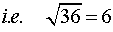 |
| Range | the set of all second (y-) coordinates from the ordered pairs in a relation. |
| Ratio | a comparison
of two numbers by division. see lesson |
| Real number | The set of rational numbers and irrational numbers together form the set of real numbers. |
| Reflexive Property of Equality |
For
any number a,
a = a |
| Relation | a set of ordered pairs. |
| Replacement Set | A set of numbers from which replacements for a number may be chosen. |
| Rise | The vertical (up and down) change in a line graphed in the coordinate plane. |
| Run | The horizontal (left and right) change in a line graphed in the coordinate plane. |
| A B C D E F G H I J K L M N O P Q R S T U V W X Y Z | |
| Scatter Plot | In a scatter plot, two sets of data are plotted as ordered pairs in the coordinate plane. see lesson |
| Scientific Notation | A number is
expressed in scientific notation when it is in the form: a x 10n, where 1 < a < 10 and n is an integer. |
| Sequence | A set of numbers in a specific order. |
| Set | A collection of objects or numbers. |
| Set-builder Notation | A notation used to describe the members of a set. For example { y | y< 17 } represents the set of all numbers y such that y is less than 17. see lesson |
| Simple Events | A single event in a probability problem (i.e. the tossing of one coin). |
| Simplest Form | an algebraic expression is in simplest form when it contains no parentheses or like terms. |
| Slope | The slope m of a line is the ratio of the change in the y-coordinates to the corresponding change in the x-coordinates. Also described as "rise over run" or "the change in y over the change in x". see lesson |
| Slope-intercept form |
Given the slope m
and the y = mx
+ b |
| Solution | A replacement for the variable in an open sentence that results in a true sentence. |
| Solution Set | The set of all replacements for the variable in an open sentence that result in a true sentence. |
| Square root | One of two identical factors of a number. |
| Standard Form |
The Standard Form of a linear equation is: Ax + By = C where A, B, and C
are integers, A > 0 and A and B are both
|
| Substitution | The substitution method of solving a system of equations is a method that uses substitution of one equation into the other equation to solve for the other variable. |
| Substitution Property of Equality |
If a = b, then a may be replaced by b in any expression |
| Subtracting integers |
To subtract a number, add its additive inverse. For any numbers a and b; a - b = a + (-b) |
| Subtraction (and Addition) Property for Inequality | |
| Sum | The result of an addition operation. |
| Symmetric Property of Equality |
For
any numbers a and
b,
if a = b, then b = a |
| System of equations | A set of
equations (two or more) with the same variables.
With respect to a system of two
linear equations, we can say the system has either: |
| System of inequalities | A set of inequalities (two or more) with the same variables. |
| A B C D E F G H I J K L M N O P Q R S TU V W X Y Z | |
| Term (1) (of an algebraic expression) | a number, a variable, or a product or quotient of numbers and variables. |
| Term (2) (of a sequence) | a number in a sequence. |
| Transitive Property of Equality |
For
any numbers a, b, and
c,
if a = b and
b = c, then a = c |
| Tree Diagram | A diagram used to show the total number of all possible outcomes. |
| Trinomial | A trinomial is the sum of three monomials (after like terms have been combined). |
| A B C D E F G H I J K L M N O P Q R S T U V W X Y Z | |
| Uniform Motion | When an object moves at a constant speed (or rate) it is said to be in uniform motion. The formula distance = rate * time ( d = rt ) is used to solve uniform motion problems. see lesson |
| Union | The union of two sets A and B is the set of elements contained in both A and B. |
| Unit cost | The cost of one unit of something. For example if 12 bagels cost $3.60, the unit cost for one bagel is $0.30 or 30 cents, which is the quotient of 3.60/12. |
| A B C D E F G H I J K L M N O P Q R S T U V W X Y Z | |
| Value | a numerical quantity that is assigned or is determined by calculation or measurement. |
| Variable | a symbol, typically a lower case letter, that is used to represent an unspecified number. |
| Vertical Line Test for a Function | if any vertical line passes through no more than one point of the graph of a relation, then the relation is a function. |
| A B C D E F G H I J K L M N O P Q R S T U V W X Y Z | |
| Whole numbers | The set of whole numbers can be expressed as {0,1,2,3,...}. Whole number are not negative. |
| A B C D E F G H I J K L M N O P Q R S T U V W X Y Z | |
| x-coordinate | the first number of an ordered pair. It corresponds to the numbers on the x-axis. |
| x-intercept | The coordinate at which a graph intersects the x-axis. |
| A B C D E F G H I J K L M N O P Q R S T U V W XYZ | |
| y-coordinate | the second number of an ordered pair. It corresponds to the numbers on the y-axis. |
| y-intercept | The coordinate at which a graph intersects the y-axis. |
| A B C D E F G H I J K L M N O P Q R S T U V W X Y Z | |
| Zero Product Property | For all numbers a and b, if ab=0 then either a=0, b=0 or both a and b equal 0. |
| Zero exponent | For any
non-zero number a:
a0 = 1 |
