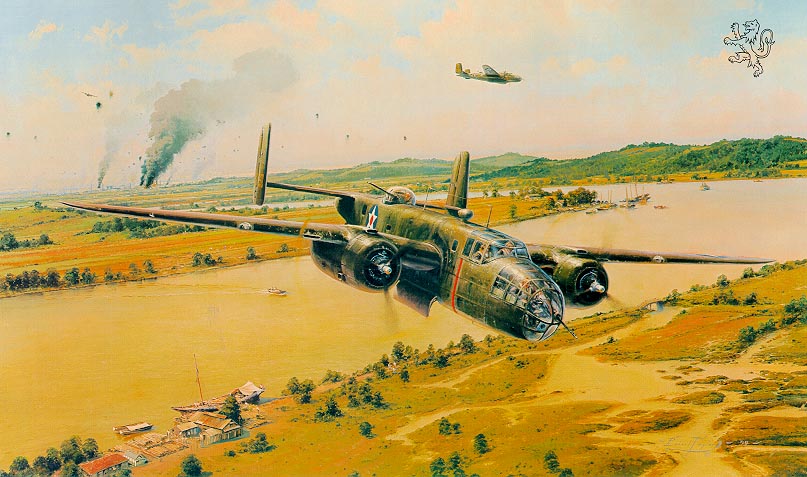
Early in its development, it was named after General William "Billy" Mitchell, an early proponent of air power who was court martialed for his public advocacy of air power. As a means to restore moral after the Japanese raid on Peral Harbor, President Roosevelt authorized a mission unique in military history. The B-25 was designed as a land-based bomber, but General Doolittle trained his pilots to take off in a very short distance. Soon the planes and pilots were loaded aboard the aircraft carrier Hornet and began steaming for Japan. The task force was sighted, so the plane were prematurely launched 800 miles from target rather than the 600 miles that had been intended. All 16 planes reached the Japanese islands, dropped their bombs on oil stores, factory areas, and military installations, and then headed out across the East China Sea. When the news of the raid was released, American morale zoomed from the depths to which it had plunged following Japan's successes. It also caused the Japanese to transfer back to the home islands fighter units which could have been used against the Allies. In comparison to the B-29 attacks against Japan two years later, the Tokyo Raid was a token effort. However, it was an example of brilliant tactics.