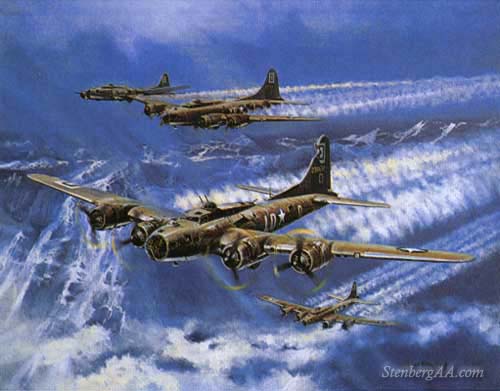
In the early 1930s, the U. S. Army Air Corps began focusing on daylight precision bombing of strategic land targets deep behind enemy lines. In August 1935, Boeing introduced the Model 299, the prototype XB-17, during an impressive non-stop flight that covered 3,381 km (2,100 miles) from Seattle to Wright Field at Dayton, Ohio. It easily beat two other bomber designs, but few funds were available to purchase new airplanes. By 1939, only thirteen B-17s were in inventory.
Concerned by German and Japanese aggression against other countries, President Roosevelt directed the air Air Corps to increase its bomber strength. When the Japanese attacked Pearl Harbor on December 7, 1941, there were 200 B-17s in service. These first models lacked defensive armament and armor, but once they were added, the plane became known as the "Flying Fortress." It carried the burden of the strategic air war in Europe to the enemy and reduced German cities to rubble. Production ended in May 1945 and totaled 12,726.