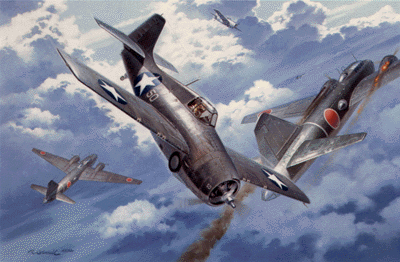
The F4F saga began in 1935 when Grumman's XF4F-1 biplane prototype lost out in competition against the Brewster F2A-1 monoplane (later called the Buffalo) for a contract with the Navy for a new carrier based fighter. Data on the F2A-1 soon showed that a biplane could not compete against a successful monoplane and further development of the XF4F-1 was stopped in favor of an alternative monoplane designed by Grumman and ordered by the Navy as the XF4F-2. As a monoplane, it was destined for far greater success than ever achieved by the Brewster Buffalo.
In 1938 Grumman Aircraft Corporation was awarded a contract for the F4F "Wildcat". This was followed in 1942 by a subcontract with Eastern Aircraft (General Motors assembly factories) to produce F4Fs with a designation of FM thus leaving Grumman to concentrate on the F6F "Hellcat". Basic differences between the two aircraft were in the armament and engines. Over 9,000 F4F/FM aircraft were produced, many of which were sent to Britain and saw combat against the Germans before United States entry into World War II.
The "Wildcat" became the tool for some of the greatest aces of the Pacific war, the first of whom was LT "Butch" O'Hare who was awarded the Medal of Honor for shooting down five enemy bombers and damaging a sixth during one flight. Chicago's O'Hare airport is named after him. The leading World War II Marine ace, Major Joe Foss, as well as five other Marine "Wildcat" pilots, received the Medal of Honor during the Battle of Guadalcanal. After the Solomon Island campaign, the F4Fs were gradually replaced by the more advanced F4U "Corsair" and the F6F "Hellcat". "Wildcats" remained in service aboard the escort carriers