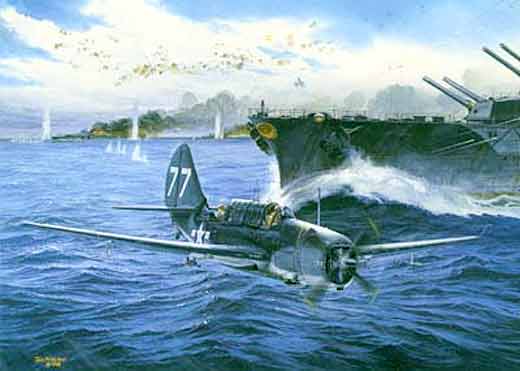
The Douglas TBD-1 was the Navy's first widely-used monoplane shipboard plane. Designed to carry a heavy torpedo below the fuselage, it was necessarily a large aircraft and its 900-horsepower Pratt & Whitney R-1830 "Twin Wasp" radial engine could drive it to a maximum speed of slightly over 200 miles per hour. The XTBD-1 first flew in April 1935 and 129 production TBD-1s were delivered in 1937-39, rapidly replacing biplanes in the Navy's carrier torpedo squadrons. The type gave U.S. Fleet aviators valuable experience with what was, for the time, a rather high-performance aircraft. "Normal" operational attrition whittled away at the TBD inventory, which peaked at about 120 in 1939 and had declined to barely more than a hundred at the start of the Pacific War.
Though the new Grumman TBF "Avenger" was entering production as its intended replacement, the TBD-1 was the Pacific Fleet's sole torpedo plane for the first part of the war against Japan. It seemingly did well in the raids of February-March 1942 and in the Battle of the Coral Sea in early May, serving in both the torpedo attack and high-level bombing roles. However, in about an hour's time on 4 June 1942, during the Battle of Midway, the TBD entered the annals of Naval history as a synonym for costly futility. Three squadrons of TBD-1s made heroic torpedo attacks on the Japanese carrier force, losing all but four of forty-one aircraft while achieving no hits. Old and slow, with a weak defensive armament and without self-sealing fuel tanks, the TBD had proven horribly vulnerable to enemy fighters, though this vulnerability was to a great extent typical of all torpedo attacks against well-defended ships. At the end of the Midway battle, the Navy had just thirty-nine TBDs left.