 |
|
|
|
|
|
|
|
|
|
|
|
|
|
|
|
|
|
|
|
 |
|
|
|
VMF-323
DEATH RATTLERS
A UNIT HISTORY |
|
 |
|
|
|
|
|
|
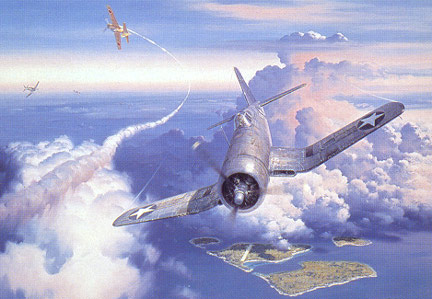
| Marine Fighting Squadron 323 was commissioned Aug. 1, 1943 at Marine Corps Air Station Cherry Point, N.C. Three hard-charging fighter pilots killed a 6 foot rattlesnake, and hung its diamond-backed skin in the squadron ready room, giving rise to the 50 year-old unit the nickname of "Death Rattlers". VMF-323 immediately began training for combat in the Pacific theater with their Chance-Vought F4U Corsairs. Often hailed as the best all-around fighter of World War II, the "bent-wing bird" was armed with six .50-caliber machine guns and a lethal warload of bombs, rockets, and Napalm. In preparation for deployment overseas, VMF-323 moved west in January 1944, flying training missions from fields at El Centro and Camp Pendleton, Calif. In July 1944 the Death Rattlers departed for the Pacific aboard the escort carrier USS Long Island. For the next nine months, VMF-323 flew training missions from secure island bases in the South Pacific, perfecting their tactics in aerial combat, dive bombing, rocketry, and close air support. |
|
|
 |
|
| On April 9, 1945 the Death Rattlers flew from an escort carrier into Kadena airfield to fly missions in support of Operation Iceberg, the campaign for Okinawa. Combat operations commenced the following day. Between April and the surrender of Japanese forces in August, the Death Rattlers shot down 124 Japanese planes in aerial combat without a single loss to an enemy pilot. Twelve VMF-323 fighter pilots became Aces - three of them in a single day. |
|
|
|
|
|
The deadly, effective close air support (CAS) the Death Rattlers gave the Leathernecks on the ground was just as important as the squadron's tremendous accomplishments in air combat. To the Marine riflemen engaged in the bloodiest close-quarter fighting of the war, Marine Corsairs became the "Sweethearts of Okinawa".
March 1946 found the Death Rattlers based at MCAS El Toro, Calif., and engaged in a rigorous peacetime training program. Operating from land and sea, VMF-323 participated in exercises throughout the western U.S., Alaska, and Hawaii. The squadron also provided Hollywood, Calif., with Marine airpower for the 1949 classic, Sands of Iwo Jima.
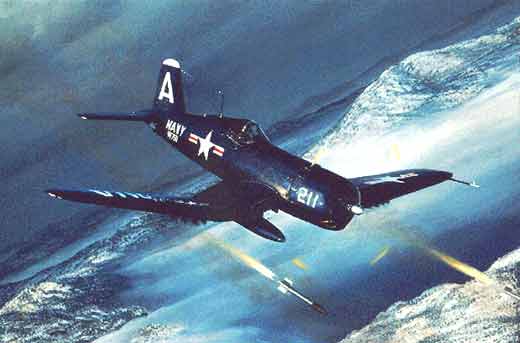
June 25, 1950, North Korean troops invaded South Korea. Within a month, VMF-323 began combat operations from the escort carrier USS Badoeng Strait, in support of ground forces in the Pusan perimeter. Again proving the effectiveness of Marine close air support during heavy fighting at Pusan, the Inchon landing, the breakout of the 1st Marine Division from the Chosin Reservoir, and every major campaign of the war, the Death Rattlers further built on the combat reputation of the Marine Air-Ground Team. Flying alternately from Navy carriers and austere airfields ashore, VMF-323 flew primarily air-to-ground missions such as CAS, interdiction, and armed reconnaissance. Reflecting this change in its primary mission, the squadron was re-designated Marine Attack Squadron 323 (VMA-323) in June 1952. The Death Rattlers departed Korea in July 1953 after accumulating 48,000 hours of flight time, and once again serving with distinction in combat. |
|
|
|
 |
|
|
|
For more history on the Deathrattlers |
|
|
|
 |
|