
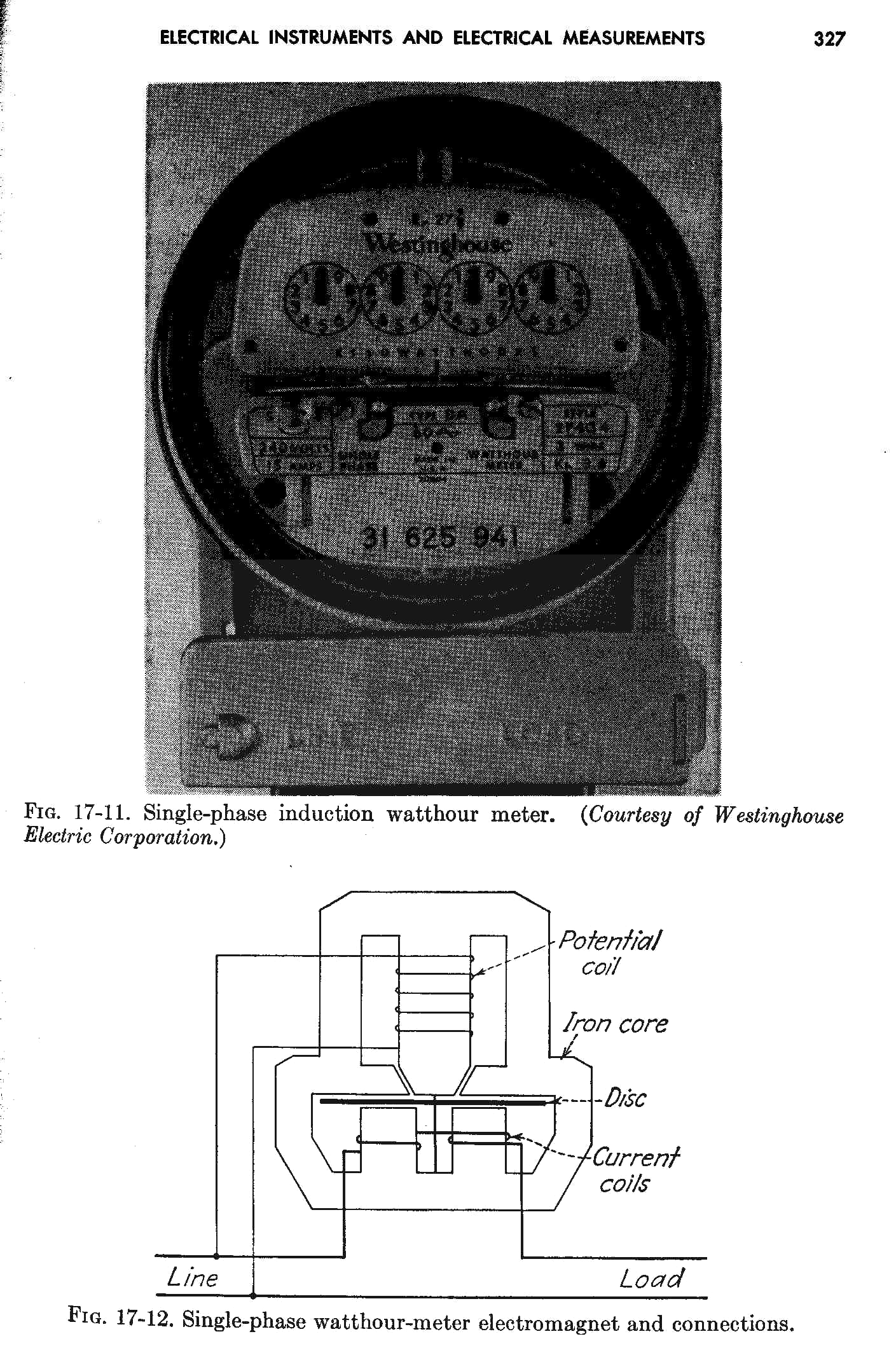
So that it may be connected directly across the circuit in which the energy is to be measured, the potential coil is wound with many turns of fine wire. Because of the high inductance of the coil, the current lags behind the applied voltage by nearly 90 deg. To cause the potential coil flux to be exactly 90 deg behind the current coil flux, a short-circuited coil is placed around the core below the potential coil. Induced currents in this coil act to retard the potential coil flux to the desired phase position....
The flux produced by the potential and current coils, being displaced both in space and time phase, as in the split-phase motor, induce eddy currents in the disk of the rotating element. The motor action so procuced is greatest at unity power factor and is zero at zero power factor and , for given values of current and voltage, is proportional to any value of power factor. Hence the speed of the rotating element is proportional to EI cos (theta)
To prevent the armature from racing at a high speed when a torque is applied and to make the speed proportional to the power supplied the meter, a retarding torque is necessary. This is obtained by placing a permanent magnet near the rotating element so that the disk rotates in the field established by the magnet. Eddy currents induced in the disk produce a field that reacts with the field of the magnet, thereby causing a damping action that is proportional to the speed of the disk: that is, the faster the disk is turned, the greater the eddy currents and the greater the retarding action. Hence, ther speed of the rotating element of a watthour meter is made directly proportional to the power in the circuit.
Since the speed of the rotating element is proportional to the power, every revolution represents a definite amount of energy. Geared to the rotating element is a register, the reading if which is an indication of the energy consumed over any given period. Register dials are calibrated to read directly in kilowatthours.....