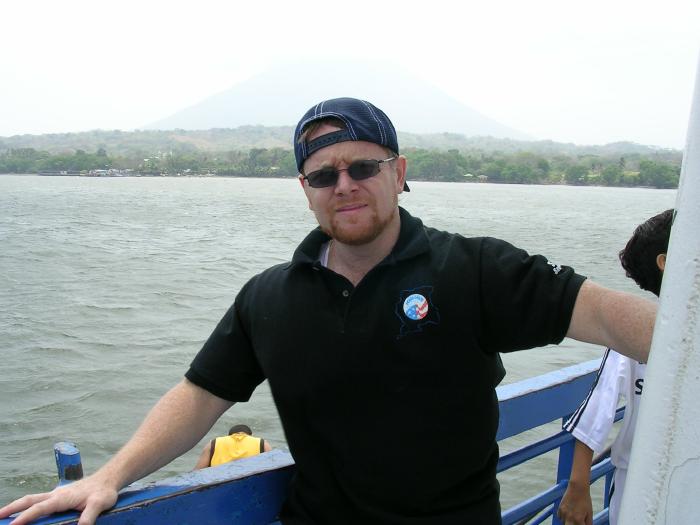
| Today I had a very exciting story about everything going wrong
on my trip to
Ometepe.
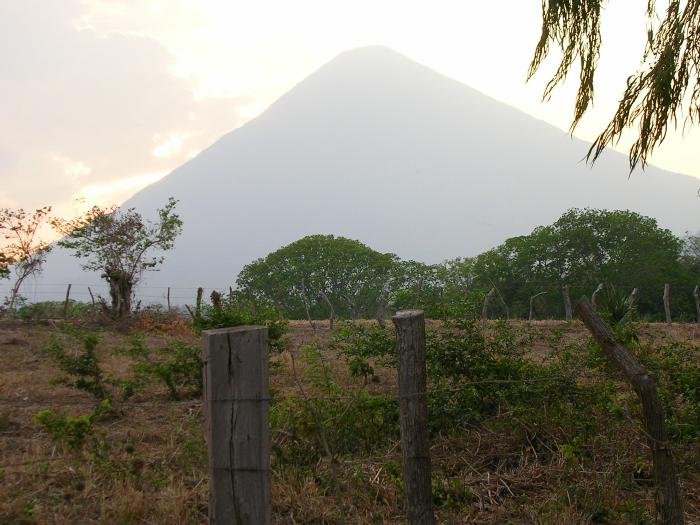
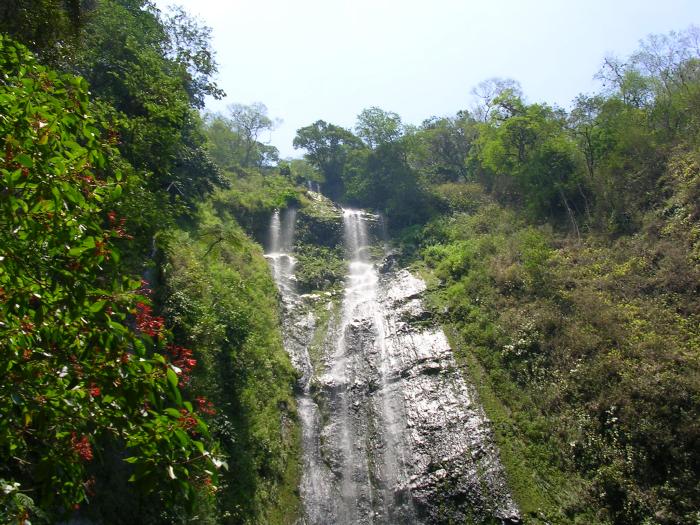
In short I walked 3 KMs up a steep mountain to see a waterfall. I was late
coming down, so late and the jeep was overheating. We put some water in
the jeep and could not get the hood closed right. The hood flew open into
the windshield, later. We were all ok, but it knocked the rearview window
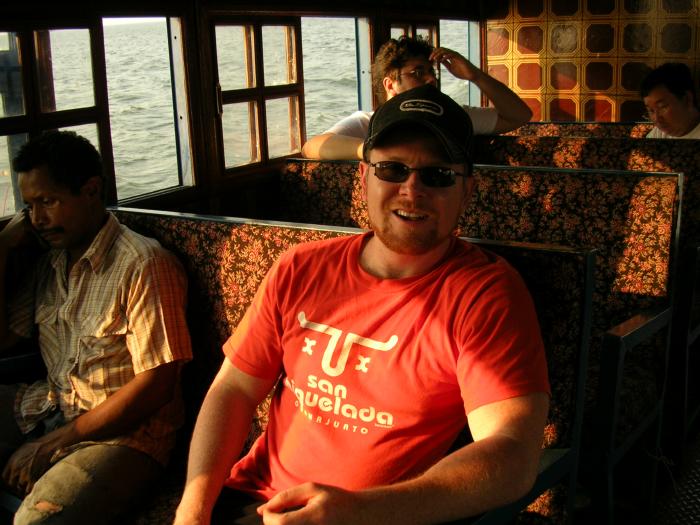
down. We missed the last ferry, as we were told, and we thought we had to
stay on the island another night. As luck would have it, another boat was
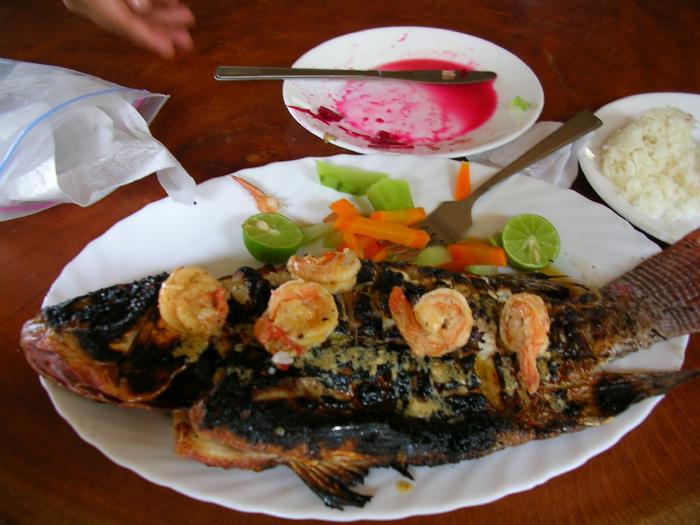
able to take us at 5:30 and we were able to catch a fantastic meal in
Granada before getting back to the
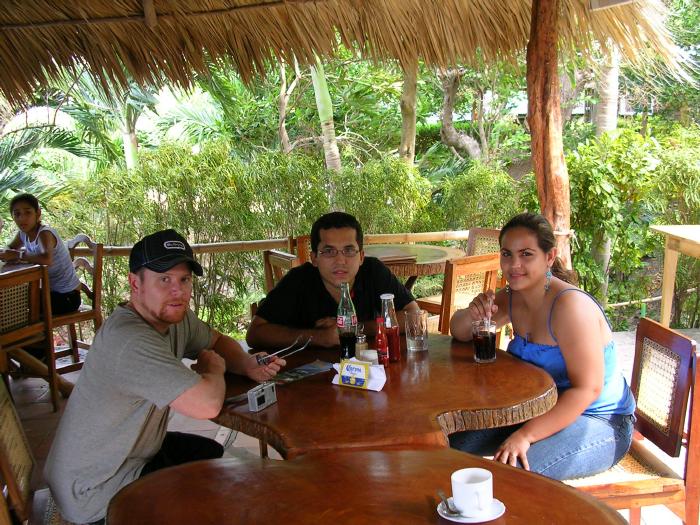
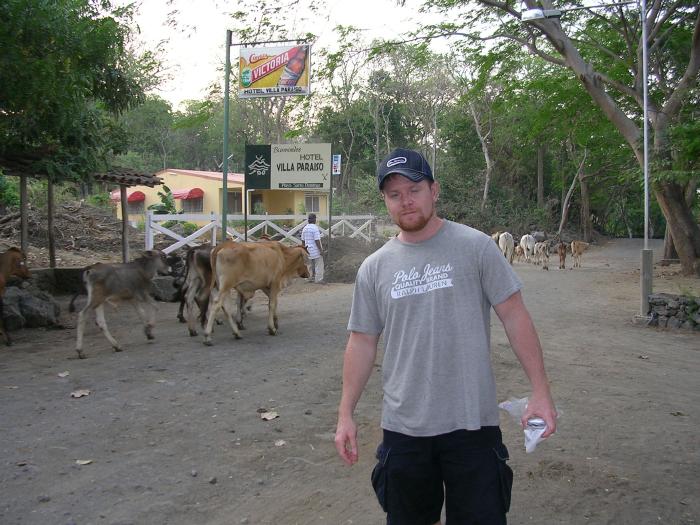
hotel. - Here are a few pictures I had taken. - Jim
Nicaragua
Nicaragua is best known not for its stunning landscapes or vast
cultural treasures, but for a war in which a popular uprising was
suppressed by a US-backed government. The after-effects of these and other
setbacks have left the country in a state of shock from which it is
gradually emerging.
The good news is that throughout this period human rights have largely
been respected and the country's battles are now confined to the political
arena. Nicaragua is a fascinating destination for those travelers who have
an awareness of history and enjoy getting to know the grass roots.
Warning
Since the end of the civil war, armed criminal groups have operated out of
the remote sectors of the northern and central regions including the North
Atlantic Autonomous Region (RAAN), particularly Bonanza and Siuna and
especially along the Honduran border. Travelers should avoid all but
essential travel and, while there, exercise caution, taking care to travel
on major highways during daylight hours only.
Full country name: Republic of Nicaragua
Area: 129,494 sq km
Population: 5.2 million
People: 69% mestizo, 17% European descent, 9% African descent, 5%
indigenous peoples
Language: English, Spanish
Religion: Roman Catholic (85%), Protestant (16%)
Government: republic
Head of State: President Enrique Bolaños
GDP: US$1.11 billion
GDP per capita: US$2,200
Inflation: 3.7%
Major Industries: Coffee, seafood, sugar, meat, bananas, food processing,
chemicals, metal products, textiles, clothing, petroleum refining and
distribution, beverages, footwear
Major Trading Partners: Canada, Japan, Germany, Venezuela, USA, the rest
of Central America
Facts for the Traveler
Visas: Citizens of the UK, USA, the Scandinavian countries, Guatemala, El
Salvador, Honduras, Argentina, Chile, Bolivia and European Union countries
do not need visas and are issued a tourist card (5.00) valid for 90 days
on arrival. Citizens of Australia, Canada, New Zealand and European
countries that do not have reciprocal agreements with Nicaragua will
require either a visa or a tourist card allowing a 30-day stay.
Health risks: cholera, dengue fever, hepatitis, malaria, rabies, typhoid
Time Zone: GMT/UTC -6
Dialling Code: 505
Electricity: 120V ,60Hz
Weights & measures: Metric
When to Go
Nicaragua has two distinct seasons, the timing of which varies from coast
to coast. The most pleasant time to visit the Pacific or central regions
is early in the dry season (December and January), when temperatures are
cooler and the foliage is still lush. With the possible exception of the
last month of the dry season (usually mid-April to mid-May) when the land
is parched and the air full of dust, there really is no bad time to visit.
Nicaraguans spend Semana Santa (Holy Week) at the beach; all available
rooms will be sold out weeks or even months in advance.
Events
Each town and city in Nicaragua has annual celebrations for its patron
saint. These celebrations (fiestas patronales) include distinctive masked
processions and mock battles involving folkloric figures satirizing the
Spanish conquistadors. The most famous of these saints' days are held in
honor of San Sebastian (20 January) and Santiago (25 July). Managua's main
patronal fete is known as Toro Guaco.
Money & Costs
Currency: Córdoba
Meals
Budget: US$1.50-4
Mid-range: US$4-8
High: US$8-12
Deluxe: US$12+
Lodging
Budget: US$3-10
Mid-range: US$10-15
High: US$15-25
Deluxe: US$25+
Comfortable travel in Nicaragua costs in the range of US$30 to US$50 a
day. A moderate budget will fall in the US$20 to US$30 a day range if you
hire a car occasionally. Budget travelers can get by on between US$15 and
US$25 a day if they confine themselves to public transport. The Caribbean
Coast is a bit more expensive than elsewhere in the country.
With the rapid expansion of the banking system, traveler's checks have
become easier to cash, but outside the capital only a handful of banks
provide this service. Casas de cambio (currency exchange offices) such as
Pinolero and Multicambios provide the service, but it's not easy to find a
bank that will do so. All over Nicaragua, many moderately priced hotels
and restaurants accept credit cards, and in some parts of the country,
even most of the cheapest places accept them. Note that Nicaraguan
córdobas cannot readily be changed in any other country.
Most Nicaraguans do not leave tips in inexpensive restaurants. In good
restaurants you could leave up to 10% of the bill. Some restaurants
include a service charge with the bill, and this is usually clearly shown.
Don't confuse a tip with the nationwide 15% value added tax that is shown
on each bill. Be certain to bargain in large outdoor markets.
Attractions
Managua
The capital of Nicaragua is spread across the southern shore of Lago de
Managua and is crowded with more than a quarter of Nicaragua's population.
It's been racked by natural disasters, including two earthquakes this
century, and since the 1972 earthquake the city has had no centre.
Several of Managua's attractions stand around the Plaza de la República,
including the lakeside municipal cathedral. Near the cathedral is the
impressively restored Palacio Nacional, which has two giant paintings of
Augusto Sandino and Carlos Fonseca at the entrance.
Around Managua
The large volcano at the centre of Parque Nacional Volcán Masaya, which
still steams and belches, is surrounded by smaller volcanoes and thermal
springs. Legends say that the pre-Hispanic inhabitants of the area threw
young women into the boiling lava to appease Chaciutique, the goddess of
fire.
While the Spanish believed it was the entrance to hell, there are some
heavenly bodies of water. Laguna de Xiloá, a stunning crater lake
northwest of the city is a favorite swimming spot. El Trapiche, to the
southeast, has spring water channeled into large outdoor pools surrounded
by lush gardens.
Granada
Granada, nicknamed 'La Gran Sultana'(The Great Sultan) in reference to its
Moorish namesake in Spain, is Nicaragua's oldest Spanish city. Founded in
1524 by conquistadors, it rumps up against the imposing Volcán Mombacho on
the the northwest shore of Lake Nicaragua.
With its access to the Caribbean Sea via the lake and the Río San Juan,
Granada has always been a main trade centre. Today the town is relatively
quiet and a major literary centre, and retains its colonial character.
It's a wonderful walking city, with the cathedral and Parque Colón near
the plaza.
León
León is traditionally the most liberal of Nicaragua's cities and remains
the radical and intellectual centre of the country. Monuments to the
revolution, including bold Sandinista murals, are dotted all over town,
and many buildings are riddled with bullet holes.
Though scarred by earthquakes and war, the city is resplendent with many
fine colonial churches and official buildings. Its streets are lined with
old Spanish-style houses that have white adobe walls, red-tiled roofs,
thick wooden doors and cool garden patios.
The Caribbean Coast (Nicaragua)
Unlike the rest of Nicaragua, the Caribbean coast was never colonised: it
remained a British protectorate until the late 1800s. The only part of the
rainforest-covered coast usually visited by travellers is Bluefields, but
some visitors also head out to the Corn Islands (Islas del Maíz).
The journey from Managua to Bluefields involves a five-hour boat trip down
the Río Escondido. Bluefields' mix of ethnic groups makes it an
interesting place, and the people here definitely like to have a good
time; there are several reggae clubs and plenty of dancing on the
weekends.
Off the Beaten Track
Archipiélago de Solentiname
The Archipiélago de Solentiname is the site of a communal society
established for artists by the poet Ernesto Cardenal, known for a school
of colorful primitivist painting. They are a great place for hiking,
fishing and taking it easy. Boats to the Solentiname islands depart from
San Carlos.
Corn Islands
The Corn Islands (Islas de Maíz), off the coast east of Bluefields, are
made up of two small islands. Like other islands near the Caribbean coast,
they were once a haven for buccaneers. A submerged Spanish Galleon wreck
that awaits exploration will help you cast your imagination back to those
days.
Nowadays, life moves at an unhurried pace on the islands. With clear
turquoise water, white sandy beaches, excellent fishing, and fantastic
coral reefs for snorkelling and diving, the islands (especially the larger
one) are unsuprisingly popular holiday spots.
Las Isletas
Las Isletas is a group of 356 small islands just offshore from Granada in
Lago de Nicaragua. Local life revolves around fishing and growing tropical
fruits, and there is a remarkable variety of birds. One island is San
Pablo, which has a small 18th-century Spanish fortress built to fend off
pirates.
Isla Zapatera is a protected national park and although it's one most
important archaeological areas, its pre-Columbian statues have been moved
elsewhere. You can visit other ancient tombs and structures here, and
there are more tombs and some rock carvings on Isla El Muerto (Island of
the Dead).
Activities
The Selva Negra (Black Forest) near Matagalpa, the mountains in the north
and the islands in Lago de Nicaragua offer great hiking. Among the many
spectacular volcanoes of interest for climbers are Volcán Masaya and the
two volcanoes on Isla de Ometepe, Madera and Concepción. Lago de Nicaragua
offers fantastic opportunities for fishing, and surfing is popular at
Poneloya beach, near León, and at Playa Popoyo, near Rivas.
Nicaragua History
The earliest traces of human habitation in Nicaragua are the
10,000-year-old footprints of the Acahualinca - prints preserved under
layers of volcanic ash of people and animals running toward Lago de
Managua. Around the 10th century AD, indigenous people from Mexico
migrated to Nicaragua's Pacific lowlands, and Aztec culture was adopted by
many indigenous groups when Aztecs moved south during the 15th century to
establish a trading colony.
The first contact with Europeans came in 1502, when Columbus sailed down
the Caribbean coast. In 1522, a Spanish exploratory mission reached the
southern shores of Lago de Nicaragua. A few years later the Spanish
colonised the region and founded the cities of Granada and León, subduing
local tribes. The inhabitants of the heavily populated area around Managua
put up a fierce resistance to the Spanish invaders, and their city was
destroyed.
Nicaragua gained independence from Spain in 1821, along with the rest of
Central America. It was part of Mexico for a brief time, then part of the
Central American Federation, and finally achieved complete independence in
1838. Soon after, Britain and the USA both became extremely interested in
Nicaragua and the strategically important Río San Juan navigable passage
from Lago de Nicaragua to the Caribbean. In 1848, the British seized the
port at the mouth of the Río San Juan on the Caribbean coast and renamed
it Greytown. This became a major transit point for hordes of hopefuls
looking for the quickest route to Californian gold.
In 1855, the liberals of León invited William Walker, a military
adventurer intent on taking over Latin American territory, to help seize
power from the conservatives based in Granada. Walker and his band of
mercenaries took Granada easily and he proclaimed himself president of
Nicaragua. He was soon booted out of the country (one of his first moves
was to institutionalise slavery) but showed almost absurd tenacity as he
repeatedly tried to invade; his efforts set a precedent for continued US
interference in Nicaragua's affairs.
In 1934, General Somoza, head of the US-trained National Guard, engineered
the assassination of liberal opposition rebel Augusto C Sandino and, after
fraudulent elections, became president in 1937. Somoza ruled Nicaragua as
a dictator for the next 20 years, amassing huge personal wealth and
landholdings the size of El Salvador. Although General Somoza was shot
dead in 1956, his sons upheld the reign of the Somoza dynasty until 1979.
Widespread opposition to the regime had been present for a long time, but
it was the devasting earthquake of 1972, and more specifically the way
that international aid poured into the pockets of the Somozas while
thousands of people suffered and died, that caused opposition to spread
among all classes of Nicaraguans. Two groups were set up to counter the
regime: the FSLN (Frente Sandinista de Liberacíon Nacional, also known as
the Sandinistas) and the UDEL, led by Pedro Joaquín Chamorro, publisher of
La Prensa, the newspaper critical of the dictatorship.
When Chamorro was assassinated in 1978 the people erupted in violence and
declared a general strike. The revolt spread and former moderates joined
with the FSLN to overthrow the Somoza regime. The Sandinistas marched
victoriously into Managua on July 19, 1979. They inherited a
poverty-stricken country with high rates of homelessness and illiteracy
and insufficient health care. The new government nationalised the lands of
the Somozas and established farming cooperatives. They waged a massive
education campaign that reduced illiteracy from 50% to 13%, and introduced
an immunisation program that eliminated polio and reduced infant mortality
to a third of the rate it had been before the revolution.
It wasn't long before the country encountered serious problems from its
'good neighbour' to the north. The US government, which had supported the
Somozas until the end, was alarmed that the Nicaraguans were setting a
dangerous example to the region. A successful popular revolution was not
what the US government wanted. Three months after Ronald Reagan took
office in 1981, the USA announced that it was suspending aid to Nicaragua
and allocating 10000000.00 for the organisation of counter-revolutionary
groups known as Contras. The Sandinistas responded by using much of the
nation's resources to defend themselves against the US-funded insurgency.
In 1984, elections were held in which Daniel Ortega, the leader of the
Sandinistas, won 63% of the vote, but the USA continued its attacks on
Nicaragua. In 1985, the USA imposed a trade embargo that lasted five years
and strangled Nicaragua's economy. By this time it was widely known that
the USA was funding the Contras, often covertly through the CIA, and
Congress passed a number of bills that called for an end to the funding.
US support for the Contras continued secretly until the Iran Contra Affair
revealed that the CIA had illegally sold weapons to Iran at inflated
prices, and used the profits to fund the Contras.
In 1990, Nicaraguans went to the polls and elected Violeta Chamorro,
leader of the opposition UNO and widow of the martyred journalist Pedro
Chamorro. Chamorro's failure to revive the economy, and her increasing
reliance on Sandinista support, led to US threats to withhold aid, but the
civil war was over, democracy installed and economic reform underway.
Daniel Ortega ran for president in October 1996 as a centrist, but he was
defeated by the anticommunist Liberal Alliance candidate Arnoldo Alemán,
who was sworn in January 10, 1997.
In November of 1998, Hurricane Mitch hit the Atlantic coast of Central
America, washing out roads and destroying buildings and bridges throughout
the region. In Nicaragua, heavy rains following in the wake of the storm
set off a mudslide at Volcán Casita that buried several villages. Over
10,000 people died as a result of the hurricane, one of the worst this
century. The tragedy prompted several nations to cancel Nicaragua's debt
in late 1999.
The 2000 mayoral elections saw the Sandinistas do well, but Liberal Party
candidate Enrique Bolaños won the presidential election in 2001, beating
his Sandinista opponent, former president Ortega. Not giving up on Ortega
yet, the Sandinistas renamed him as the party's leader in March 2002.
Bolaños took office pledging to clean up the country's corrupt government,
a policy which many viewed as being at odds with his party. Bolaños took
an aggressive stance and in spite of rifts he created, convinced the
assembly to strip former President Alemán of his diplomatic immunity.
Alemán was subsequently charged with money-laundering and embezzlement,
and was sentenced to 20 years in jail in 2003. When the World Bank wrote
off four-fifths of the country's debt in January 2004 the president
declared it was the best news for Nicaragua in a quarter-century; six
months later Russia cancelled debts stretching back to the Soviet era.
Culture
Earthquakes and war have obliterated much tangible evidence of Nicaragua's
cultural heritage, especially its colonial architecture - although León
retains many fine old buildings. Poetry is one of Nicaragua's most beloved
arts, and no other Central American country can match its literary output.
Rubén Darío (1867-1916) is known as the 'Prince of Spanish-American
literature,' and recent work by Nicaraguan poets, fiction writers and
essayists can be found in most bookshops. Bluefields, the largely
English-speaking town on the Caribbean coast, is a center for reggae
music. The Archipiélago de Solentiname in Lago de Nicaragua is famous as a
haven for artists, poets and craftspeople. Sandinista street art in the
form of modernist murals is especially prominent in the university town of
León.
Spanish is the language of Nicaragua, but English and a number of
indigenous languages are spoken on the Caribbean coast. The main religion
is Catholicism, although there are a number of Protestant sects such as
the Pentecostals and the Baptists. The Moravian church, introduced by
British missionaries, is important on the Caribbean coast.
A typical meal in Nicaragua consists of eggs or meat, beans and rice,
salad (cabbage and tomatoes), tortillas and fruit in season. Most common
of all Nicaraguan foods is gallo pinto, a blend of rice and beans, with
cooking water from the beans added to color the rice. Other traditional
dishes include bajo, a mix of beef, green and ripe plantains and yucca
(cassava), and vigorón, yucca served with fried pork skins and coleslaw.
Street vendors sell interesting drinks such as tiste, made from cacao and
corn, and posol con leche, a corn-and-milk drink. Nicaragua boasts the
best beer and rum in Central America.
Environment
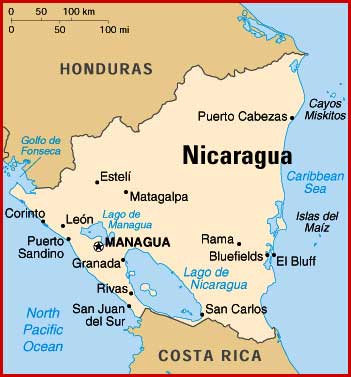
Nicaragua is the largest country in Central America. It's bordered to the
north by Honduras, to the south by Costa Rica, to the east by the
Caribbean Sea and to the west by the Pacific Ocean. The country has three
distinct geographic regions: the Pacific lowlands, the north-central
mountains and the Caribbean lowlands, also called the Mosquito Coast or
Mosquitía. The fertile Pacific lowlands are interrupted by about 40
volcanoes, and dominated by Lago de Nicaragua, which is the largest lake
in Central America. The Mosquito Coast is a sparsely populated rainforest
area and the outlet for many of the large rivers originating in the
central mountains. To date, 17% of the country has been given
national-park status.
Lago de Nicaragua supports unusual fish, including the world's only
freshwater sharks, as well as a huge variety of bird life. The cloud- and
rainforests in the northwest contain abundant wildlife including ocelots,
warthogs, pumas, jaguars, sloths and spider monkeys. Avian life in the
forests is particularly rich: the cinnamon hummingbird, ruddy woodpecker,
stripe-breasted wren, elegant trogon, shining hawk and even the quetzal,
the holy bird of the Maya, can all be seen. The jungles on the Caribbean
coast contain trees that grow up to almost 200ft (60m) high and are home
to boas, anacondas, jaguars, deer and howler monkeys.
Nicaragua was devastated by Hurricane Mitch in November 1998, when more
than a year's worth of rain fell in in just seven days. A series of
violent earthquakes and volcanic eruptions in the fall of 1999 didn't help
the situation much.
Further Reading
Fire from the Mountain: The Making of a Sandinista by Omar Cabezas is a
classic account of the Sandinista guerrilla experience.
Nicaragua: Revolution in the Family by Shirley Christian is a historical
narrative of the 1979 revolution by the leading US journalist on the
ground at the time.
The Jaguar Smiles: A Nicaraguan Journey by Salman Rushdie is a short
travelogue assessing the Nicaraguan revolution. The book is limited by the
briefness of Rushdie's visit.
Death, Dreams and Dancing in Nicaragua by Australian journalist Penny
O'Donnell is an entertaining account of the establishing of public radio
stations Sandinista-style during the revolution.
So Far From God by Patrick Marnham is an unflinching and lucid appraisal
of Central America, its Spanish legacy, its current problems and its
troubled relationship with the USA.
PJ O'Rourke takes a rather more light-hearted approach in Holidays in
Hell.
Poets of Nicaragua, edited by Stephen White, is a useful bilingual
anthology.
CLICK HERE TO VIEW SLIDESHOW ON WEBSHOTS
VISIT LONELY PLANET - NICARAGUA
VIEW LONELY PLANET SLIDESHOW
http://www.nicaragua.com/
US Wars and Conflicts 1950's to 1990's
|
