|
In office |
|
|
Vice President(s) |
Musa Hitam (1981 - 1986), Ghafar Baba (1986 - 1993), Anwar Ibrahim (1993 - 1998), Abdullah Ahmad Badawi (1998 - 2003) |
|
Preceded by |
|
|
Succeeded by |
|
|
|
|
|
Born |
|
|
Political party |
|
|
Spouse |
|
|
Religion |
|
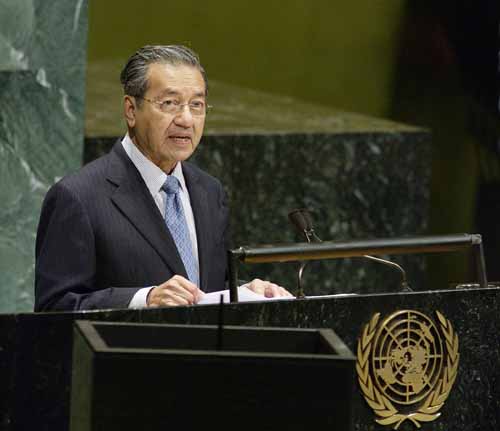
Tun Dr. Mahathir Mohamad (born July 10, 1925) is the former Prime Minister of Malaysia. He held the post from 1981 to 2003. During his term in office he was credited for engineering Malaysia's rapid modernization and the resulting growth of prosperity. Another of Mahathir's central issues is the promotion of "Asian values". He is also widely perceived to have widely encourage cronyism in government.
Although his formal title is "Yang Amat Berbahagia Tun Dr. Mahathir bin Mohamad", Mahathir is fondly called "Dr. M" by his supporters, an appellation also used by the media.
Early life and career
Born in Alor Setar, the capital of the northern state of Kedah, Mahathir said in his autobiography that he had Indian ancestry (from his father), with its origins tracing back to Tamil Nadu/Kerela border in India, while his mother was a Kedah-born Malay. Mahathir, however, considers himself to be a "full Malay", in line with Article 160 of the Constitution. Under Article 153 of the Constitution, Malays are granted particular rights not available to other citizens.
During World War II, he sold pisang goreng (banana fritters) to supplement his family income in the Japanese occupation of Malaya.
Mahathir first attended a Malay vernacular school before continuing his education at the Sultan Abdul Hamid College in Alor Star. Mahathir then attended the King Edward VII Medical College in Singapore, where he edited a medical student magazine called The Cauldron; he also contributed to the The Straits Times newspaper anonymously under the nickname "Che Det". Mahathir was also President of the Muslim Society in the college In 1953, Mahathir entered the then Malayan government service as a medical officer upon graduation. left the government service in 1957 to set up his own practice in Alor Star.
Mahathir rejoined UMNO on 7 March 1972, and was appointed as Senator in 1973. Mahathir became the Prime Minister of Malaysia on 10 July 1981 when Tun Hussein Onn stepped down due to health reasons. After 22 years in office, Mahathir retired on October 31, 2003, making him one of Asia's longest-serving political leaders. Upon his retirement on 31 October 2003, Mahathir was awarded a "Tun"-ship, Malaysia's highest civilian honour.
Economic policies
During his term in office, Mahathir turned Malaysia into a regional high-tech manufacturing, financial, and telecommunications hub through his economic policies based on corporate nationalism, known as the various "Malaysia Plans" which set out the government middle-term objectives. These policies with strong Keynesian tendency remained in effect almost to the end of his tenure in office.
His pet projects have included Perwaja Steel, an attempt to emulate South Korea and Japan, the Proton car company, and Astro, a satellite television service.
Mahathir is credited with spearheading the phenomenal growth of the Malaysian economy, now one of the largest and most powerful in South East Asia. Growth between 1988 and 1997 averaged over ten percent and living standards rose twentyfold, with poverty almost eradicated and social indicators such as literacy levels and infant mortality rates becoming on par with developed countries.
During this period, Mahathir embarked on various large scale national projects, such as:
· the North-South Highway, which has cut transport times in half on the west coast of Malaysia;
· the Multimedia Super Corridor, a flagship project based on Silicon Valley designed to enable Malaysia's foray into information technology (it includes Malaysia's new administrative capital Putrajaya);
· the glittering Kuala Lumpur International Airport (KLIA) in Sepang, and an adjacent Formula One circuit;
· the Bakun Dam, meant to supply all of the electricity needs of the East Malaysian states of Sabah and Sarawak and which has enough capacity to enable exportation of power to Brunei. The project has since run into various difficulties and controversies, leading to at first, its cancellation and then its revival as a greatly scaled down project.
· Olympic-class stadium in Bukit Jalil; and
· the Petronas Twin Towers, the tallest twin towers in the world, and the world's tallest building from 1997 to 2003, that have become symbolic of modern Malaysia.
Speculation work under Mahathir Administration
· 1981, 1982 - Involve in the international tin venture. The whole practice has account Malaysia to losses amount to 209 million ringgit, or $80 millions dollar(1982 exchange rates) [2]
· 1990 - Bank Negara Malaysia(BNM) pound sterling speculation. Estimated losses is close to US$4 Billions[3]
· In 1993, BNM lost $2.2 billion in speculative trading, according to Millman (p.229)
· In 1994, BNM became technically insolvent and was bailed out by the Malaysian Finance Ministry (Millman, p. 229)
Educational system
In 1975, Mahathir was appointed Minister of Education. He had always believed in the need for "education for the masses", with greater emphasis on maths and science, at high school level, in order to achieve his dream of a developed Malaysia.
· The University of Nottingham in Malaysia (in partnership with the University of Nottingham, UK)
· Malaysia University of Science and Technology - MUST (in partnership with MIT (USA) and Motorola)
· Monash University Malaysia (in partnership with Monash University, Australia)
· Curtin University of Technology, Sarawak Campus (in partnership with Curtin University of Technology, Australia)
Private companies with a long running history in Malaysia like Intel and AMD were also encouraged to set up, and run partnerships and/or higher education centres and centres of excellence.
Foreign relations
During Mahathir's tenure in office, Malaysia's relationship with the West was turbulent. Early during his tenure, a small disagreement with the United Kingdom over university tuition fees sparked off a boycott of all British goods led by Mahathir, in what became known as the "Buy British Last" campaign. It also led to a search for development models in Asia, most notably Japan. This was the beginning of his famous "Look East Policy". Although the dispute was later resolved by Prime Minister Margaret Thatcher, Mahathir continued to emphasize Asian development models over contemporary Western ones. Although Mahathir has managed to find solutions to many problems in Malaysia, ironically, he has managed to create more problems diplomatically, as seen with a great number of countries. These problems are usually small ones which crop up from personal matters, yet Mahathir always brings the Malaysian government into play, such as the imposition of boycotts.Mahathir has always been an outspoken critic of the United States but yet the United States was the biggest source of foreign investment, and was Malaysia's biggest customer during Mahathir's rule. Furthermore, Malaysian military officers continued to train in the US under the International Military Education and Training (IMET) program.
Retirement
In 2002, a tearful Mahathir announced his resignation to a surprised UMNO General Assembly. He was persuaded to stay on for a further eighteen months, in a carefully planned handover that ended in October 2003. On his retirement, he was granted Malaysia's highest honour, which entitles him to the title Tun from his original Datuk Seri. Since retirement, he has been serving as an advisor to the Malaysian national oil company Petronas and the Malaysian national car company Proton, an original core national project initiated by Mahathir during his premiership.
Chronology
· 1975: Became one of the three vice-presidents of UMNO, after winning the seat by 47 votes.
· 1976: Elected as Deputy President of UMNO on March 5.
· 1978: Appointed Deputy Prime Minister by the then Prime Minister, Tun Hussein Onn on September 15;
· 1981:
o July 16: Appointed or sworn in as Prime Minister of Malaysia at the age of 56 at Istana Negara, when Tun Hussein Onn stepped down for health reasons;
o July 18: Dr Mahathir announced his new Cabinet, naming Tun Musa Hitam as his deputy. It was the largest Cabinet the country has ever held. Plus, he concurrently took charge of the Ministry of Defence (July 18, 1981 - May 6, 1986);
o July 31: Ban on Dr Mahathir's book "The Malay Dilemma", which was imposed in 1968, lifted. It soon became a bestseller.
o August 6: Introduction of a punch card system for senior civil servants to cut out late arrivals and early departures at government offices. Later that year, Dr Mahathir implemented measures to get ministers and civil servants to wear name tags.
o August 15: Dr Mahathir said the Auditor-General's report of 1977 was made public for the first time to let the people know how government funds were spent. Previously, all auditor reports were kept confidential.
o October 26: Dr Mahathir celebrated his 100th day in office as Prime Minister.
o December 31: Dr Mahathir standardised time by moving forward the clock by half an hour in Peninsular Malaysia to bring it in line with East Malaysia;
· 1982:
o January 3: Dr Mahathir was announced as The Star's Malaysian of the Year.
o February 8: Dr Mahathir advocated the "Look East Policy" for Malaysia to beef up work ethics and management to achieve economic success.
o April 15: Dr Mahathir promised and launched the slogans for a "Clean, Efficient and Trustworthy Government" public administration. They are "Leadership Through Example", the "Look East Policy"; "Permeation of Islamic Values", and "Buy British Last";
o June 1: Dr Mahathir announced an austerity drive to cut down on seminars and overseas trips for senior officials on account of an economic downturn in the country. The next day (i.e. June 2), he announced that he and Musa would cut their salaries by RM1,000.
o July 10: Dr Mahathir announced the proposal to set up Islamic banking in Malaysia.
o September 10: Dr Mahathir in his address at the 33rd UMNO Annual General Assembly urged Malaysians to aim for a population of 70 million within 120 years as a basis for a ready market and demand for local goods.
· 1983:
o February 19: Dr Mahathir declared a six-month war on drugs
o March 19: Dr Mahathir launched the "Leadership by Example" campaign where he urged civil servants to work 15 minutes longer each day as a "symbolic sacrifice".
· 1985:
o July 9: At 10.30am, the country's first national car Proton Saga rolled off the assembly line, witnessed by Dr Mahathir.
o October 17: Dr Mahathir's hard-hitting speeches against apartheid at the Commonwealth Heads of Government meeting in Nassau, Bahamas, won him international acclaim.
· 1987:
o May 1: Dr Mahathir expelled three ministers and four deputies from his Cabinet.
o June 17: Dr Mahathir was announced as the chairman of the International Conference on the Abuse and Trafficking of Narcotics in Vienna, Austria.
· 1989:
o January 18: Dr Mahathir was admitted to the Kuala Lumpur General Hospital after complaining of chest pains.
o January 24: Dr Mahathir underwent a successful coronary bypass operation at the Kuala Lumpur General Hospital.
· 1990:
o January 1: The official start of Visit Malaysia Year by Dr Mahathir after a colourful launch at the Dataran Merdeka.
· 1991:
o February 21: Dr Mahathir launched the establishment of UMNO in the state of Sabah.
o July 10: Dr Mahathir outlined the blueprint for Malaysia to become a caring and industrialised nation by the year 2020 in the 6th Malaysian Plan tabled in Parliament. The plan has since been known as the Vision 2020.
o July 20: Dr Mahathir spoke for the first time of the need to set up the East Asia Economic Caucus at the Asean Post-Ministerial Conference held in Kuala Lumpur. It met with stiff resistance from the United States.
o October 12: Dr Mahathir announced an 8% to 10% pay revision for civil servants under the New Remuneration System, which would come into force early next year.
· 1994:
o January 30: Dr Mahathir launched the RM15 billion Bakun Dam project in Sarawak, which would supply electricity to that state, Sabah, and Brunei. It would be linked to Peninsular Malaysia with an underwater cable. However, the project ran into objections from the environmental and the orang asli groups. .
o May 7: Dr Mahathir met Bill Clinton in Washington for the first time to set the stage for better ties between the two countries.
o August 29: Malaysia's second national car Perodua Kancil was launched and witnessed by Dr Mahathir.
· 1995:
o August 29: Dr Mahathir launched the RM20 billion Putrajaya project, one of the country's most ambitious infrastructure projects and the future administrative capital.
o October 26: A coalition of 25 ruling and Opposition parties met in the Putra World Trade Centre (PWTC) and signed a five-point resolution to condemn France's nuclear testing in South Pacific. The meeting was chaired by Dr Mahathir, who remarked that this was the first time the political parties were united and adopted a common stand.
o November 1: Mega TV, the country's first multi-channel subscription television, made its debut.
o November 25: The UMNO General Assembly unanimously adopted a "binding" motion to retain Dr Mahathir and Anwar as president and his deputy respectively until the year 1999.
· 1996:
o January 13: Malaysia's first satellite --- the Malaysia East Asia Satellite (Measat-1) was launched into orbit from the Ariane Launch Complex in Kourou, French Guyana, South America.
o August 1: Dr Mahathir announced the Multimedia Super Corridor project, a 15 km by 50 km environment for companies specialising in multimedia products and services.
o September 25: The All-Asia Satellite Television and Radio Company (Astro), Malaysia's first digital satellite television and Radio network, was launched. It offered 223 satellite TV channels and eight new radio channels.
o October 1: Malaysia's tallest telecommunications structure in Asia and also the third tallest (at that time of the official opening) in the world, the KL Tower was officially launched by Dr Mahathir. At the height of 421 metres high, it cost the nation RM300million to build.
o December 18: Dr Mahathir revealed that Microsoft Corp founder and chairman Bill Gates had accepted Malaysia's invitation to sit on the advisory panel of technological leaders to develop the MSC.
· 1997: Introduced the currency peg to resolve the 1997 Asian financial crisis on September 1.
o Completion of the 88-storey Petronas Twin Towers, the tallest twin towers in the world;
o Named as "Asia's Newsmaker of 1998" by TIME Magazine.
· 1999: Took over the Ministry of Finance on January 8;
· 2001: Took over the Ministry of Special Functions on June 5.
· 2002: Announced that Mathematics and Science subjects will be taught in English, rather than in Malay with effect from 2003;
· 2003: Retired as Prime Minister of Malaysia on October 31, after 22 years in office, making him one of Asia's longest-serving political leaders;
· 2006:
o November 9: Being warded in National Heart Institute, after suffered minor heart attack.
o Member of the International Committee for the Defence of President Saddam Hussein