You see, inasmuch as we have eliminated God to a great extent, it is just as if we were all denying the fact that we were hungry, but then we begin to eat each other; we get so hungry that a catastrophe will follow...we now think that the progress of thought and the development of the human mind is hampered by the existence of such old prejudices [religion], and we destroy those old forms because we think that we are gods and can do without them... There, of course, is the great danger of any creation: it destroys something which should not be destroyed, and out of that develop the most catastrophic consequences...
- Carl G. Jung
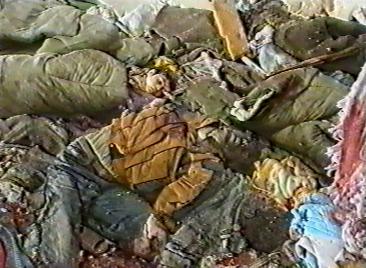 Qana Mourning Page
In the UNIFIL (United Nations International Forces Interim Lebanon) base at Qana 108 civilian refugees were killed and 351 were injured, mostly children, women and old men. [Click on the link above to read and look at the truth about Isreali policies.] It has been called the Holocaust of the year 1996 done by Israel. Unfortunately, no one in the world knows about it. Let's make another movie about the Jewish holocaust!
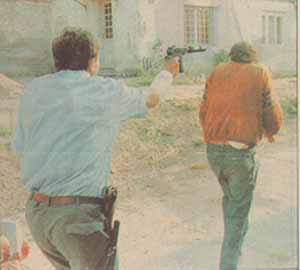
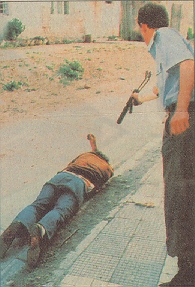
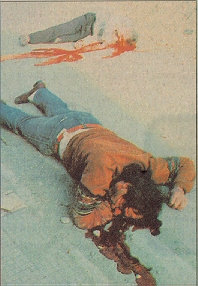
(above) A inhuman killing in Bosnia. Courtest:unkown
On the Charlie Rose Show, Sept 14, 1995, Henry Kissinger argued for what would be in effect an ethnic-partition and religious apartheid in Bosnia-Herzegovina. Kissinger urged a dividing up the country between Croatia and Serbia and, in effect, forcing the Muslims (and any Bosnians who wanted a state not based on "ethnic-cleansing") into a ghetto in the center. The basis of Kissinger's argument was his claim that "There is no Bosnian culture."
The same Kissinger-type reasoning was used by advocates of apartheid in South Africa. There was no "African culture", they said, so why not put Africans on reservations called homelands and have apartheid?
The same approach was also used during the extermination of the American Indian nations. There was no Native American Culture so why not put the American Indians on reservations or "ethncially cleanse" those who refuse to go to the reservations?
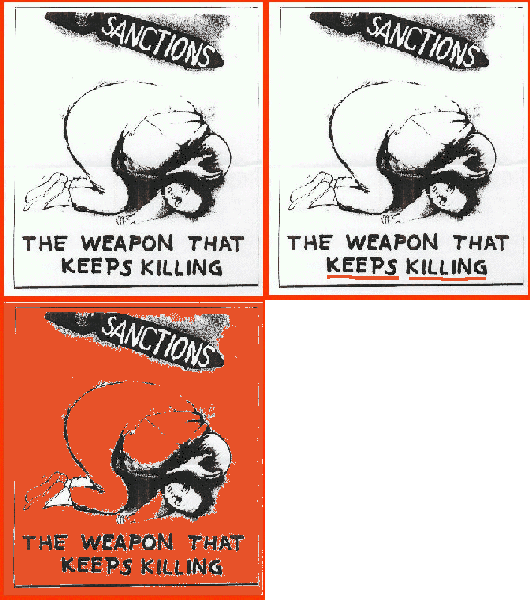 Fight against Iraqi sanctions
STOP THE IRAQI MASSACRES! Click on the image to learn about the inhuman agression against the Iraqi people.
An Untold Tragedy
I was sitting in my office in Rome when I heard the news. It was a warm afternoon, full of sunlight and promise - the kind of day when you cannot help but think how good life can be. Phones were ringing, colleagues coming and going. And there were plans to make - for another story and another foreign trip.
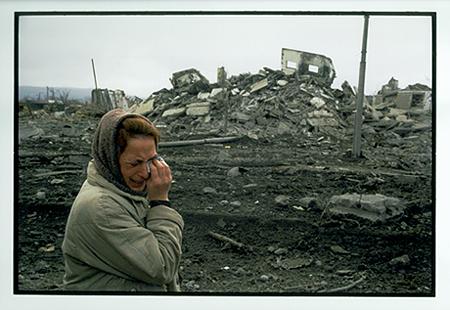
(below)Chechnya. courtesy: Eric Bouvet. Photo-essays on www.Time.com
Then my mobile rang - on the other end a familiar voice full of tears.
"I have bad news," she said. "It's Zarema. She died on Saturday. And she has already been buried."
It was Coreena, a colleague working for the Reuters news agency in Moscow. She could hardly speak.
"I feel like my own child has died," she said.
She was the one who had first seen Zarema, and she had fought since then to try to save her life.
The world moves so fast these days that we live in the moment - today's disaster is what matters, today's conflict, and today's suffering, not yesterday's. Our attention span is short. And our compassion can be shorter still.
As far as most people are concerned the war in Chechnya is over, though refugees are still fleeing at the rate of about 1,000 a week. But Russia is looking forward now - ready for a new beginning with new President-elect Vladimir Putin. These days the casualties of Chechnya hardly get a mention. Certainly Moscow has never wanted to recognize or count them. Zarema's life and needless death will pass unnoticed - except by a few.
Slow death
Her story begins in a cellar in Grozny. She and countless others had been driven below ground - like rats - when Russian forces began their assault on the city. For week after week, bombs rained down.
Zarema and her family were trapped. They were cold and hungry and desperate.
In the darkness this young girl of 16 watched her mother die of TB. She herself became ill, but the Russians would not allow her to be moved. By the time they eventually let her leave the tormented city she was barely alive. "I couldn't even lift my head up," she told me the first time we met.
Stranger in need
By then she was in hospital across the border in Ingushetia, where the local staff were doing what they could to try to save her. But Zarema was suffering terribly. It was painful for her even to speak. Every breath was an effort. All the flesh had fallen away from her arms and legs.
Her eyes were heavy and she hung her head. When we spoke, her aunt was by her bedside, stroking her hair.
"Before all this she was beautiful," she said with pride.
When we told Zarema's story in a television news report, a concerned viewer from Wales rang in. Gerard Kiley was ready to move heaven and earth for a girl he had never met. He contacted a Cardiff chest specialist, Dr Ian Campbell, who had seen the story and also wanted to help.
From Cardiff to Ingushetia, messages went back and forth, by phone, e-mail and satellite transmission. We sent Zarema's x-rays and copies of her medical notes. Dr Campbell responded with advice, and additional drugs. A chain had been established and the contacts continued for weeks.
Money and assistance were offered in the UK, but Zarema was too ill to be moved. The kind and caring chief doctor back in Ingushetia told us there was a risk she would die on the way.
We told Zarema about the efforts to help. I remember her look of surprise, and her smile.
"Please say thanks," she said.
Moments of joy
I asked Zarema about her life before the war. I wanted to know more about her interests and how she had spent her time. As soon as I asked the question I realized my own stupidity. Her life had not been about choice.
"I never had much time to myself," she said. "Then, after my mother died I had to do all the work, and look after my brother's two children."
She had never had the chance to be a normal teenage girl.
The weeks passed. Dr Campell continued to monitor Zarema's condition. At times Zarema seemed a little better, at times a little worse. When we bought her a new cardigan it wrapped around her twice.
My colleagues from the BBC's Moscow bureau saw her recently. They asked what if there was anything they could get for her. She asked for just one thing - a teddy bear. They found one almost as big as she was, which brought her great joy.
As Vladimir Putin was celebrating his victory at the polls I got word from our translator in Ingushetia, herself a Chechen refugee, that she had seen Zarema again. She said she was feeling well.
Then within days the call came to say that her struggle had ended and she had slipped away. I am haunted by the idea of this quiet gentle girl dying alone, in the lonely silence of a hospital bed.
Zarema will not be mourned in the Kremlin. Moscow is already busy sweeping the horror of its campaign in Chechnya under the carpet. It was on the back of this war that Vladimir Putin rode to victory in the presidential election. The suffering and death of one young girl counts for nothing compared to that.
But those who tried to help, in Cardiff and Moscow, have marked her passing with sorrow and tears.
By Orla Guerin 4 / 8 / 00 BBC Online
Stalin's view
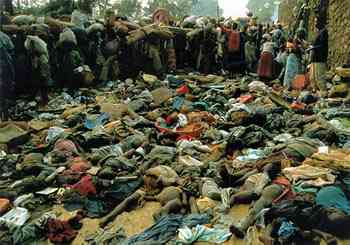
(left) Rwanda 1994
When Josef Stalin was on his deathbed he called in two likely successors, to test which one of the two had a better knack for ruling the country.
He ordered two birds to be brought in and presented one bird to each of the two candidates.
The first one grabbed the bird, but was so afraid that the bird could free himself from his grip and fly away that he squeezed his hand very hard, and when he opened his palm, the bird was dead. Seeing the disapproving look on Stalin's face and being afraid to repeat his rival's mistake, the second candidate loosened his grip so much that the bird freed himself and flew away.
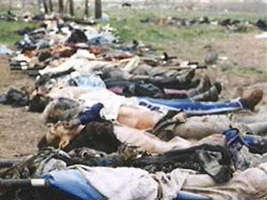
(right) Chechnya 1995-present
Stalin looked at both of them scornfully. "Bring me a bird!" he ordered.
They did.
Stalin took the bird by its legs and slowly, one by one, he plucked all the feathers from the bird's little body.
Then he opened his palm. The bird was laying there naked, shivering, and helpless.
Stalin looked at him, smiled gently and said, "You see... and he is even thankful for the human warmth coming out of my palm."
To find the solution to the turmoil encompassing the globe, 5% of which I've mentioned above, please click here:
To look at the terror children face in the world, click here:
