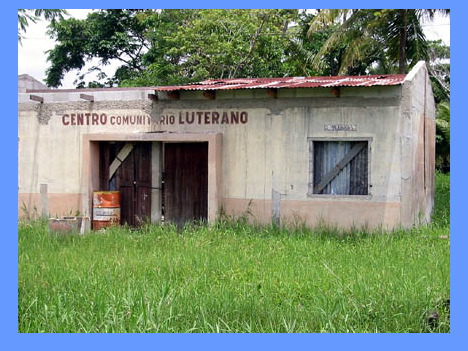
Centro Luterano
de la Iglesia
Cristo el Salvador
Lutheran Community Center of Christ the Savior
Centro Luterano
de la Iglesia
Cristo el Salvador
Lutheran
Community Center of Christ the Savior
The Rev. Byron Paz, Pastor
Turn the clock back to the early 1970's. The Lutheran church is busy leading Sunday School classes under nearby palm trees and worshipping in a newly established "Lord of the Sea" chapel. Area youth are spending evenings and weekends at the new community center. The building is filled with singing, laughing, and smiling faces.
Lutheran Missionaries Rev. Garry and Marilyn MClure were instrumental in establishing the ministry among the Garífuna. Up until then, Garífuna families walked to Cristo el Salvador Lutheran Church in another part of town. However, their parents were worried about having to walk through the port area to get to church, Sunday school classes, and other activities.
The parents told their concerns to the McClures and asked if something could be done. It was not long before a small building was bought for a chapel and later a nearby building to be the community center in the heart of the Garífuna section of town.
The Garífuna people are descendants of escaped African slaves who intermarried with Carib Indians of the West Indies. They have their own distinct language and social customs.
The center was used extensively for Sunday school classes and youth activities for several years; however, circumstances changed in the late 1980’s. Leadership faltered, attendance dropped, and the buildings fell into neglect. Eventually the chapel was dismantled and the center is all but abandoned.
A new interest in ministering among the Garífuna people arose in the late 1990’s when Lutheran Bible Translators began literacy work. Their work has included classes in the Garífuna language, translating Bible stories in Garífuna, and sponsoring Garífuna-language Vacation Bible Schools for the area children.
The Lutheran Church in Guatemala
The Germans had the first Lutheran churches in Guatemala, ministering to the numerous German colonists who came to Guatemala in the early 20th century. The Germans were a strong and influential community running their government’s lucrative coffee plantations and other businesses. During the second World War, however, Guatemala expelled most of the Germans, including their Lutheran pastors.
Following the war, a group of Guatemala Lutherans invited the Lutheran Church-Missouri Synod to establish work in the country. Three sites were chosen for ministry: Guatemala City, Zacapa, and Puerto Barrios. In Guatemala City the ministry focus was to German Guatemalans and their families. In Zacapa, it was to Spanish-speaking Ladinos.
The Lutheran ministry in Puerto Barrios began among the English-speaking community in this thriving port city. At the time it was Guatemala's only East coast port and pretty much a boom town thanks to the banana export industry. The early worshippers were Jamaican immigrants, mostly working in the banana industry. As the years passed, more Spanish-speaking people began attending the worship services. In time, there were two services, one in English and the other in Spanish. Today, worship is in Spanish, the common language of the different cultural groups.
More about the Garífuna People
The Garífuna trace their origins back to 1635, when Spanish slave ships wrecked near the island of St. Vincent. The native Arawaks gave refuge to the surviving enslaved Africans. They soon intermarried and blended their cultures. This blend became known as the Black Caribs, or the Garífuna.
The Garífuna were a constant and dangerous irritation for British colonists. Being black, but not slaves was an additional problem for the British. They feared having these free blacks living in the same islands as enslaved Africans would lead to slave revolts. Their solution was to forcibly resettle the Garífuna on the distant island of Roatan in 1797.
On Roatan the Garífuna flourished and soon spread to the mainland. From there they moved up and down the coastline, arriving as far as Belize by 1802. There are Garífuna communities in Belize, Guatemala, and Honduras. By way of naval service, there also are "transplanted" Garífuna communities in Los Angeles, New Orleans, and New York City.
The Garifuna culture has its own distinct music, dance, and story-telling. Their language is a blend of African, Carib, and French. Most practice a religion consisting of a mixture of Catholicism, African, and Indian beliefs. The largest concentration of Garîfuna in Guatemala is in the coastal port of Livingston, at the mouth of the Rio Dulce. Puerto Barrios is across the bay from Livingston.
| Photos | |||||
| Puerto Barrios area | |||||
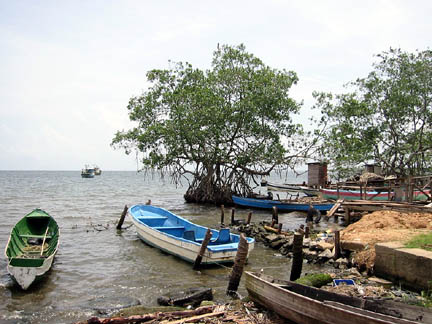
Boats |
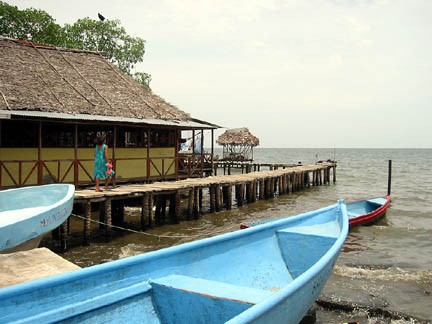
More Boats |
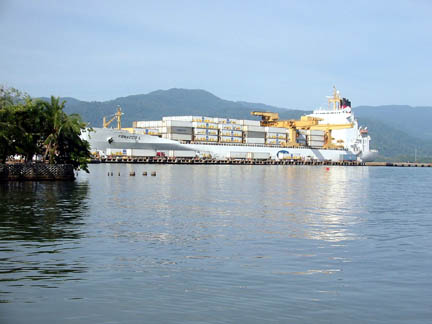
And More Boats |
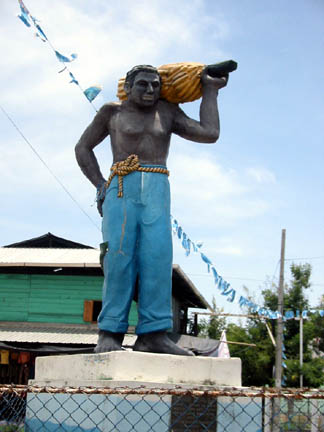
Banana Man |
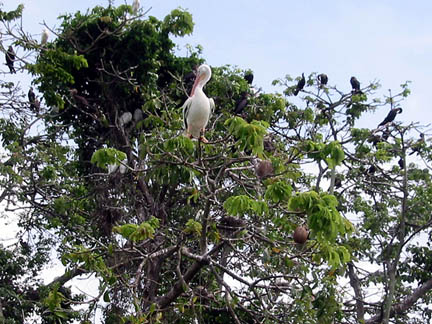
Pelican |
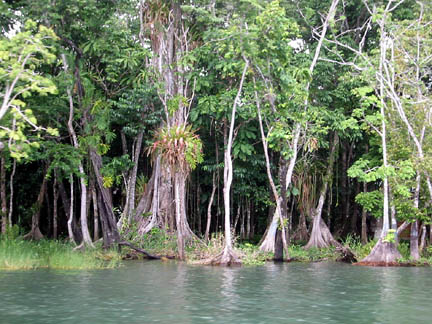
Ecology |