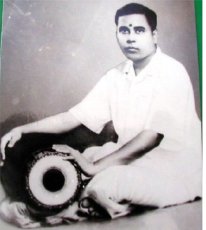
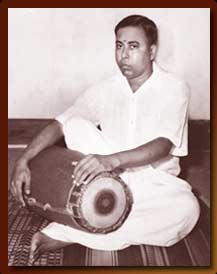
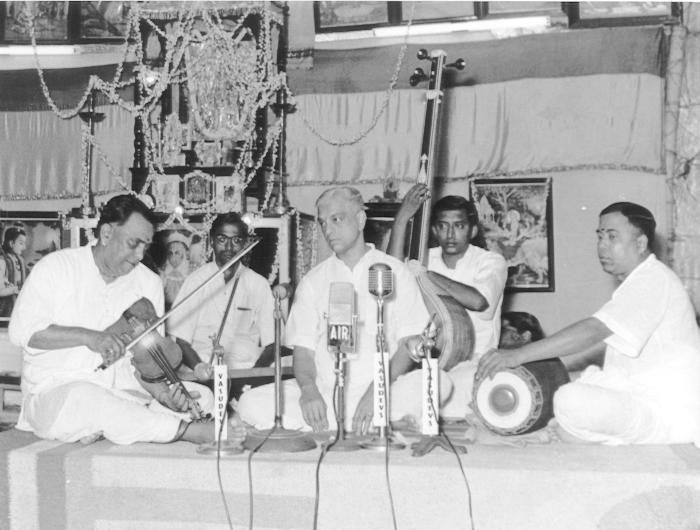
Pazhani's style had many characteristic features. Firstly, his brisk sarvalaghus, or propulsive flow patterns, were not continuous but jagged. His famed student, K.S.Kalidas, described his sarvalaghus as "amorphous" in contrast to "crystalline." Further, Pahzani's melodic accompaniment tended to highlight the in-built rhythm of the tala or beat cycle more than the rhythmic or melodic components of the song. This was in accordance with the Pudukottai school but quite contradictory to the approach of his peer Palghat Mani Iyer. Moreover, Pazhani laid an almost equal emphasis on the thoppi and valanthalai drum heads, utlizing both to the maximum. He presented highly mathematical patterns during the song as well as in his thanis, and in particular, he was famous for his chatrushram-based korvais in tisra nadai (four beat patterns presented in a three beat pulse). He originated a myriad of patterns that were considerably influenced by the tavil technique. His rich legacy has been continued by his numerous disciples, grand disciples, and various other percussionist abosrbed by his technique.