Thus far I find the class exciting, the people knowledgable and the style most effective. I would recommend this class to any serious practioner.
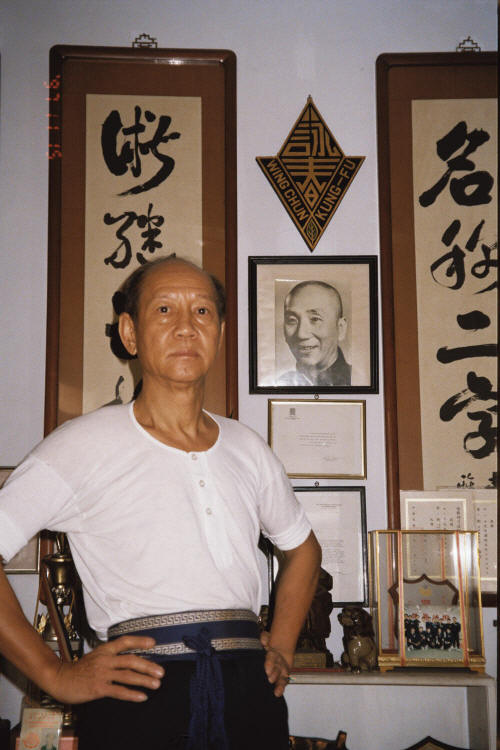
Sifu Lo Man Kam
The third student of his maternal uncle Grandmaster Yip Man, Master Lo Man Kam practiced Wing Chun for 10 years in Hong Kong, starting from 1950. Following his uncle's guidance, he moved to Taiwan in 1960 to serve in military intelligence. Recognized worldwide, Master Lo stands out as the resident authority on Wing Chun Kung Fu in Taiwan, having opened his Taipei school in 1975. Given his commitment and love of teaching Wing Chun, foreigners flock to his school to join the Chinese who study there. Over the last 30 years, he has taught over 2000 students from the United States, Canada, Panama, Brazil, the Dominican Republic, England, Germany, France, Italy, Switzerland, Romania, Denmark, Belize, Hungary, Spain, Austria, Israel, Saudi Arabia, Japan, Korea, Indonesia, the Philippines, India, Thailand, Malaysia, Singapore, New Zealand, Australia, Ireland, Mexico, South Africa, Madagascar, Taiwan, Hong Kong and Macau; totaling 35 countries and territories spanning all six major continents. He also teaches general martial arts to the Taiwan police and SWAT teams.
His teaching methods emphasize developing a solid foundation, and stress sensitivity and feeling over speed and strength.
Informal and inexpensive classes are being offered in the Oakland area, held by John Kang, a student of Lo Man Kam in Taiwan.
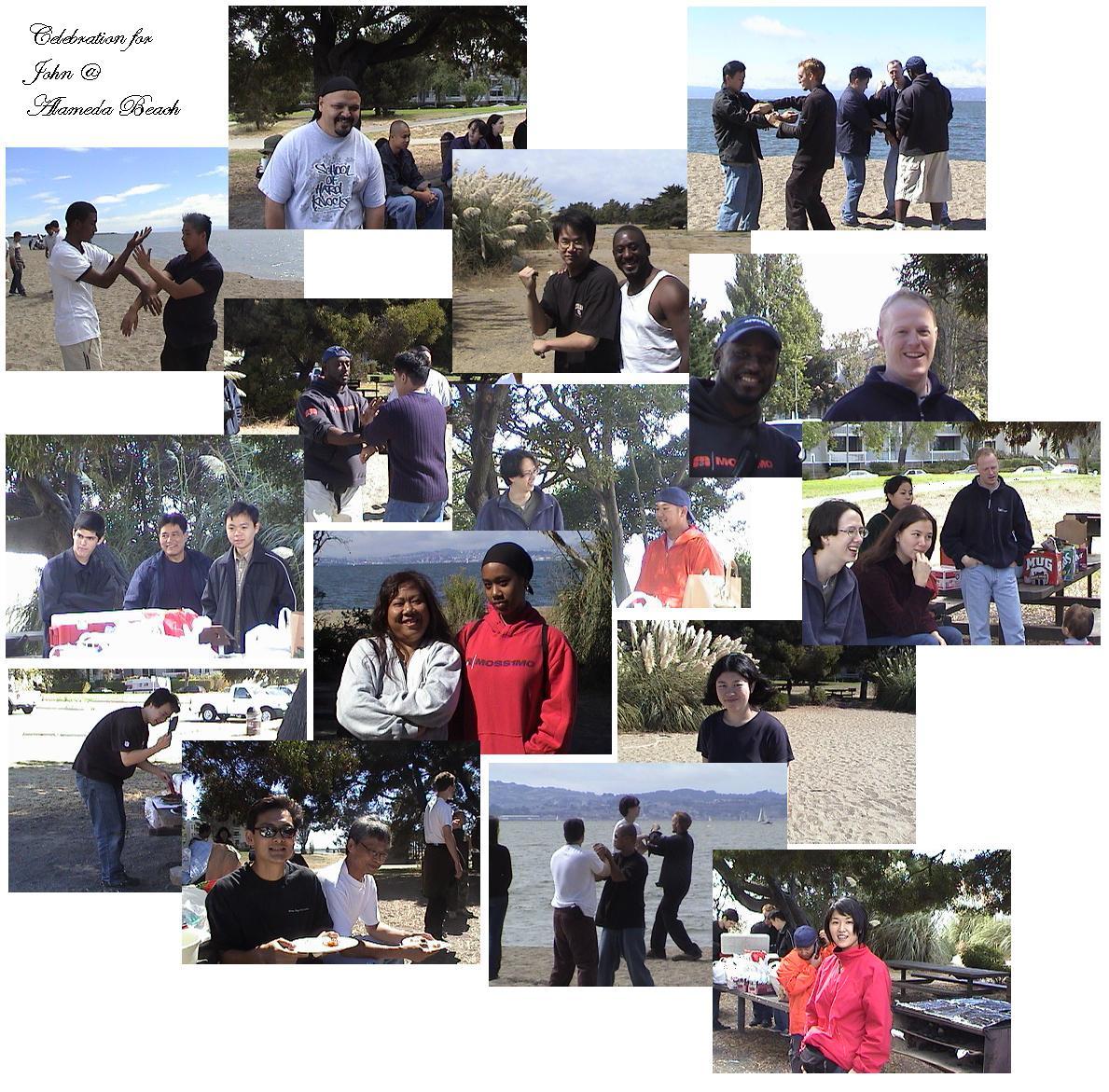
John recently earned a degree in Chinese medicine and Accupuncture and my
family and I were honored to be apart of the celebration held at Alameda beach
September 15, 2002. We were also fortunate to have Bradley and his family visit us from Las Vegas. It was a great reunion of the old and new students.
China Lo Man Kam Wing Chun
Federation, SF Bay Area
Email: [email protected]
http://www.wingchun-sf.com
Contact: John Kang
Concepts of Wing Chun
Invented by a woman, Wing Chun Kung Fu assumes that an opponent will be bigger and stronger than you. Therefore, Wing Chun emphasizes fast and strong structure over physical strength and speed. Further, instead of focusing on individual techniques (though these need to be practiced), Wing Chun is more concerned with following principles that work at all ranges of combat in varying situations. Many can be also applied to everyday life.
Center line
Passing from the top of the head to the base of the groin, the center line serves as the foundation of Wing Chun combat theory. Given the number of vital points along that line, the practitioner must concentrate on attacking his opponent's center line while defending his own. An awareness of the center line is developed in all stages of training.
Economy of motion
Rather than waste energy on flashy techniques with fancier names, Wing Chun embraces simplicity and efficiency. In all aspects of training, the student seeks the simplest and most cost-effective way to attack his opponent's center line.
Covering instead of Blocking
While many martial arts teach a student to block against specific attacks, the Wing Chun exponent learns to cover his open areas through body positioning and hand movements. Although you may not know what attack your opponent will launch, you can position yourself in a way to limit his choices, and move your hands to stop whatever comes in. Instead of answering A, B, or C to a multiple choice question which has not yet been asked, the practitioner is choosing D, "all of the above."
Simultaneous Attack and Defense
Wing Chun focuses on combining a defensive movement with an offensive movement, or using offensive techniques that provide defense. In this way, Wing Chun is structurally faster that those styles that teach one to defend first, then attack. Drills and sticky hands help the student improve this skill.
Contact Reflexes
The hand is truly faster than the eye. Further, your eyes can deceive you. In Wing Chun, the student develops tactile sensitivity in the arms, allowing him to feel his opponent's openings and sense oncoming attacks. Thus, upon arm contact with an adversary (forming what is known as a bridge), the Wing Chun exponent can react immediately to any move his rival makes-- instead of first perceiving the movement, ascertaining what it is, deciding upon a reaction, and finally moving. Contact reflexes are developed through constant sticky hands practice.
Trapping
Sifu Lo Man Kam says, "Hitting someone is easy. Not getting hit is hard." A Wing Chun practitioner is sometimes able to control both of his opponent's hands with just one of his own, leaving a free hand to attack. This particular technique is known as a trap. Sticky hands is the best way to refine trapping skills.
Sticky Hands
The jewel of the Wing Chun system, sticky hands practice teaches the student to integrate Wing Chun's fundamental movements and combat principles into a functional whole. Through sticky hands, also called "chi sao," one learns to react quickly and naturally to the ever-changing conditions of a fight.
Body Alignment and Linkage
In order to transfer power, the Wing Chun practitioner must be able to align her body correctly so that an optimal amount of force is conducted from her center into her opponent. Correct practice and pondering of the forms helps develop this sense of structure. Correspondingly, while the practioner will want to "link" her body correctly to hit with his maximum potential force, she will also want to be able to "unlink" as well, so that an opponent will not be able to affect her center of gravity. This concept of linking and unlinking can be developed through sticky hands practice and working the wing chun wooden dummy.
Kicks, footwork, and body unity
The higher one kicks, the less stable his stance becomes. Wing Chun as taught by Sifu Lo Man Kam never kicks above the abdomen, and usually targets the opponent's knees or ankles. Further, they are integrated with hand techniques so as to increase power through total body unity.
Flexibility and unlimited application
Through sticky hands and associated drills, Wing Chun becomes tailored to the student as an individual, taking into account physical abilities and limitations, as well as mindset. He learns how to apply a relatively small number of techniques to a wide variety of combat situations, while maintaining an open mind so as to be ready to change if the need arises.
Wing Chun Forms
Wing Chun as taught by Grandmaster Yip Man has three empty-hand forms, a wooden dummy form, and two weapons form. Integrated into drills and sticky hands practice, the motions of the forms form to basis of an effective repertoire of self-defense skills.
Siu Nin Tao, "Little Idea"
The foundation upon which an individual's Wing Chun skills are built upon, the first form contains many of the hand motions found in the Wing Chun system. 108 movements are executed from the training stance (or "horse", with no turning of the waist or horse. In this way, the student learns to maintain relaxation, and execute quick, springy punches.
Chum Kiu, "Searching for the Bridge"
The second form teaches the turning of the horse to change angles, adjust facing, and increase punching power. Its name refers to the fact that it contains techniques to create a "bridge," or arm contact with an opponent from which one can apply sticky hands skills. It further introduces two kicks and side-horse stepping.
Biu Jee, "Flying Fingers"
The final empty-hand form, Biu Jee, was once passed on to only the closest of students. It appears to be a straight forward, energetic form; yet, beneath the surface, one learns subtle skills such as releasing potential energy in the joints ("short power"), opposing pulling-pushing forces, and "bridge borrowing."
Wooden Dummy Form
Although a student will start using the dummy early in training to toughen forearms and practice hand positions, there is also a set routine of 108 movements. The form includes many side-stepping techniques and low kicks, as well as several other subtleties of the style.
Weapons
Two weapons sets, the "Six and a Half Pole" form, and the "Eight Cutting Knives" form, complement the unarmed skills of Wing Chun. Embodying the same principles and basic techniques, the weapons become an extension of the hands. While weapons skills were a quite important aspect of self-defense in the past, in modern times, the training of these two weapons sets can help the Wing Chun practitioner improve his empty-hand skills.