
Solo Runs
First we will start with  Night Runs….
Night time is the right time to start pups on bunnies in the wild. All the previous training efforts were all just to get your young hound ready for their first solo run. At night you, your light and your pup will find more bunnies out and about. The abundance of night time rabbits along with the damp moist air should give our young trainee lots of opportunity to smell, trail, jump and run Mr. Bunny.
Advantages of Solo Runs at Night.
1: Running solo teaches our young
hounds independence.
2: One hound is easier to control
and direct in the dark.
3: While our hounds can see well
enough to follow their nose in the dark, they
may not see
or be distracted by a bird, butterfly or leaf floating in the wind.
4: Best reason, rabbits are out
and easier to locate at night.
How It Is Done.
Just after dark, I take my head
light, spot light and a puppy and go looking for a bunny. I keep
the pup on a short lease as we explore the grass patches and lanes looking
for a rabbit to run. When we have the good fortune to find a long
eared, fur bearing, flat footed varmint it is time to play.
I walk the pup over the location where the bunny was feeding and hope for some action. If all goes well you will get some reaction. It could be just a little excited waging and smelling around or maybe more. I release the pup and encourage it to hunt. This young trainee may trail after the bunny for a short distance then return or maybe more. They may whimper, whine and open on their first bunny in the wild.
Chances are the first few times out with a young (five or six month old) pup they may not respond. This means that you will need to keep taking them until they get the idea. Some pups will need to go many times before the lights come on and they get started as a rabbit running hound.
Finally the day will come. You will shine a bunny and your pup will get busy. The first time a pup trails up and opens on a bunny will be a moment to remember. There can only be one first time. Chances are you will grow a big smile all over your face.
The very first time a puppy opens and runs a bunny may only result in a short run with just a few barks. This short run and the sound of your pup’s voice will keep you bragging for days.
Yooooa yooooa yooowa……..


After a few more nights out your pup’s ability to jump and run bunnies should improve. Soon that rabbit running pup will be able to jump, run and push a bunny for more than a few minutes.
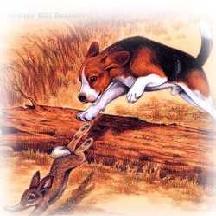
When your young trainee progresses and can keep a bunny up and moving for five minutes or more it will be time to join in the race. With a little luck and lots of clear trails in your training area you should be able to get ahead of the pup. You need to stop the pup and pick it up while still in hot pursuit. Give that fine rabbit running pup lots of praise. Leash the pup and then go look for the next night time bunny. On a good night you may be able to find two or more rabbits for your pup to run.
After several very short races you will want to pick up the pup and call it a night. The object is to never let the pup experience a loose and to stop while the pup is all excited and wanting more. If this is done right, the next time you go back to take the pup out to look for bunnies this young upstart will be rearing to go.
After however many nights that it takes your pup will take a bunny for a long run and you will just set back and enjoy the sound of your hound. After several long runs you will celebrate your pup’s first time to circle a bunny. You are sure to laugh out loud, dance a jig and sing out, “Yaber Daber Daber Do” “Hot Digity Dog” or some such sound of jubilation.
After a number of productive night time runs, your pup will be ready for the challenge of a day time run.
It is now time to run some
Day Time Bunnies.
Daytime runs will present a whole other list of challenges and adventures. Finding daytime bunnies will be your first challenge. Up to this point you have been placing your pup on top of the bunnies and letting them go for a run. They may have trailed up some bunnies but most you found with your light. You have for the most part seen and knew your pup was after a bunny.
Daytime bunnies will be much harder to locate. You may want to try early mornings or late afternoons and take your pup to areas that are known to have a good number of bunnies.
If all goes well, your pup will strike a track, trail the bunny and take them for a run. This may not happen, the first time out, so keep taking them until they get good at locating and running bunnies solo.
In addition to learning to run bunnies,
this is a great time and opportunity to review those basic commands learned
as a pup. Use their name and give them the “Here” and “Down” commands
to maintain control.
Some hunters may like a hound that ranges at some distance. I like my hounds to hunt close, with me and for me. Keep the pup hunting and working the cover and brush close to you. This way you will be able to evaluate their performance and should they strike a track, you will be close to the action.
By this time your pup is seven or eight months old and may weight 15 to 20 pounds. They are old enough and big enough to strap on an E-Collar. If your pup is starting daytime solo runs they are ready to learn about E-Collars. When a pup is young, you do not want to over do it, but should they come across a deer or refuse to follow a command, the collar will be a great help. I will cover my take on the use of E-Collars in great detail later on this site.
The more you can take your young trainee on solo runs the more they will learn. It is a sure bet pups will not learn anything about chasing bunnies while in their kennel.
Scheduling time for outings especially when there are several pups to train, finding enough daytime bunnies, dealing with extreme heat in the spring and summer, avoiding snakes and staying motivated are just some of the other challenges that I have faced when trying to provide solo training to a group of upstarts.
This solo training and individual attention will prepare your young hound to do their part when running with the pack.