
Snake Avoidance Training

Snakes are found throughout most of the United States. Some are poisonous while many are not. Snakes like most earthly creatures, have a part to play in the great scheme of things.
Snakes eat rats, mice and some eat other snakes. They, like most animals, eat to survive. They attack, kill and eat small animals. When given the opportunity snakes will back away from larger animals that they come in contact with. While you or your hound may get away with disturbing a non-poisonous snake you will not fair so well if you try to corner, catch or kill a poisonous snake.
There is only one rule when it comes
to snakes:
Avoid Snakes and teach your
hounds to do the same.
I first learned of snake avoidance training from the Beagles Unlimited site. That site is now inactive, but it continues to store a lot of excellent training information. Check out that site and then see how I have applied that information to my situation.
http://www.beaglesunlimited.com/beagletraining_snakeavoidance.htm
 Hounds
that avoid the sight, sound and smell of snakes will live to hunt another
day.
Hounds
that avoid the sight, sound and smell of snakes will live to hunt another
day.
I have been providing my hounds with “Snake Avoidance Training” for the past several years. This training seems to be paying off. I have not had any trained hounds to receive a snake bite.
In years past, I had more than my fair share of fine hounds lost to snake bites. How, was I to know that a little training could have saved my little hunting buddies from an early demise?
Here in the Deep South, snakes are on the move for about ten months out of the year. This means that we can expect to encounter old Mr. No-Shoulders during off season training and much of hunting season. We normally do not see a heavy frost and freezing temperatures until the first week of December. This means that snakes are a concern for much of the time we spend in the woods.
Catch a Snake
Catching a non-poisonous snake
to use in the training of your hounds may be the hardest part of the training
process. Most of us do not like snakes and are not real crazy about
going out and picking one up.
First you must know enough about snakes to distinguish between those that are poison and those that are not. You should never ever attempt to catch a rattler or other poisonous snake unless you are a professional snake wrangler.
I normally do most of my Snake Avoidance Training in early spring. This is when I have found it easier to locate and catch a snake. The snakes will spend time during the first few warm days of spring, stretched out in the sun. I look for a nice fat, five foot snake. I like to use Garter Snakes, Rat Snakes, Corn Snakes or King Snakes.
Now you may walk right up on one
of these snakes, step on their tail and reach down with a gloved hand and
pick it up. Being the coward that I am, I like to catch them using
a Cajun Snake Snare. This nifty snake catcher, consist of a six foot
length of ½ inch PVC and about 15 feet of weed eater cord.
You just double the cord and run the two ends into one end of the PVC pipe
and out the other. This leaves a loop out one end. (I like
to put a washer or ring over the loop to keep it from pulling through.)
The two ends can be fastened to the pipe with a band or small bungee cord.
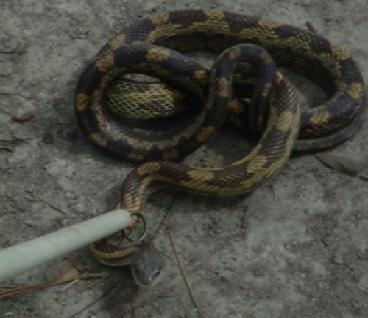
Catching A Snake
The snake catcher is very easy
to use. I walk up to the snake, step on its tail and then drop
the loop over the snake’s head. I pull the loop tight and the snake
is caught. If you plan to use the snake latter or need to store it
for a day or so, then you will need a five-gallon bucket with a lid.
I recommend that if the bucket has a bail you should remove the bail before
attempting to put the snake in the bucket. If you do not, the snake
will wrap the bail and you will have a hard time getting it in the bucket.
Put a little wet grass in with the snake and put the lid on the bucket.
Store the snake in a cool and shady spot.
Avoidance Training.
Now that you are in possession
of a training snake you are ready to start the training.
I conduct Snake Avoidance Training inside my (100 by 200 ft) training pen. This keeps the hound confined and easy to control. While I use my training pen, you may use a fenced in back yard. This training may be accomplished in an open area, but I prefer to keep my young hounds enclosed.
I use the PVC snake catcher to move the snake from the bucket and to stake it out in one corner of the pen. Open the bucket with care. The snake may be subdued and allow you to put the loop around them and remove them from the bucket or they may jump out and take off. If they do try to escape, you will need to step on their tail and get the loop on them.
Sight and Smell
When placing the snake in the pen,
I slide the loop down the snakes body a foot or more. This allows
the snake to get its head up and sway back and forth. This action
will help to get the hounds attention. I pull the loop down tight
and use a band or bungee cord to secure the ends of the weed eater line
to the PVC pipe. This keeps the snake from working loose. I
place the snake, attached to the catcher in one corner of the training
pen. If the snake is big and able to move off with the catcher, I
place a brick or log on the PVC snake catcher.
I bring my hound wearing an E-Collar
into the far end of the pen.
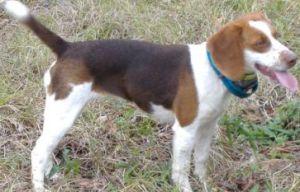
Young hounds that are receiving
Snake Avoidance Training for the very first time will normally run right
to the snake to investigate the strong smell and movement of the snake.
When the hound shows interest and is close enough to see and smell the
snake it is time to nail them hard with the E-Collar. If I know a
hound is very sensitive I may only hit them with half power but most will
receive a short burst of full power. The pain they experience may
very well prevent them from a nasty snake bite and could even save their
life.
After your hound has received punishment for showing interest in the snake, you will need to call to them and walk them to the far end of the pen and away from the snake.
After a short time, you can move back towards the area where the snake is staked out. If your hound returns to the snake, unleash the full wrath of the E-Collar on that hound. Most young hounds will not go back for a second taste, but if they do you will have to light them up. Most young trainees will choose to stay in the far corner away from the snake.
Most young hounds only need to receive
this training once. However, I do provide this training once each year.
Most of my older hounds that have previously received this training have
no desire to approach a snake. When they see or smell the snake they
retreat to the far end of the pen.
Sound
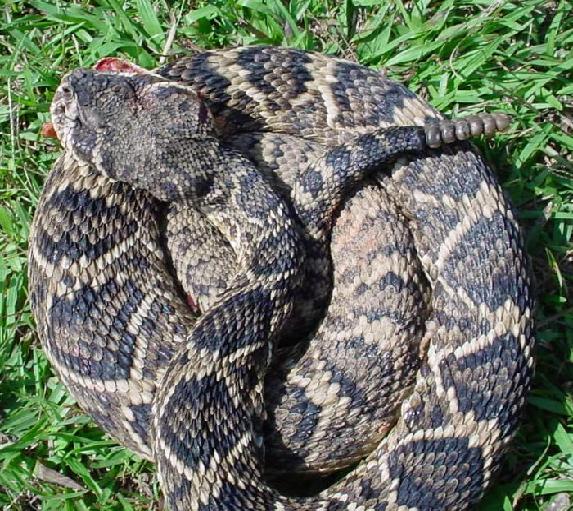
The sound of a rattle snake can
make the hair stand up on the back of your neck. That sound can be
heard at a great distance and alerts you of danger. Your survival
instincts tell you to move away from the sound and do it fast. It
would be good that your hounds could also recognize the danger associated
with the sound of a rattler.
You can find lots of rattle snake
sounds on the internet. The big challenge is recording that sound
onto a cassette or CD. Here is one site that comes up when you run
a search on “snake sounds”.
http://www.junglewalk.com/sound/snakes-sounds.htm
If you are able to record the sound of a rattler you can then use that recording to teach your hound to stir clear of the sound of a rattler. I use a portable CD player with a remote control to introduce the sound of a rattler to my hounds. I hide the recorder in the training pen. When the hound gets near the recorder, I use the remote to turn on the CD. If the hound shows any interest in the sound, I give them a jolt from the E-Collar.
Any hound that fails to run away from the sound is given another high power shock.
Most hounds will have smelled and may have seen the snake long before it decides to rattle so if they recognize the sound of a rattler as a treat this is just a little insurance that they will avoid snakes.