
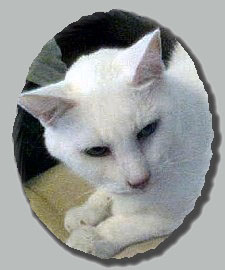
Riverlight Barishnikov
our first Russian White,
imported from Australia,
shown here at 13 years of age.
"On the Continent two main types of black cats are to be found, the short, thick set Cobby type with round yellow eyes, and the slim, elongated, small boned type with pointed heads and almond shaped green eyes. From very early on, these cats would throw blue sports, as they are called, and these gradually extended their range all over the continent from Chartruse to the Baltic . . .Buffon, in his natural history, lists a
shorthaired blue, orange-eyed cats, as existing more than 200 years ago. These cats are somewhat similar to present day British Blues, though much more powerfully built. The green-eyed blues were to be found mainly in the Northern half of the
Continent, and as the climate grew steadily more severe, they were found to have beautiful thick short, sleek hair which protected them from the rigours of the Northern winter. These cats lived mainly in the woods, and made their homes with people only in the winter when food was scarce. Some of them were brought over to England at the end of the last century, and they became the earliest ancestors of present day Russian Blues. We are indebted to Frances Simpson for most of the information."
"The Field", May 30, 1968
F.H. Laugher, V.P.
Russian Blue Newsletter Editor
(England)
The Tartars ruled southern Russia as part of a vast empire, known as the Golden Horde for more than two centuries. Thus began an era of Russian isolation from Western culture. At the same time however, trade routes with the Middle East and China were established. Smaller boned, shorthaired cats of southern climates were able to follow the trade routes and intermingle with the wild cats of Russia. Over centuries, these cats adapted to their frigid environment; the result was the origin of their short, thick coat that carried a mutation of wild gray, not unlike the ticking of a wild Grey rabbit or the Russian silver fox.
Russian cats are enmelanistic in color. The Russian Whites lives mostly in the snowfields; the Russian Blacks and Russian Tabbies lives mostly in the Northern forests; the Russian Blues populated the Archangelesk region.
It is not surprising that the first Russian cats to appear in other countries were Blue. Blue is considered a "Lucky" cat color and they were favored. Their habitat was located near a Port and "Lucky" cats were welcomed on the ships headed to other countries. Once these cats were in other countries, Blue mated to Blue always resulted in Blue Progeny.
In the 60's, Mavis and Richard Jones, Myemgay Cattery, Sydney, Australia, learned about the Russian Whites and
managed to obtain a female from Russia.
White is an epistatic trait. The White allele, 'W', is a dominant mutant and produces a translucent all white coat. The non-white allele, 'w', is recessive and allows full expression of coat, color, and pattern. The cat fancy was fortunate that the Jone's White cat masked the dominant Agouti allele (expressible as Tabby) and the dominant Maltesing allele (expressible as Black). The Myemgay registered Blue cats were, of course, homozygous recessive for both Agouti and Maltesing.
Under a 4 generation program supervised by the RAS of NSW, the White female was mated with a Blue stud, and the best progeny subsequently mated to different Blues. White color Russians were accepted for registration in 1975. Black color cats appeared at a natural evolution in the breeding program,(after two generations). Science and history thus embraced the Validity of the Black and Tabby, both only dominant expressions of two genetic systems in the same breed, when Australia recognized the Russian Group of four colors.
Please do not be fooled by several Russian Blue websites who claim the "russian white" is derived from the outcross of the Russian Blues to the Siamese after World War II--nothing could be farther from the actual truth. These russians are refered to as "colorpoint" or "pointed" russians, not russian whites. It is not uncommon for these pointed russians to be born in Russian Blue litters today, with both parents being blue.
The Russian Group Alliance wishs to promote these colors developed over a twenty year period in Australia, thus giving recognition to the work of the Australian breeders and helping to preserve these genes for future generations of breeders in the United States. To this end, Riverlight Cattery in South Australia, sent a Russian White stud, "Barishnikov", to us in September 1998. He is a direct descendent of the original White cat from Russian and has a 10 generation pedigree.
TICA appears to be the appropriate registry to cooperate with the Australian Registries, and Barishnikov's progeny are being registered and classified NBC. At a suitable time the Alliance hopes to attain Championship status for the Russian Group.
Recently, ACFA has also shown a great interest in these Russian Colors. Kittens and cats are also being registered in ACFA, again, with the hopes to attain Championship status.
Breeders interested in becoming members of this Conservancy Group would be expected:
until TICA and ACFA standards are realized, (i.e., earset)
to lessen the chances of deafness
Tabby and Black kittens to the appropriate
breeders to avoid inbreeding
Director: |
Co-Director: |
We would love to talk with you!

