 |
|
|
|
|
|
|
|
|
|
|
|
|
|
|
|
|
|
|
|
|
|
|
|
|
|
|
|
|
|
|
|
|
|
|
|
|
|
|
|
|
|
|
|
|
|
|
|
|
|
|
|
|
|
|
|
|
|
|
|
|
|
|
|
|
|
|
|
|
|
|
|
|
|
|
|
|
|
|
|
|
|
|
|
|
|
|
|
|
|
|
|
|
|
|
|
|
|
|
|
|
|
|
|
|
|
|
|
|
Here Are A Few Tips For Racing and Saillng A MacGregor Catamaran |
|
|
| WeightControl |
|
|
| Nothing is more important to performance And safety than keeping weight down. In a 12 knot wind, The addition of 100 pounds will cut speed by 1 1/2%. In a 100 mile race, it makes a 1 1/2 mile difference. Considering how close most races end up, this is a big penalty. |
|
| If you are really serious about getting weight down for an important race, |
|
|
| here are some things you can remove: |
|
|
| Cushions, replace with air mattresses 65 lbs.* |
|
|
| Carpet 40 lbs.* |
|
|
| Trim Panels 35 lbs. |
|
|
| Galley 25 lbs. |
|
|
| 20 HP outboard, replaced with a 10 40 lbs. |
|
|
| Sail Covers 10 lbs. |
|
|
| Battery, replace with an aircraft battery 25 lbs. |
|
|
| Head, use a bucket 15 lbs. |
|
|
| All this comes to about 255 lbs. *worse when wet |
|
|
| With careful crew selection, light provisioning, and by keeping personal gear weight down, another 200 to 300 pound weight saving is possible. This gets up around 500 pounds, which can make one hell of a difference in the boat's speed. |
|
| Remember to bail the bilge, nose and stern compartments. They can pick up a lot of weight. |
|
|
| As weight increases, rig loads increase, cross tube loads go up, and the boat is less likely to slide away from breaking seas. If it is capsized, or flooded, it is much more vulnerable and harder to right. |
|
| Don't build in a lot of stuff. An overweight multihull has no reason for existence. |
|
|
| Weight Position |
|
|
| As a general guideline, try to keep the weight as near to the fore and aft center as possible to reduce pitching motion. |
|
| In light air, position the crew and gear far enough forward to get the transoms out of the water. This cuts wetted surface and substantially reduces transom drag. In winds up to 12 knots, keep the weight off the sterns |
|
| As the wind increases, move the crew aft. As speed increases, the water will flow cleanly off the transoms even if the weight is aft. When running downwind in heavy winds or steep seas, the weight near the stern will help keep the nose from digging in. |
|
| Obviously, keep the crew to windward to improve stability. In really light air, however, some weight on the downwind side will help. |
|
| Underwater Surfaces |
|
|
| The bottom must be smooth -- 600 grit sandpaper smooth. At 12 knots or more, a polished underbelly is essential. Any growth or roughness will turn the boat into a real turkey. Scrub the bottom before each race. The rudders and centerboard are a major percentage of the drag, so really work on them. A slightly fouled bottom can cut speed by 20%. |
|
| Capsize Prevention |
|
|
| When the windward hull starts to feel light, when you find yourself luffing sails to get thru gusts, when a bow gets low, or when things seem like they might get a bit out of hand - reef, change headsails, or otherwise reduce power. The time to reef or change headsails is when you first think about it. |
|
| When oversailed, the cat is an ultra powerful, ultra fast rocket. With a small sail plan set, it is quite tame. Be conservative, and concentrate on developing the judgement to know when to ease off. We have learned this with cars. Now it is almost instinctive. Cars are not driven wide open all the time. The cat shouldn't be either. You won't win many races if you have to spend time righting the boat, or worse. |
|
| Never take more than three wraps on a winch. Four or more may not slip when you want them to. Line can seize up on a winch. It is important to let it slip and pull it in occasionally when it is blowing hard, so you know that it will run free in an emergency. Make sure the tails are free to run, and that nothing can jam any block. |
|
| When it is blowing hard, don't cleat down any sheet. Hold them in your hand for instant release. |
|
| Watch for overrides on winches. This occurs when the loaded line comes up and over the next wrap on the winch. They are almost impossible to get loose, and dangerous. The most common cause is having a crew member lift up on the line between the fairlead block and the winch while another crew member cranks the winch. The line should always lead to the winch from below the winch, not from above. |
|
| A wrap sometimes occurs when the winch is cranked while the line is loose and flapping around. Don't even start to wrap a sheet on a winch until all the slack is out of it. |
|
| Make sure the mainsheet tail is near the helmsman. Lay it on the deck so that it can be released from either side of the boat. The Genoa or jib should always be cleated near the helmsman so it can be released instantly. |
|
| If a hull lifts, it is quite possible for the crew to slide down to the low side. If the sheets are cleated on the high side, and the crew is not manning each sheet, you may just have to sit there helplessly as the boat goes over. Wherever you go, or slide, on the boat take the sheet tails with you . |
|
| I have always made a practice (on big cats and big monohulls) to have a good sharp knife in a sheath taped within easy reach. If a crewman gets tangled up in a loaded line, or if a winch gets a tight overwrap in an awkward situation -- cut the line! On the cat, it's a good idea to tape a sheath on each tiller. |
|
| Use the "chicken" technique. Anytime any crewman feels like the boat is overpowered, he should ease his sheet without consulting with anyone and without getting a lot of lip from anyone. No sense sitting around in great debate while the boat goes over. |
|
| If the boat starts to go over, slide to the lower side. This beats taking a long fall later. |
|
|
| One weird problem. If you have a novice hold on to a sheet...be careful When a hull lifts, even experienced crews will clutch, panic, or sit there in stupid fascination, hold the line with desperation and simply watch the boat go over...without ever releasing it. Warn everyone and still be prepared to have to pry a line loose now and then. |
|
| Remember, it is possible to dump a boat in very strong winds by allowing the boat to head directly into the wind without releasing the jib or Genoa sheet. The sail can backwind, stop the boat, quickly spin it around and blow it over. |
|
| Don't fly a hull. It is dangerous and slows down the boat.~ Shorten sail |
|
|
| If a nose starts to bury, shorten sail. |
|
|
| Equipment |
|
|
| Here is a list of the items I usually carry for coastal cruising and racing . |
|
|
| Mainsail Spare Blocks |
|
|
| Working Jib Winch Handles (2) |
|
|
| Genoa Drifter Bridle |
|
|
| Spinnaker |
|
|
| Drifter |
|
|
| Spinnaker Pole Righting Bag |
|
|
| Spinnaker Sheets (2) Fire Extinguishers (2) |
|
|
| Vang Bilge Pump |
|
|
| Foreguys (2) Bucket (for bailing) |
|
|
| Centerboard Wedge Life Preserver (1 per person) |
|
|
| Centerboard Pin Horn |
|
|
| Jib Sheets Anchor, Chain & Rope (2) |
|
|
| Man Overboard Ring, Outboard Motor |
|
|
| With Pole, Dye Marker, Extra Fuses for VHF & Lights |
|
|
| Strobe Light & Whistle Dock Lines |
|
|
| Personal Strobe Light Sail Covers |
|
|
| For Each Crew Member Fuel |
|
|
| Raft & Paddles (Avon Redcrest) Water |
|
|
| Inflated,on Intermediate Net Boat Tape |
|
|
| Pump for Raft Alcohol Stove & Alcohol |
|
|
| Radar Reflector Sail Patching Equipment |
|
|
| First Aid Kit Flashlights Head |
|
|
| Flare Gun & 10 Rockets Extra 1/2" Clevis Pins |
|
|
| Fully charged battery Tools (include 2 pairs vice grips) |
|
|
| Knife Extra 1/2" Clevis Pins Extra Shackles & Cotter Pins |
|
|
| RDF Wet Suit ForEach Crew |
|
|
| Extra RDF Batteries (for cold weather) |
|
|
| Charts Wet Weather Gear |
|
|
| Chart Compass Bosun's Chair |
|
|
| Pencils Food |
|
|
| VHF, With Spare Antenna Ice Chest |
|
|
| EPIRB (beacon) Bedding |
|
|
| Extra Compass |
|
|
| Parallel Rule |
|
|
| Protest Flag |
|
|
| Stop Watch |
|
|
| Accurate Watch |
|
|
| Signet Knotmeter (O to 30 |
|
knots) with log |
|
|
|
| Windex Masthead Wind Pointer |
|
|
| Danforth Cl51 Compass |
|
mounted on seat |
|
|
|
|
| Where possible, get the absolute lightest of everything. Be ridiculous about it. All this stuff can add up to a lot of tonnage. - |
|
| Daggerboard Control |
|
|
| When sailing close into the wind, the dagger board should be down, with the top of the board 3 feet below the top of the deck...no lower ..or you may break the board or the trunk. |
|
| Tie the daggerboard line to the pad eye on the deck so the board cannot go more than 3 feet below the top of the deck. (If a hull lifts, the board may fall out or go below the 3 foot point if the rope is not tied securely.) |
|
| This line will also prevent the board from sliding out the top and mashing someone in the event of a capsize. |
|
| Important: when sailing over 10 knots, never have the top of the board below the level of the top_of_the deck. This will give you about 2 1/2 feet of board below the hull, which is all the area you need at these speeds. More board than this will cause unnecessary drag, create excessive loads on the hull and board, and greatly increase the risk of damage if the board hits something. |
|
| When running, no board is necessary. Pull it up and pin it. When the board starts clunking from side to side with wave action...it is no longer creating lift, because there is no significant sideways force on the sails pull it up. |
|
| In extreme conditions, Pull the board all the was up to let the boat slide away from breaking seas. |
|
| Looking down on the board, note that it positions itself at about a 3 degree angle to the centerline of the boat, with the leading edge pointing to the windward side of the boat. This allows the board to generate lift without the entire boat having to crab sideways to provide the neccessary angle (a centerboard provides no lift at all unless it has some angle relative to the flow of water.) |
|
| In light to medium winds, a wedge can be used to add another 2 or 3� I normally carry a mahogany 2"x2n, about 4' long, with a long taper at one end. This is used to push the board full down and to wedge the lead-ing edge to a greater angle of attack. |
|
| Rig Tuning |
|
|
| The dolphin striker wires should be tightened just enough to give an absolutely straight center cross tube in a 12 knot wind. Both wires should have the same tension. |
|
| No matter what you do, the leeward shrouds will be loose when sailing. There is no reason to pre-tension everything super tight. |
|
| To flatten out a full main in moderate to heavy winds, adjust the lower shrouds and lower forestay to bring the center of the mast about 4" forward of a straight line between masthead and deck. |
|
| The mast should rake slightly aft, and be absolutely straight sideways, when under load in a 12 knot breeze. |
|
| If the mast pumps (or moves fore and aft at the center) as the boat goes thou seas, tighten up the lower shrouds and lower forestay. |
|
| Do not try to get the same forestay tension that you would try for on an IOR monohull. You will simply bend the boat. The jib and Genoa are both cut with a substantial luff hollow curve, a rod straight forestay is not desirable. |
|
| Don't over tighten the lower forestay. You will just bend the forward cross tube. |
|
|
| Sail Trim |
|
|
| There are literally hundreds of books and articles on proper sail trim, so I won't go into detail here. Treat it as you would a standard IOR rig. The big differences are (1) sails should be flatter because of the high wind velocities the cat rig sees, and (2) apparent wind will shift radically from the true wind as the boat speed builds up. |
|
| Use the gang to take unwanted twist out of the main. Always vang to lee-ward... never to windward. You may not be able to release it in time to prevent capsize. |
|
| Concentrate primarily on the streamers on the Genoa. With the sail properly trimmed, the windward streamer should be just starting to float off of the sail, while still generally streaming aft. The leeward streamer should be flowing aft. If it isn't, the sail has stalled. Ease the sheet or head up. |
|
| Headsail Changes |
|
|
| Here is a really quick way to change headsails. While the boat is moving, disconnect the 2 lowest hanks on the sail that is driving the boat. Leave the tack connected. Snap all of the hanks of the new sail on the headstay between the tack and the 3rd hank. Connect the new sail tack to a second shackle on the bridle triangle. |
|
| Lower the old sail, unsnapping the lowest hanks first as the sail comes down. Quickly change the halyard from the old to the new sail and hoist the new sail. You should go bald for about 30 seconds. Then, when you are all set - disconnect the tack of the old sail. |
|
| Fairlead Positions |
|
|
| The jib and Genoa fairleads are unique. The strongest points on the boat to secure fairleads are the cross tubes. It takes a lot of heavy beefing under the fiberglass decks to take the severe loads of headsail fairleads, and the hulls are too far apart anyway to provide proper sheeting points. So we are stuck with locations on the tubes, which give infinite adjustment inboard and outboard, but none fore and aft. It is possible to give precise adjustment by carrying the headsails either higher or lower on the headstay. Moving the sail up the headstay a few inches has the effect of moving the fairleads forward by a much greater distance. As a starting point, a short pennant (about 9") between the jib tack and the attachment point on the bridle moves the jib up enough to give a good lead. (The jib fairleads attach to the forward cross tube and the Genoa leads attach to the rear tube.) The Genoa leads are generally about right with a 6" pennant between the bridle and the jib tack. The fairlead positions are good if the entire leading edge of the sail starts to luff uniformally from top to bottom as the boat heads up slowly into the wind. |
|
| For reaching, the Genoa is best sheeted as far outboard as possible. Try using a snatch block on the lifeline post base to pick up the sheet and carry it forward and outboard. The sheet goes thru the snatch block, thru the regular fairlead block, and then to the winch. Don't use this set up in heavy winds. |
|
| The jib fairleads can also be moved outboard about 8" for reaching. This involves another set of 1/2" holes drilled horizontally thru the center cross tube. |
|
| Spinnaker Handling |
|
|
| If the apparent wind is aft of the beam, and winds are moderate, use the chute. Keep the tack and clew level and always have the end of the pole as far aft as possible. Trim the sheet so that the leading edge is just on the verge of folding over. |
|
| Do not reach with the chute in winds over 10 knots. Never let the pole go forward of the windward bow. If you can't keep the chute open at this point, douse it and use the Genoa. You will go faster. |
|
| Remember, the spinnaker is a light air sail. |
|
|
| Always have the Genoa up before raising and lowering the chute. This causes it to be blanketed and prevents a wrap around the forestay. Try to head directly downwind to get the chute up and down. |
|
| Use the foreguy as shown in the assembly instructions. |
|
|
| Practice with the chute in really light air. These things are big, capricious and potentially dangerous. They require knowledge, skill and practice. |
|
| Steering for Speed |
|
|
| In light air, tack downwind. Never let the apparent wind too much aft of the beam. You will have to go farther, but the additional speed generated by reaching will more than make up for the extra distance. |
|
| For example, tacking 20 degrees above the straight downwind rhumb line adds only 6% to distance, but can add as much as 30% to speed. 30 degrees adds 15% to the distance and 45 degrees adds 40%. |
|
| In heavy wind, tacking downwind is of much less value. Square off and run with it unless heading up a bit produces a significant increase in speed. |
|
| When tacking downwind, bear off in the puffs. |
|
|
| When going to weather, don't pinch. |
|
|
| When you try to point up with monohulls, you will drop back to their speed. You can outpoint them, but it isn't worth it. |
|
| Generally, the slower a boat goes, the higher it can point, because the boat's speed through the air shifts the apparent wind to more on the nose. |
|
| As the cat picks up speed, the apparent wind shifts around and forces you to sail further off the true wind. As you fall off a few degrees, your speed will pick up as much as 40%, and you will more than make up for the extra distance that you will have to sail. |
|
| A monohull will only pick up a small percentage of speed as it heads away from the wind, so it pays for them to pinch like crazy. You will soon get used to the idea of seeing a monohull pointing 10� higher, going 4 knots, with its jib on the edge of luffing, while you are going 7 or 8 knots, with your jib also starting to luff. And you will get there first. if you come up to their pointing angle, your speed will drop to 4 knots and your jib will still be on the edge of a luff. |
|
| Don't try to beat them at their game. The apparent wind angle will limit you to their speed if you do. Sail off and go for boat speed. Remember, a big percentage of the wind you are feeling is created by the speed of the boat. |
|
| Caution. This is seductive. As you point farther from the wind, boat speed will continue to increase, and the apparent wind, created by the boat speed, will shift with you and you will think you are close hauled even though the boat is on a broad reach with respect to the true wind. |
|
| The shifting of apparent wind is the reason that monohull sailors still sometimes think cats don't point well. No competent cat sailor will try to point with them if he wants to win. |
|
| Tacking |
|
|
| The boat sails nicely under main alone, but it is slow to tack without the jib. The reason is that the center of effort of the main is quite far aft of the center of hull resistance. The boat will tack thru the eye of the wind, but will be slow to start on its new course without the jib. |
|
| The boat will try to weathervane back into the wind. The jib will prevent this. When trying to get around fast and surely, let the jib backwind for a few seconds. If you get in irons, push the boom toward the side you wish to go, and also push the tiller toward the side you wish to go. The boat will back up and turn toward the new tack. |
|
| Practice sailing backwards.. |
|
|
| When racing, have one of the crew pull the clew of the Genoa in as tight as possible, to get the boat started, while another crew member works the winch. If you can get it in before the boat takes off, you can save a lot of cranking. |
|
| Securing Hatches |
|
|
| In heavy weather, secure lifting hatches with the cabin lock or a line over the top. With high winds from the rear, they could slam open hard. With really high winds from the side, they could lift and let in a lot of Spray. |
|
| Radio |
|
|
| I strongly recommend having a VHF radio on board. The Horizon 25 is excellent, and reasonably priced. Use a masthead antenna, with the cable coming down the inside of the mast. Mount the radio to the front face of the galley (with the top of the radio pointing forward). Mount it far enough inboard so that the knobs don't stick too far out in the aisle, but not so far back that the antenna cable has to kink where it comes out of the back of the set. |
|
| The masthead antenna mount gives far better range than a deck mount. However, it is useless if you lose your mast. You can get a small antenna (for about $10) that plugs directly into the back of the set and gives good range. I always carry one in the event the regular antenna is disabled. |
|
| One of the most essential safety items is an emergency position indicat-ing radio beacon (EPIRB) that will send out a continuous locator signal on a frequency that is closely monitored. |
|
| Speed Indicator |
|
|
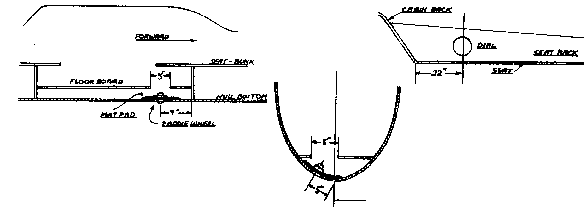
| Use a Signet knotmeter (0 to 30 knots) with a log incorporated in the unit. Mount the dial and the paddle wheel as shown below. |
|
|
 |
|
|
| In this position, you can see it from both sides of the boat. Where you drill thru the hull for the paddle wheel, reinforce the area with 4 layers of 14 ounce fiberglass mat and resin, 6" x 6". Make sure you mount the paddle wheel flush with the outside of the hull. If the log runs improperly with the engine running, you may have to install resistor (non-static) spark plugs in the outboard. |
|
|
Compass |
|
|
| Mount a Danforth C-151 "Lodestar" compass in either or both seats. |
|
|
| Don't cut into the vertical cabin back for a flush mounted compass. The area is heavily loaded and an important piece of the structure. In fact, the compass holes and speedometer hole are the only cuts I would make in the fiberglass structures. |
|
|
Drifter |
|
|
| One of the most valuable sails on the boat is the drifter, a huge 1 oz. nylon sail that flys from the spinnaker halyard at the masthead and the end af the spinnaker pole (about 3' ahead of the boat). It sheets in with the spinnaker sheet near the rear of the boat. It looks like a huge Genoa flying from a bowsprit. It has a wire luff and no hanks. |
|
| The spinnaker pole attaches to the mast, and goes straight forward under the bridle. |
|
| To keep the pole from breaking, the forward end of the pole is held down with a secondary bridle. |
|
|
This sail is perfect under the following conditions. |
|
|
| 1. When the air is so light or the sea so lumpy that the spinnaker will not stay filled. This is a very common condition at night. |
|
| 2. Reaching in light winds with the wind abeam or forward of the beam. In this circumstance, the Genoa is too small and the spinnaker will not allow the boat to point high enough. The drifter is a perfect airfoil and can be carried close into the wind. |
|
| Do not use this rig in apparent winds of more than 8 knots. The pole won't take it. The sail won't take it, and the bridle won't take it. |
|
|
Haul Out |
|
|
| If you have to haul the boat, and you don't have a trailer, be sure that the hulls are supported under the bulkheads. |
|
|
Maintenance |
|
|
|
Here are a few things to keep an eye on as the boat ages. |
|
|
| 1. Wear on the rudder shaft or hull bearing surface. Inspect these items at least once per year. |
|
|
| 2. Cross tube clamps. Make sure they are tight but not so tight they damage the tubes. Check them every 6 months. |
|
| 3. Chafe on trampoline ropes, halyards and sheets. Replace. |
|
|
| 4. Turnbuckles. make sure clevis pins are cotter pinned. Inspect these each time you sail. |
|
|
| 5. Block shackles. Keep them tight and make sure each clevis pin is properly cotter pinned securely. |
|
|
|
6. Mast tune (See prior instructions.) |
|
|
| 7. Winch position. Make sure all winches are mounted so that the line approaches the winch from below the plane of the base of each winch. This will help prevent dangerous winch wraps. Re-bend the Genoa winch plate as required and, if necessary, put thin wood angle blocks under the other winches to tilt them in the proper direction. |
|
| 8. Electrolysis on metal parts. The stainless to aluminum contact may cause problems, depending on the electrical systems carried on board. Keep an eye on the cross tubes where the shroud rings, mast hinge and clamps attach. If you see any sign of electrolysis, isolate the clamps from the tubes with a l/16th thick sheet of rubber. |
|
|
9. Rigging - check for broken wire strands and replace rigging as necessary. |
|
|
| 10. Fasteners - do a periodic tightening of all nuts and bolts. |
|
|
| Hose the boat down regularly and flush your outboard with fresh water. Use WD-40 on all fittings that move. Leave your hatches open as much as possible to preclude mildew. |
|
| The forward face of the cabin is slippery. It would be a good idea to apply self adhesive non skid tape on this area as a safeguard. Generally you are best off staying on the trampoline when you go forward. The further you are from the edge of the boat, the better... especially in rough weather. |
|
| Topping Lift |
|
|
| This is a real convenience. Fasten a 3/16 stainless cable permanently to a pad eye bolted to the masthead. The lower end of the wire should have a strong snap shackle, permanently attached. This shackle can snap into one of the outhaul eyes on the boom. The wire should be just long enough to hold up the boom and take all of the load off the sail. |
|
|
Wind Indicator |
|
|
| Use a Windex masthead fly. They are better than any of the electronic goodies. |
|
| Bosun's Chair |
|
|
| If you have to go up the mast, always clip 2 halyards to the chair, and have them both manned by competent crew members. Don't trust your life to one halyard and its fittings. |
|
| Rudders |
|
|
| Make sure the rudders are parallel when centered--If the cross tube gets bent, it is possible for the rudders to toe in. The effect on speed will be major. With the rudders set along the centerline, the dimension between the leading edges at the top of the rudders and between the trailing edges (also at the top of the ruddersJ should be identical. If not, drill new holes in the tiller and relocate the tiller crossbar to position the rudders to a perfectly parallel position. |