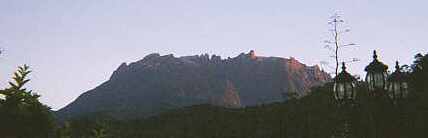
1999 World Mountain Running Trophy
Kinabalu, Saban, Malaysia
1999 Race Results
My experiences, by Paul Low
The Selection:
Runners are chosen to represent the United States of America at the World Mountain Running Trophy by one of two ways. Either you can place in the top two at the Mount Stratton Race, or you can be selected by a small group of relatively well-informed officials based on the strength of your c.v.
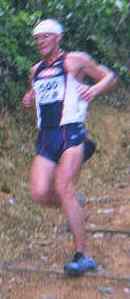 A quick geography lesson; Mount Stratton is in southern Vermont and I live in central Oregon. Even after driving for three days to visit my parents in Central Michigan, I would still require two days of driving to reach Vermont. Thus, I decided to skip the trial with the hope that I could race well enough to be one of the remaining 4 to be chosen for the team based on some subjective merit.
In attempting to pad my resume with wins prior to the end of June selection date, I discovered that the vastness of American geography was once again not on my side. You see, the top mountain runners in the country tend to race in New England or Colorado, and my Oregon wins were not against the sort of people that I needed to beat in order to impress the selectors. This is not to say that Oregon does not have some great Mountain running venues and events, (Mac Forest 15k is a particular favorite of mine) rather that there is not the population density and interest level here to generate good competitions, yet.
For my last attempt at impressing the selectors, I decided to run the Wasatch Steeplechase 17 miler, just north of Salt Lake City, Utah, a stop on the Fila Skyrunning circuit and one of those rare beasts, an American trail race with prize money. After pulling a three-minute lead in the first 30 minutes of the race, I made a poor decision at an unmarked intersection and ended up on the campus of Utah State University (quite far from the course.) Not very impressive, at least not in my assessment.
Then, in early July, I received an e-mail from the USA team captain stating that they had ranked the runners for the team and that I was ranked eighth based on my limited 1999 season in the USA and my 1998 season in England. Eighth as in four to score, six to run, seven to travel, and eight, well, the eighth guy is the fastest guy to watch the race on television. One of those chosen in front of me declined his position and so I became the traveling alternate. Finally, less than one week before I was to leave for Malaysia, another member of our team pulled out with an injury allowing me the opportunity to run in the championship race rather than the open. There was only one more quirk prior to my departure; I changed addresses and, as a result, never received my uniform.
 The Journey:
My journey was about as pleasant as, well, spending 26 hours on a plane, then getting on a bus and driving for almost three more hours. At the Los Angeles airport, I met most of the team members from west of the Mississippi including Scott Gaul, Jeremy Wright, and Danelle Ballengee along with the new alternate for the men�s team, Dave Eckley. When we finally disembarked at Kota Kinabalu, three days prior to the race, we entered a land that was as, sunny, humid, and hot as one would assume for a place that is less than two degrees north of the equator.
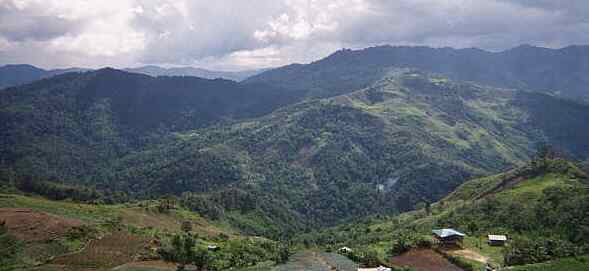
About 8 km down a huge hill from the national park where the race was to be held was Kundasang, the location of the athletes� village (find it on a map, I dare you.) The village consisted of several villas and a central dining commons all with views of
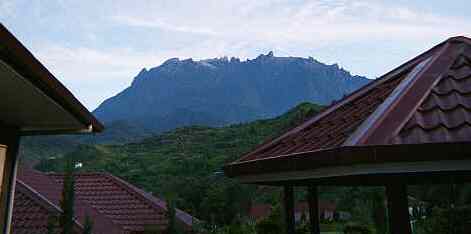
Mt. Kinabalu (the highest point in Southeast Asia) and local farms on impossibly steep hillsides (imagine farming in the coastal range, except with more rain.) During the next few days, our diet consisted primarily of rice (lots of rice) and vegetables that I had never heard of before, and seafood that made the veggies seem as familiar as corn on the cob. In between meals, we played round after round of hearts and looked for flat places to run. Actually, the only the only flat place within 100km was a putting green in the village that took about 35 seconds to circumnavigate once. At any given time, a dozen, or so people could be seen running around the green in order to save their legs for the race. These people missed out on running through Saban farm country where everyone waves to you with a fervent hello and, as long as you stay off of the main thoroughfare, the only traffic with which you must contend are laxidasical stay dogs, free range chickens, and a seemingly endless parade of children who want to race you over the next 100 meters. Aside from our daily preparations, we also spent a day previewing the course, traveled to see some of the local natural sites, and attended the opening ceremonies.
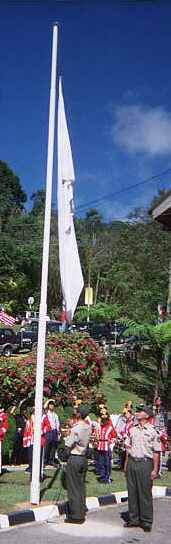 At the opening ceremonies, I began to get an idea of the size and importance of the event to the country of Malaysia and the international community as a whole. Members of the press and several television stations were there to cover the event and the keynote speaker of the event was none other than the Prime Minister of Malaysia.
The Race:
The start of the race was on a road not much wider than two lanes and every country was given room enough for one person on the line with the rest of the team filing in behind him. Needless to say, the start was anarchy with 110 runners trying to push their way to the front before the road narrowed to one lane about 200 meters beyond the start.
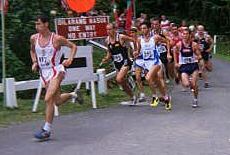 I recall pushing quite a few of the backs in front of me, particularly members of the French team who seemed to be pushing back with a vigor that far exceeded reciprocity. Not only was the start narrow, and not only did it funnel quickly, but it was also noticeably downhill. Things finally settled down after one mile when the climbing began, at first on the steepest paved road that I have ever seen, then passed the start/finish area, and onto the trails. When I was previewing the course two days earlier, this uphill did not seem to be very difficult.
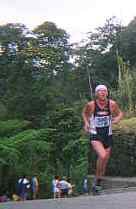 That, however, was pre-race easy run pace and this was all out. On the uphills, I was traveling so slow through the densely foliated rain forest that the wind speed around me became negligible and my uniform felt as though it was cut from neoprene. I was running to the highest point on the course and from this point on, I was running as fast as I could. Unfortunately, this was not the last time that I would see the highest point on this course; I still had to come back twice more.
Next, came a long downhill, followed by a short uphill, followed by a sustained downhill to the lowest point on the course. And what is your reward for sprinting down a muddy, swichedback trail with a 100 ft cliff to your left and no room to pass on your right? You get to run (if you can call it that) uphill for several minutes and hopefully not be passed by too many people before the next decent. On the final descent, two Brits went screaming by and, since my downhill running had been severely compromised by running downhill at some point earlier that day (I forget when), I just had to watch them go. Most up and down mountain races (races that start and finish at the same elevation) finish with a downhill. This course was an exception; moreover, the last 400m seemed to have about 800m of elevation gain and my kick at the end of an hour-long race was at about 12 minute pace. I did, however, manage to kick down some non-scoring runners from England and Italy.
Throughout the race, I managed to pass two or three runners on every descent and get passed by three or four runners on every ascent. With the exception of the first two kilometers, I was running as hard as I possibly could. For this reason, I am pleased with my race. 42nd in the world and second scoring American is a good start and that is how I view it, as a launching point for the future.
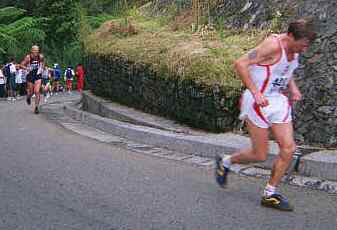 Runner�s World Daily quoted me as saying that in the next few years the US men�s team is going to be very, very good. That is what I am looking forward to. Sure, we placed 9th behind Wales this time around, but our 1, 2, and 4th counters are all only 25 years old. With the addition of a few veterans and the steady improvement of our younger members, I can realistically foresee a top three finish for the USA in the next few years.
Traveling Home:
The journey home was about as pleasant as, well, spending 26 hours on a plane.
Some Links
1999 World Trophy Page
AAATR
Northeastern Trail Runner
Cool Running
Kelvin Broad's Mountain Trophy Site
Bergen Site
Runner's World Daily Article on the 1999 World Mountain Trophy
Coolrunning Article on the 1999 World Mountain Running Trophy
1999 USA Team Announced
SEACOWS