Grand Canyon Ultramafics
Optical Mineralogy
Brief Overview
Sample Locator Maps
List of Photomicrographs by Subject
List of Photomicrographs by Location
Brief
Overview
Petrology and Petrography
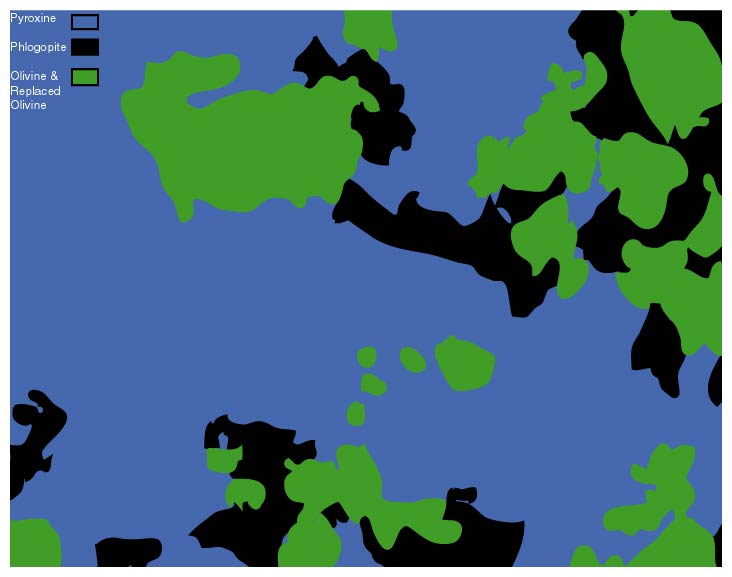
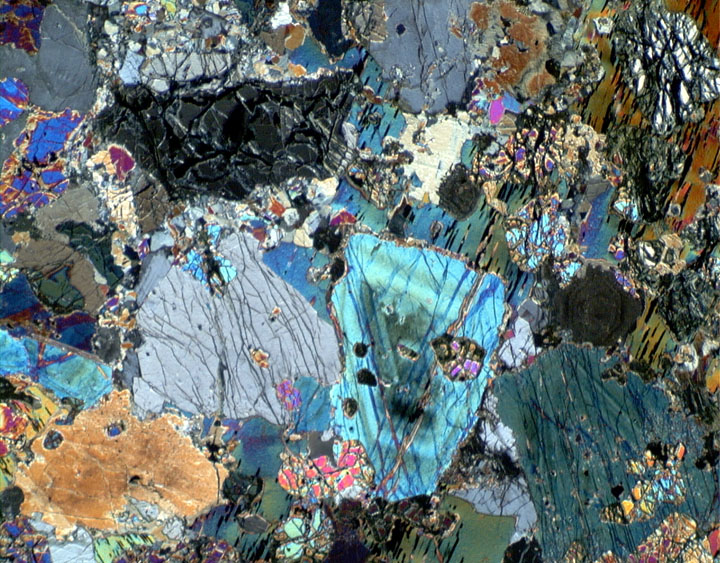
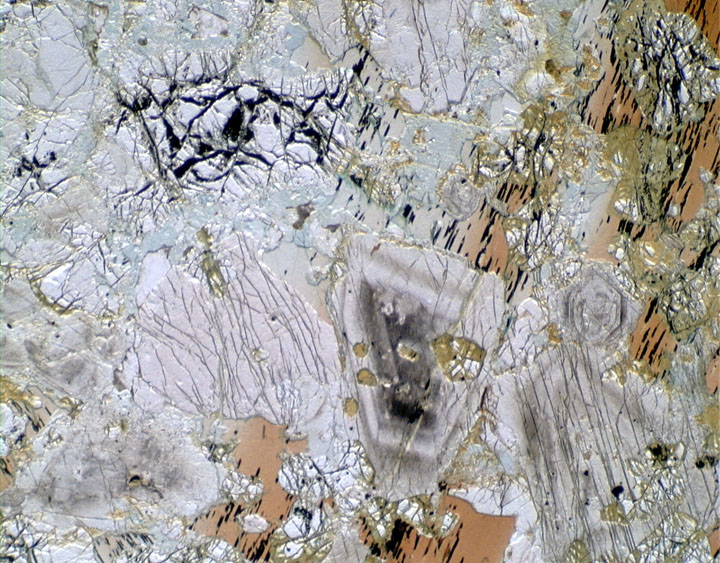 Rocks sampled from the mile 91 ultramafic body are generally composed of interlayered harzburgite (olivine and orthopyroxene), wehrlite (olivine and clinopyroxene), and lherzolite (olivine, clinopyroxene, and orthopyroxene). Much of the body is made up of phlogopitic wehrlite consisting originally of 30% phlogopite, ca. 35% diopside, and 35% olivine (Seaman, personal communication, 2002); however, many of the slides contain sufficient amounts of orthopyroxene (enstatite) to be categorized as lherzolite. In some samples, up to 10% of the olivine has been altered (serpentinized and chloritized.) Most of the samples contain large amounts of magnetite both as large, rounded, opaque blobs, and as fine, opaque powders. Photomicrographs to the right display what could be considered ordinary mineral assemblages and textural relations that can be found throughout the mile 91 ultramafic body. Minerals present in most of the slides from the mile 91 samples include olivine, orthopyroxene (enstatite-MgMg and possibly ferrosilite-FeFe), clinopyroxene (diopside-CaMg and possibly augite-CaMgFe2+), phlogopite (of both primary and secondary origin), magnetite, and altered products of olivine such as serpentine. Additional hydrous phases such as chlorite, talc, actinolite, and possibly tremolite are present in some slides and/or hand samples.
Rocks from the mile 83 ultramafic body are hydrothermally altered pyroxenites containing clinopyroxene, orthopyroxene, and phlogopite with quartz, magnetite, actinolite, talc, and possible chlorite in one or more of the thin sections. In addition to mineralogical differences, the rocks at mile 83 show an increase in evidence for deformation and shearing from the ultramafic rocks at mile 91.
Geothermobarometry
In addition to evaluating mineral assemblages, textures, any preserved reaction relationships, one of the goals of the optical characterization of these samples was the search for any occurrence of spinel or garnet to be used in geothermobarometry. Unfortunately, neither phase has yet been discovered although there are some isotropic things
(S5-91.1-5 and S5-91.1-5b) that have yet to be definitively identified. Any spinel or garnet present would be of assistance for use in paleobarometry, as would the presence of plagioclase (for plagioclase/pyroxene barometry); however, none has been observed in the samples thus far. Additionally, four phase geothermobarometers such as those discussed in Brey et al., (1990), Brey and Kohler, (1990) and Kohler and Brey, (1990) are of little help in the analysis of these rocks due to the absence (for the time being) of one of their required phases (garnet). Previous attempts at clinopyroxene/olivine calcium barometry as discussed in Righter and Carmichael (1996) failed possibly due to an inordinate time lag between crystallization of the two mineral phases.
Progressive Metasomatism
With a mineral assemblage composed almost entirely of pyroxene, olivine, and metasomatically derived (?) phlogopite, the rocks of the ultramafic pod at mile 91 inticate that they have undergone metasomatic processes. Textural and petrographic evidence for metasomatic replacement includes the development of hydrous minerals such as phlogopite, amphiboles, and opaque oxides such as magnetite (Erlank et al., 1987) all of which are present in the mile 83 and 91 rocks. Chemical evidence for metasomatic enrichment include a high concentration of K (average K2O=1.44 n=10; Bushemi, unpublished data) and incompatible elements due to the presence of phlogopite and a depletion of major basaltic constituents such as Ca (average CaO=5.1752 n=10; Bushemi, unpublished data) and Al (average Al2O3=4.4078 n=10; Bushemi, unpublished data) (Erlank et al., 1987). According to Erlank et al. (1987), if a rock contains primary phlogopite, it has been metasomatised; while there is abundant textural evidence for secondary phlogopite in these samples, it is unknown at this time whether any of the phlogopite is in equilibrium with other primary phases in the rock and thus, definitively primary. Primary phlogopite tends to be large, tabular, and in textural equilibrium with other primary phases within the rock (Erlank et al., 1987) whereas secondary phlogopite tends to be smaller, undeformed, and irregular forming serpentinous veins, overgrowths, and exsolution rims (Delaney, et al., 1980). Chemically, primary phlogopite is lower in Ti, Cr, and Fe than secondary phlogopite (Erlank et al., 1987). There is, however, an overlap between the chemical properties of different textural groups and some textural features are ambiguous with respect to primary or secondary designation (Delaney, et al., 1980). Phlogopite is capable of replacing olivine (S99-91-7), enstatite (S99-91-13i), and diopside (S5-91-8) (Erlank et al., 1987) as it appears to being doing in many of the photomicrographs taken from the mile 83 and 91 thinsections. Examples also exist of phlogopite replacing orthopyroxene (S96-83-2a) at mile 83. Textural features that result from dynamo-thermal and chemical processes indicative of a residential history in the mantle include: 1. exsolution (S99-91-12-2), 2. recrystallization (S99-91-6m), 3. deformation (S99-91-4), and 4. hydration (S99-91-11). (Erlank et al., 1987)
Progressive mantle metasomatism as discussed in Erlank et al. (1987) involves the evolution of a magma body through the following sequence of assemblages: 1. garnet-peridotite, 2. garnet-phlogopite-peridotite, 3. phlogopite-peridotite, 4. phlogopite-amphibole-peridotite. Samples from the ultramafic bodies at miles 83 91 and 98 are mostly phlogopite-peridotites with some phlogopite-amphibole-peridotite assemblages as well. Specifically, the rocks from mile 91 probably evolved through the following sequence (modified from Erlank et al., (1987)):
Garnet + Olivine + Clinopyroxene + K2O solution -->
30Phlogopite + (35-n)Orthopyroxene + nClinopyroxene + 35Olivine -->
30Phlogopite + (35-n)Orthopyroxene + nClinopyroxene + 25Olivine + 10Serpentinized Olivine (Serpentine, Talc, Chlorite, Actinolite, and possible Tremolite)
Pyroxene Phase Relations
With regard to the proposed progression from a phase assemblage involving first only clinopyroxene into assemblages with both clinopyroxene and orthopyroxene, there is textural evidence at mile 91 for both clinopyroxene preceding orthopyroxene associated with metasomatic evolution ( S99-91-13ia ) and orthopyroxene preceding clinopyroxene as would be predicted by Bowens's reaction series (S99-91-BG). Furthermore, in the rocks at mile 83, there are clinopyroxene phenocrysts that display odd (ragged) twinning boundaries between mineral lattices that display inclined and parallel extinction (S99-83-2 and S99-83-4A).
Alteration
Secondary processes resulting from post-metasomatic alteration include: 1. opaque oxide formation (S99-91-4b), 2. serpentinization (S96-91-4), and 3. other low-temperature alteration (S99-91-11x and S99-83-4Abt) (Erlank et al., 1987) all of which are evident in many of the slides from the ultramafic rocks sampled at miles 83, 91, and 98. In addition, some of the samples from mile 83 show late forming quartz that was most likely hydrothermal in origin (S96-83-1a). Some of the most obvious examples of textural evidence indicative of secondary processes include: 1. veined samples (S99-91-9 and S5-91.1-8), 2. local concentrations of phlogopite, diopside and amphibole coatings on planar surfaces (???), 3. pervasive grain boundary corrosion (S96-91-4 ???), 4. embayment (S99-91-7), and 5. replacement by fluids depositing secondary minerals such as phlogopite or serpentine (S96-91-7q). (Erlank et al., 1987) Prior to secondary alteration, these rocks were probably composed of olivine and pyroxene with polygonal texture. Post alteration, anhydrous silicates such as pyroxene and olivine were altered to form hydrous magnesian silicates such as (magnesian) chlorite (S99-91-1mc) and amphiboles. In addition, minerals formed pseudomorphs such as mesh texture serpentine with a moderate degree of lattice retention (S96-91-4). (Spry, 1969)
Anhydrous ultramafic rocks are generally resistant to the effects of thermal metamorphism; whether or not they are altered depends largely on the availability and amount of water and its ability to penetrate the rock (Spry, 1969). One of the big questions for this project is the nature of these fluids; were they metamorphic, meteoric, or oceanic in origin? While this question will be addressed primarily through the study of oxygen and hydrogen stable isotope geochemistry, it is relevant to briefly examine the genesis of mantle-derived fluids and their role in the creation of hydrous secondary phases. Secondary phlogopite may be formed when hydrous silicate melts originating from a deeper part of the mantle metasomatizes peridotite (pyroxenes and olivine) at shallower levels. This replacement of garnet by phlogopite (see discussion above) has been observed petrographically in metasomatised mantle xenoliths, suggesting that secondary phlogopite can be formed by the introduction of a metasomatising agent that has its origin in the mantle (Bailey, 1982).
As discussed earlier, there is a question as to the genetic nature of the phlogopite in the ultramafics rocks at miles 83 and 91. There are many examples of what seem to be secondary textures present in the mile 83 and 91 thinsections (examples of secondary textures involving phlogopite). If some of the phlogopite is, in fact, secondary, then what is the origin of the additional K and Al that was utilized in the creation of phlogopite (above and beyond the elemental constituents of the original mineral phases)? When the solidus of the enstatite + phlogopite composition in a peridotite is encountered, secondary phlogopite can be formed from the reaction of a metasomatic agent (K2O bearing liquid-see above) with garnet in the peridotite (Sato, et al., 1997). Also relevant in the discussion of the abundance of K and Al are amphibolite phase concentrations which are determined by the concentration ratio of K relative to Al. If this ratio is not high enough, later phases such as those seen throughout the mile 91 ultramafics (serpentine, talc, chlorite, actinolite, and possible tremolite) will not form (Erlank et al., 1987).
Deformation
Typomorphic textural elements such as widespread grain deformation and compositional variation are not widely evident in the mile 91 samples. In one mile 91 thinsection (S99-91-4), however, there are some phlogopite crystals that have undergone deformation in addition to several undeformed phlogopite crystals. In contrast, both thinsections(S6-98-7, for example) from mile 98, in the Crystal shear zone, show intense deformation and alteration throughout the thinsections and most of the slides from mile 83 show at least some degree of deformation. While there is evidence of shearing at mile 83 (S96-83-2 and S96-83-2e), much of the evidence for deformation is seen in fish tail-textured phlogopite (S96-83-2d and S99-83-4). There is also deformed clinopyroxene engulfed by late forming quartz at mile 83 (S96-83-1a. Many of the samples from mile 83 show a faint compositional foliation with a planar alignment of phlogopite crystals (S96-83-2b, S96-83-2c, and S99-83-4Aa).
List of Photomicrographs by Subject
Mineral assemblages from mile 91 ultramafic rocks
S99-91-1m
S99-91-1ma
S99-91-3m
S99-91-2
S99-91-4b
S99-83-4Ac
Pyroxene Phase Relations
S99-91-13ia
S99-91-BG
S99-83-2
S99-83-2 (additional)
S99-83-4A
S99-83-4A (additional)
Examples of secondary textures involving phlogopite
S99-91-1mf
S99-91-1md
S99-91-1me
S99-91-7
S99-91-7a
S99-91-13i
S99-91-13ib
S96-91-q
S96-91-7
S5-91.1-8l
S5-91-8
S96-83-1
S96-83-2a
Other textural examples of secondary (post metasomatic) alteration
S99-91-1mc
S99-91-6m
S99-91-11
S99-91-11a
S99-91-11x
S99-91-12-2
S99-91-9
S96-91-7q
S96-91-4
S5-91.1-6a
S99-83-4a
S99-83-4Abt
S99-84.7-1
S99-83-2a
S99-83-2a (additional)
Examples of textures indicative of deformation
S99-91-4
S99-91-4a
S6-98-7
S6-98-7a
S6-98-7b
S96-83-1a
S96-83-2
S96-83-2b
S96-83-2c
S96-83-2d
S96-83-2e
S99-83-4b
S99-83-4
S99-83-4Aa
S99-83-4Ad
Examples of possible isotropic minerals
S5-91.1-5
S5-91.1-5b
List of Photomicrographs by Location
Mile 83
S99-83-4Ac
S99-83-2
S99-83-2 (additional)
S99-83-2a
S99-83-2a (additional)
S99-83-4A
S99-83-4A (additional)
S96-83-1
S96-83-2a
S99-83-4a
S99-83-4Abt
S96-83-1a
S96-83-2
S96-83-2b
S96-83-2c
S96-83-2d
S96-83-2e
S99-83-4b
S99-83-4
S99-83-4Aa
S99-83-4Ad
Mile 84.7
S99-84.7-1
Mile 91
S99-91-1m
S99-91-1ma
S99-91-3m
S99-91-2
S99-91-4b
S99-91-13ia
S99-91-BG
S99-91-1mf
S99-91-1md
S99-91-1me
S99-91-7
S99-91-7a
S99-91-13i
S99-91-13ib
S96-91-q
S96-91-7
S5-91.1-8l
S5-91-8
S99-91-1mc
S99-91-6m
S99-91-11
S99-91-11a
S99-91-11x
S99-91-12-2
S99-91-9
S96-91-7q
S96-91-4
S5-91.1-6a
S99-91-4
S99-91-4a
S5-91.1-5
S5-91.1-5b
Mile 98
S6-98-7
S6-98-7a
S6-98-7b

 Rocks sampled from the mile 91 ultramafic body are generally composed of interlayered harzburgite (olivine and orthopyroxene), wehrlite (olivine and clinopyroxene), and lherzolite (olivine, clinopyroxene, and orthopyroxene). Much of the body is made up of phlogopitic wehrlite consisting originally of 30% phlogopite, ca. 35% diopside, and 35% olivine (Seaman, personal communication, 2002); however, many of the slides contain sufficient amounts of orthopyroxene (enstatite) to be categorized as lherzolite. In some samples, up to 10% of the olivine has been altered (serpentinized and chloritized.) Most of the samples contain large amounts of magnetite both as large, rounded, opaque blobs, and as fine, opaque powders. Photomicrographs to the right display what could be considered ordinary mineral assemblages and textural relations that can be found throughout the mile 91 ultramafic body. Minerals present in most of the slides from the mile 91 samples include olivine, orthopyroxene (enstatite-MgMg and possibly ferrosilite-FeFe), clinopyroxene (diopside-CaMg and possibly augite-CaMgFe2+), phlogopite (of both primary and secondary origin), magnetite, and altered products of olivine such as serpentine. Additional hydrous phases such as chlorite, talc, actinolite, and possibly tremolite are present in some slides and/or hand samples.