
[Discussion Board] [Sign Guest Book] [View Guest Book]
[True Links] [Library] [Calendar] [True Stories] [Home]
Justin's Story
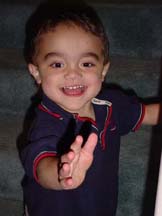
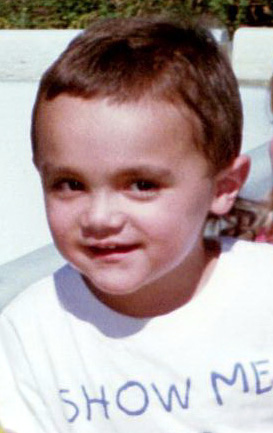
as of February 2002
Justin Lars Marquez was born March 23, 1999 in Glenwood Springs, Colorado. Although labor was just four hours, the pregnancy had been rough. Justin's mom, Paula, had had placenta privia and had been restriced to bed rest for the last six months of the pregnancy. A prenatal screening indicated that our unborn child could have spina bifida. When the results of the amniocentesis cam back we were overjoyed to find out he did not have spina bifida. In fact, the chromosome analysis of our unborn son read "normal male karyotype" (if only we had known he had an error on one of the thousand genes on chromosome 7!)
Justin was born on a Tuesday. When they sent us home they told us to keep him bundled because he was a cold baby. By the following Friday night, due to his lack of interest in breast feeding, the neonatologist ordered us to give him formula. Later that night he had an hour long screaming fit and then fell into a deep sleep. The following morning we couldn't get his attention. He was very dopey and wouldn't drink formula. By Saturday night his temperature had dropped to 95 degrees. We were ordered back to the hospital. All day Sunday they ran every test in the book to try to determine why precious little Justin was comatose. I remember his birth announcement was printed in the newpaper that day and thinking how devastatingly ironic it would be if he died that day.
Children's hospital in Denver suggested that the Glenwood neonatologist run an ammonia level. Four months earlier they had just encountered twins who had been found to have a very rare thing called a "urea cycle disorder". The ammonia test came back and it was a dangerous 340(I later found out that many UCD kids levels got to the 1000 and 2000 range). He was airlifted to Denver. They had us sign release forms to use "experimental" drugs to lower his ammonia.
By Monday morning Justin awoke from his coma. That Monday afternoon a group of doctors came into my son's newborn intensive care cubicle. "Your son has 'argininosuccinic aciduria.' They continued, "you will need to feed him three special medical formulas, give him arginine every eight hours and he won't be able to eat protein."
Now, fast forward past a handful of ER visits and hospitalizations to when Justin turned 8 months old. It was early November, Justin's ammonia had risen to 270. He was put in the hospital and was running a high fever. That's when Justin had his first seizure. A second and third seizure followed and his pediatrician ordered him airlifted to Denver. His first night in Denver Children's included four more seizures.
One of the reasons Justin's ammonia had climbed to 270 was he had been refusing to drink his prescribed quota of cyclinex/prophree/prosobee for three weeks and he had started to catabolize his body protein. Feeding time was unpleasant for both Justin and us. We were under intense pressure from the dietician o get the formula into him yet he did not want to feed. He only wated to drink 2 ounces at a time. We had to feed him every two hours, often in the middle of the night, and even then he was leaving a third of his quota per day. Paula and I were determined that he was not going to leave Denver Children's Hospital without a g-tube.
He spent the next month at Children's Hospital. We began to feel like residents of the hospital. They gave him a nasal feeding tube. He underwent tests to see if he had gastrointestinal reflux disorder, neurological problems, and other maladies. He also underwent his second spinal tap in his fledgling live (the first was when he was five days old but he was too out of it to feel it).
After 10 days in the hospital he contracted rotavirus and was severely miserable for three days. He then had surgery for his g-tube and they took a liver biopsy at the same time. While recovering from getting his g-tube, they fed Justin with a tube that bipassed the stomach and went straight into the intestine. When the liver biopsy came back we were told Justin had a "fair amount" of fibrosis on is liver and that we would have to monitor his liver every few months. He was discharged from Children's Hospital on Paula's Birthday (December 2).
In 2000 Justin was hospitalized for a week at a time in January, February, April, and May, August and September of 2000. Each hospitalization included high fevers and seizures. To our disappointment he had a 200 ammonia in January, a 150 ammonia in February and a 259 ammonia in August (we had hoped the g-tube would prevent hyperammonia episodes since we were now able to meet his formula quota).
In May, Justin was diagnosed with a very rare case of cholera(we have no idea how he got it since he hasn't eaten any raw seafood and we don't know who could have come in contact with someone who already had cholera).
In August I started hearing and reading medical opinion that the high plasma level of argininosuccinic acid kids with ASA have was toxic and was resulting in poor mental development and liver problems. Justin was already exhibiting significant developmental delays. He did not crawl until he was almost 15 months old and was missing walking and talking milestones.
In February 2000 we met with the liver transplant team at The Children's Hospital of Denver and Justin was listed stat three (lowest priority level) on the liver transplant list. In October 2000 he was elevated to status one because of his recurrent hyperammonias. When a one year old girl from Connecticut suffered an unexpected head trauma on or about January 21, 2001 her family decided that their tragedy should become a group of miracles for other children. Justin received the gift of her liver on January 22 at 22 months old.
When the hospital pathologist examined his old liver she found it to be in "a very poor state of affairs" and on the path to failure. Since the transplant Justin has twice the energy, focuses on people and things better and just seems overall to be able to tap his brain better.
Justin spent most of the three months following his transplant in the hospital. He had three rejection episodes, a bout of dangerously high potassium (which later in the year became too low) and he had to have a second major surgery to open a bile duct that had become obstructed because he had prematurely passed the stent holding it open.
In May we stopped his phenobarbital (which some believed was contributing to the rejection episodes because it was making him metabolize his immunosuppression too fast and making his cyclosporine and then prograf levels erratic). And, we added Rapamune to his regimen (the powerful yet different mechanism of this newer immunosuppression agent is just what he needed).
He has been rejection free ever since and with his metabolic problems alleviated.
He was hospital free from May to September.
In September, he came down with a virus and spent a week in the hospital but his liver numbers stayed good.
Between September and December he got sick a few times but his numbers stayed great.
Then on December 23 he became dehydrated and was hospitalized. He was in the hospital December 23, 24th and Christmas Day! However, his numbers stayed great (other than a temporary spike in his Alk Phos possibly related to Bactrim).
His EBV PCR is still zero (boy am I jinxing that. . . I know he can't hide from EBV forever - especially since we're told his donor was EBV+).
In February 2002 he spent a day and a half in the hospital because he came down with influenza A. Regretably, the flu vaccination was very late coming to our town this year and somehow we let getting him vaccinated slip through the cracks. With the fever he got from the flu, his seizure disorder returned. This time since we are convinced more than ever that his seizures only come around when he has a rapid spike in temperature so we are not going to treat them long term. Instead we are going to keep emergency seizure medicine in his travel bag and resolve to reduce any of his fevers ASAP via tylenol and, if possible, a bath.
Justin has come a long way from when he was 5 days old laying in a coma in the hospital - dying from a mysterious illness.
Now he is a happy, active, nearly 3 year old toddler, whose mind has awakened and is re-networking to overcome the damage your disease caused. He loves preschool and is starting to regularly use and understand speech (e.g., "go get your coat, throw that away and shut that door").
Thanks for letting us share,
Joe & Paula Marquez
To see a video discussing the damage argininosuccinic aciduria had done to Justin's former liver click here [warning: takes 1.5-3 minutes to download & video shows his former liver]. To view. . .using Netscape is advised and you need a recent version of RealPlayer. To download free RealPlayer 8 Basic click here.