by Paul Trow
|
Line integrals - which generalize the ordinary integral of freshman calculus to integrals of vector fields higher-dimensional space - are an essential tool in mathematics and physics. One of the most important applications of line integrals is to compute the work performed when an object moves through a force field, such as a gravitational or electromagnetic field. For example, to find the amount of energy required to launch a satellite into orbit, you compute the line integral, along the satellite's trajectory, of the force exerted by the Earth's gravity. The article explains how to compute line integral. It also describes Green's theorem, which relates the line integral of a closed curve to a double integral over the curve's interior. Green's theorem is the idea behind the planimeter, a mechanical device for finding the areas of regions with curved boundaries. The article covers the following topics: |
- Vector Fields
- Curves and Line Integrals
- Conservative Vector Fields
- Green's Theorem and the Planimeter
|
A vector field is a function that assigns a vector to each point in |
|
|

|
Vector fields have many important applications, including the following:
|
|
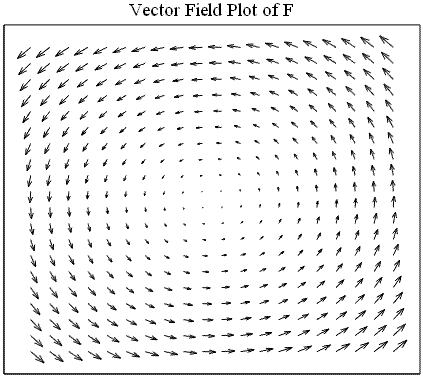
You can visualize a 2-dimensional vector field by creating a vector field plot, which is drawn on a rectangular array of points. At each point (x,y) in the array, an arrow, corresponding to the vector F(x,y), is drawn starting at (x,y). The following graph shows a vector field plot of the vector field F defined above. |
|
|
|
A line integral of a vector field is
an integral defined over a curve. Usually, the curve is parameterized
by a function from an interval of real numbers into the space of
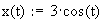
vectors. For example, the following function |
|
|
|
|

|
|

|
|

|
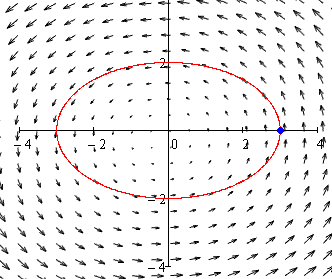
The plot below shows the ellipse. |
|
|
|
The curve traverses the ellipse in the counter-clockwise direction. Note that the initial point, r(0), and the final point, r(2π), of the curve are the same. |
|
|

|
|

|
A curve with this property is called a closed curve. |
|
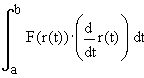
The line integral of a vector field F along a parameterized curve r(t), from |
|
|
|
If F represents a force field, the line integral is the work done when an object moves along the curve from r(a) to r(b). |
|
For a 2-dimensional vector field of the form |
|
|

|
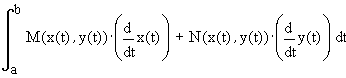
you can write the line integral as |
|
|
|
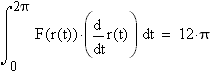
The line integral of the vector field F above around the ellipse is |
|
|

|
|

|
|

|
Alternatively, you can write the line integral in vector form as follows. |
|
|
|
A vector field is conservative if it is the gradient of a scalar function φ, called a potential function. For example, a vector field corresponding to a gravitational force is conservative. For a conservative vector field, a line integral over a curve depends only on the initial and final points of the curve, but not the points in between - that is, the integral is path independent. |
|
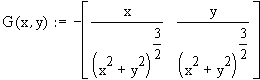
The following is an example of a conservative vector field. |
|
|
|
Note that the G is essentially a two dimensional version of the force exerted on an object by gravity, except that G does not take account the mass of the object. To get the actual gravitational force, you would have to multiply G by a constant (as stated by Newton's Law). |
|
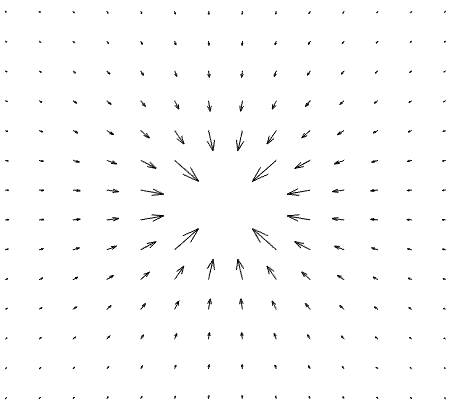
Here is a vector field plot of G. Think of the arrows as representing the force of gravity, which point toward the center of the Earth. Since the gravitational force on an object increases the closer it is to the Earth, the vectors are longer the closer they are to the point (0, 0). |
|
|
|
The coordinate functions of G are |
|
|
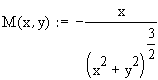
|
|
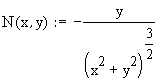
|
To find the potential function φ, integrate M(x,y) with respect to x. |
|
|
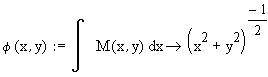
|
You can verify that the gradient of φ equals G as follows. |
|
|

|
|

|
|
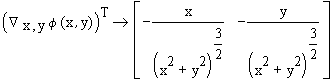
|
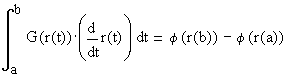
The line integral of a conservative vector field over any curve from r(a) to |
|
|
|
The result depends only on the values of φ at the initial and final points of the curve. For example, the line integral of G over any curve that begins at the point (1,0) and ends at the point (4,3) is |
|
|

|
If you evaluate a line integral of a conservative vector field around a closed curve, the result must be 0, because the initial and final points are the same. If you evaluate G around the ellipse from the previous section, the result is 0. |
|
|

|
On the other hand, the vector field F described in the previous section cannot be conservative, because the integral around the ellipse is not 0. |
|
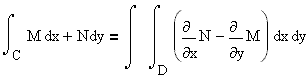
Green's theorem relates the line integral of a 2-dimensional vector field around a closed curve C to a double integral over the region D bounded by C. |
|
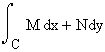
A common notation for the line integral of a 2-dimensional vector field of the form |
|
|

|
around a curve C is |
|
|
|
With this notation, Green's theorem says the following: |
|
|
|
The theorem was first discovered around 1828 by George Green. Green, a mainly self-taught mathematician, did his early research while working in his father's grain mill in Nottingham, England. |
|
Green's theorem provides an alternate way to evaluate line integrals over closed curves. For example, you can compute the line integral of the vector field F over the ellipse C, described in the section Curves and Line Integrals, by evaluating the right-hand side of the equation above as follows. |
|
|

|
|

|
The equation for the ellipse is |
|
|

|
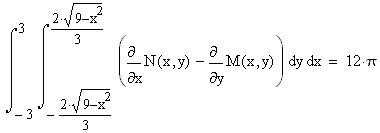
So you can evaluate the double integral on the right-hand side of Green's Theorem as follows. |
|
|
|
The limits of integration on the inner integral are found by solving the equation of the ellipse for y. The limits on the outer integral are found by setting y = 0 and solving for x. The result is the same as for the line integral. |
|
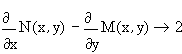
Since the integrand of the above integral is |
|
|
|
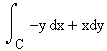
the value of the double integral is twice the area of the ellipse, so the ellipse has area 6π. More generally, for any closed curve C, the value of the line integral |
|
|
|
is twice the area of the region bounded by C. This is the principle underlying the planimeter, a mechanical device for finding the areas of regions with curved boundaries. When you trace the boundary of the region with a planimeter, the device computes a line integral like the one above. |
|
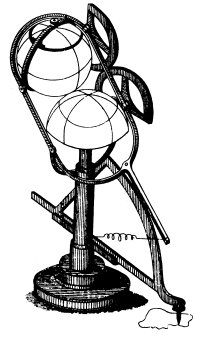
The physicist James Clerk Maxwell, whose pioneering work on electricity and magnetism relied heavily on Green's work on vector calculus, designed an early version of the planimeter. A diagram of Maxwell's planimeter is shown in the figure below. |
|
Download a Mathcad 14 file for this article.
|