A Famous Infinite Series
by Paul Trow
|
As every calculus student knows,
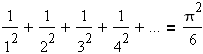
finding the sum of an infinite series can be challenging. A famous
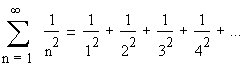
example is the following series, whose sum eluded several of the best
mathematicians of the 17th century. |
|
The problem of finding an exact
expression for the sum of this series was first posed in 1644. Two of
the foremost mathematicians of the time - Leibniz, a co-inventor of the
calculus, and Jacob Bernoulli, one of the founders of probability theory - tried to solve the problem and failed.
It took the greatest mathematician of the 18th century, Leonhard Euler,
to finally obtain the answer in 1735. |
|
To find the sum of the series, Euler started with a seemingly unrelated function: |
|
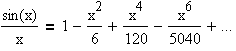
Using standard tools of calculus, he
expanded the function sin(x)/x as a Taylor series. The first four terms of the
series are |
|
Then Euler did something truly brilliant. By an ingenious method, he expressed sin(x)/x as the following infinite product: |
|
You may well wonder how this product,
which looks so different from the Taylor series, could also represent
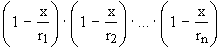
the function sin(x)/x. Let's imagine how Euler might have discovered this infinite product. He probably thought of the Taylor series for sin(x)/x as an infinite "polynomial." He knew that a finite polynomial whose roots are r1, r2, ..., rn, and whose constant term is 1, can be factored as a product of the form |
|
Euler then made a remarkable leap of
faith. He assumed that he could factor the series for sin(x)/x - an
infinite "polynomial" - as a product of the above form. Since sin(x)/x
has infinitely many roots, the product contains infinitely many terms. |
|
The roots of sin(x)/x are the non-zero roots of its numerator, sin(x) - that is, ±π, ± 2π, ± 3π, and so on. (Note that 0 is not a root of sin(x)/x because the limit of sin(x)/x, as x approaches 0, is 1.) Using these roots, Euler factored the series for sin(x)/x as the following infinite product: |
|
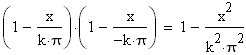
The product of each pair of terms corresponding to the roots kπ and -kπ is |
|
By replacing each pair of terms with the expression on the right, Euler rewrote the infinite product for sin(x)/x as |
|
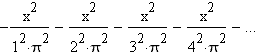
Next, Euler expanded this infinite product as a new infinite series. The constant term in the expansion is the product of all the 1's in the binomial terms above, which equals 1. There is no x term, because all higher order terms are the result of multiplying at least one x2 term. Furthermore, each x2 term comes from multiplying a term of the form |
|
by the 1's in every other binomial. So the x2 terms make up the following infinite sum. |
|
Factoring x2 from each term, and adding the constant term 1, the terms of the expanded product up to x2 are |
|
Euler did not need to expand the product any further - for observe that the coefficient of x2 is exactly the series he was trying to sum, multiplied by -1/π2. So he now had two series for sin(x)/x - the series above and the Taylor series. |
|
Since both series represent the same function, the coefficients of x2 in the two series must be equal. In other words, |
|
Finally, Euler multiplied both sides of this equation by -π2 to get the answer he was seeking. |
|
This is a highly unexpected answer. Why should the sum of the reciprocals of the squares of the natural numbers have anything to do with π, the ratio of a the circumference of a circle to its diameter? The beauty of this result is that it reveals hidden and surprising connections between apparently unrelated ideas. |
Math and Science Articles
| | |