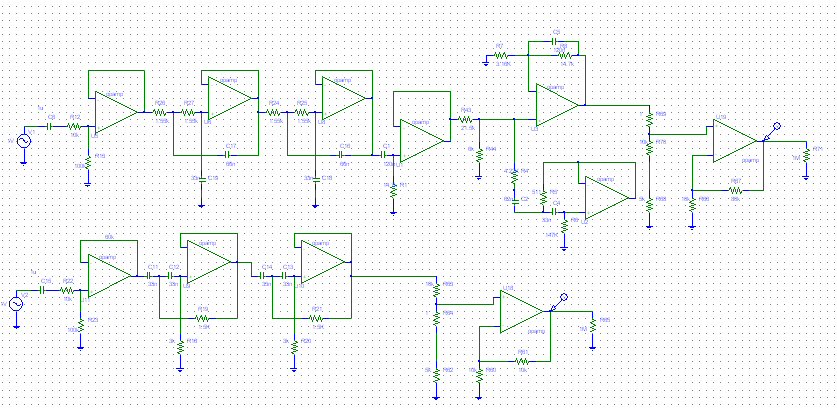
Figure 1: Crossover Schematic
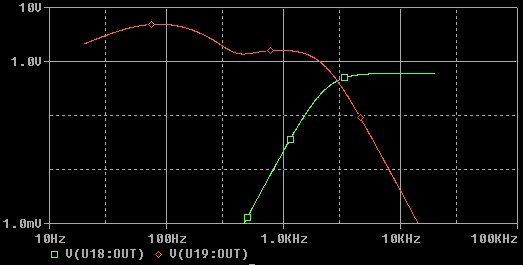
Figure 2: Crossover Schematic Frequency Response
The Shorties are a small dipole speaker. The drivers that they use are the Peerless 850122 and the Focal TC90TDX tweeter. They are called "Shorties" because they were designed to be short, and have an overall height of just over 3 feet. The way that this was accomplished was by looking at the frequency response of the individual drivers and then using them in the Radiation Pattern spread sheet available at the FRD Consortium. This showed a flat response anywhere from 5 degrees to about 15 degrees above the tweeter axis. Many of the design principles are based on those found at Linkwitz Lab. Please visit his website to read more about dipole speakers.
Crossover
I used a 24dB per octave crossover between the tweeter and the midwoofer. I used a board from Elliot Sound Products I created my own filter to deal with the dipole roll-off. You can read all about the preamp/crossover elsewhere on my webpage. Each driver is powered by its own 25W amplifier, which you can also read about elsewhere on this webpage. Here is an image of the crossover schematic:
Figure 2: Crossover Schematic Frequency Response
The Speakers
They sound very nice, the absence of any internal box reflections is audible, as is the advantages of the dipole type speaker. UPDATE I have recently switched to the Focal TC90TDX. It has a better response in the upper half of an octave. After several hours of listening, I feel that I like the focal better. It really gives the music more detail and texture. This was immediately apparent with brass instruments. Vocals also sound more real.
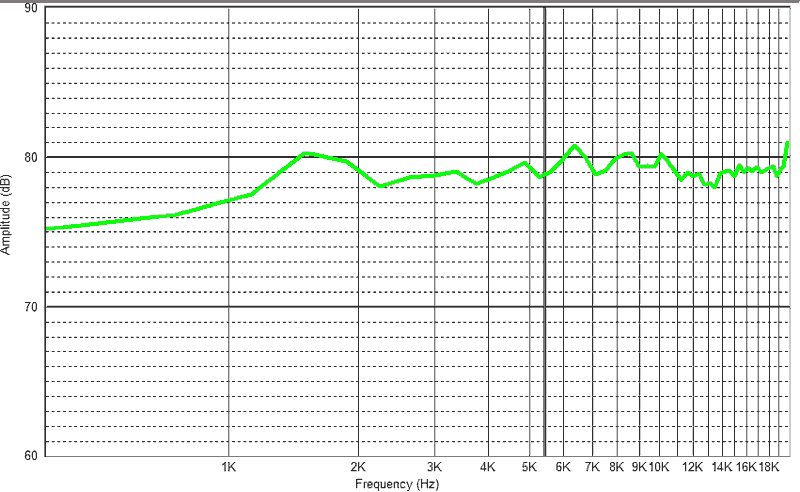
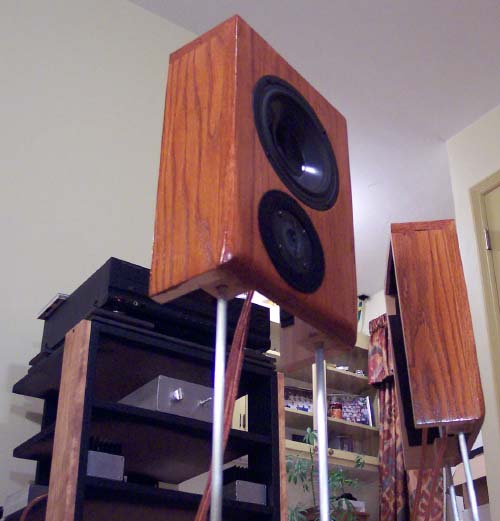
Figure 4: Bottoms Up.
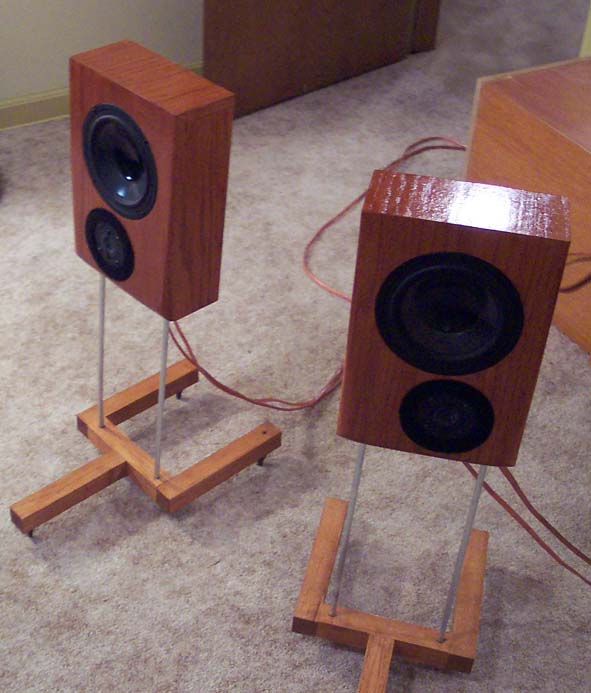
Figure 5: Another Shot.
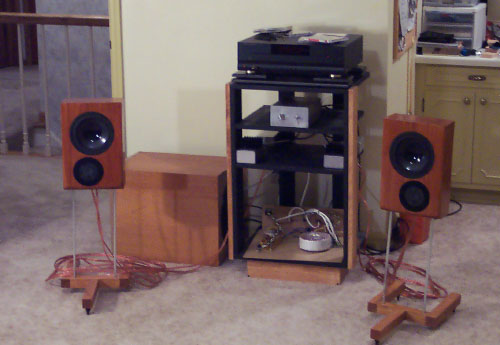
Figure 6: Image of the Shorties in my listening room.
The Woofer - Peerless 850122
Here is the raw measurement for the woofer in red, and the filtered measurement is in green. I get a somewhat similar measurement to the one found on the peerless web site, with a dip around 3 Khz, and a peak at 4Khz, and falling like a rock after. The dipole roll-off is also severe. As you can see with the green measurement, the dipole roll-off is corrected by the filter, and the crossover point of 2.2Khz is realized. I believe that my measurement set-up, whether it be the software or the hardware, has trouble with the lowest few data points that you can see there. I do think that it should be flat through that region, as the raw driver is flat, and the dipole roll-off is a very scientific phenomenon. I am sure that I fully compensated for it in my filter.
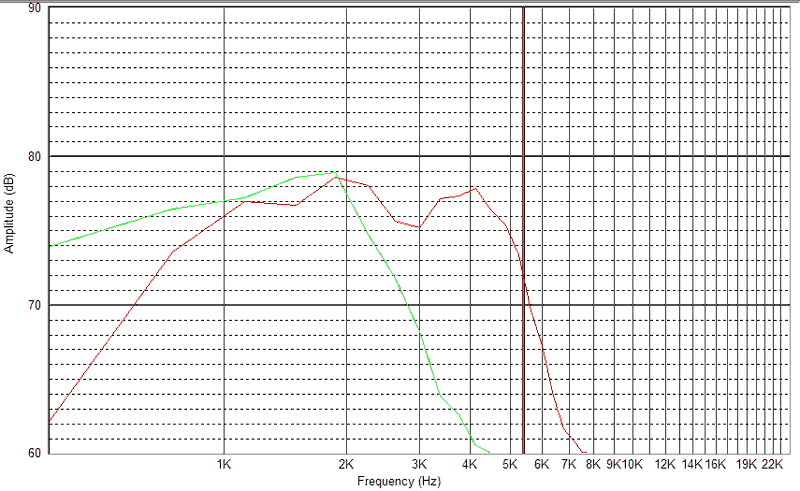
Figure 7: Woofer Response.
The Tweeter - Focal TC90TDX
Here is the raw measurement of the tweeter in red and the filtered measurement in green. This is very similar to the response on the Focal website, with a slight lift between 3 and 10Khz. I am not sure why I get such a large lump at 2Khz though.
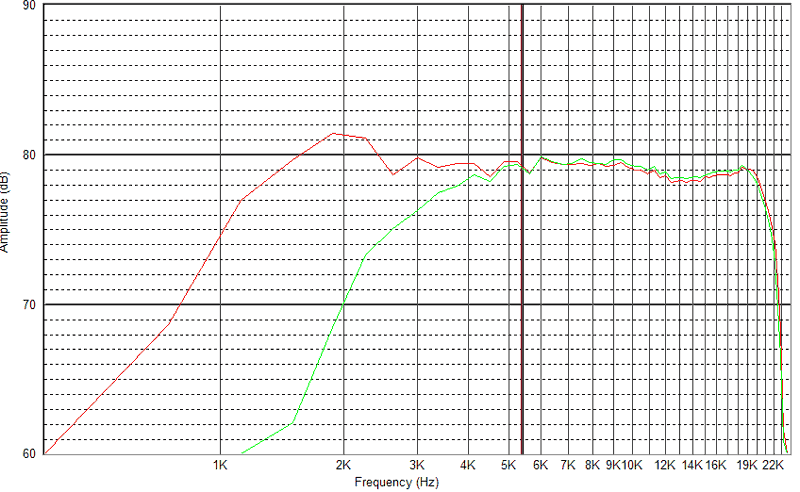
Figure 8: Tweeter Response.
Channel - Channel Matching
This is a comparison of the response of one channel vs. the other channel. I simply used the same speaker and hooked it up to one channel, then the other. This verified that my active crossover was working the same on both channels and that the amplifiers were all working similarly.
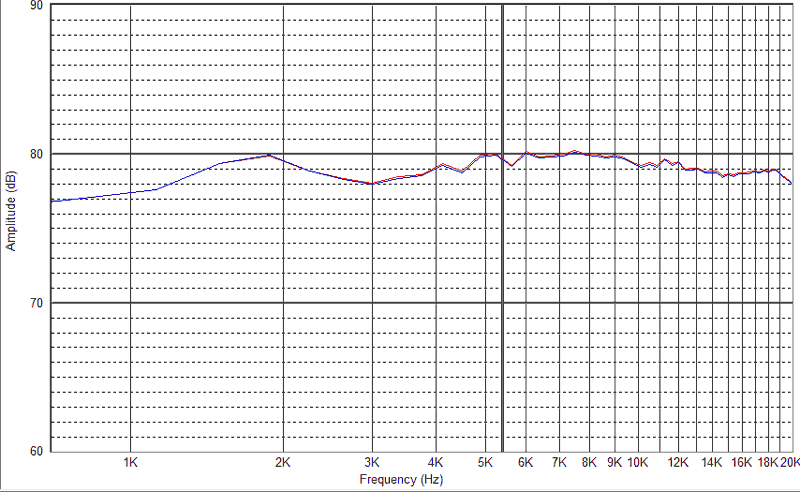
Figure 9: Channel matching.
Speaker - Speaker Matching
This is a comparison with the speakers compared to each other. This shows a very good response of a matching within about .25dB of each other. There is one point at about 5Khz that has a separation of about .5dB, but that is the largest difference. This measurement is very important for the imaging of the speaker. I did notice an improvement in instrument placement after this 'calibration' took place.
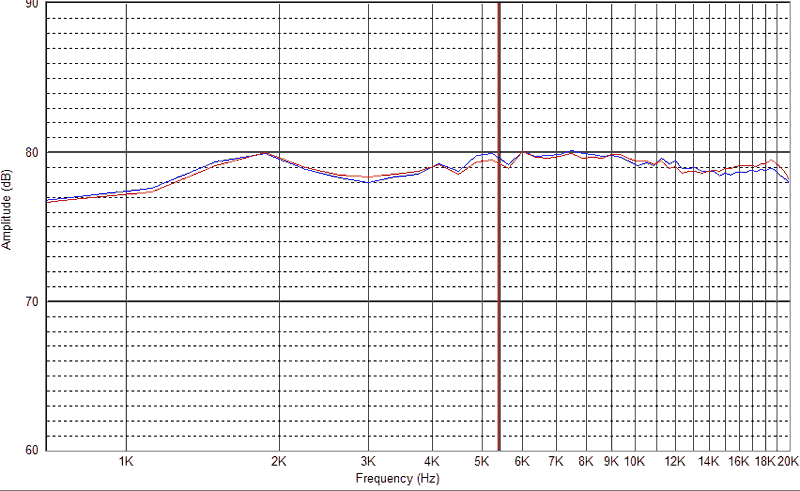
Figure 9: Speaker matching.