.
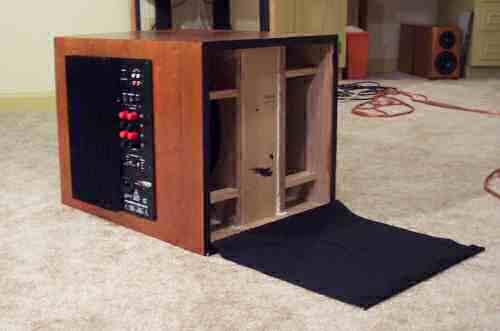
This is a picture of the dipole subwoofer that I use with the system. It uses a 350W amplifier and two 12" Peerless drivers in a standard W-Frame dipole. It is oustanding, and goes very very deep, and sounds very pure.
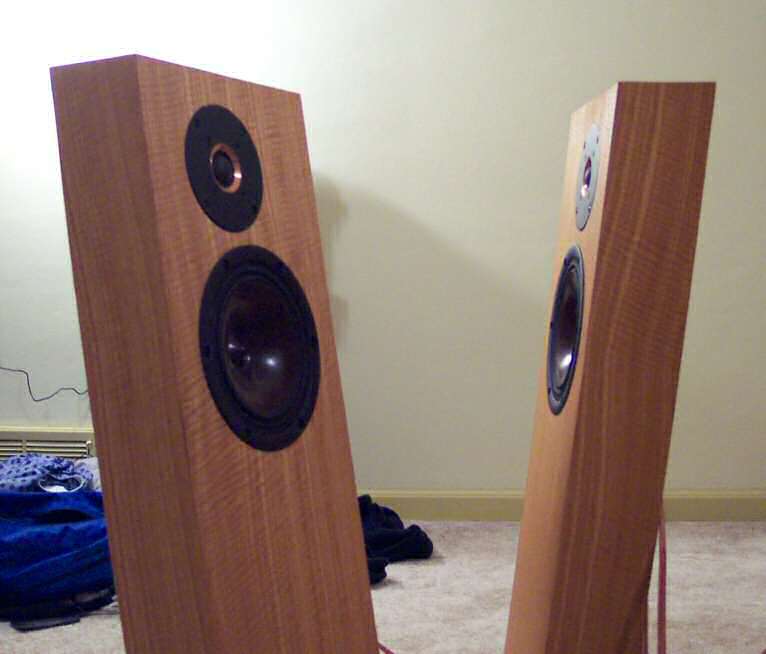
I really enjoy listening to this speaker, it gives me exactly what I want. Albeit I have by no means heard everything there is to hear, it is my current realization of "ultimate". The sound is very lightweight, extremely textured, and to me sounds very accurate. It really feels like you hear every last detail of the music. It is in no way harsh, and is very easy to listen to. The character is a bit sweet and warm, but from many people's opinions, the Millennium tweeter has this character. It is far and away different from the ribbons in this class. I don�t know how exactly to describe the differences, but I am not a fan of the single ribbon I have heard. It is just my preference. The highs are extremely dynamic, the Millennium definitely can bring out the best in many recordings (also the worst) the leading edge of sharp and transient sounds have a whole new feel. Cymbals and snares have the best attack and decay that I have ever heard. The midrange sounds very pure to me. It has a feel to it like I have heard with the Fostex Speaker at DIY Milwaukee, but without the "breathy" forwardness. It has that incredible crispness and presence that the Fostex Full-Range/Super Tweeter had, but it lacks all of the things I did not like about that speaker.
Many of you will notice that I did not round over any of the edges. I did this for several reasons. First, I did work out an optimal location, using the 1.6x1x.6 "golden" ration to locate the tweeter on the baffle. This places it optimally-unequal distances from each edge, to reduce baffle edge diffraction. The main reason that I did not do any roundovers is because the Seas Millennium really doesn�t have the best far-off-axis response. Since the 90 degrees off-axis response is what will result in edge diffraction, I measured it. To put it lightly, it is so far below the on-axis response that it is not going to make much of a difference.
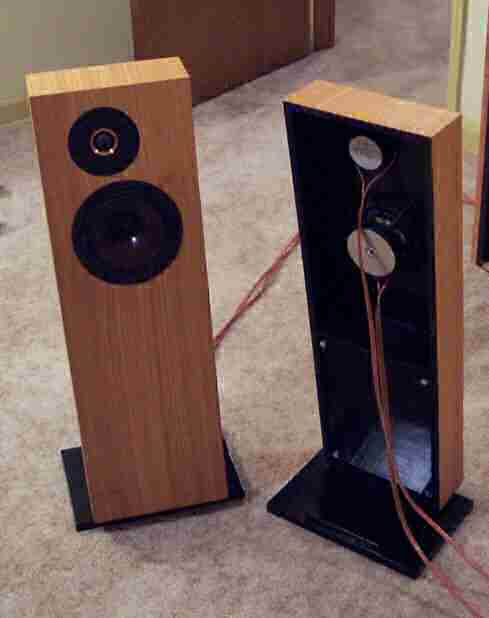
In the picture of the rear, you will notice that there are 4 bolts on the lower rear. Those hold a panel on, behind which you can place a bag of sand, to further anchor the speaker. I may also re-route the wires, so that I actually have connectors, and don't have to lug around big cables every time I want to move them. This also allowed me to put in a horizontal brace about half-way up the speaker to damp baffle vibrations. The baffle is made of .5" MDF
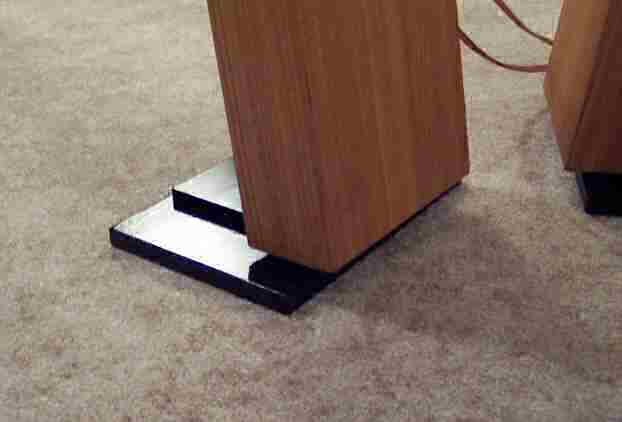
For the base, I wanted to do a hovering look. First, on the bottom is a 9" x 12" .75" thick slab of MDF, on top is a 7" x 10" x .5" piece. The speaker is mounted to this, via three t-nuts in the base. The bolts screw through the speaker, into the base, securing it.
The veneer is Fiddleback Anegre, and I used Boiled Linseed Oil to finish them. I will do a few more coats after this one soaks in and hardens a bit. The base is brushed on gloss black paint. I would highly recommend this finish. It is not nearly as labor intensive as a gloss-black, but gives a good irregular look.
.
This is a picture of the dipole subwoofer that I use with the system. It uses a 350W amplifier and two 12" Peerless drivers in a standard W-Frame dipole. It is oustanding, and goes very very deep, and sounds very pure.