 |
|
| The Emperor Diocletian |
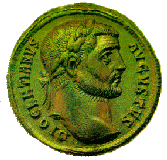
| GAIUS AURELIUS VALERIUS DIOCLETANIUS (c 243-316) is the Latinized name of an ordinary soldier with a Greek name - Diokles - born in the nearest vicinity of the then capital of the Roman province of Dalmatia Salona. He was pronounced emperor on November 20, 284 AD. In order to restore order in Gaul and to prevent usurpation of the throne, he named his friend Maximian as co-regent and placed the western part of the empire under his rule. In 293, the two of them took as co-regents Galerius, married to Diocletian's daughter Valeria and Constanline Chlorus. Diocletian continued to govern directly the Asiatic part of the empire and Egypt from the capital of Nicomedia. He made of the empire an absolutist monarchy on the Persian model. He secured the state borders implemented a new |
| territorial partition of the empire separated military from civilian administration, reconstructing the inner organisation of the army and state bureaucracy, and put in order the financial monetary and tax systems. He ordained that estates be hereditary, binding people in this way to their properties and cities. Diocletian passed a decree limiting prices. He took away from the Senate their former rights. Rome was no longer the capital. Although initially tolerant of Christianity, in 303 he issued an edict in Nicomediam in which he prohibited it. This brought about numerous executions, the confiscation of property, and the destruction of churches. On May 1, 305 he abdicated (persuading Maximian to do likewise), and retired to the palace he had prepared for his retirement. His biographer, Lactantius, a writer of little talent and even less honour, describes Diocletian's "implacable passion to build", without mentioning his Split palace nor the monumental baths he had built in Rome, which he had visited probably only once. During the half century before his appearance there were no less than twenty emperors proclaimed by the Senate and at least as many usurpers and pretenders. Diocletian's seemingly fortuitous rise to power was not a mere episode but he succeeded to rule for two decades and lived to see a long retirement after abdicating, which amounts almost to a miracle. It can be stated that it was thanks to him that the Empire at least in the East, was rescued. The faces of Diocletian and his wife Prisca can be made out on the busts in the medallions of the frieze inside the Mausoleum (today's Cathedral). |
| Diocletian's Palace |
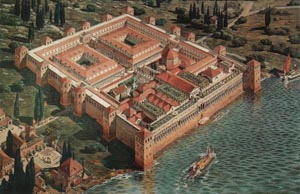 |
| At the end of the third century AD, the Roman Emperor Diocletian built his palace on the bay of Aspalathos. Here, after abdicating on the first of May in A.D. 305, he spent the last years of his life. The bay is located on the south side of a short peninsula running out from the Dalmatian coast into the Adriatic, four miles from the site of Salona, the capital of the Roman province of Dalmatia. The terrain on which the palace was built slopes gently seaward. It is typical karst terrain, consisting of low limestone ridges running east to west with marl in the clefts between them. This palace is today the heart of the inner-city of Split where all the most important historical buildings can be found. The importance of Diocletian's Palace far transcends local significance because of its level of preservation and the buildings of succeeding historical periods, |
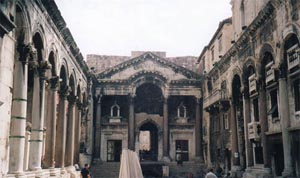
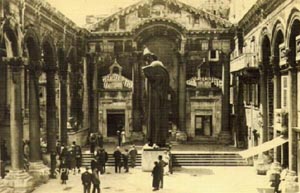
| stretching from Roman times onwards, which form the very tissue of old Split. The Palace is one of the most famous and integral architectural and cultural constructs on the Croatian Adriatic coast and holds an outstanding place in the Mediterranean, European and world heritage. In November 1979 UNESCO, in line with the international convention concerning the cultural and natural heritage, adopted a proposal that the historic Split inner city, built around the Palace, should be included in the register of the World Cultural Heritage. The ground plan of the palace is an irregular rectangle with towers projecting from the western, northern, and eastern facades. It combines qualities of a luxurious villa with those of a military camp. Only the southern facade, which rose directly from, or very near to, the sea, was unfortified. The elaborate architectural composition of the arcaded gallery on its upper floor differs from the more severe treatment of the three shore facades. A monumental gate in the middle of each of these walls led to an enclosed courtyard. The southern Sea Gate was simpler in shape and dimensions than the other three. Perhaps it was originally intended as the emperor's private access to boats, or as a service entrance for supplies. The dual nature of the architectural scheme, derived from both villa and castrum types, is also evident in the arrangement of the interior. The transverse road (decumanus) linking the east and west gates divided the complex into two halves. In the southern half were the more luxurious structures; that is, the emperor's apartment, both public and private, and cult buildings. The emperor's apartment formed a block along the sea front. Because the sloping terrain created large differences in level, this block was situated above a substructure. Although for many centuries almost completely filled with refuse, most of the substructure is well preserved, giving us evidence as to the original shape and disposition of the rooms above. A monumental court, called the Perystile, formed the northern access to the imperial apartments. It also gave access to Diocletian's Mausoleum on the east, and to three temples on the west. |
 |
 |
| The northern half of the palace, which was divided in two parts by the main longitudinal street (cardo) leading from the North Gate to the Perystile, is less well preserved. It is usually supposed that each of these parts formed a large residential complex, housing soldiers, servants, and possibly some other facilities. Both parts were apparently surrounded on all sides by streets. Leading to perimeter walls there were rectangular buildings, possibly storage magazines. |
| Post-Diocletianic Development |
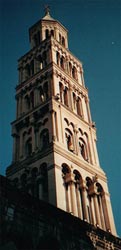
| After Diocletinan's death, the palace remained an imperial possession, and was probably used by members of the imperial families at least until A.D. 480. The Notitia Dignitatum mentions that textile production was carried on there. In the fifth century a cross was carved on the architrave of the west gate over a bas relief of Victory. This is the earliest evidence of Christianity within the Palace. The final transformation of the Palace into a town took place in the seventh century. When Salona was destroyed by an invasion of Avars and Slavs shortly after A.D. 612, some of the survivors took refuge in Split. According to a thirteenth century writer, only the richer refugees built houses; others settled in the towers and substructures of the old palace. The new residents brought some of their old institutions with them. The most important of these was the ecclesiastical organization, which was reorganized and revived by the archbishop John of Ravenna. His program caused significant adaptations in the Palace. He turned Diocletian's mausoleum into a Christian church. Probably the Temple of Jupiter became a baptistery at the same time. These changes can be taken as inaugurating the early medieval period in architecture and art, which is generally considered to last until the end of the eleventh century. Other Roman buildings adapted for the needs of the new inhabitants during the medieval period included St. Martin's chapel in the Roman sentries' gallery above the north gate, and another chapel above the west gate. During most of the first period of urban life, Split was under Byzantine administration, while the surrounding area was settled by Croatian Slavs who were ruled by their native princes, initially the vassals of Frankish kings. The Croatian rulers were developing a state which had the social structure of a tribal community. The existence of this Slavic population outside must have had its influence on the ethnic composition of Split itself. We have little evidence about the nature or rate of Croatian penetration into the town. In the tenth century Constantine Porphyrogenitos said that the inhabitants of Split and other Dalmatian coastal cities were still called Romani. Some Croats had apparently already settled there, however, because a sarcophagus inscription from the same century commemorates a man born in Split, whose father had a Slavic name, and who became Archbishop. From the eleventh century on, city records mention citizens whose names are Slavic in origin. By the thirteenth century, many members of the town council were Slavs. Several times in the tenth and the eleventh centuries Split came under the rule of Croatian Kings. At the beginning of the twelfth century it, like other Dalmatian towns, became a free commune under the direct authority of a Hungaro-Croatian king. This political position benefited the economic and architectural development of Split. The extent of its urban territory doubled, spreading out west of the palace. The new process radically changed the original town plan by reducing the width of ancient streets and lining them with Romanesque and Gothic houses. The ancient Peristyle, probably both the religious and the municipal center of the early medieval town, by the end of the Middle Ages retained only the role of an ecclesiastical square, architecturally dominated by the Romanesque bell tower of the Cathedral. The municipal center had moved to the new part of Split west of the Palace. At the beginning of the fifteenth century, the medieval free commune was replaced by a Venetian administration which lasted until the end of the eighteenth century. Noblemen built mansions in the late Gothic and early Renaissance styles, the finest of which are whose designed by Juraj Dalmatinac and his school. The fortified building complex (Castello) southwest of the palace was one of the most outstanding buildings of the period. The second stage of Venetian rule was characterized by artistic and architectural stagnancy caused primarily by frequent wars between Venice and Turkey. A few Baroque mansions of modest values were built, but the greatest visual impact was created by the strong polygonal fortifications which encompassed the whole town. At the beginning of the nineteenth century, after a short period under French rule, the town fell under the Austrio-Hungarian empire (1813-1918). It then expanded far beyond its earlier boundaries and absorbed several rural settlements which had grown up around it during the Middle Ages. It was given an important role as an administrative, cultural and, in particular, economic center; factories were erected and the harbour obtained greater economic significance. After World War I, the role of Split as a cultural, administrative and economic center became still greater, reflecting the town's expansion and large population influx. Following the Second World War, during which the town suffered from frequent bombing raids, the most dynamic development of Split began. |
| Salonae - Salona (Solin) |
| Salona was a stronghold and a harbour of the Illyrian Delmati which quite early came into the sphere of influence of the Greeks on the Adriatic. Julius Caesar, who was then the governor of Illyricum gave it the rank of a colony (Colonia Martia Julia Salona) - the center of the province of Illyricum and afterwards of the province of Dalmatia. It developed into a cosmopolitan centre of the Adriatic. The high point of its expansion was during the time of Diocletian when it received the honorary title Valeria, which as a family name belonged to the emperor himself. In the period between the IVth and Vlth centuries Salona became an important centre of Christianity. It fell before the onslaught of the Avars and Slavs around the year 641. The Illyrian core of the city has been discovered recently. A segment of the city walls with a monumental gate (Porta Caesarea) and towers has been preserved from the first Roman phase. The city quickly spread to the East and West and in the IInd century was enclosed with new walls. |
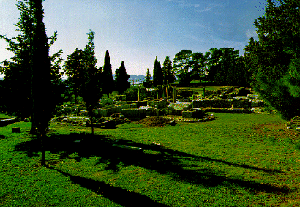 |
| The Forum was located in the centre of the city near the sea. In the Ist century a theatre and baths were built next to it. A much better preserved complex of baths was found to the East of the later bishop's basilica in the eastern part of the city. Here we also find the sumptuous Villa Urbana known for its mosaics with depictions of Apollo Orpheus Triton (now kept in the Split Archaeological Museum). Within the fortification system in the north-western corner of the city an amphitheatre was raised in the IInd century. The great city necropolis containing some of the most famous sarchophagi in Solin stood alongside the road that led to Tragurium (necropolis in horto Metrodori). Christian grave yards with basilicas grew on pagan necropoles. The oldest basilica is the one known as "the basilica of the ve martyrs" on Kapljuc next the city walls. The most complex is the one on Manastirine, the starting point of most walks through Solin. The most interesting in view of new architectural solutions, is the Early Christian necropolis on Marusinac. Two large basilicas (geminae) stood in the new Christian centre of Salona. The northern one had three naves, a baptistry and the episcopal palace that was organically joined to it. During the last phase the southern one received a cross-like ground plan. Both were connected with a narthex. It is important to mention that eight additional basilicas have been explored within the city perimeter. Most of the movable monuments from Salona are kept in the Archaeological Museum, in Split which was founded in 1821. The old Croatian Solin grew alongside the river Jadro to the East of the ruins of the Antique city. The churches built by the Early Medieval Croatian rulers have been thoroughly investigated: St Mary's and St Stephen's churches, the royal mausoleums alongside today's church of Our Lady of the Isle, where the famous table containing queen Jelena's epitaph was found, the church in Gradina (possibly a reused Early Christian edifice) and King Zvonimir's coronation "Hollow church" (Xlth century) built on the foundations of one of the most monumental Early Christian basilicas on the eastern Adriatic coast. The remnants of the Benedictine monastery in Ritince beneath Klis lie a little further from this spot. A number of Old Croatian necropoles have been explored in the surrounding area. The finds are presented in the Museum of Croatian Archaeological Monuments and in the Archaeological Museum in Split. |
| Middle Dalmatia |
 |
 |
 |
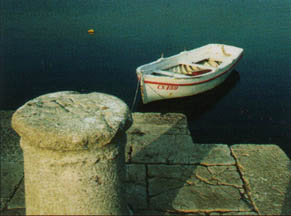 |
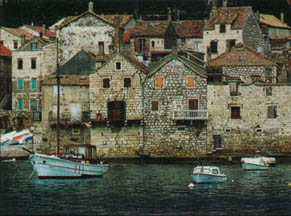
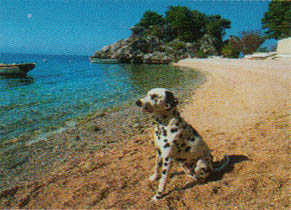
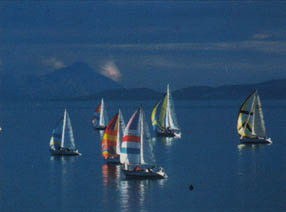
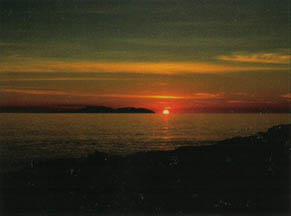
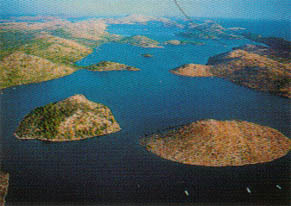
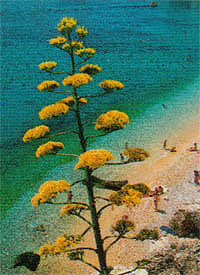
| Because of its central position on the eastern coast of the Adriatic sea, the district of Split and Dalmatia has always had an extraordinary cultural and historical role. This entire rounded area consists of a wide hinterland through which flows the river Cetina, and of a coastal belt with an archipelago with many islands. Generous nature has garnished this rich and heterogeneous area with hidden bays, beaches, cliffs, karst, emerald groves, sea straits and vast high seas. The islands of Brac, Solta, Hvar and Vis are wide, with beautiful landscapes and hierarchies of bigger and smaller settlements. The towns and smaller settlements seem to be threaded on a string along the coast. The hinterland, to which even the breath of the Mediterranean reaches, consists of a mountainous landscape with karst, wide fields and settlements, among which Sinj and Imotski have got urban characteristics. |
 |
 |
 |
 |
| On the coast, the crossroads of continental and sea - ways, during the prehistoric and ancient era, the town of Salona has developed as the metropolis of the Roman province Dalmatia, whose role was taken over by Split in the early Middle Ages. From the 5th to the 2nd century B.C, the Greek colonists have founded some urban settlements on the islands and on the land. The emperor Diocletian, who was of Dalmatian origin himself, has had a huge palace built, into which he withdrew in the year 303. The Diocletian's palace became the centre, out of which the medieval town of Split has developed. Therefore, it is understandable that the medieval Croatian rulers have had many churches and mausoleums built on the ruins of Salona, near Split. This extraordinary beautiful area abounds in cultural monuments. The Diocletian's palace is recorded into the UNESCO register of monuments of universal importance. The peculiar characteristic of this area is the masonry, because this region abounds in stone. No wonder that many famous builders and sculptors originate from this area. The most famous monument of the Dalmatian masonry is the portal of the cathedral in Trogir, which was chiseled out by the master Radovan in the 13th century. However, worthier than single buildings are the rural and the urban settlements in this region, fused with its natural frame, with rounded contours and polished masonry, which can be considered collective pieces of art. |
 |
 |
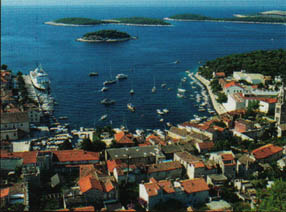 |
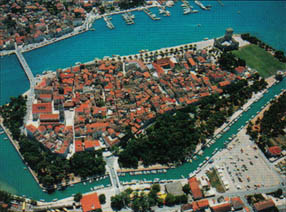
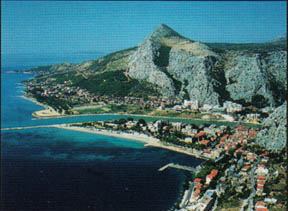
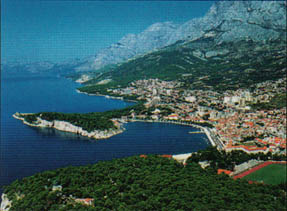
| Trogir with its condensed contours, situated on a small island seems to be a castle on the water with the prisms of its towers and crystals of its bell - towers. The tiny town of Omis under the fortress situated on the mouth of the river Cetina has got an almost pathetic scenery with cliffs and rocks in the background. The town of Hvar grows steplike, with its facades one above the other, always turned towards the sun and the high seas. In the background of the urban centre of Makarska one can see the slopes of the mountain of Biokovo, under which there are many beaches and clear blue sea. Split, which has developed out of the Diocletian's palace is the most imaginative town of Dalmatia, with complicated spatial relationships, medieval houses and churches built on the ruins of imperial chambers. Split is therefore a town with secret historical semantics, especially concernlng imperiai memories. |
 |
 |
 |
| Makarska |
| Hvar |
| Omis |
| Trogir |
| The City of Split - Celebrating 1700 years Anniversary |
 |
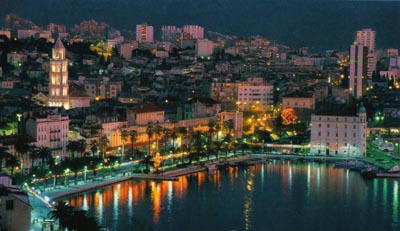
| Split is the economic and administrative center of Middle Dalmatia, with about 300,000 inhabitants. |
 |
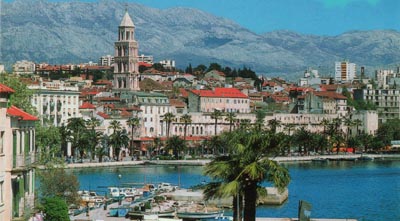 |
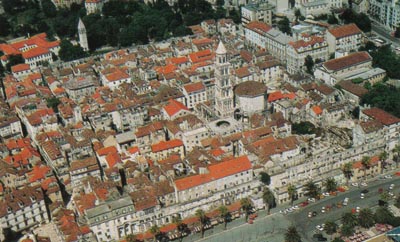
| It is also the jumping-off point for exploration of the coast and islands of the beautiful Croatian Adriatic. The site was first settled when, at the end of the third century AD, the Roman Emperor Diocletian built his palace here. The importance of Diocletian's Palace far transcends local significance because of its level of preservation and the buildings of succeeding historical periods built within its walls, which today form the very heart of old Split. |
 |
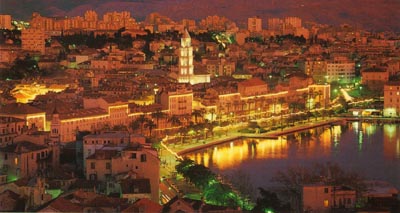 |
| Split's growth became particularly rapid in the 7th century, when the inhabitants of the destroyed Greek and Roman metropolis Salonae (present-day Solin) took refuge within its walls. The lovely ruins of Solin outside the city can still be explored today. In the Middle Ages, Split was an autonomous commune. Many of Split's historical and cultural buildings can be found within the walls of Diocletian's Palace. In addition, numerous museums, the National Theatre, and old churches and other archeological sites in the Split region make it an important cultural attraction. |
 |
 |
 |
| Split is a busy port, with an international airport and regular ferry services with the nearby islands, the north and south Adriatic, Italy and Greece. The merchant and passenger ships of the Split shipyards may be encountered in almost all the seas of the world. In addition, the city has large chemical works, metallurgy plants, and workshops for the production of solar cells. The fertile fields around Split represent a good base for agriculture, while cultural monuments, superb landscapes and unparalleled seascapes make it a tourist's wonderland. Split is also a university seat and host to numerous scientific institutions. |
| Croatian National Theatre |
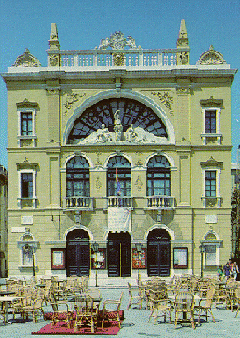 |
| Located downtown Split. It was built in the Neo-Renaissance style from 1891 until 1893 designed by the architects Vecchietti and Bezic. The great fire in 1971 ruined most of the theatre. Restoration was finished in 1979 by architect Rasica. |
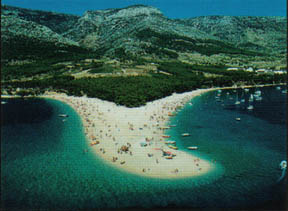
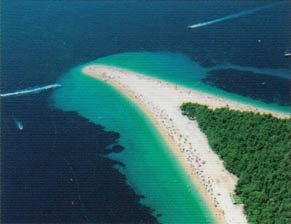
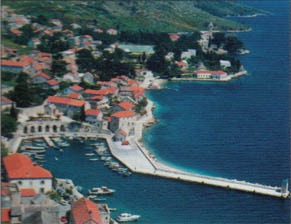
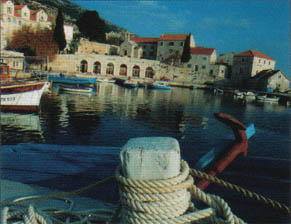
| Island Brac |
 |
 |
 |
 |
 |
 |
 |
 |
 |
 |
 |
 |
 |
 |
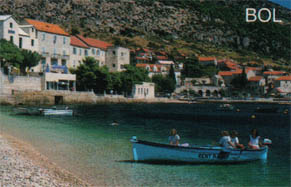
| BOL |
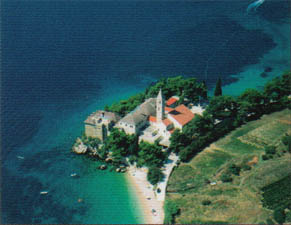
| BOL |
 |
|
|
|
|
|
|
|