JULIUS CAESAR
The AP English Language and Composition exam come to life ... with deadly consequences. Brutus scores a two, while Mark Antony gets a perfect five. The only thing left at that point is to go to war.
MACBETH
Part of what I see as an ongoing dialectic of thought and action in Shakespeare's plays. Macbeth is, to me, the anti-Hamlet. Hamlet has exquisite control over his thoughts, but he can't act. Macbeth has no control over his own imagination, and all he can do is to perform bloody actions that he knows are wrong. Despite Macbeth's lack of control over his own mind, he has some of the best speechs in all of Shakespeare. His reaction to his wife's death is perhaps the most profound statement of nihilism that you can find anywhere -- a poor player up on stage insulting not only his own performance but calling the playwright himself an idiot.
THE SONNETS
What interests about reading Shakespeare's sonnets as a collection is the interplay of persona and audience. Who exactly is speaking, and to whom? Most of the poems are written as apostrophes, but clearly not all to the same person. Although we want to assume that it is Shakespeare himself speaking, we can't necessarily make that assumption; we can only consider the persona a fictional character. That makes the interplay of persona and audience no less intriguing, though.
THE TEMPEST
O brave new world: This play fascinates because the world that it creates is unique in all of Shakespeare. It is a world of great possibility, yet it reverts to the control of its sole native inhabitant at the end of the play.
ABOUT THE IMAGE
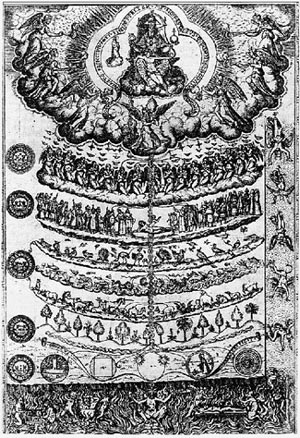
I chose the image of the Great Chain of Being because it explains much of what goes on in Shakespeare's worlds. When Macbeth kills Duncan, all of nature reacts because the very order of the universe has been disturbed. At the same time that W.S. presents this divinely ordered notion of the universe, though, I think that he often seems to give us an alternative view; ultimately, I think, it is a human-centered universe that he posits for us, one in which all of the richness and diversity of human types can be found.