BUSH FAMILY FILES
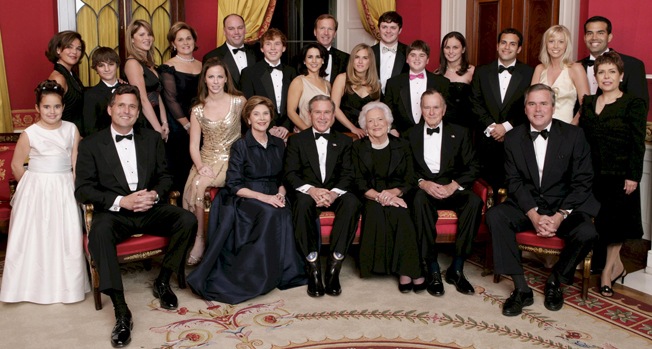
President George W. Bush, Laura Bush, former First Lady Barbara Bush,
and former President George H. W. Bush sit surrounded by family in the
Red Room at the White House. Also pictured
are, from left, Georgia Grace Koch, Margaret Bush, Walker Bush, Marvin
Bush, Jenna Bush, Doro Koch, Barbara Bush, Robert P. Koch, Pierce M.
Bush, Maria Bush, Neil Bush, Ashley Bush, Sam LeBlond, Robert Koch,
Nancy Ellis LeBlond, John Ellis Bush, Jr., Florida Gov. John Ellis
"Jeb" Bush, Mandi Bush, George P. Bush, and Columba Bush.
The Bush Family and The Third Reich
Bush's family were actively financing the Nazis from the 1920's through 1942.
After the seizures in late 1942 of five U.S. enterprises, he managed on behalf of Nazi industrialist Fritz Thyssen, Prescott Bush, the grandfather of President George W. Bush, failed to divest himself of more than a dozen "enemy national" relationships that continued until as late as 1951, newly-discovered U.S. government documents reveal.
Bush - Nazi Dealings Continued Until 1951 - Federal Documents Prove
Furthermore, the records show that Bush and his colleagues routinely attempted to conceal their activities from government investigators.
Bush's partners in the secret web of Thyssen-controlled ventures included former New York Governor W. Averell Harriman and his younger brother, E. Roland Harriman. Their quarter-century of Nazi financial transactions, from 1924-1951, were conducted by the New York private banking firm, Brown Brothers Harriman.
Prescott Bush, 1.5 Million Dollars, and Auschwitz: How the Bush Family Wealth is Linked to the Jewish Holocaust
The American Nazification
Journalist John Buchanan discusses how his research led him to uncover the deep and historical ties between the Bush family and the Nazi war machine. Buchanan's endeavors led to highly respected newspapers such as the London Guardian covering the story.
John Buchanan has been an investigative reporter/journalist for 35 years and has worked in every media market in the US and written for more than 100 newspapers and magazines nationally and internationally.
In September 17, he became the first journalist in US history to go to the US National Archives and Library of Congress to go over the thousands of pages and documents at both places to prove beyond a shadow of a doubt or refutation of the facts that Prescott Bush (the grandfather of president Bush) and George Herbert Walker (whom G.H.W. Bush was named after) were Nazi traitors to the country who should have been tried for treason.
The London Guardian reported on these facts nationally on September 25, 2004. They flew reporter Duncan Campbell over to Washington to take John Buchanan with him back to the National Archives and Library of Congress to confirm that these documents were real and not forged.
The article's headline read:
"Rumours of a link between the US first family and the Nazi war machine have circulated for decades. Now the Guardian can reveal how repercussions of events that culminated in action under the Trading with the Enemy Act are still being felt by today's president."
How Bush's grandfather helped Hitler's rise to power
The Guardian Report
The Bushes and The Nazis: Alex Jones Interviews John Buchanan
Reporter John Buchanan and Alex discuss new revelations on how the Bush family helped Hitler rise to power.
Prescott Bush is the grandfather of George W. Bush, and father of George Herbert Walker Bush, and George H.W. Bush is named after his father-in-law, George Herbert Walker.
Prescott Bush graduated from Yale University in 1917 and was a member of Skull & Bones with E. Rolland Harriman, the younger brother of W. A. Harriman.
The Bush family at this time was not well known and were essentially "social climbers" and opportunistic people. At the time that Prescott Bush met Dorothy Walker he was a tire salesman. George Herbert Walker wanted to improve his son-in-law-to-be's social status and so brought Prescott into his business with Brown Brothers Harriman and then Union Banking Corporation. This was essentially a Nazi money laundering system and not a bank. They owned a shipping line company called Hamburg American Line, which was the first Nazi business seized. Although the line was no longer operational in 1942, in the early 1930s it transported Nazi spies into the US and their promotional ads offered cash rewards to any American citizens who would go back on Hamburg American Line and proselytize for Hitler. Eight months after the US had entered the war, the New York Herald Tribune ran a front page article, Thyssen Has $3,000,000 Cash in New York Vaults in the July 31, 1941. This caused a major scandal and rocked the world of politics. Brown Brothers H, which GHW & Prescott were partners in, worked with IG Farben, the German chemical conglomerate that built and operated Auschwitz and 40 other slave labor death camps. The Rockefeller's Standard Oil of NJ (today known as EXXON) was half owner of IG Farben.
Prescott Bush did a number of things both anti-American as well as pro-Hitler. He did all he could to proselytize for Hitler and the rise of his Third Reich, because the largest client, Fritz Theissen, of his patron W. A. Harriman dictated what kind of behavior he practiced to his own career. So he was but on the board of directors of Union Banking Corp, and was a shareholder in UBC along with Harriman.
The documents clearly state that all the shareholders were phantom shareholders for Fritz Theissen and did his bidding directly. The point being they did not buy these shares of stocks as a passive investment to profit from the war, but they were directly doing the bidding of the individual who built the Nazi war machine.
Documents discovered at the Library of Congress show the hearings of McCormick-Dickstein committee of November, 1934, show Prescott Bush, JP Morgan, DuPont family, Remington family, General Motors elite, etc, tried to overthrow the government, assassinate FDR and put into place a Hitler style fascist state into place. They were going to follow Hitler�s model, impose martial law, round up unemployed people, criminals and Jews, and put them in internment camps, if not exterminated.
1934 - Coup d'etat attempt by JP Morgan, the DuPonts, GM people, American Legion reps, Turned to Smedley Butler, former Marine Commandant who allegedly turned over information to Roosevelt. Was forced to resign as Commandant after he called Mussolini a Dictator. Fortune Magazine, a Henry Luce publication, praises Italy's Mussolini. McCormick-Dickstein hearings into coup attempt confirmed it, but the report was not immediately released. Gold Reserve act passed. Made private ownership of gold bullion illegal, made gold notes redeemable for paper money only in America, but could still be redeemed for gold from overseas. Multinational corps could take in notes, cash in from overseas subsidiaries. Teagle starts at Standard Oil, starts drilling for oil in Hungary. United States Chamber of
Commerce issues report "Combating Subversive Activities in the United States," that blueprinted a legislative and intelligence program against the political left that would last through the 1950's, maybe beyond. Report demanded passage of anti-subversive legislation, including a sedition law and demanded an agency within the Justice Dept. be created to deal with subversive activities. A supervisor from the "Nazi Labor Front" rides with every shipment of the Harriman-Bush line. Further, employees of the New York offices were directly organized into the Nazi Labor Front organization. Hamburg-Amerika provides free passage to those going to Germany for propaganda purposes. The Line also subsidizes pro-Nazi newspapers.
GM President William S. Knudsen says Germany is "the miracle of the twentieth century."
This coup failed because they put the wrong General in place to lead it. General Smedley D. Butler worked with plotters just long enough to identify them, and blew the whistle on them to Congress. After being warned by the FBI, Justice Dept., and Treasury Dept to cease and desist any of their Nazi dealings, they continued them until 1951. There had been 28 additional seizures of Nazi assets and business fronts in America from late 1942-1951, and found that they had moved Nazi assets to banks in Switzerland, Brazil, Argentina and Panama and they had continued to do business with Nazi patron, and German industrialist Fritz Thyssen, the original backer of Adolf Hitler, and the wealthiest man in Germany. Thyssen and his partner F. Flick had essentially built the Nazi War Machine along with I.G. Farmann.
(Thyssen Funds Found in U.S. New York - $3,000,000 fund established in US)
When Thyssen died, US Banking Corp. was liquidated by the US Government, and Prescott received 1.5 million dollars for his holdings in the Nazi business, and this was the origins of the Bush family fortune.
George Bush takes his philosophical inspiration from the Thule society, Skull & Bones, and groups alike in which reflect the Nazi idealism and philosophy. Men such as Carl Rove are the masters of propaganda like Joseph Goebbels and Hermann Goering.
Auschwitz was a model for the type of corporate efficiency that people like Rockefeller would have liked to apply to a slave-like labor force worldwide and that globalization is now gradually bringing about in an incremental, and therefore almost invisible, way.
Following WWII the top stock holders and lawyers of IG Farben created the CIA, after importing thousands of Nazi intelligence officials into the US, and then became its earliest directors. The pharmaceutical and chemical companies that IG Farben was broken up into after WWII are today's biggest Bush supporters and they continue to carry out a worldwide program of eugenics via the pharmaceutical drugging of almost 70% of Americans, dangerous vaccines, invented diseases like AIDS, and the creation of thousands of new viruses via DNA technology.
The human genome project is headquartered at the actual building complex where both the American and Nazi eugenics programs were started, Cold Springs Harbor, NY. When Bush says that Americans living longer is the cause of the social security problem, he's subtly hinting at what their real "solution" to this problem is going to be, what I termed in an essay written in 2000, The Profitability of An Early Death. Bush's efforts to eliminate class action lawsuits against drug and vaccine makers is one step in preparation for a planned mass kill-off of "useless eaters.� Hitler used inefficient concentration camps while today's eugenicists will use other far more efficient means to reduce unwanted population, often without their victims ever leaving their homes. The Bush family connection to Standard Oil/IG Farben and to eugenics goes back more than 100 years to Samuel Bush and continues through every subsequent generation. As just one example of this continuity, GW Bush's father, former President Bush, was both CIA director and director of the Eli Lilly pharmaceutical company before becoming US President. As UN ambassador he publicly lauded Rockefeller and others efforts to revive a world-wide eugenics style population reduction of minorities and repeatedly endorsed, a New World Order, word for word taken from Hitler's own speeches. The Bush administration is nothing other than the recreation of the IG Farben oil, chemical, munitions and pharmaceutical corporate identity as an official government - unfortunately our government. Condoleezza Rice, a former EXXON executive, is now our Secretary of State. No US corporation was more inextricably tied up with the Nazis than was Standard Oil/EXXON. Eugenicists like Bush understand propaganda better than anyone.
Discussion Link
The two principal German organizers of this Hitler takeover, were Hjalmar Schacht and Fritz Thyssen. Both men were operatives of the British Empire, through Bank of England Governor Montagu Norman, and of a British-controlled Wall Street grouping at the center of which were Averell Harriman, and Harriman's partner, Prescott Bush, the father of the later U.S. President George Bush.
Over several years, every Nazi step toward power in Germany was coordinated, and Nazi campaign finances were overseen, by this British-New York axis. Hitler's master-race ideology, which led to mass extermination, was simultaneously promoted and given the stamp of approval by this same British-New York faction.
Fritz Thyssen was the earliest important financial backer of Hitler. In 1923, he gave Gen. Erich Ludendorf 100,000 gold marks for the Nazis, prior to the attempted putsch by Hitler. From then through the 1930s, the bulk of the funds to build both the Nazi party, and Hitler's career, went through Thyssen.
On Oct. 5, 1942, during World War II, U.S. government investigators reported on Thyssen's Nazi base in America: "Averell Harriman was in Europe sometime prior to 1924 and at that time became acquainted with Fritz Thyssen, the German industrialist." Harriman and Thyssen agreed to set up a bank for Thyssen in New York.
"Certain of [Harriman's] associates would serve as directors." Thyssen agent "H.J. Kouwenhoven . . . came to the United States . . . prior to 1924 for conferences with the Harriman Company in this connection."
The first Harriman-Thyssen meeting was most likely in 1922, when Averell Harriman had been in Berlin to set up the Berlin branch of W.A. Harriman & Co. This Harriman banking house had recently been created by the British-allied American financier, George Herbert Walker (George Bush's maternal grandfather), who was the bank's president.
In 1924, Harriman and Walker formally organized, within their New York office, a shell company entirely devoted to projects to be run through Thyssen, called the Union Banking Corporation. This interlocked with the Thyssen-owned Bank voor Handel en Scheepvaart (BHS) in the Netherlands, which represented Thyssen's German interests.
Thus, the W.A. Harriman & Co. (alias Union Banking Corporation) would be transferring funds back and forth between New York and the European Thyssen projects. By putting up about $400,000, the Harriman organization became the controller of Thyssen's banking operations outside of Germany.
In 1926, Walker's son-in-law, Prescott Bush (George's father), joined the firm as vice president, and soon became its Chief Executive. That same year, Wall Street's Dillon Read set up the United Steel Works, Thyssen's main German corporation.
On Jan. 1, 1931, the Harriman bank merged with the old British-U.S. company, Brown Brothers. This put the new Brown Brothers Harriman, which would be the world's largest private investment bank, directly under the control of London's Montagu Norman. The governor of the Bank of England, personally a satanic Theosophist, and Britain's best-known public supporter of Adolf Hitler, Norman had earlier been a Brown Brothers partner; his family had run the firm since the 1860s. London's Hitler project was stepped up, with Harriman, Bush, and Thyssen as leading intermediaries.
After the war, Fritz Thyssen revealed to Allied interrogators, certain limited aspects of his mediation between the Norman-Harriman-Bush complex and the Nazi rise to power. He stated, "In 1930 or 1931 . . . I told [Hitler's deputy Rudolph] Hess . . . I would arrange a credit for him with a Dutch bank in Rotterdam, the Bank fr Handel und Schiff [a branch of the Union Banking Corp.].
"The credit was about 250,000-300,000 [gold] marks - about the sum I had given before..."
In January 1931, immediately after Montagu Norman's Brown Brothers merged with Harriman and Bush, their agent Thyssen met privately to talk money and strategy with Adolf Hitler, Nazi propagandist Joseph Goebbels, and Montagu Norman's German banker protg, Hjalmar Schacht, at the home of Hitler's deputy Hermann Goering.
In Congressional hearings at the end of the war, the U.S. Treasury Department reported on the Harriman-Bush banking front for Thyssen, on the huge part that the Thyssen organization played in Hitler's war buildup, and on the flow of money that had put Hitler into power.
The Treasury officials stated:
"During the . . . two years [after the 1931 crash] Thyssen dedicated his fortune and his influence to the single purpose of bringing Hitler to power. In 1932, he arranged the now famous meeting in the Dsseldorf Industrialists' Club, at which Hitler addressed the leading businessmen of the Ruhr and the Rhineland. At the close of Hitler's speech, Thyssen cried, `Heil Herr Hitler'. . . . By the time of the German . . . elections later that year Thyssen had succeeded in eliciting contributions to Hitler's campaign fund from all of the big industrial combines. He himself is reported to have spent 3,000,000 marks on the Nazis in the year 1932 alone.
"During 1933 Thyssen served as intercessor between von Hindenburg, von Papen, and Hitler. He brought them together at a secret meeting which laid the basis for the appointment of Hitler as Reichschancellor."
REF LINKS:
www.APFN.org
Bush-Nazis Ties

How the Bush Family helped Hitler's rise to power:
George Bush's grandfather, the late US senator Prescott Bush, was a director and shareholder of companies that profited from their involvement with the financial backers of Nazi Germany.
The Guardian has obtained confirmation from newly discovered files in the US National Archives that a firm of which Prescott Bush was a director was involved with the financial architects of Nazism.
His business dealings, which continued until his company's assets were seized in 1942 under the Trading with the Enemy Act, has led more than 60 years later to a civil action for damages being brought in Germany against the Bush family by two former slave laborers at Auschwitz and to a hum of pre-election controversy.
The evidence has also prompted one former US Nazi war crimes prosecutor to argue that the late senator's action should have been grounds for prosecution for giving aid and comfort to the enemy.
...the new documents, many of which were only declassified last year, show that even after America had entered the war and when there was already significant information about the Nazis' plans and policies, he worked for and profited from companies closely involved with the very German businesses that financed Hitler's rise to power. It has also been suggested that the money he made from these dealings helped to establish the Bush family fortune and set up its political dynasty.
Remarkably, little of Bush's dealings with Germany has received public scrutiny, partly because of the secret status of the documentation involving him. But now the multibillion dollar legal action for damages by two Holocaust survivors against the Bush family, and the imminent publication of three books on the subject are threatening to make Prescott Bush's business history an uncomfortable issue for his grandson, George W, as he seeks re-election.
...the documents reveal that the firm [Prescott] worked for, Brown Brothers Harriman (BBH), acted as a US base for the German industrialist, Fritz Thyssen, who helped finance Hitler in the 1930s before falling out with him at the end of the decade. The Guardian has seen evidence that shows Bush was the director of the New York-based Union Banking Corporation (UBC) that represented Thyssen's US interests and he continued to work for the bank after America entered the war.
Bush was also on the board of at least one of the companies that formed part of a multinational network of front companies to allow Thyssen to move assets around the world.
Thyssen owned the largest steel and coal company in Germany and grew rich from Hitler's efforts to re-arm between the two world wars. One of the pillars in Thyssen's international corporate web, UBC, worked exclusively for, and was owned by, a Thyssen-controlled bank in the Netherlands. More tantalizing are Bush's links to the Consolidated Silesian Steel Company (CSSC), based in mineral rich Silesia on the German-Polish border. During the war, the company made use of Nazi slave labor from the concentration camps, including Auschwitz. The ownership of CSSC changed hands several times in the 1930s, but documents from the US National Archive declassified last year link Bush to CSSC, although it is not clear if he and UBC were still involved in the company when Thyssen's American assets were seized in 1942.
Three sets of archives spell out Prescott Bush's involvement. All three are readily available, thanks to the efficient US archive system and a helpful and dedicated staff at both the Library of Congress in Washington and the National Archives at the University of Maryland.
The first set of files, the Harriman papers in the Library of Congress, show that Prescott Bush was a director and shareholder of a number of companies involved with Thyssen.
The second set of papers, which are in the National Archives, are contained in vesting order number 248 which records the seizure of the company assets. What these files show is that on October 20 1942 the alien property custodian seized the assets of the UBC, of which Prescott Bush was a director. Having gone through the books of the bank, further seizures were made against two affiliates, the Holland-American Trading Corporation and the Seamless Steel Equipment Corporation. By November, the Silesian-American Company, another of Prescott Bush's ventures, had also been seized.
The third set of documents, also at the National Archives, are contained in the files on IG Farben, who was prosecuted for war crimes.
A report issued by the Office of Alien Property Custodian in 1942 stated of the companies that "since 1939, these (steel and mining) properties have been in possession of and have been operated by the German government and have undoubtedly been of considerable assistance to that country's war effort".
Prescott Bush, a 6ft 4in charmer with a rich singing voice, was the founder of the Bush political dynasty and was once considered a potential presidential candidate himself. Like his son, George, and grandson, George W, he went to Yale where he was, again like his descendants, a member of the secretive and influential Skull and Bones student society. He was an artillery captain in the first world war and married Dorothy Walker, the daughter of George Herbert Walker, in 1921.
In 1924, his father-in-law, a well-known St Louis investment banker, helped set him up in business in New York with Averill Harriman, the wealthy son of railroad magnate E H Harriman in New York, who had gone into banking.
One of the first jobs Walker gave Bush was to manage UBC. Bush was a founding member of the bank and the incorporation documents, which list him as one of seven directors, show he owned one share in UBC worth $125.
The bank was set up by Harriman and Bush's father-in-law to provide a US bank for the Thyssens, Germany's most powerful industrial family.
August Thyssen, the founder of the dynasty had been a major contributor to Germany's first world war effort and in the 1920s, he and his sons Fritz and Heinrich established a network of overseas banks and companies so their assets and money could be whisked offshore if threatened again.
By the time Fritz Thyssen inherited the business empire in 1926, Germany's economic recovery was faltering. After hearing Adolf Hitler speak, Thyssen became mesmerized by the young firebrand. He joined the Nazi party in December 1931 and admits backing Hitler in his autobiography, I Paid Hitler, when the National Socialists were still a radical fringe party. He stepped in several times to bail out the struggling party: in 1928 Thyssen had bought the Barlow Palace on Briennerstrasse, in Munich, which Hitler converted into the Brown House, the headquarters of the Nazi party. The money came from another Thyssen overseas institution, the Bank voor Handel en Scheepvarrt in Rotterdam.
By the late 1930s, Brown Brothers Harriman, which claimed to be the world's largest private investment bank, and UBC had bought and shipped millions of dollars of gold, fuel, steel, coal and US treasury bonds to Germany, both feeding and financing Hitler's build-up to war.
Between 1931 and 1933 UBC bought more than $8m worth of gold, of which $3m was shipped abroad. According to documents seen by the Guardian, after UBC was set up it transferred $2m to BBH accounts and between 1924 and 1940 the assets of UBC hovered around $3m, dropping to $1m only on a few occasions.
In 1941, Thyssen fled Germany after falling out with Hitler but he was captured in France and detained for the remainder of the war.
There was nothing illegal in doing business with the Thyssens throughout the 1930s and many of America's best-known business names invested heavily in the German economic recovery. However, everything changed after Germany invaded Poland in 1939. Even then it could be argued that BBH was within its rights continuing business relations with the Thyssens until the end of 1941 as the US was still technically neutral until the attack on Pearl Harbor. The trouble started on July 30 1942 when the New York Herald-Tribune ran an article entitled "Hitler's Angel Has $3m in US Bank". UBC's huge gold purchases had raised suspicions that the bank was in fact a "secret nest egg" hidden in New York for Thyssen and other Nazi bigwigs. The Alien Property Commission (APC) launched an investigation.
There is no dispute over the fact that the US government seized a string of assets controlled by BBH - including UBC and SAC - in the autumn of 1942 under the Trading with the Enemy act. What is in dispute is if Harriman, Walker and Bush did more than own these companies on paper.
Erwin May, a treasury attache and officer for the department of investigation in the APC, was assigned to look into UBC's business. The first fact to emerge was that Roland Harriman, Prescott Bush and the other directors didn't actually own their shares in UBC but merely held them on behalf of Bank voor Handel. Strangely, no one seemed to know who owned the Rotterdam-based bank, including UBC's president.
May wrote in his report of August 16 1941: "Union Banking Corporation, incorporated August 4 1924, is wholly owned by the Bank voor Handel en Scheepvaart N.V of Rotterdam, the Netherlands. My investigation has produced no evidence as to the ownership of the Dutch bank. Mr. Cornelis [sic] Lievense, president of UBC, claims no knowledge as to the ownership of the Bank voor Handel but believes it possible that Baron Heinrich Thyssen, brother of Fritz Thyssen, may own a substantial interest."
May cleared the bank of holding a golden nest egg for the Nazi leaders but went on to describe a network of companies spreading out from UBC across Europe, America and Canada, and how money from voor Handel traveled to these companies through UBC.
By September May had traced the origins of the non-American board members and found that Dutchman HJ Kouwenhoven - who met with Harriman in 1924 to set up UBC - had several other jobs: in addition to being the managing director of voor Handel he was also the director of the August Thyssen bank in Berlin and a director of Fritz Thyssen's Union Steel Works, the holding company that controlled Thyssen's steel and coal mine empire in Germany.
Within a few weeks, Homer Jones, the chief of the APC investigation and research division sent a memo to the executive committee of APC recommending the US government vest UBC and its assets. Jones named the directors of the bank in the memo, including Prescott Bush's name, and wrote: "Said stock is held by the above named individuals, however, solely as nominees for the Bank voor Handel, Rotterdam, Holland, which is owned by one or more of the Thyssen family, nationals of Germany and Hungary. The 4,000 shares hereinbefore set out are therefore beneficially owned and help for the interests of enemy nationals, and are vestibule by the APC," according to the memo from the National Archives seen by the Guardian.
Red-handed
Jones recommended that the assets be liquidated for the benefit of the government, but instead UBC was maintained intact and eventually returned to the American shareholders after the war. Some claim that Bush sold his share in UBC after the war for $1.5m - a huge amount of money at the time - but there is no documentary evidence to support this claim. No further action was ever taken nor was the investigation continued, despite the fact UBC was caught red-handed operating a American shell company for the Thyssen family eight months after America had entered the war and that this was the bank that had partly financed Hitler's rise to power.
The most tantalizing part of the story remains shrouded in mystery: the connection, if any, between Prescott Bush, Thyssen, Consolidated Silesian Steel Company (CSSC) and Auschwitz.
Thyssen's partner in United Steel Works, which had coal mines and steel plants across the region, was Friedrich Flick, another steel magnate who also owned part of IG Farben, the powerful German chemical company.
Flick's plants in Poland made heavy use of slave labor from the concentration camps in Poland. According to a New York Times article published in March 18 1934 Flick owned two-thirds of CSSC while "American interests" held the rest.
The US National Archive documents show that BBH's involvement with CSSC was more than simply holding the shares in the mid-1930s. Bush's friend and fellow "bonesman" Knight Woolley, another partner at BBH, wrote to Averill Harriman in January 1933 warning of problems with CSSC after the Poles started their drive to nationalize the plant. "The Consolidated Silesian Steel Company situation has become increasingly complicated, and I have accordingly brought in Sullivan and Cromwell, in order to be sure that our interests are protected," wrote Knight. "After studying the situation Foster Dulles is insisting that their man in Berlin get into the picture and obtain the information which the directors here should have. You will recall that Foster is a director and he is particularly anxious to be certain that there is no liability attaching to the American directors."
But the ownership of the CSSC between 1939 when the Germans invaded Poland and 1942 when the US government vested UBC and SAC is not clear.
"SAC held coal mines and definitely owned CSSC between 1934 and 1935, but when SAC was vested there was no trace of CSSC. All concrete evidence of its ownership disappears after 1935 and there are only a few traces in 1938 and 1939," says Eva Schweitzer, the journalist and author whose book, America and the Holocaust, is published next month.
Silesia was quickly made part of the German Reich after the invasion, but while Polish factories were seized by the Nazis, those belonging to the still neutral Americans (and some other nationals) were treated more carefully as Hitler was still hoping to persuade the US to at least sit out the war as a neutral country. Schweitzer says American interests were dealt with on a case-by-case basis. The Nazis bought some out, but not others.
The two Holocaust survivors suing the US government and the Bush family for a total of $40bn in compensation claim both materially benefited from Auschwitz slave labor during the second world war.
Kurt Julius Goldstein, 87, and Peter Gingold, 85, began a class action in America in 2001, but the case was thrown out by Judge Rosemary Collier on the grounds that the government cannot be held liable under the principle of "state sovereignty".
Jan Lissmann, one of the lawyers for the survivors, said: "President Bush withdrew President Bill Clinton's signature from the treaty [that founded the court] not only to protect Americans, but also to protect himself and his family."
Lissmann argues that genocide-related cases are covered by international law, which does hold governments accountable for their actions. He claims the ruling was invalid as no hearing took place.
In their claims, Mr. Goldstein and Mr. Gingold, honorary chairman of the League of Anti-fascists, suggest the Americans were aware of what was happening at Auschwitz and should have bombed the camp.
The lawyers also filed a motion in The Hague asking for an opinion on whether state sovereignty is a valid reason for refusing to hear their case. A ruling is expected within a month.
The petition to The Hague states: "From April 1944 on, the American Air Force could have destroyed the camp with air raids, as well as the railway bridges and railway lines from Hungary to Auschwitz. The murder of about 400,000 Hungarian Holocaust victims could have been prevented."
The case is built around a January 22 1944 executive order signed by President Franklin Roosevelt calling on the government to take all measures to rescue the European Jews. The lawyers claim the order was ignored because of pressure brought by a group of big American companies, including BBH, where Prescott Bush was a director.
Lissmann said: "If we have a positive ruling from the court it will cause [president] Bush huge problems and make him personally liable to pay compensation."
The US government and the Bush family deny all the claims against them.
In addition to Eva Schweitzer's book, two other books are about to be published that raise the subject of Prescott Bush's business history. The author of the second book, to be published next year, John Loftus, is a former US attorney who prosecuted Nazi war criminals in the 70s. Now living in St Petersburg, Florida and earning his living as a security commentator for Fox News and ABC radio, Loftus is working on a novel which uses some of the material he has uncovered on Bush. Loftus stressed that what Prescott Bush was involved in was just what many other American and British businessmen were doing at the time.
"You can't blame Bush for what his grandfather did any more than you can blame Jack Kennedy for what his father did - bought Nazi stocks - but what is important is the cover-up, how it could have gone on so successfully for half a century, and does that have implications for us today?" he said.
"This was the mechanism by which Hitler was funded to come to power, this was the mechanism by which the Third Reich's defense industry was re-armed, this was the mechanism by which Nazi profits were repatriated back to the American owners, this was the mechanism by which investigations into the financial laundering of the Third Reich were blunted," said Loftus, who is vice-chairman of the Holocaust Museum in St Petersburg.
"The Union Banking Corporation was a holding company for the Nazis, for Fritz Thyssen," said Loftus. "At various times, the Bush family has tried to spin it, saying they were owned by a Dutch bank and it wasn't until the Nazis took over Holland that they realized that now the Nazis controlled the apparent company and that is why the Bush supporters claim when the war was over they got their money back. Both the American treasury investigations and the intelligence investigations in Europe completely belay that, it's absolute horseshit. They always knew who the ultimate beneficiaries were."
"There is no one left alive who could be prosecuted but they did get away with it," said Loftus. "As a former federal prosecutor, I would make a case for Prescott Bush, his father-in-law (George Walker) and Averill Harriman [to be prosecuted] for giving aid and comfort to the enemy. They remained on the boards of these companies knowing that they were of financial benefit to the nation of Germany."
Loftus said Prescott Bush must have been aware of what was happening in Germany at the time. "My take on him was that he was a not terribly successful in-law who did what Herbert Walker told him to. Walker and Harriman were the two evil geniuses, they didn't care about the Nazis any more than they cared about their investments with the Bolsheviks."
What is also at issue is how much money Bush made from his involvement. His supporters suggest that he had one token share. Loftus disputes this, citing sources in "the banking and intelligence communities" and suggesting that the Bush family, through George Herbert Walker and Prescott, got $1.5m out of the involvement. There is, however, no paper trail to this sum.
The third person going into print on the subject is John Buchanan, 54, a Miami-based magazine journalist who started examining the files while working on a screenplay. Last year, Buchanan published his findings in the venerable but small-circulation New Hampshire Gazette under the headline "Documents in National Archives Prove George Bush's Grandfather Traded With the Nazis - Even After Pearl Harbor". He expands on this in his book to be published next month - Fixing America: Breaking the Stranglehold of Corporate Rule, Big Media and the Religious Right.
In the article, Buchanan, who has worked mainly in the trade and music press with a spell as a muckraking reporter in Miami, claimed that "the essential facts have appeared on the internet and in relatively obscure books but were dismissed by the media and Bush family as undocumented diatribes".
Buchanan suffers from hyper-mania, a form of manic depression, and when he found himself rebuffed in his initial efforts to interest the media, he responded with a series of threats against the journalists and media outlets that had spurned him. The threats, contained in e-mails, suggested that he would expose the journalists as "traitors to the truth".
Unsurprisingly, he soon had difficulty getting his calls returned. Most seriously, he faced aggravated stalking charges in Miami, in connection with a man with whom he had fallen out over the best way to publicize his findings. The charges were dropped last month.
Biography
Buchanan said he regretted his behavior had damaged his credibility but his main aim was to secure publicity for the story. Both Loftus and Schweitzer say Buchanan has come up with previously undisclosed documentation.
The Bush family have largely responded with no comment to any reference to Prescott Bush. Brown Brothers Harriman also declined to comment.
The Bush family recently approved a flattering biography of Prescott Bush entitled Duty, Honour, Country by Mickey Herskowitz. The publishers, Rutledge Hill Press, promised the book would "deal honestly with Prescott Bush's alleged business relationships with Nazi industrialists and other accusations".
In fact, the allegations are dealt with in less than two pages. The book refers to the Herald-Tribune story by saying that "a person of less established ethics would have panicked ... Bush and his partners at Brown Brothers Harriman informed the government regulators that the account, opened in the late 1930s, was 'an unpaid courtesy for a client' ... Prescott Bush acted quickly and openly on behalf of the firm, served well by a reputation that had never been compromised. He made available all records and all documents. Viewed six decades later in the era of serial corporate scandals and shattered careers, he received what can be viewed as the ultimate clean bill."
However, documents from the Harriman papers include a flattering wartime profile of Harriman in the New York Journal American and next to it in the files is a letter to the financial editor of that paper from Prescott Bush congratulating the paper for running the profile. He added that Harriman's "performance and his whole attitude has been a source of inspiration and pride to his partners and his friends".
One of the country's oldest Jewish publications, the Jewish Advocate, has aired the controversy in detail.
More than 60 years after Prescott Bush came briefly under scrutiny at the time of a faraway war, his grandson is facing a different kind of scrutiny but one underpinned by the same perception that, for some people, war can be a profitable business.
RELATED ARTICLES
Bush - Nazi Dealings Continued Until 1951 - Federal Documents
*
The Bush-Nazi Connection: Article showing Skull and Bones members, E. R. Harriman, and Prescott S. Bush(The President's Grandfather.) tied to Hitler's funding and Banking.
The full story on Arnold Schwarzenegger, the Self-proclaimed Wannabe Dictator
THE BUSHY KNOLL
THE RISE
The year is 1946. With the defeat of the Nazis, the USSR is shaping up as the big enemy of freedom. In Munich, Germany, ALLEN DULLES of the OSS, the Allies' WWII secret spy network, begins recruiting Nazis to shelter under the umbrella of the U.S. government. Among other American agents working to recruit the presumably dead Hitler's master spies are RICHARD HELMS, JAMES ANGLETON, THEODORE SHACKLEY and WILLIAM HARVEY. All these would later become Central Intelligence Agency (CIA) big shots.
The CIA, officially born 1 year later, is supposedly formed just to be a central clearinghouse of intelligence coming in from other U.S. government intelligence agencies, such as Naval Intelligence and Army Intelligence. There is also a minor
provision in the original enacting legislation saying that the Agency is to "perform such other functions and duties related to intelligence affecting the national security as the National Security Council may from time to time direct."
The CIA takes the "minor provision" and, by 1954, has interpreted it as somehow meaning it has full authority to help topple the legally elected government of Jacobo Arbenz in Guatemala.
Because of the "success" of the Guatemalan coup d'etat, veterans of that affair are later selected by CIA "covert plans" Deputy Director Richard Bissell to help with attempts to overthrow the government of Fidel Castro's Cuba. Among those chosen by Bissell is E. HOWARD HUNT.
Just prior to "Bay of Pigs", MARITA LORENZ, then a girlfriend of Castro, is recruited by Alex Rorke and FRANK STURGIS (a.k.a. Frank Fiorini) to poison Fidel. She smuggles two poison capsules in a jar of cold cream. But the cold cream melts the capsules and the plot fails.
Then comes Bay of Pigs: on board a U.S. Navy vessel that officially "doesn't exist" at that time and place, the "USS Essex", is JIMMY ROTHSTEIN. He and others are there to help support the Bay of Pigs operation.
But the Bay of Pigs operation does not succeed. CIA attempts to overthrow the Cuban regime, however, still continue. In October of 1961, a plot to murder Castro by firing a bazooka at him while he stands on a balcony is thwarted. One of the plotters is
captured by Castro's men; he is found hiding at the estate of AMADOR ODIO, a wealthy Cuban. Another conspirator, ANTONIO VECIANA, escapes to Miami.
Secret director of the "bazooka plot" against Castro is "MAURICE BISHOP", a cover name used by DAVID ATLEE PHILLIPS, the CIA's Chief of Western Hemisphere. "Bishop" suggests to Veciana that he form a group called ALPHA 66. It becomes an extremely militant Cuban exile group.
In spite of the Bay of Pigs disaster, President John Kennedy remains staunchly anti-Castro. JM/WAVE, the largest CIA installation anywhere except for CIA headquarters in Langley, Virginia, is set up and covert actions to overthrow Castro continue. Head of operations at the JM/WAVE facility (disguised as "Zenith Technical Enterprises, Inc") is DAVID SANCHEZ MORALES. Working closely with Morales at JM/WAVE is JOHN ROSSELLI, originally a gangster with Al Capone's Chicago mob. (Also connected with Chicago organized crime is JACK RUBY.)
By this time, assassination has long since become part of U.S. policy and is a sizeable business. Helping develop the weaponry is MITCHELL LIVINGSTON WERBELL III.
Castro is not feeling too safe, what with plots to kill him and to invade "his" island and/or overthrow his government going on. Is that why his Soviet allies begin smuggling missiles to Cuba? JFK finds out that missiles are being shipped to Cuba. And now, as we all "know", comes JFK's moment of glory where he boldly stares down Khruschev until the Soviet leader "blinks" and withdraws the missiles. This is what we are told. But the real story is that Khrushchev makes a deal with JFK: "I'll withdraw the missiles if you'll stop going after Castro and Cuba." We don't get the whole story because, hey, that's politics; President Kennedy wants to look "tough" to help him politically.
So at this point -- after the Cuban Missile Crisis -- JFK causes covert actions against Castro to ease off. This in turn causes the Cuban exiles to become furious and to believe that JFK has "betrayed" them.
The Conspiracy
BUSH CIA FILES
A recently discovered F.B.I. memorandum raises the possibility that George H.W. Bush worked for the Central Intelligence Agency in 1963, more than a decade before he became its director. The document places Bush working with the now-famous CIA agent, Felix Rodriguez, recruiting right-wing Cuban exiles for the invasion of Cuba. It was Bush's CIA job to organize the Cuban community in Miami for the invasion. The Cubans were trained as marksmen by the CIA. Bush at that time lived in Texas. Hopping from Houston to Miami weekly, Bush spent 1960 and '61 recruiting Cubans in Miami for the invasion. That is how he met Felix Rodriguez.
Rodriguez as the Iran-contra CIA agent who received the first phone call telling the world the CIA plane flown by Gene Hasenfus had crashed in Nicaragua. As soon as Rodriguez heard that the plane crashed, he called his long-time CIA supervisor, who was now vice president, George Bush. Bush denied being in the contra loop, but investigators recently obtained copies of Oliver North's diary, which documents Bush's role as a CIA supervisor of the contra supply network.
In 1988, Bush told congress he knew nothing about the illegal supply flights until 1987, yet North 's diary shows Bush at the first planning meeting Aug. 6, 1985. Bush's 'official" log placed him somewhere else. Such double sets of logs are intended to hide Bush's real role in the CIA; to provide him with "plausible deniability." The problem is, it fell apart because too many people. Like North and Rodriguez, have kept records that show Bush's CIA role back to the 1961 invasion of Cuba (Source: The Washington Post, 7-10-90)
That is exactly how evidence was uncovered placing George Bush working with Felix Rodriguez when JFK was killed. A memo from FBI head J. Edgar Hoover was found, stating that, "Mr. George Bush of the CIA" had been briefed on November 23rd, 1963 about the reaction of anti-Castro Cuban exiles in Miami to the assassination of President Kennedy. (Source: The Nation, 8-1388)
The F.B.I. memorandum, dated November 29, 1963, is from Director J. Edgar Hoover to the State Department and is subject-headed "Assassination of President John F. Kennedy November 22, 1963." In it, Hoover reports that the Bureau had briefed "Mr. George Bush of the Central Intelligence Agency" shortly after the assassination on the reaction of Cuban exiles in Miami. A source with close connections to the intelligence community confirms that Bush started working for the agency in 1960 or 1961, using his oil business as a cover for clandestine activities.
That memo also provides insight as to the qualifications for why George Bush was selected Director for Central Intelligence in 1976, during a period when the CIA was washing its dirty linen and allegedly reforming itself.
Here are some excerpts from the NATION:
Informed of this memorandum, the Vice President's spokesman, Stephen Hart, asked, "Are you sure it's the same George Bush?" After talking to the Vice President, Hart quoted him as follows: "I was in Houston, Texas, at the time and involved in the independent oil drilling business. And I was running for the Senate in late '63." "Must be another George Bush," added Hart.
Hoover's memo, which was written to the director of the State Department's Bureau of Intelligence and Research, was buried among the 98,755 pages of F.B.I. documents released to the public in 1977 and 1978 as a result of the Freedom of Information Act suits. It was written to summarize the briefings given to Bush and Capt. William Edwards of the Defense Intelligence Agency by the F.B.I.'s W.T. Forsyth on November 23, the day after the assassination, when Lee Harvey Oswald was still alive to be interrogated about his connections to Cuban exiles and the C.I.A. The briefing was held, according to the F.B.I. director, because the States Department feared that "some misguided anti-Castro group might capitalize on the present situation and undertake an unauthorized raid against Cuba, believing that the assassination of President John F. Kennedy might herald a change in U.S. policy, which is not true." Hoover continues:
"Our sources and informants familiar with Cuban matter in the Miami area advise that the general feeling in the anti-Castro Cuban community is one of stunned disbelief and, even among those who did not entirely agree with the President's policy concerning Cuba, the feeling that the President's death represents a great loss not only to the U.S. but to all of Latin America. These sources know of no plans for unauthorized action against Cuba.
An informant who has furnished reliable information in the past and who is close to a small pro-Castro group in Miami has advised that these individuals are afraid that the assassination of the President may result in strong repressive measures being taken against them, and although pro-Castro in their feelings, regret the assassination.
The substance of the foregoing information was orally furnished to Mr. George Bush of the Central Intelligence Agency..."
Vice President Bush's autobiography, "Looking Forward," written with Victor Gold (Doubleday, 1987), is vague to the point of being cryptic about his activities in the early 1960s, when he was running the Houston-based Zapata Off-Shore Company. ("Running an offshore oil company," he writes, "would mean days spent on or over water; not only the Gulf of Mexico but oceans and seas the world over.") But the 1972 profile of Bush in "Current Biography" provides more details of his itinerary in those years: "Bush traveled throughout the world to sell Zapata's oil-drilling services. Under his direction it grew to be a multimillion-dollar concern, with operations in Latin America, the Caribbean, the Middle East, Japan, Australia, and Western Europe." And according to Nicolas King's "George Bush: A Biography," Zapata was concentrating its business in the Caribbean and off South America in the early 1960s, a piece of information that meshes neatly with the available data on Bush's early C.I.A. responsibilities.
Bush's duties with the C.I.A. in 1963 -- whether he was an agent, for example, or merely an "asset" -- cannot be determined from Hoover's memo. However, the intelligence source (who worked with the agency in the late 1950s and through the 1960s) said of the Vice President: "I know he was involved in the Caribbean. I know he was involved in the suppression of things after the Kennedy assassination: There was a very definite worry that some Cuban groups were going to move against Castro and attempt to blame it on the C.I.A."
On the day of the assassination, Bush was in Texas, but he denies knowing exactly where he was. Since he had been the supervisor for the secret Cuban teams, headed by former Cuban police commander Felix Rodriguez, since 1960, it is unlikely Bush was also in Dallas in 1963. Several of the Cubans he was supervising as dirty-tricks teams for Nixon, were photographed in the Zapruder film.
The initial reaction of Senator Frank Church, chair of the Senate Select Committee on Intelligence, to the firing of William Colby and the naming of Bush as Director of Central Intelligence in 1975 was to complain that it was part of a pattern of attempts by President Gerald Ford (a former member of the Warren Commission) to impede the Church committee's nearly concluded investigation into C.I.A. assassination plots, with which Colby was cooperating but which Ford was trying vainly to keep secret.
Asked recently about Bush's early C.I.A. connections, (former Texas Democratic Senator Ralph) Yarborough said, "I never heard anything about it. It doesn't surprise me. What surprised me was that they picked him for Director of Central Intelligence -- how in hell he was appointed head of the C.I.A. without any experience of knowledge." Hoover's memo "explains something to me that I've wondered about. It does make sense to have a trained C.I.A. man, with experience, appointed to the job."
Bush's C.I.A. connections might throw new light on his knowledge of the *contra* funding and supply operation, and his alleged knowledge of *contra* drug smuggling and the activities of General Noriega. It is worth noting in this context that, as Leslie Cockburn writes in "Out of Control," "The anti-Castro C.I.A. team in Florida were already drawing attention to their drug-smuggling activities by 1963," and that it was Felix Rodriguez, the C.I.A., "alumnus who wore Che Guevara's watch and counted George Bush among his friends," who allegedly coordinated a $10 million payment to the *contras* by the Colombian cocaine cartel.
THE BUSHY KNOLL
1952 - Prescott Bush was elected to the US Senate. A year later, his son George H W Bush used money from the Nazi bankers Brown Brothers and Harriman to form Zapata Oil, a front for the CIA.?
?Zapata's offshore oil served as the perfect CIA cocaine smuggling scam, as those who worked on the rig never had to go through customs.5?In 1961, Zapata's annual report boasted that the company had paid no taxes since it was founded. In 1981, SEC filings for Zapata Oil for 1960-66 were found to have been "inadvertently destroyed."
George Bush Sr. went from Skull & Bones to the son of the Director of Hiring for the CIA to working for a recruiter for the CIA.
1959 The year Allen Dulles began planning CIA invasion of Cuba at the Bay of Pigs, Bush began his independent business career as the sole owner of Zapata Offshore Oil. Zapata Offshores oil rigs just happened to be positioned in the middle of CIA operations, just 30 miles north of Cuba near Casal, an island used by CIA to supply various terrorist raids of Operation 40, Operation Alfa-66, Operation Mongoose, and others.
E. Howard Hunt: Hunt was the leader of the Watergate burglars, a band of CIA-funded Miami-based anti-Castro Cuban terrorists and assassins. In 1978, Spotlight magazine published an article saying that Hunt was in Dallas the day JFK died and had murdered Kennedy. Hunt sued and lost!! The jury decided he did it. (Mark Lane, Plausible Denial, 1991, Thundermouth Press, page 332)
The assassins of Operation 40 was supervised by E. Howard Hunt, who also was a supervisor for the Bay of Pigs Invasion. The secret code name for the Bay of Pigs Invasion was Operation Zapata, as in Zapata Offshore. Who would give a secret mission the same code name as his company used? George Bush.
CIA liaison officer L. Fletcher Prouty, who was a consultant for the movie JFK, by Oliver Stone, said one of the projects he did for the CIA was in 1961 to deliver US Navy ships from a Navy ship yard to the CIA agents in Guatemala planning the invasion of Cuba. He said he delivered three ships to a CIA agent named George Bush, who had the 3 ships painted to look like they were civilian ships. That CIA agent then named the 3 ships after: his wife, his home town and his oil company. He named the ships: Barbara, Houston & Zapata.
While the CIA was preparing for the Bay of Pigs invasion the CIA ordered a large ship from the Navy to carry tanks, guns, and men to the Bay of Pigs Invasion. Nobody was supposed to know this was a US Navy ship; it was supposed to be the Cuban citizens, so the ship was disguised and its name was changed to The Barbara. Named after his wife, along with the two planes Bush flew in the Air Force.
At the same time E. Howard Hunt was moved from working inside Herrimans office to go to the CIA where he supervised the Bay of Pigs Invasion, at the same time Richard Bissel moved from working inside Herrimans office to working for the CIA where he became the Director of Planning for the Bay of Pigs Operation, at the very same time the oldest son (George W.Bush) of Herrimans closest associate (Prescott Bush) went to work in the exact same outdoor office where Hunt and Bissel were now operating.
5 days after the Kennedy assassination, J Edgar Hoover, the head of the FBI, and signed a memo naming George Bush of the Central Intelligence Agency as an apparent supervisor of the bands of CIA-funded Miami-based anti-Castro Cuban terrorists and assassins. Bush acknowledges the memo is real. The title of the memo is Assassination of President John F. Kennedy. Why would J. Edgar Hoover name it that?
Hoovers Memo names George Bush as the CIA supervisor of the Bay of Pigs invaders, the Anti-Castro Cubans. There is no question about this connection. Bush was working for the CIA, assisting their operation at the Bay of Pigs, working for Bissel, working with Hunt, working with Sturgess, supervising the CIAs anti-Castro Cubans.
After Bush lost two elections for Senate (both at a time when he was still in the CIA), Nixon brought him into the White House, with E. Howard Hunt brought in by Bush.
H. R. Haldeman, US Chief of Staff, had no idea who had brought Hunt into the White House, but it isn�t that hard to figure out. Bush and Hunt both came to the White House at the same time, and nobody had connections to CIA operations aside from Bush, who was involved in CIA operations at the same time and place as Hunt.
1970 - Haldeman, Nixon�s Chief of Staff, says that everyone was astonished when Nixon brought in Democrat John Connelly as his Secretary of Commerce. No one understood the connection between these two men: one the leader of the Republican party, and the other the leading Texas Democrat.
Haldeman said that Connally insisted that before they hired him, they had to get a White house job for George Bush.
Connally made the point to the President of the overriding importance of getting something for Bush right away because we couldn�t do anything on the Connally announcement until Bush was set. Haldeman
Why? What connection do these men have? None. Except they all made their power in the White House via the death of John F. Kennedy.
Hunt was in jail demanding a $1,000,000 to keep quiet about shooting JFK.
He argued that if "Nixon didn't pay heavy to suppress the documents they had showing he was implicated in the planning and carrying out, by the FBI and the CIA, of the political murder of President Kennedy"
Hunt was paid this money. The money came from Bill Liedtke, the oldest, and closest business partner of George W. Bush. Liedtke helped Bush found Zapata Offshore, then in 1959 when the CIA needed the company, Liedtke handed over full ownership to Bush. Bush continued the operations.
Liedtke's payment of $1,000,000 to Hunt went through Ramone Rodriguez, a CIA trained money launderer working in a Mexican Bank. He wrote the actual checks that Hunt received.
There is every indication that Bush recruited Hunt for the Watergate burglaries. Bush set up the slush fund that paid $1,000,000 in bribes to the burglars, his friends contributed the money, and he laundered it.
[In December 1972, while George H. W. Bush was at the Republican National Convention, a United Airlines flight carrying Mrs. E. Howard Hunt, CIA operative and wife of Howard Hunt, (CIA operative and suspect in the Kennedy assassination) crashed. Believed to be carrying $25,000 in "hush money", she died in this crash.]
18 years later in 1990, Rodriguez was working with the main Columbian drug cartel, when then Vice-President Bush sent Felix Rodriguez to ask for $10,000,000 in order to pay for the illegal war being waged by Bush in Nicaragua. How did Bush know he could get the money from Rodriguez? For whatever reason, this is yet another connection between Bush and Hunt.
An internal FBI memo reported that on November 22 a reputable businessman named George H. W. Bush reported hearsay that a certain Young Republican had been talking of killing the president when he came to Houston. The Young Republican was nowhere near Dallas on that date. According to a 1988 story in The Nation, J. Edgar Hoover said in a memo that Mr. George Bush of the CIA had been briefed on November 23rd, 1963 about the reaction of anti-Castro Cuban exiles in Miami to the assassination of President Kennedy. George H. W. Bush has denied this, although he was in Texas at the time and cannot account for his whereabouts at the time.
In 1975 The Senate Select Committee on Assassination began to investigate the CIAs involvement in the assassination of JFK. The committee uncovered the memo in which states Hunt was in Dallas at the assassination.
William Colby was Director of the CIA at the time and stated to the Committee that Hunt and Bush were in Dallas but were not in charge. Civilians like Allen Dulles and John Rockefeller were calling the shots.
Hunt was in Dallas the day the President was murdered, and was involved in the conspiracy to kill Kennedy. A decision was made, and a course of action determined. They were calculated to both fascinate and confuse the public by staging a clever limited.
Colby was suddenly fired by then President Ford (who had been on the Warren Commission) and under advisement of Henry Kissinger, and George HW Bush was hired to take over the CIA. Bush ended cooperation with the Committee and basically ended the investigation.
In later life, and in consonance with his long-held liberal views, Colby became a supporter of the nuclear freeze and of reductions in military spending. He practiced law and advised various bodies on intelligence matters. After reportedly going out canoeing in the middle of the night, Colby died near his home in Rock Point, Maryland.
He reportedly did not mention any canoeing plans to his wife, nor was it normal for him to go boating at night. Colby's body was not immediately located, but later found underwater close to where his canoe was (minus the life jacket Colby's friends insisted he always wore while boating) and buried promptly.. The cause of death was reportedly an aneurism, which caused him to drown, resulting in hypothermia. John DeCamp, a lawyer from Lincoln, Nebraska, and Colby's close friend and confidant, said Colby's death was not an accident. He stated that Colby was prepared to disclose that missing P.O.W.'s were working for a dope smuggling operation orchestrated by General Colin Powell, Pentagon official Richard Armitage, and George H. W. Bush.
George de Mohrenschildt was an important witness in the first Kennedy assassination. He got Lee Harvey Oswald the job in the School Book Depository. De Mohrenschildt, a rich Russian oilman, was described with his wife as being the two people friendliest to Oswald at the time of the assassination. He was the man who moved Oswald to Dallas. In the late 1970's, shortly before the first meeting of the House Select Committee on Assassinations, de Mohrenschildt started seeing a new doctor in town. He quickly became mentally unstable, at which time his wife convinced him to stop seeing the doctor. They moved away and left a false forwarding address. On the same day that the Committee tried to contact him about testifying, he was found murdered: dead of a gun shot wound. In his personal address book was the entry Bush, George H.W. (Poppy) and Zapata Petroleum Midland (the oil company owned by G.H. Bush).
BUSH & NIXON
According to a biography of Richard Nixon, his close personal and political ties with the Bush family go back to 1941 when Nixon claims he read an ad in an L A. newspaper, placed by a wealthy group of businessmen, led by Prescott Bush, the father of George Bush. They wanted a young, malleable candidate to run for Congress. Nixon applied for the position and won the job. Nixon became a mouthpiece for the Bush group. (Source: Freedom Magazine, 1986, L.F. Prouty).
In fact, Prescott Bush is credited with creating the winning ticket of Eisenhower-Nixon in 1952.(Source: George Bush, F. Green, Hipocrene, 1988).
Newly discovered FBI documents prove that Jack Ruby has been an employee of Richard Nixon since 1947. In that FBI document Ruby is listed as working as a spy & hit man for Nixon. On Nov. 22, 63 Ruby was seen by a women who knew him well, Julian Ann Mercer, approximately an hour before the arrival of JFK's motorcade, unloading a man carrying a rifle in a case at the Grassy Knoll from his car. Ruby later was seen on national TV killing a witness who could link Nixon & Bush to the killing of JFK: Oswald. On the Trail of the Assassins, Garrison, p xiii.
Richard Nixon was Vice President from 1952 until 1960. In fact, Nixon was given credit for planning Operation 40, the secret 1961 invasion of Cuba, during his 1959 campaign for President After Batista was kicked out by the starving people of Cuba, and Fidel Castro came to power, Castro began telling American corporations they would have to pay Cuban employees decent wages. Even worse, Pepsi Cola was told it would now have to pay world market prices for Cuban sugar.
Pepsi, Ford Motor Co., Standard Oil and the Mafia drug dealers decided Fidel had to be removed since his policies of requiring corporations to pay market wages was hurting their profits. So the corporations asked then Vice-President Nixon to remove Fidel. Nixon promised he would, just as soon as he'd won the 1960 elections against some underdog, an unknown Democrat named John Kennedy. It would be an easy victory for Nixon. The polls had Nixon winning by a landslide. Besides, Kennedy was a Catholic, and Americans would no more elect a Catholic President than they would elect a woman, a black or a Jew. This was 1959.
Nixon told Pepsi, Standard Oil and other corporations who lost property given back to the farmers of Cuba, that if they would help him win, he would authorize an invasion to remove Castro. To further impress contributors to his campaign, then Vice-President Nixon asked the CIA to create Operation 40, a secret plan to invade Cuba, just as soon as he won.
JFK LINKS & REFERENCES:
Great Summary
Bushy Knoll
BUSH TRADITION IN TERROR
BUSH TIMELINE
ZAPATA BAY OF PIGS
OPS MISSIONS
Education Forum
BUSH KILLED JFK JR?
Deaths Linked to Bush Family
Nixon-Bush-JFK Assassination
Reagan, Hinckley & Bush
Deaths linked to Bush
JFK INDEX
William Colby
E. Howard Hunt
Joseph Trento
IRAQ TIMELINE
CRIMES OF POLITICIANS LISTS
CURRENT EVENTS
BUSH LINKS (Gaygate, etc)
Tom Flocco
Dark History
********************************************
LINKS
JFK ASSASSINATION FILM
JFK-George-Bush-BayOfPigs
JFK JR MURDER
Above Top Secret
Example of how far can the BIG LIE technique "tell as much truth as required as long as the core lie is sold" goes. Just one example: trying to clear LBJ
http://www.matt-marriott.faithweb.com/mind_control/big_lie.html
UNAUTHORIZED BIOGRAPHY OF GEORGE BUSH
9/11 VIDEO LINK
Why did JFK, Jr. name his ill-fated magazine "George?"
http://www.ccgdata.com/1978-10.html
http://www.onlinejournal.com/bush/102200Heldt/102200heldt.html
http://news.bbc.co.uk/1/hi/world/americas/398372.stm