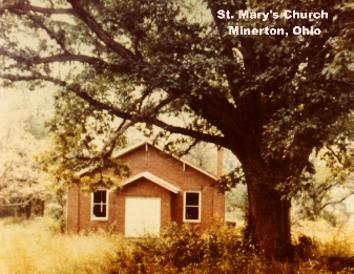
Resting on a hillside in Southern
Wilkesville Township, in Vinton County are the remains of
what used to be a beautiful church. St. Mary's Catholic
Church in Minerton was one of the oldest churches in the
Columbus Catholic Diocese.
The church had not been used for a number
of years due to lack of church membership. Since the church
closed it's doors for the last time, it has been marred by
hunters and vandals.
As a result, windows were shot out, items
left in the church that had not been removed for safekeeping
were destroyed and the brick church itself fell to ruin.
The last act of vandalism occurred late in
December 1978 and hunters were suspected of building a fire
in the church to keep warm. The fire spread quickly from the
floor to the walls and ceiling. Before long, the church went
up in flames, the tin roof collapsing under the heat of the
fire.
Since that time, numerous area residents
have been coming to the site carrying away many of the
bricks, even though there is a No Trespassing sign clearly
posted on the grounds.
Strangely enough, the brick church met with
the same fate as two other churches built in exactly the same place. The first burned to the ground in 1873 and the second
in 1920.
The history of the church dates back to
1837 when a group of people from New York City came to Vinton
County and settled in the neighborhood of St. Mary's Church.
One of the settlers, Patrick Quinn,
purchased quite a tract of land for timber and on part of it
built a small frame 24x30 church. He decided to name the
church St. Mary's. Mr. Quinn also donated part of his land
solely for the church.
The first priest ever to visit the church
was Rev. Joseph O'mealy from Portsmouth. His
visits were of occasion nature and continued until the year
1844. He afterwards went to Pittsburgh and St. Vincent's Monastery in West Moreland, Pennsylvania. From these two
places he spread the news of the New Catholic settlement.
By the year 1846, only six Catholic
families belonged to St. Mary's. From 1844 to 1851 the small
Catholic membership of the first St. Mary's church was
visited by Rev. Emmanuel Theinpont of
Portsmouth. He visited the mission quarterly riding on
horseback.
At this time a large number of families
from Pittsburgh emigrated and settled in the neighborhood of
the church.
The first Parish priest was Rev. David
Kelly. He came in 1851. When Father Kelly came, it
was under most trying circumstances. There were no accommodations for him, not even a house.
During Father Kelly's stay a house was
built, then remodeled and the church was enlarged making it
sufficient for the large congregation.
In 1857, Father Kelly was sent to Dayton.
From 1857 to 1864 Rev. Fr. McHon was the
resident priest, assisted by Fr. Tierney
from time to time.
Numerous priests came to the church later
between the years 1864 and 1873. Then in 1873 Rev. Fr. Thomas
Darcy came to St. Mary's in November. His pastorship lasted but one week. On Sunday at 9 a.m. a fire swept through
the church and it burned to the ground. As the cruel flames
destroyed the church and everything with it, the little band
of faithful members stood silently watching their sacred
place of worship being reduced to ashes.
There was no insurance. Father used his
parsonage every Sunday for services until the new St. Mary's
was built. In the winter of 1874, money was raised to build
the church and was built by Nicholas Fagan.
Over the years the church was remodeled and
improved. Between 1891 and 1899, Rev. J.J. McCa
?? had a beautiful bell placed in the tower (the first ruined
by fire). The bell could be heard for miles.
By 1889 the church membership had risen
nearly 400. When the Iron Furnace nearby went out of
business, naturally many of the people and employment went
elsewhere. Around 1900 an organ was bought and placed in the
church.
By 1902, as the church membership began to
lack Father Kessler was assigned to the
church, but only to hold services every other Sunday.
The church continued on until Christmas
Day, 1920, when the old parish burned to the ground. Nothing
but the old foundation remained. Father Gressel of
Gallipolis was directed by the bishop to rebuild the church.
The job was completed and the new church was paid for
entirely by some friends.
Priests were assigned to the church at
Minerton until in the 1940's when the diocese decided to
discontinue the practice due to lack of sufficient membership
in the church.
Still, throughout the 59's and early 60's
occasional services were held along with an annual homecoming
and picnic that later ended.
The church is now gone in all her glory.
Maybe since this was the third church to burn in the same
location, it was just not meant to be. Once the parish is
leveled to the ground, the only reminder of the church will
be the cemetery located on the hillside behind the church.
Markers of remains buried there date back
as far as the early 1800's. The cemetery is still mowed and
cared for.
This article was written by Lenoir
Glass and appeared in the Wellston
Sentry on Thursday May 31, 1979
 Patrick
Family
History
Patrick
Family
History