
The History of the Refrigerator and Freezers
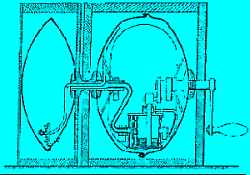 Drawing:
Patrick Chua's Design
Drawing:
Patrick Chua's Design
Before mechanical refrigeration systems were introduced, people cooled their food with ice and snow, either found locally or brought down from the mountains. The first cellars were holes dug into the ground and lined with wood or straw and packed with snow and ice: this was the only means of refrigeration for most of history.
Refrigeration is the process of removing heat from an enclosed space, or from a substance, to lower its temperature. A refrigerator uses the evaporation of a liquid to absorb heat. The liquid, or refrigerant, used in a refrigerator evaporates at an extremely low temperature, creating freezing temperatures inside the refrigerator. It's all based on the following Physics: - a liquid is rapidly vaporized (through compression) - the quickly expanding vapor requires kinetic energy and draws the energy needed from the immediate area - which loses energy and becomes cooler. Cooling caused by the rapid expansion of gases is the primary means of refrigeration today.
The first known artificial refrigeration was demonstrated by William Cullen at the University of Glasgow in 1748. However, he did not use his discovery for any practical purpose. In 1805, an American inventor, Oliver Evans, designed the first refrigeration machine. An American physician, John Gorrie, built a refrigerator based on Evans' design in 1844 to make ice to cool the air for his yellow fever patients.
Side Note:
Improved refrigerator designs were patented by African American inventors, T.
Elkins (11/4/1879 U.S. patent #221,222) and J. Standard (7/14/1891 U.S. patent
#455,891 - See patent drawings below).
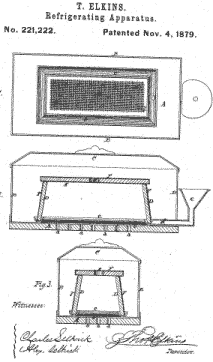
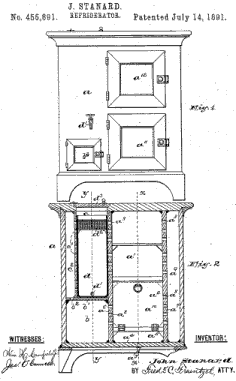
Refrigerators from the late 1800s until 1929 used
the toxic gases ammonia (NH3), methyl chloride (CH3Cl), and sulfur dioxide (SO2)
as refrigerants. Several fatal accidents occurred in the 1920s when methyl
chloride leaked out of refrigerators. Three American corporations launched
collaborative research to develop a less dangerous method of refrigeration;
their efforts lead to the discovery of Freon.
In just a few years, compressor refrigerators using Freon would became the
standard for almost all home kitchens. Only decades later, would people realize
that these chlorofluorocarbons endangered the ozone layer of the entire planet. Further
details can be found in the CFCs section !