This program is modeled after the Solitaire algorithm, also known as Pontifex in Neal Stephenson's book "Cryptonomicon". For a full explanation of the algorithm, go here: www.counterpane.com/solitaire.html. This version though expands the basic concept of using a deck of playing cards to a system that can be used in the real world. All characters with the ANSI code of 32 to 122 are compatible with this Pontifex varient.
Version History:
To Use
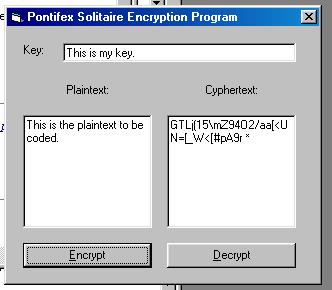
This program isn't complicated to use. First, input a passphrase at the top for the key. In the picture below, it is "This is my key." Now, type in the text you want to encrypt in the text area under the label plaintext. The example is "This is the plaintext to be coded." Now click "Encrypt" and the cyphertext will appear. Clear out the plaintext and click "Decrypt" to see what the cyphertext will appear after decryption. As you can see, it is just as you typed it in. There is no 5-letter blocks in capital letters. Here is the snapshot:
Implementation Notes
If you just want the needed classes to encrypt/decrypt, you will need all .cls files. My implementation has each class using another. You will use Coder only for your own coding and decoding with Public Function encrypt(plaintext As String) and Public Function decrypt(cyphertext As String) As String. Coder uses Pontifex to get the keystream, Pontifex uses Deck to generate the keystream, and Deck uses Card.
The folder "Source Code" contains, of course, the source code. A Java version is also available.
Brian Ogan
www.geocities.com/patriciointp/