The
early history of the founders of Patiala state is more of a myth and mystery
than reality. The rulers of the erstwhile states of Patiala, Nabha and Jind
trace their ancestry to one Chaudhary Phul. Phul the founder of this family along with his brother Sandaali became
orphans in 1618, and both were taken under the wing of their uncle. They both
visited Guru Har Rai as youngsters along with their uncle. It is said that their
uncle told them to rap their bellies to indicate to the Guru the poverty and
hunger they were enduring. The Guru blessed Phool and is said to have told him
that he would make a king.
Phool set up his own village and was often in conflict with local
chiefs. This enraged the Governor of Sirhind who summoned him and put him behind
bars. Phool died in 1652. He had 6 sons, of whom Rama emerged from this group as
the most eminent. The Governor of Sirhind appointed Rama to the post of Chaudari.
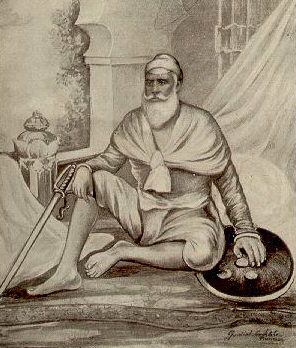
Chaudhary Ram Singh was baptized
and blessed by Guru Gobind Singh. He was killed at Maler-Kotla in 1714 and was succeeded by his son, Ala
Singh. (Click
to view photo). Apparently the appellation
of dynasty ‘Phulkain’ is derived from their common founder. Ala
Singh assumed the leadership in 1714 when Banda Bahadur was engaged in the
fierce against the Mughals. A man with vision and courage, Ala Singh carved out
an independent principality from a petty Zamindari of 30 villages. Under his
successors, it expanded into a big state, touching the Shivaliks in north,
Rajasthan in the South and upper courses of the Jamuna and Sutlej while
confronting the most trying and challenging circumstances.
In the middle of the eighteenth century, Baba Ala Singh, unlike many of his contemporaries, displayed tremendous courage and shrewdness in dealing with the Mughals, Afghans and Marathas and successfully established and maintained a state which he had started building up bit by bit from its nucleus Barnala.
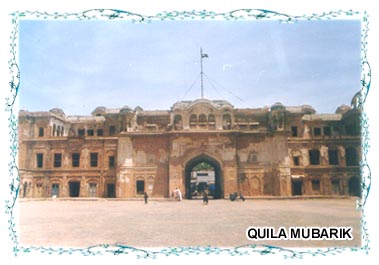
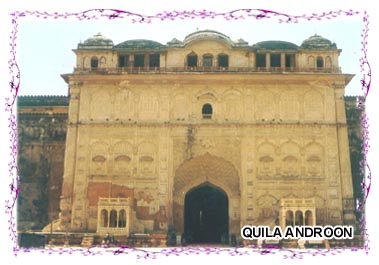
In 1752, a General of Ala Singh, Sardar Gurbaksh Singh Kaleka won possession of eighty-four villages, one of which was Patiala.. In 1763 Baba Ala Singh laid the foundation of the Patiala fort known as Qila Mubarak, (Click to view photo). around which the present city of Patiala is built. After the third battle of Panipat in 1761 in which the Marathas were defeated, the writ of the Afghans prevailed through out Punjab. It is at this stage that the rulers of Patiala began to acquire ensigns of royalty. The Afghan Ahmad Shah Abdali conferred the title of Maharajah on Ala Singh during the formers eighth invasion between 1764 & 1765. The teritory of Patiala continued to grow right up to the death of Maharajah Ala Singh on August, 22nd 1765. After that, his grandson Amar Singh succeeded and received the title of Raja-I-Rajjan. Amar Singh continued to use other Sikh leaders to further his aims. He continued to extend his territory. In 1767 during Abdalis 9th invasion of India, Amar Singh paid a sum of 2 lakh rupees to set thirty thousand Indians captured by Abdali as slaves free. For this benevolent act he was given the name of Bhandi Chhor (Liberator of the slaves). It was Maharaja Amar Singh who completed Qila Mubarak in 1764. It has two portions, Qila Androon, (Click to view photo). the inner fort, Qila Mubarak the outer. The facade of gate of Qila Androon is decorated with geometrical and floral designs in lime plaster. There are two painted chambers depicting scenes from Hindu mythology and portraits of Sikh Gurus in Patiala style. The complex has a unique under-ground sewerage system. An excellent museum of Chandeliers and famous weapons is located here.
Maharajah
Amar Singh died in February 1781. His son, Sahib Singh succeeded him at the
tender age of seven. Sahib Singh was a very weak figure and was outdone by his
sister Sahib Kaur on the battlefields. Maharajah Sahib Singh died on March 26th
1813. His eldest son, Karam Singh succeeded him. Karam Singh helped the British
during the war against the Gurkhas in 1814 and during the first Sikh War in
1845. He died on December, 23rd 1845 and was succeded by his son Narinder Singh.
He
died in 1938 and was succeeded by his son, Maharajah Sir Yadvinder Singh on
March 23rd, 1938.
Patiala signed its teritory over to the Indian union on May 5th, 1948. Maharajah Sir Yadvinder Singh was among those Indian princesses who readily came forward to sign the Instrument of accession, thus facilitating the process of national integration. He given the title of Rajparmukh of the newly created Indian state of PEPSU. He was allowed a privy purse of 17 Lakh rupees for his upkeep and allowed to retain control over all his personal property.
The merger of PEPSU in Punjab in 1956 and its close proximity to Chandigarh have not robbed Patiala of any of its importance although many had feared the decline of this erstwhile princely capital on account of these factors. The location of a number of offices of the Punjab Government and the establishment of the Punjabi University at Patiala have rather added to its importance.
The old and the new worlds go hand in hand in Patiala. Its massive forts, its magnificent palaces and its narrow and crooked lanes preserve all the charm of the old world while its modern buildings and institutions, gardens and wide concrete roads make it look a pre-eminently young city equipped with all the amenities of present day life.