 |
| Torsion Bar Lift |
| Copyright (c) 2001 Aaron Wiltsey |
|
| Using the front torsion bars to lift your Pathfinder or Hardbody an acceptable amount: Evening out the front-to-back nose-diving look. |
| Looking at a pic of a stock Pathfinder from an ad or brochure back in the day, you'll see that they all sat lower in the front than in the rear. This is due to the fact that the 5-link rear axle has more travel(up and down movement) than the front suspension, plus the fact that torsion bars will sag over time, where coil springs tend not to. Therefore, when the people at the factory set the suspensions up, they were set in the middle of their respective travel lengths, the front sitting lower than the rear. |
| The front suspension of the Pathfinder is suspended not with a leaf or coil spring, but with a linear spring called a torsion bar. They have been in use for a long time in many different kinds of cars and trucks. A torsion bar is a spring constructed of a steel rod, splined at both ends, made of cast spring steel. The ends are held in place by a grooved socket in the lower A-arm with the other end residing inside a sleeve with an adjuster arm welded to it inside the transmission crossmember. |
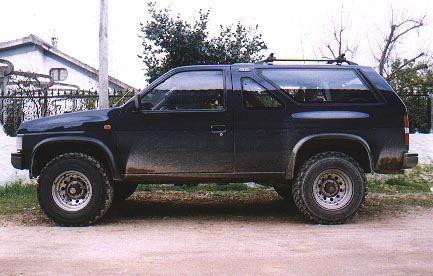 |
| Julio's 'Path from Portugal. Not stock height, but the front end does sit a bit lower than the rear. |
 |
 |
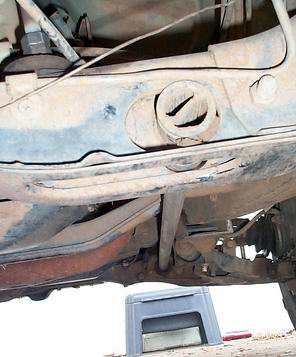
| Driver's side torsion bar. |
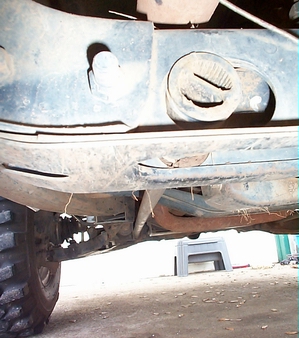
| Passenger's side torsion bar. You can see one end located in the lower control arm. |
| This is the tranny cross-member in the middle of the 'Path. |
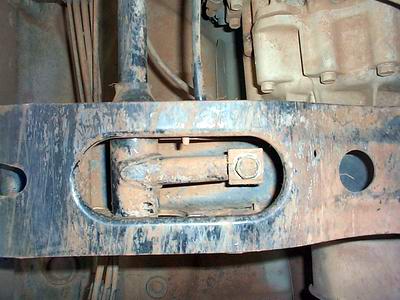 |
| The adjuster arm inside the transmission crossmember at the end of the torsion bar. |
 |
| Cranking up the torsion bars is an acceptable way to create more front end lift on your Pathfinder. The main reason people want to lift the front only is, after larger tires(31x10.50 for example)have been installed, they will generally rub the fenderwells if the stock torsion bars are sagging from many years of use. Lifting the front end will correct this problem. |
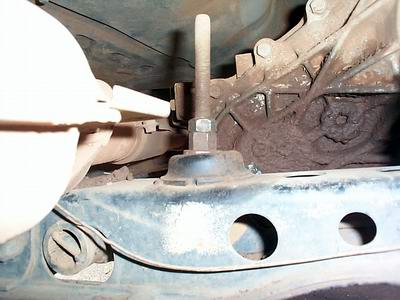
| Picture of the adjuster's topside bolt and stopnuts. This adjuster is completely maxed out at around three and one half inches as measured from the top of the upper nut. My torsion bars are in need of reindexing or replacement! |
| An alignment is sometimes not possible after the torsion bars are cranked up too far. This can be taken care of by installing new upper control arms or a ball joint spacer made by Automotive Customizers(www.4x4parts.com). Upper control arm replacements are available from several different companies... Superlift, Calmini and Automotive Customizers are the most popular. |
 |
| The torsion bars are adjusted by loosening the locknut on the top of the adjuster bolt and screwing the bolt clockwise from below(as if tightening it). It's best to make sure both adjuster bolts are even(adjusted the same), otherwise the Pathfinder may sit crooked. When the torsion bars have reached the limit of their upward adjustment, the upper control arms will contact the bumpstops and there will no longer be any available downward travel in the front suspension, only upward. This causes a stiff ride and increased vibration in the front end. The C/V joints and ball joints will also be much more susceptible to early wear and failure than if the Pathfinder were left at it's stock height. Your alignment will also be off and may show increased wear on the inner tread section of your front tires as opposed to the opposite side. Any major adjustments to the torsion bars should be accompanied by an alignment. |