The Schrödinger’s wave equation
and the rationalization of duality
Edgar Paternina
email: [email protected]
Abstract. In
this second paper of four the Schrödinger’s wave equation is presented under
the concept of the basic unit system. Again it
is too a result and a promise because of those dialogues in Physics
Forum in its TD sub forum. By using complex numbers we find that the duality of
time and space cannot be dropped out just by taking the square of a complex
equation as in this way we drop out not just one part of that complex equation
but, we do not rationalize duality of time and space, of wave-particle,
anymore.
Key words: duality,
rationalization of time and space, magnetic field, relativity, Lorentz
transformation group and Maxwell’s
equations.
1. Introduction
Richard Feynman wrote in his well-known lectures
on physics:
“…the great historical moment marking the birth of
the quantum mechanical description of matter occurred when Schrödinger first wrote down his equation in 1926...In
principle, Schrödinger’s equation is capable
of explaining all atomic
phenomena except those involving magnetism and relativity…
The Schrödinger’s equation as we have written
it does not take into account any magnetic effect...However...magnetism
is essentially a relativistic effect.”(1, 16-18)
It is
said that the Schrödinger’s equation
suffers from not being
relativistically covariant, meaning that it does not take into account Einstein’s special theory of relativity.(3) But are not
magnetism, the spin property, those
equations of electromagnetism or Maxwell’s equations and the Lorentz
transformation group –not precisely the philosophical conception known as special relativity in which Einstein framed this LTG -, are not they intimately related? It
is not true that if we can put
them both, the Schrödinger’s equation and the Lorentz transformation
group under a kind of same conceptual mathematical roof, we have solved those incapabilities
mentioned above?
It is
also known that in the intend to solve these incapabilities, a new equation
known as the Klein and Gordon’s equation(3), was introduced:


or else after introducing a correction relativistic
factor, the complex nature of the Schrödinger’s equation was dropped out by
taking its square, being in this way reduced, that Schrödinger’s equation, to
just one of its parts; a complex equation has a magnitude associated with the
its square and an angle associated with its inherent wave character: but in
this case it became just a scalar
equation in which again time and space are always coupled, which is not the case with the Schrödinger’s equation, as time and space
are decoupled precisely by the symbol i.
From this very moment, in modern physics, the duality of time and space is not
rationalized anymore.
The wave
nature of matter was introduced by Max Plank when studying black-bodies, when
he noted that it behaves as kind of oscillator, so its energy
was always given by his well-known formula:
E = h
f (3)
If we make the assumption that electrons have an
inherent magnetic field or else an intrinsic polarity that is continually
oscillating like kind of inherent dipoles, inherent in the sense they cannot be
separated, don’t we have another point of view in which we do not have to think
anymore in terms of “independent charge
oscillators”, or else in the need to think
the magnetic field as being a relativistic effect?
2. The Basic
Unit System and the Schrödinger’s
equation
That
Cartesian ideal introduced in his
Discourse of the Method, to reduce what
is complex to the simple has certainly permeated not only philosophy but
western science. In this way, as we
have pointed out, even a self-entity as the magnetic field has been
always explained as a function of the part, i.e., as a function of the electric
charge which is not a complex entity but a scalar one. But does not reflect the same definition of
the magnetic field a radical duality in its inherent polarity? Does not it
reflect that it is a complex entity not a scalar one? Why then try to explain
it as a function of the charge? Why then try to explain a whole/part
entity as the magnetic field by the part?
The
Maxwell’s equation that represent the fact that the magnetic field is a
self-consistent entity is expressed as:
Ñ. B = 0 (4)
If
we represent B, by means of the complex basic unit system concept:
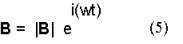
where |B| can be
a function in general of spatial coordinates
then we have

in this case it is clear
that the first expression is zero as
i(wt)
e
does not vary with the
spatial coordinates; we have then that we cannot have a vector potential for
the magnetic field as is the case with conservative fields. It is known the “patching intends”, to
introduce such a kind of vector potential for the magnetic field, but does
it have any sense for it?
So far so
good for the magnetic field.
In the same way
it does not have any sense to try to generalize an equation as that of
the pendulum, by the same token, in our effort to put the Schrödinger’s
equation under the same roof of the BUS, we must consider at the outset that it
only has to do with the behavior of one
particle, I mean, the electron. Its
behavior can be expressed by means of the complex differential element of
reality expressed as:

where “S” is
a complex variable that represents the
complete behavior of an energetic system such as the electron; this variable is known as the wave function
in quantum mechanics represented by
the symbol Y. We
have used S instead of Y, in honor
to that noble intend made by Einstein
to generalize its special relativity. In
fact S is sort of generalized path but in the complex plane, so we have
sort of dynamic complex geometry to represent the behavior of energetic
systems.
The wave
mathematical procedure is well established so we are going to use it to put that Schrödinger’s equation in a
unified context.
The angle
q, has to do in case of the BUS concept with that
essentially dynamic character of reality and we already known it was
expressed[2, 584], as
q = 2 p / h (p
x - E t) (8)
when dealing with an entity such as the electron, where,
p = momentum of the entity in
question, and “x” y “t” = the
coordinates of time and space, or else the variables of state, E = Energy.
We can write according to de Broglie: 1/ l = p / h, where l = de Broglie’s wave length, and h = Plank’s
constant.
The momentum of the entity can be written too as:
p² = 2 E m (9)
3. The Principle of Uncertainty
The state of the BUS can be determined if we have laws with
which we can couple its two variables of state, i.e., time and space. According to the uncertainty principle the
relation between those two state variables for the case of the electron is not
possible, which is expressed as:
D x . D p ³ h (10)
In those cases such as of the planets where we have a
central force, and as so, a second Kepler’s law, the state of that system can
be determined as an ellipse, that has associated a differential equation, but
this is not the case for the electron, as it does not behave as a little
spherical entity spinning around an atomic center.
4.
The Schrödinger’s wave equation and the BUS
Let us take as starting
point a general unknown solution for our electron or quantum mechanical system
as:

From (9) we have:
E = p²/2m
So

separating x and t,

We have here two
different expressions:
·
one as a function of
space, and
·
other as a function of time, but each embedded in
Euler relation.
We note here that the duality of time and space is
rationalized in the sense they are not coupled.
4.1.2 Double variation to space
The first
derivative of 13, with respect to space gives:

where the internal derivative of
2pi p/ h x
e
is precisely: i(2p/ h) p
For convenience the rest of this 14 expression,
including its internal derivative, will be expressed by S", so

The second derivative gives us:
¶² S (x, t)/¶²x = (i(2p/ h) p)² S"
or else S"

4.1.3 Variation with respect to time
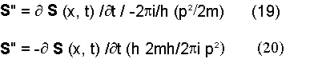
By taking
the partial derivative of 13, with respect to time, the internal derivative of
the exponent:
-2pi/h
(p²/2m) t
is : -2pi/h
(p²/2m), so we have :
¶ S (x, t)/¶t = -2pi/h (p²/2m) S" (18)
or
5. The
Complex Schrödinger’s wave equation
It seems
a general law of nature to have an equality to obtain a solution to its
problems. In gravitational fields we have the equivalence between inertial mass
and weighting mass; in electric circuits the capacitive and inductive effects must be made equal to obtain
resonance; in this case we must equal the expressions 17 and 20 to obtain the
Schrödinger’s wave equation:
¶ ² S (x, t)/¶ ² x h ² / 4p ² p ² = ¶ S (x, t)/¶t (h 2mh/2pi p ²)
if we organize terms we
have finally:

the well-known Schrödinger’s wave equation
postulated by him in 1926 for a free electron moving in the direction of x’s.
If
we look closely at this expression we have
two different expressions:
·
a double derivative of space
·
and second, a derivative of time
but
in between, there we have that symbol i: a symbol that reminds us that time and
space are decoupled, when dealing with the electron.
In
fact that symbol i, is a symbol for not confusing, as it were, pearls and
apples, wave and particle, time and space as we clearly realize when dealing
with complex numbers and its well-known
operational rules. If we take the square of a complex expression such as this one, we certainly drop out that
non-wanted symbol i, but then we just consider one aspect of that symbolism and
as so one aspect of reality: we certainly do not rationalize duality
anymore or in other words we have to
forget ourselves of that equation that
marked that great historical moment of the
birth of quantum mechanics.
As an electrical engineer who used complex numbers all
his entire professional life, verifying in a real time control center how
measurements and reality agreed with
each other day by day, by means of a complex algorithm called State Estimator,
based both in statistics and in those equations of electromagnetism, it was not
clear for me why modern physics abandoned those complex numbers that are so
essential to understand and represent the dual nature of reality, duality that
for an EE is expressed in that complex expression of power he uses daily as his
bread and butter, and which is at the base of the most complex interconnected
network ever built by man, I mean, the power system on which all our economy
and technological advances rest.
ã, 1991, 1999, 2001. Edgar
Paternina
August 30 2004
Email: [email protected]
References
1. Feynman Richard. Física. Mecánica
Cuántica. Volumen III. Fondo Editorial Interamericano. S.A.
2. Hazen / Pidd. FISICA. Editorial Norma. 1965
3. Wikipedia, the free encyclopedia.htm.
Klein-Gordon equation.