The Lorentz Transformation
Group from a non relativistic point of view
Edgar Paternina
email: [email protected]
Abstract. The aim of this
paper is to present the LTG under a more general and dynamic context than that
of systems in uniform
translatoy motion, in
which SR was conceived, in this way
even that famous equation of the equivalence of mass-energy can be found in a
more consistent and natural way; in a certain sense this approach can be
considered a philosophical and semantic evolution of that work of Einstein
though. Two main points must be recalled additionally: one has to do with the
complex plane considered in this case sort of dynamical background; the other
one has to do with the fact that the magnetic field is taken as the fundamental
physical field, what is expressed in a proposed new order of Maxwell’s
equations.
Key words: Maxwell’s equations, Euler relation, spin, Bus, radical
duality
Introduction
This is the third
paper of four in which a new methodology to represent the fundamental equations
of physics is presented. The basic unit system concept based on Euler relation
will be used again as in the case of the pendulum and the Schrödinger wave
equation. In the former we found an exact expression of the pendulum behavior
that included an approximation factor that can be validated with what is
observed. In the second one the aim was to put under a same roof that complex
equation.
In this third
case the complex plane will be considered not sort of “fixed
background(non-dynamical)” but sort of dynamic canvas where we can make, as it
were, drawings of the dynamic and complex nature of reality. We certainly have
read in the web of all that incompatibility between quantum mechanics and
general relativity, and those noble efforts to make quantum mechanics
relativistic covariant.
The good news in
this case is that if we put all those equation under a same roof, having as
background the complex plane, those incompatibilities and problems disappear,
but for it we must certainly make sort of paradigm shift if we really want to
see the whole thing in a more unified way; this means among other things that
reality is complex, so a complex or triadic symbolism must be used to represent
it properly. The Lorentz Transformation
Group will not be put in this case under the philosophical background known as
relativity which does not mean that we must reject the findings of Einstein, on
the contrary with this methodology all those known objections we have found in
that Einstein’s approach will be transcended and those equations of mass and
energy will be found again, in a most intuitive and elegant way, as a physicist
friend of mine expressed kindly, but most importantly the main Einstein’s dream
will be accomplished to a certain extent.
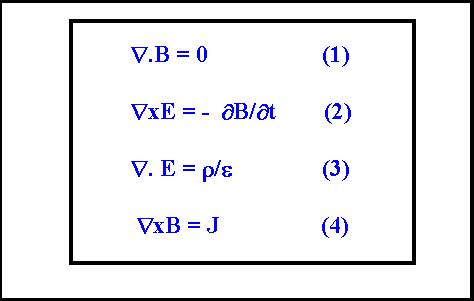
Another presentation of Maxwell’s equations
The
importance of Maxwell’s equations and its relation with the Lorentz
Transformation Group was pointed out by Einstein(4, 51), in his classical paper
On the Electrodynamics of moving bodies. We have inverted in this presentation though
the order in which those Maxwell’s equations are presented in texts, as our
starting point is to consider the magnetic field as self-consistent entity as
expressed in the first equation, what cannot be said of the corresponding
electric field as “These fields posses
no real physical basis, for physical measurement must always
be in terms of the forces on the charges in the detection equipment.”(6,
231). On the other hand magnetic poles are not known to exist, as the magnetic
flux is always found in closed loops and never diverges from a point source, or
else that point source has an inherent polarity in its magnetic field.
On the other hand we know that the orbital angular momentum obtained classically [1, 137-142], is
M = -(e/2m)Lz
But, the behavior of the
electron cannot be explained under the supossition it is sort of little sphere
with a –e charge, rotating around itself. Its intrinsic angular momentum
cannot be obtained under that supposition, as the observed value is doubled as
that calculated or else:
Ms =
-g(e/2m)S
where g, is expressed as, g = 2S +1
so, S = ½.
It is not true that this impasse is solved if we consider each intrinsic polarity of the inherent magnetic field of the electron contributing with that half? Does not it give reason in a most natural and intuitive way of the same spin concept?
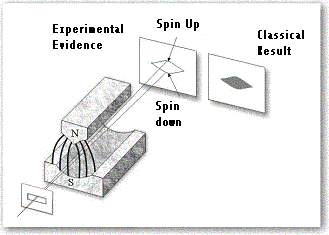
Figure 1. Stern-Gerlach experiment and the spin
We have
presented then two main reasons for inverting the presentation of Maxwell’s equations;
the third is a more philosophical one, as being the magnetic field a whole/part
entity, i.e., a holon, it is more consistent philosophically to explain the
whole thing in this way than trying to explain it by the part, or else trying
to reduce something that is naturally a whole/part to the part; something that
is complex to the simple.
Another Approach to the Lorentz Transformation Group
The metric
we will use is a complex one based on Euler relation and its associated basic
unit system concept, where in this case, we will determine the state of an
electromagnetic entity, represented as:

One of the main advantages of this representation with
the complex plane, is that those Lorentz transformation equations can even be
obtained almost in a most intuitive way, but here we will follow the analytical
procedure. The expression for the differential element of time and space, but,
with real time is:
DS = c
dt + i DSr
where we have:
·
one component associated with the
dynamic behavior, c dt, where c is the velocity of light and
·
one component associated with its, as
it were, static behavior, i DSr, i.e., with space
If we simplify we can imagine a movement in
the x’s direction only:
DSr = dx

It
is important to notice that DS² is just the magnitude of the complex expression
or just one part of the corresponding polar form.
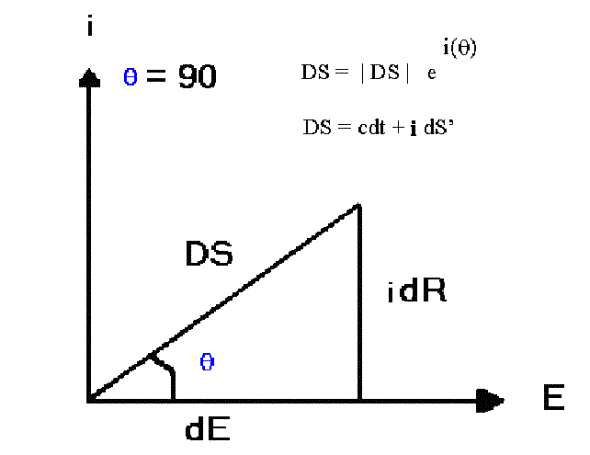
Figure 2. Differential element of time and space.
To find the state of this system we must find
relations or laws between its state variables having in mind three fundamental
suppositions :
· We have two systems S and S’
rotating one against the other, as is shown in figure 3, at an angle Y. The complex plane in this case is ideal to represent
dynamic physical entities even those that have to do with gravitational fields.
· The second supposition is that the velocity of light is
a constant in the universe.
· The third one is that DS², is an invariant; we are dealing not
with points but with differential elements, or a complex differential geometry.
With these three suppositions in our toolbox
we will proceed to obtain the Lorentz Transformation Group.
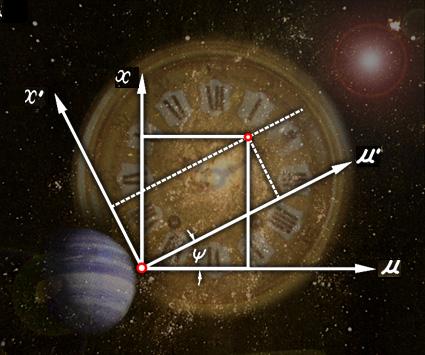
Figure 3. Representation in the complex plane
In regards to having two system rotating against each
other, the condition they have a same frequency permits us to see them both as
in sort of “merry-go-round”, what is expressed in that angle between the two
systems ; in the complex plane, sums,
differences, integral and derivative of a Bus of a given frequency are
themselves Buses of the same frequency.
The Lorentz
Transformation Group
It is important to recall that what remains
invariant in this case is the BUS, or its magnitude in the complex plane, which
is kind of representation of a dynamic reality whose state must be determined
in each case. It is this DS, the one that will remain the same in all systems.
In this sense we deviate clearly from a relativistic conception of systems of
coordinates, where time was just another space coordinate, or a generalization.
In Einstein’s treatment of the LTG we have:
“These two principles we defined as
follows:-
1.
The laws by which the states of
physical system undergo change are not
affected, whether these changes of state be referred to one or the other of two
systems of coordinates in uniform translatory motion.
2.
Any ray of light moves in the “stationary”
system of co-ordinates with the determined velocity c, whether the ray be
emitted by a stationary or by a moving body.” (4, 41)
On the other hand we know this is a very special case, an ideal case, as:
“The word “special” is
meant to intimate that the principle is restricted to the case when K’ has a
motion of uniform translation relatively to K, but that the equivalence of K’
and K does not extend to the case of non-uniform motion of K’ relatively to
K.”(4, 111)
We already know that here
lies the great well-known incommpatibility between SR-QM and GTR, that Karl R.
Popper defined as the great schism of physics. In fact QM was dragged by SR to
the point that the complex nature of the Schrödinger wave equation was by all
means dropped out. In a complex equation we must have always in mind both, its
magnitude and its phase; if we consider just one of them we are just making a
rough simplification.
But let us return to our approach. The path DS in the
complex is invariant for both systems S and S’ so,

for system S, and
DS’² = c² dt’² -
dx’²
for system S’.
We have then for those differential
displacements of time and space:
dx = dx' + V dt'
dt = a dx' + dt'
where a, is a
normalization factor to be found so we can determine the state of the system,
or a relation between its state variables.
If
we transform these two equations in velocities, we have:
dx/dt = (dx' +
V.dt')/(a dx' + dt’)
= (dx'/dt' + V)/( a dx'/dt'+1)
or
dx/dt = (Vx' + V) /(a Vx'+1)
Vx = (Vx' + V) /(a Vx' + 1)
As we are dealing with an electromagnetic
entity we have:
Vx = Vx' = c = velocity of light
c = (c + V)/( a c + 1)
so finally
a = V / c²
normalizing
dt = a dx' + dt'
and multiplying, and taking the square:
c² dt² = c² a² dx'² + 2 c² a dx' dt' + c²
dt'²
replacing a
c² dt² = V²/ c² dx'² + 2 V dx'
dt' + c² dt'² (2)
taking the square
dx = dx' + V dt'
and its negative we have:
- dx² = - dx'² - 2 V dx' dt' + - V²
dt' ² (3)
if we sum 2 and 3, and replacing a, we have:
DS '² = (c² - V² ) dt'² - (1 - V² / c² ) dx'² = c² dt² - dx²
= DS²
as DS is an invariant:
c²- V² = c²
or
1 - V² / c² = 1
so we have an absurd that is solved by introducing the
well-known relativistic factor as:
(c² - V²) b ² = c²
or
(1 - V²/c²) b² = 1
where
b = 1/ Ö[1 -(V/c)²]
or
b = 1 / Cos (Y), where Y is the angle between both
systems, as is shown in figure 3.
Cos (Y) = Ö [1 -(V/c)²]
that when applied gives us the Lorentz Transformation
Group, but in differential form, not in point form as was the case with
Einstein.
dx = (dx' + V
dt') / [1 -(V/c)² ] (4)
dt = (V/c² dx' +
dt') / [1 -(V/c)² ]
(5)
Mass and velocity
When dealing with mass and energy it is not appropiate
to think in systems in uniform translatory motion, as we must then consider the
newton’s second law and its acceleration, expressed originally as:
“the force F acting on the particle is equal to the rate
of change of the momentum of the particle”
and the law of conservation of momentum:
“…when the sum of the impulses of the external forces
acting on the system of particles is zero, the total momentum of the system
remains constant.
So
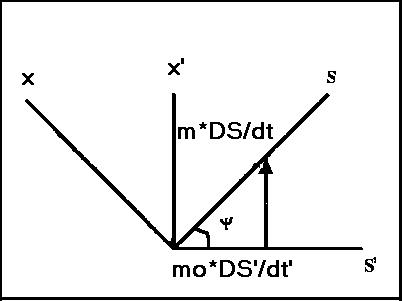
this law will give us for the two systems S and S’, their respective momentums,
so according to figure 4, we will have:
mo DS’/dt’ = m DS /dt Cos (y)
where y,
is the angle between the two systems and Cos (y) is the factor already introduced, so if:
DS/dt = DS'/ dt' = c
We have:
m = mo / Cos (y) (6)
the well-known and famous equation
of mass as a function of velocity, necessary to conserve the momentum, which is
obtained in this case in a most intuitive way.
Energy and Mass
With the expresión 6 we can found that equation that
established the equivalence between mass and energy. For the work on a particle
we have:
dEc = F ds
F = d(m v) /dt
dEc = d(m v) ds /dt
dEc = v d(m v)
as, m = mo/ Cos (y), and replacing
dEc = v
d ((mo / Cos (y)) v)
multiplying and dividing by c², and having in mind that Sen (y) = v/c
Figure
4. Conservation of momentum
dEc = mo
c² d((1/ Cos (y)) Sin (y))
dEc = mo
c² Sin (y) d(Tan (y))
according to the rules of derivatives
d(Tan (y) = d y/ Cos² (y)
then
dEc = mo
c² Sin (y) d y/ Cos² (y)
by the same token
d(Cos(y)) = -
Sin (y) d y
dEc = - mo
c² d (Cos(y))/ Cos² (y)
and
d(1/ Cos(y)) = d (Cos(y))/ Cos² (y)
so finally we have
dEc = mo
c² d(1/ Cos(y))
This expression must be integrated between y = 0 and y
Cos(y)
Ec = mo
c² ò d(1/ Cos(y))
Cos(y) =1
Ec = mo
c² [1/Cos(y) - 1]
so finally we have
Ec = m c² - mo
c²
Ec = Dm c²,
where: Dm = m - mo
Conclusions
To have found those equations
of SR in a new context not relativistic on the one hand, and on the other not
in a context of two systems of coordinates in uniform translatory
motion(4,41) but under that same dynamical context used to find other two
fundamental equations, not only validates the work of Einstein but at the same
time makes it possible to have a unified framework or methodology to see the
whole thing under a same roof which in a certain sense was part of his dream,
but not in the sense to have a unified field theory.
A TOE has always seemed to me a
more subtle version of reductionism which is not the way science works in all
its fields.What we have instead is that:
“It is necessary
to study not only parts and processes in isolation, but also to solve the
decisive problems found in the organization and order unifying them, resulting
from dynamic interactions of parts, and making the behavior of parts different
when studied in isolation or within the whole.”(2, 31)
With the Bus
concept we have taken the GST to a level that is not so abstract anymore on the
one hand, but on the other hand, it is just a mathematical tool that as a good
engineering tool must be carefully applied in which case, as is always done
with differential equations: the solution depends on the particular case, there
are no general solutions for all cases. Whenever we try to apply an equation
out of its original context, what we naturally have are paradoxes and
confusion, not order. For an electrical engineer who have seen how complex
numbers and reality fit so well, not only in the representation of a power
system, but also even in those elegant applications known as Automatic Control
Systems, where Laplace Transforms play such a fundamental role, the real
paradigm shift to be done in modern physics has to do with using complex numbers
for real, in all its full power, and not just as an abstract mathematical tool
that sometimes for the sake of convenience can be reduced to just a couple of
“real” numbers, avoiding in this way that radical duality represented in Euler
relation, that as we have seen, has to do with that radical duality of reality
itself, with its inherent dual structure.
“The goal of
science is order. Science is constructed from facts just as a house is
constructed from stones, but an accumulation of facts is no more a science than
a pile of stones is a house.”
Henri Poincaré
ã, 1991, 1999, 2001. Edgar Paternina
October 4, 2004
email: [email protected]
References
1. Alonso&Finn. Física. Vol III. Addinson-Wesley. 1968
2. Beer/Johnston. Vector Mechanics for Engineers. McGraw Hill. 1962
3. Bertalanffy von Ludwing. General System Theory. George Braziller.N.Y. 1998
4. Einstein Albert et all. The Principle of Relativity. Dover P.Inc.1952
5. Feynman
Richard. Física. Mecánica Cuántica. Volumen III. Fondo Editorial
Interamericano. S.A.
6. Hayt. Jr. William H. Engineering Electromagnetics. McGraw-Hill. 1974
7. Hawking Stephen W. Historia del Tiempo. Editorial Crítica. 1988
8. Kuhn T.S. The Structure of Scientific Revolutions. The University of Chicago Press . 1996
9. Scott R.E .LINEAR CIRCUITS I & II. Addison-Wesley PC. 1967