Not many people know this man yet millions around the world have admired his work. In 1997 his art sold for three times its estimated value at Sotheby's in London. But he did not receive a penny of it.
He is a gentle and unassuming man. Yet he has the ability to reduce the sternest of executives and the sturdiest of men to a state of child-like awe.
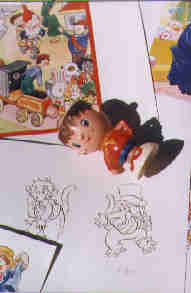
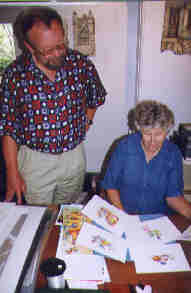
Robert Tyndall is the man who drew Noddy.
From 1953 until 1968 he worked tirelessly to illustrate the prodigious output of Enid Blyton. As well as Noddy books there was also a weekly cartoon strip, illustrations for Noddy products and endorsements, and set designs for a Noddy pantomime. If Blyton wanted it drawn, Tyndall drew it. There were no exclusion clauses in his contract.
He was not the first person to draw the character. That honour fell to Dutch artist Harmsen Van Der Beek in 1949.
Van Der Beek developed Noddy from a series of figures he had produced for a jam company promotion. At the time Blyton's publisher was seeking inspiration for a 'Disney-style' character. He was entranced by Van Der Beek's drawings of the little people who inhabited a world of brightly coloured shops and houses. These little people were used to illustrate booklets given away by the jam manufacturer.
It was the Dutch artist who first drew up Noddy and the other members of Toyland like Big Ears the Pixie and teddy bears Mr. and Mrs. Tubby. Their clothes and homes were based on Dutch rather than English style and it was this colourful continental look that first appealed to Blyton's publisher David White.
And 'Little Noddy' - as he was originally called - got his name from the fact that he was a perpetually nodding wooden puppet.
But Van Der Beek's health began to fail shortly after he began work on Noddy and he died in 1953. Tyndall still wonders whether the pressure of work contributed to his death.
"There was an enormous amount of work to do," he says. "Noddy was extremely popular and it was necessary to work very long hours to keep up with the demand."
As Van Der Beek became increasingly unwell Blyton's publishers started to look around for a replacement. They chose Tyndall because they had seen some posters he had drawn promoting coach tours in Britain. He had adopted a particularly colourful style and the publishers felt that it was sufficiently similar to Van Der Beek's to warrant giving him the job.
Tyndall was 23 years old at the time. His age and the fact that he had a young family to support ensured that he kept up with the demands of the job. Even his agent had advised him "Behave yourself and you could do very well."
Behaving himself meant doing as he was told. Every week he would be sent copy from Enid Blyton and he would dutifully illustrate it and return it. As well as illustrating her stories he would also design everything from Noddy eggcups and slippers through to promotional material and snow domes. When Noddy's face was to appear on cereal packets, biscuit boxes and other products Tyndall was expected to draw that too.
In 1954, when Blyton wrote a Noddy pantomime, Tyndall was required to design the sets.
"It was a most peculiar experience," he recalls. "They just gave me a sheet of paper listing the things that they wanted me to design.
There were all sorts of crazy things; the Faraway Tree, an aerial ballet - none of which had anything to do with Noddy but they were in there anyway! When I asked about dimensions and the size of the stage they told me not to worry about it.
'Your drawings will be handed to a company that does all that sort of thing' they said."
The end result disappointed Tyndall, yet no one else seemed concerned.
"When I went to see the panto it was also the first time that I met Enid Blyton," says Tyndall. "It really was quite strange. Everything was out of scale. The set for Big Ears' house, for example, included a huge table and chair. There was no way that Noddy or Big Ears could have climbed onto those things!
I couldn't get over it but nobody else seemed to notice."
And what did Enid Blyton think of it?
"She wasn't in the slightest bit concerned," says Tyndall. "Didn't mind at all!"
Whilst the design company was credited for its work Tyndall received no acknowledgment for his contribution. It was to become a familiar pattern over the years.
It was also to be one of the few times he met or even spoke with Enid Blyton.
"Our agents discouraged any contact," he says. "I think that they were a bit concerned that we might by-pass them and they'd lose their commission."
The next time that Blyton was to communicate directly with Tyndall would be under more strained circumstances.
In 1962 the Daily Mail ran an article entitled Crisis in Toyland. Columnist Paul Tanfield claimed to have met and talked with Tyndall. During the alleged conversation the artist had said that he was unhappy with the payment he was receiving. At that time Tyndall was paid a total of seven guineas for each illustration even though book sales had reached twenty six million copies.
The artist denies both the conversation and the complaint. But he remembers the difficulties the article created.
Enid Blyton was clearly not impressed and rang him immediately for further details. Tyndall describes her tone as very much like a schoolteacher.
"She took a carrot and stick approach," he says. "On the one hand she was very nice but there was a very big stick in the other hand to ensure she got what she wanted."
After their discussion she took the artist's side and wrote a long letter stating as much. Then the matter was considered closed and they had little direct contact again.
Blyton's approach to this issue summed up her approach to life in general. She was very clear and focused about what she wanted and had little time for matters that distracted her from this. Even her family life was structured around her work.
According to her biographer, Barbara Stoney, she hated interruptions and disturbances - even from her own children.
Blyton's own daughter Imogen Smallwood confirmed this in her 1989 autobiography A Childhood at Green Hedges. In it she describes her sense of isolation from her mother and Blyton's pre-occupation with her work. From the earliest days of her life her care was assigned to someone else.
"…not only did my mother not want to feed me herself, but she did not want to be involved with any baby care; she simply wanted to get back to her writing." wrote Smallwood.
Blyton retained such a distance from her daughters that for a number of years Imogen did not even realise who the woman was. Describing her weekly routine of collecting her pocket money Smallwood wrote:
"It was on one of these occasions, when I was on my way to collect my sixpence, that I came upon a new piece of knowledge. Something that one of the staff said to me made me realise that this woman with dark curly hair and brown eyes, so different from my own mouse-like appearance, who paid me just as she paid the other staff, who was in fact the absolute ruler of our household, was also my mother.
By this time I had met mothers in stories that were read to me, Enid Blyton stories included, and I knew that a mother bore a special relationship to her child… There was no special relationship. There was scarcely a relationship at all."
Yet despite these harsh words, Tyndall believes that Imogen has now overcome many of those negative feelings.
" Although Imogen was very critical of her mother she is also very proud of her," he says.
So much so that Imogen established the Enid Blyton Trust for Children in 1982 in memory of her mother.
Blyton's other daughter, Gillian, has remained circumspect about life with her mother and today acts as an advisor to the Enid Blyton Company.
Gillian's involvement is the only influence the family has over the management of Blyton's works. Blyton and her husband effectively lost control in the 1960's.
At that time the Tax Office discovered that Blyton was paying very little tax on the huge sums she was earning. This was not deliberate tax evasion but simply financial naiveté on the part of the writer.
To avoid a potentially huge tax bill Blyton's advisors suggested the establishment of a company. This was duly enacted and Blyton's financial problems were resolved - or so they thought.
In the years following Blyton's death the family has become less and less involved in the management of the company.
At one point newspaper magnate Robert Maxwell bought the rights to Noddy. He wanted to re-issue the books and extend their appeal to a global market. But to do this he needed to change the image of the books.
Tyndall was approached to add and amend the Toyland characters. The golliwogs were the first to go. Decried earlier as negative racial stereotypes they risked offending Maxwell's new global audience. They were removed and replaced with monkeys and goblins. Asian characters were also drawn and added to the background.
But then Tyndall began to re-consider.
Already feeling short-changed from his first involvement with Noddy he was determined to be adequately reimbursed this time. At the beginning of the project Maxwell's company had given the artist a number of verbal assurances about payment. But as the work progressed they were slow to confirm the financial details.
Tyndall decided to withdraw. No one realised at the time but his departure marked not only the loss of an artist but also the last contact with anyone who understood the history and development of Noddy.
"There's no one in the Company that understands the character now," he says "They don't have an Art Department so there are no guidelines on the way characters should be drawn. There are lots of Noddys coming out that don't look like the original Noddy - there are lots of basic mistakes in the details."
In the rush to capitalise on Noddy's name the character and his friends have been transformed repeatedly. Many of the alterations are now done by computer. In some cases, says the artist, Noddy's face "had the appearance of a Dutch cheese or pixilated peach".
The expansion into the overseas market has also brought about many changes.
"The rights have been sold to an American company," says Tyndall. "Apparently it is a big success but Noddy and Big Ears are nothing at all like the English originals. And all sorts of new characters that don't sound Toytown-like at all have been introduced.
The same is true for the Japanese versions - it's all quite strange really."
Tyndall is saddened more by the current revisions of Noddy than by the poor recompense he has received for the vast amount of work he has done. It seems that no one really knows or cares about Noddy and that the driving force now is purely a financial one.
As if to rub salt into the wound he received little acknowledgment and no money when Sotheby's auctioned a collection of his Noddy illustrations in October 1997. His works had become the property of the Enid Blyton Company and his name had been omitted from the auction catalogue. It was even more upsetting when they sold for more than three times their estimated value.
He remains philosophical.
"At least it afforded Blyton's daughters the opportunity to buy some of the works," he says.
And the prices that his work fetched have now encouraged him to put his own collection on the market. This time he will get to keep the money.
But whilst the 'Noddy market' is so hot in England it has not taken off in Australia. His works have been available at Sydney's Seasons gallery for some time yet there have been few takers.
In one case a detailed map of Toytown surrounded by drawings of all its inhabitants remained unsold at $800. Tyndall took it back to England where he sold it to Enid Blyton's daughter at the heavily discounted price of seven thousand pounds. Had it gone to auction it could have fetched upwards of twenty thousand pounds.
The only real interest in buying his works came from an over-zealous English collector. She had been in England when Sotheby's had auctioned the other illustrations and therefore knew of their increased value. That news had yet to reach the Australian gallery, which still had them priced at pre-auction levels.
But instead of buying them quietly (and profitably) at those prices she asked if she could have a discount if she bought them all. It was not a decision that gallery owner Lerida Harrison could make. So Harrison rang Tyndall in England for advice.
He had completely forgotten
about the illustrations in Australia and ordered their immediate
withdrawal from sale pending further notice.
Now Harrison now finds herself in a dilemma. Noddy simply is
not selling in Australia.
"The English are very nostalgic about Enid Blyton and that influences the prices they will pay," she says. "But she means much less to Australians. We were raised on Snugglepot and Cuddlepie and Blinky Bill."
So Tyndall's works may not fetch the same prices here as in England. That being the case, Harrison is currently thinking about sending them back over there.
"Robert hasn't really benefited from Noddy's popularity in the past," she says "Perhaps now it's time that he did."
BACK TO TOP OF PAGE