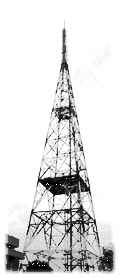
| PHILIPPINE TELEVISION HISTORY IN A NUTSHELL 1950s During the 1950s, the University of Santo Tomas and Feati University were experimenting with television. UST demonstrated its home-made receiver, while Feati opened an experimental television station two years later. On October 23, 1953, the Alto Broadcasting System (ABS), the forerunner of ABS-CBN, made its first telecast as DZAQ-TV Channel 3. The ABS offices were then located along Roxas Blvd. ABS was owned by Antonio Quirino, brother of former president Elpidio Quirino. Consequently, the first telecast was that of a party at the owner's residence, earning Elpidio Quirino the honor of being the first Filipino to appear on television. The station operated on a four-hours-a-day schedule (6-10PM), covering only a 50-mile radius. ABS was later sold to the Lopez family, who later transformed it into ABS-CBN By 1957, the Chronicle Broadcasting Network (CBN), owned by the Lopez family, operated two TV stations--DZAQ Channel 3 and DZXL-TV Channel 9. 1960s By 1960, a third station was in operation, DZBB-TV Channel 7, or, the Republic Broadcasting System. It was owned by Bob Stewart, a long-time American resident in the Philippines who also started with radio in 1950. RBS started with only 25 employees, a surplus transmitter, and two old cameras. During this time, the most popular horror series on Philippine television was Gabi ng Lagim. In 1961, the National Science Development Board was established. It was behind the earliest initiative to use local TV for education, "Education on TV" and "Physics in the Atomic Age." In 1963, RBS TV Channel-7 Cebu was inaugurated The Metropolitan Educational Association (META), in cooperation with the Ateneo Center for Television Closed Circuit Project, produced television series in physics, Filipino, and the social sciences which were broadcast in selected TV stations and received by participating secondary schools. The META team was headed by Leo Larkin, S.J., with Josefina Patron, Florangel Rosario, Lupita Concio and Maria Paz Diaz as members. The project lasted from 1964 to 1974. By 1966, the number of privately owned TV channels was 18; ABS-CBN was the biggest network by the time Martial Law was declared. By 1968, the daily television content consisted mostly of canned programs; only 10% of programs was locally produced. The same year, ABS-CBN provided Filipinos with a live satellite feed of the Mexico Olympics. Filipino audiences also saw the Apollo 11 landing live in 1969. 1970s KBS' Channel 9 was born and started operations with programming headed in direct competition with ABS-CBN. When Martial Law was declared, then president Ferdinand Marcos ordered the closure of all television stations. KBS' channel 9 was eventually allowed to operate with other stations like GTV 4, IBC-13 and Bob Stewart's Channel 7. ABS-CBN, owned by the Lopez family had to cease all operations and their facilities were operated by the KBS management group. In 1973, the Kapisanan ng mga Brodkaster sa Pilipinas (KBP) was organized to provide a mechanism for self-regulation in the broadcast industry. By the latter part of 1973, Channel 7 sold 70% of the business to a group of investors, who changed the name from RBS to Greater Manila Area (GMA) Radio Television Arts. Bob Stewart ceded majority control to Gilberto Duavit, and RBS reopened under new ownership, with a new format as GMA-7. At this time, the TV stations operating were channels 2, 9, 13, and 4, which belonged to the Ministry of Information. DZXL-TV Channel 9 of CBN was sold to Roberto Benedicto, the name was changed from CBN to KBS, Kanlaon Broadcasting System. When a fire destroyed the KBS television studios in Pasay, KBS took over the ABS-CBN studios on Bohol Avenue, Quezon City and by August 1973, KBS was broadcasting on all former ABS-CBN channels. A year later, Salvador "Buddy" Tan, general manager of KBS, reopened Channel 2 as the Banahaw Broadcasting Corporation (BBC). 1980s In 1980, Channels 2, 9, and 13 moved to the newly-built Broadcast City in Diliman, Quezon City. In 1980, Gregorio Cenda�a was named Minister of Information. GTV Channel 4 became known as the Maharlika Broadcasting System. After martial law in 1986, government management contractors took over the operations of all KBS stations. On September 14, 1986, ABS-CBN Channel 2 made a comeback and resumed broadcasting after 14 years On Novermber 8, 1988, GMA inaugurated the "Tower of Power," its 777-feet, 100kW transmitter, the country's tallest man-made structure. In 1988, PTV Channel 4, then MBS, was launched as "The People's Station." 1990s In the 1990s ABS-CBN launched the Sarimanok Home Page, the station's Web presence, making it the first Philippine network on the Internet. On February 21, 1992, ABC Channel 5 reopened with a new multi-million-peso studio complex in Novaliches. By 1996, 89% of Filipinos and 57% of Philippine households watched television 6-7 days a week. In 1997, the Children's Television Act (RA8370), providing for the creation of a National Council for Children's Media Education, was passed. By 1997, 57% of Filipino households had at least one television. 100% of those in class AB had televisions, as opposed to only 4% in class E. In 1997, the Mabuhay Philippines Satellite Corporation successfully launched Agila II, the country's first satellite. By 1998, there were 137 television stations nationwide. On April 19, 1998, ZOE TV 11 of ZOE Broadcasting Network, Inc., owned by born-again evangelist Eddie Villanueva, was officially launched. |
 |