Do not I Mean Do Not show this to anyone


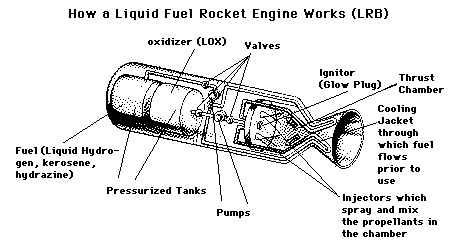
This is the basic design of the liquid rocket engine. Your Oxidant (liquid oxygen) ,and you fuel (liquid hydrogen, rp-1, rp-2) mix in an explosion chamber. This breaks into water (and carbon dioxide if rp-1/rp-2). This has a lot of heat (energy), then this exits through the nozzel. That produces force, and that force in turn defies gravitational force and you can leave the planet. Simple huh?

Rocket Equations
Conservation of Momentum

Momentum is mass (m) times velocity (V). The conservation of momentum law states that momentum is conserved and can be stated mathematically as the sum of all momentum is zero:

I discussed an experiment where a bowling ball was thrown away from you, and you are sitting on a chair that rolls easily, then after throwing the bowling ball away you would start rolling away in the opposite direction. Mathematically we can apply the conservation of momentum equation to show this:

or rearranging the terms

Where m1 is your mass
V1 is your final velocity
m2 is the bowling ball's mass
V2 is the bowling ball's velocity

So for this example if you weight 180 lbs., the bowling ball weights 10 lbs., and you throw it a velocity of 10 feet per second then you would start rolling a little over 6 inches a second in the opposite direction:

The negative sign means that you would move in the opposite direction that you threw the bowling ball. Notice that you would roll backwards very slowly because you weight much more than a bowling ball and cannot throw the ball that fast.

Rockets work on the same principle only they throw the combusted propellant back very very fast. We can see this in another example. If a rocket weighs 100,000 lbs, and expends 500 lbs. of fuel in one second, and the exhaust gasses travel at 10,000 feet per second; then in that one second the rocket will increase velocity by 5 feet per second.

This isn't really a good example, because the rockets mass isn't constant (after all it's lost the 500 lbs of fuel hasn't it). Also a rocket will probably expend fuel a lot longer than one second. A better equation in addressed in "Change of Velocity" (below).

Thrust

Newton's first law is that a body in motion will tend to stay in motion and a body at rest will tend to stay at rest. Put another way it takes force to cause a change in velocity.

Newtons second law addresses force. The more force on an object the more it accelerates, but the more massive it is the more it resists acceleration. Mathematically force (F) is the change (or differential) of momentum with respect to time, i.e. a change in momentum requires force.

Typically mass is constant and the change in velocity with respect to time is acceleration (a), so the equation can be expressed as force equals mass times acceleration, or:

However, for a rocket, if we look at the exhaust products, the mass isn't constant but changes with flow, however the exit velocity of that exhaust velocity is constant. Therefore for rockets we can say force equals the mass flow rate (m* ) times the exhaust velocity (Ve ), or;


This is the thrust of the rocket at any given time neglecting any effects from outside air pressure.

Therefore, when we account for the effects of air pressure this equation becomes:

Where
Ae = The area at the exit plane of the nozzle
Pe = The rocket exhaust pressure at the nozzle exit plane
Pa = The outside atmosphere pressure

From this equation we can see why the optimum expansion for a nozzle is when the pressure at the exit plane equals the atmospheric pressure . When the nozzle pressure is higher than the outside atmospheric pressure (underexpanded), the exhaust area is too small, and not all the energy has been converted to exhaust velocity so the thrust isn't optimized. Alternatively, when the nozzle pressure is lower than the outside atmospheric pressure (overexpanded) then the second term in the equation (i.e. Ae ( Pe - Pa ) ) becomes negative and actually causes a drag instead of a thrusting force.

Change in Velocity

On rockets, typically the propellant flow rate ( m* ) is constant and the exit velocity of the propellant (Ve ) is also constant, so the thrust is approximately constant (it may change some as the atmospheric pressure changes as the rocket climbs in altitude - however this term is less dominant than the F = m* Ve term). Even though the thrust is constant, the acceleration rate is typically increasing. Why? The propellant being burned and expelled from the rocket is decreasing the weight of the overall vehicle. At any instant in time F = m a, so rockets acceleration is equal to the thrust divided by the vehicle mass at that instant.

What is often critical is determining the total change in velocity of the rocket due to a specific thrust in a linear direction. Every change in orbit, or boost is a change in velocity. To even achieve orbit, a certain velocity must be reached.

Change in velocity, is often called or delta V ( d V).
The determine delta V we go back to Newton's second law

To get the two equations we have already solved

However this time mass is expressed as a function of time. Setting the two equations equal we get

Using calculus we can integrate this formula from the initial mass ( mo ) to the final mass (mf ) and get the change in velocity, delta V ( d V)

Or in English, the change in velocity is equal to the exit velocity of the rocket's exhaust times the natural logarithm of the initial rocket mass before the rocket started firing divided by the final rocket mass after the rocket was completed firing.

Specific Impulse

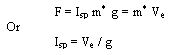
Specific Impulse is a parameter used in evaluating engine performance. Specific impulse ( Isp ) is the rockets thrust, for force (F), divided by the mass flow rate ( m* ) times gravity (g), or

This parameter has the units of seconds and can be looked at two ways.
�������- Specific Impulse is a measure of how many pounds of thrust one pound or propellant can deliver in one second.
�������- Specific Impulse is a measure of how many seconds one pound of propellant can deliver one pound of thrust.

Specific impulse is often used to characterize rocket engines. The higher the specific impulse the more thrust can be obtained for the same amount of fuel, or the less fuel can be used for the same amount of thrust.

Propellants are also characterized by specific impulse. In the case of propellants, specific impulse refers to the maximum theoretical specific impulse that could be delivered by a specific propellant combination (assuming a perfect engine). If you know an engine's specific impulse and mass flow rate you can calculate thrust by rearranging the definition;

Also, since thrust is equal to the mass flow rate times the exhaust velocity of the rocket.

Hosted by www.Geocities.ws


Rocketdyne H-1 Engine

The Rocketdyne H-1 engine was the workhorse of the early Apollo-Saturn program. The Saturn 1 and Saturn 1B rockets used eight of these capable engines in the first stage booster. The first Apollo astronauts roared into space atop an H-1 powered Saturn 1B, as did all the Skylab mission crews. The 205,000 lb thrust H-1 is a fixed-thrust, single-start gimbaled engine that employs a propellant system of RP-1 (kerosene) and liquid oxygen. Advances include a turbopump with a one-piece gearbox and fuel additive lubrication, a solid propellant gas generator for start-up, propellant valve sequencing, and hypergolic start-up in the thrust chamber.


Rocketdyne F-1 Engine

The Mighty F-1 was perhaps Rocketdyne's greatest contribution to the American space program. Just one F-1 engine provided as much thrust as all three Space Shuttle Main Engines! If you ever get to see one up close you are sure to be impressed. How big is it? Look to your right! Even more amazing is that a cluster of FIVE F-1 engines were used in the first stage of the 363-foot tall Saturn V rocket. A single-start, fixed-thrust engine, the F-1 is gimbaled and uses liquid oxygen as the oxidizer, while RP-1 (kerosene) is used as the fuel, the turbopump lubricant, and the control system fluid. A gas generator utilizing the same propellants drives the turbine, which is direct-coupled to the turbopump. The F-1 engine still holds the record for being the largest liquid rocket engine ever made. The Nova (which was never built) could have had up to 12(!) of them. Is this big enough? This magnificent example of American determination and Rocketdyne enginuity sits on permanent display in front of the Rocketdyne Main Lobby in Canoga Park, California.


Rocketdyne J-2 Engine

The Rocketdyne J-2 engine may be the most important engine in the development history of manned space flight propulsion. The J-2 was the first manned booster engine that used liquid hydrogen as a propellant. The J-2 was also the first large booster engine designed to be restarted multiple times during a mission. The J-2 engine was so versatile that it was used for both the second AND third stages of the Saturn V moon rocket. And a modified J-2 engine was used to demonstrate principles that lead to the development of Rocketdyne's Space Shuttle Main Engine. The 230,000 lb thrust J-2 features independantly driven pumps for both liquid oxygen and liquid hydrogen, a gas generator to supply hot gas to two turbines running in series, pneumatic and electrical control interlocks, altitude restart capability, and a propellant utilization system.


Rocketdyne SSME

The Space Shuttle Main Engine is the most reliable and highly tested large rocket engine ever built. The SSMEs have achieved 100% flight success with a demonstrated reliability of over 0.999. The SSME is a reusable, staged-combustion cycle engine. Using a mixture of liquid oxygen and liquid hydrogen, the SSME can attain a maximum thrust level (in vacuum) of 512,950 pounds which is equivalent to greater than 12,000,000 horsepower. The regeneratively cooled engine also features high performance fuel and oxidizer turbopumps that develop 69,000 horsepower and 25,000 horsepower respectively. Ultra-high-pressure operation of the pumps and combustion chamber allows expansion of all hot gases through a high-area-ratio exhaust nozzle to achieve efficiencies never previously attained in a production rocket engine. These advantages allow a heavier payload to be carried without increasing the launch vehicle size.

The Space Shuttle Main Engine Main Engines are being upgraded to incorporate the Large Throat Main Combustion Chamber (LTMCC) to further improve the reliability of the engine systems. The LTMCC reduces system operating pressures and temperatures that is projected to double engine reliability. In conjunction with the LTMCC, the Main Injector is redesigned to maintain the high Specific Impulse (Isp) output of the engines. This upgraded SSME configuration was launched in January 1998.

  • Rocketdyne's Space Shuttle Main Engine operates at greater temperature extremes than any mechanical system in common use today. The liquid hydrogen fuel is -423 degrees Fahrenheit, the second coldest liquid on Earth. When the hydrogen is burned with liquid oxygen, the temperature in the engine's combustion chamber reaches +6000 degrees Fahrenheit - that's higher than the boiling point of Iron.
  • The maximum equivalent horsepower developed by the three SSMEs is just over 37 million horsepower.
  • The energy released by three of Rocketdyne's Space Shuttle Main engines is equivalent to the output of 23 Hoover Dams.
  • Although not much larger than an automobile engine, the SSME high-pressure fuel turbopump generates 100 horsepower for each pound of its weight, while an automobile engine generates about one-half horsepower for each pound of its weight.
  • Even though Rocketdyne's SSME weighs one-seventh as much as a locomotive engine, its high-pressure fuel pump alone delivers as much horsepower as 28 locomotives, while its high-pressure oxidizer pump delivers the equivalent horsepower for 11 more.
  • If water, instead of fuel, were pumped by the three Space Shuttle Main Engines, an average family-sized swimming pool could be drained in 25 seconds.
  • The SSME high-pressure fuel turbopump main shaft rotates at 37,000 rpm compared to about 3,000 rpm for an automobile operating at 60 mph.
  • The discharge pressure of an SSME high-pressure fuel turbopump could send a column of liquid hydrogen 36 miles in the air.
  • Block I/IIA Space Shuttle Main Engine
    Maximum Thrust:
    At sea level/vaccume (109% Power Level)
    408,750 lb
    512,300 lb
    418,130 lb
    512,410 lb
    Throttle Range: 67% - 109% 67% - 109%
    Pressures:
    At 109% thrust
    in psia
    Hydrogen Pump Discharge: 7040
    Oxygen Pump Discharge: 8070
    Chamber Pressure: 3260
    Hydrogen Pump Discharge: 6860
    Oxygen Pump Discharge: 8040
    Chamber Pressure: 3280
    Specific Impulse: (In Vacuum) 453.5 sec 454.4 sec
    Power: High Pressure Pumps Hydrogen:????? hp
    Oxygen:????? hp
    Hydrogen:69,040 hp
    Oxygen:25,150 hp
    Area Ratio: 77.5:1 77.5:1
    Mixture Ratio: 6.0:1 6.0:1


    Rocketdyne RS-68

    Rocketdyne is simultaneously developing the first two new large liquid-fueled rocket engines in the United States in more than 25 years. One of these -- the RS-68 -- will power the Delta IV evolved expendable launch vehicle (EELV) being developed by The Boeing Company. The bell nozzle RS-68 is a liquid hydrogen - liquid oxygen booster engine that develops 650,000 lb. of sea level thrust. The RS-68 utilizes a simplified design philosophy resulting in a drastic reduction in parts compared to current cryogenic engines. This design approach results in lower development and production costs.

    RS-68
    Thrust Level: 100% 60%
    Thrust, vacuum: 745 Klbf 440 Klbf
    Weight: 14,560 lb ­
    Thrust, s/l: 650 Klbf 345 Klbf
    Engine Mixture Ratio: 6.0 6.0
    Is, vacuum: 410 sec 410 sec
    Is, sea level: 365 sec 365 sec
    Chamber Pressure: 1410 psia 836 psia
    Expansion Ratio (E): 21.5 ­


    Rocketdyne RS-72

    The RS-72 storable propellant liquid rocket engine is a commercial, joint-development program between Boeing Rocketdyne and DaimlerChrysler Aerospace to provide an advanced engine that addresses the increasing payload and launch vehicle upper stage requirements in both the American and European markets. The RS-72 pump-fed, gas generator cycle engine delivers higher performance, thrust, and reliability than today's pressure-fed engines. The gas generator cycle engine also allows the use of low-pressure propellant tanks resulting in substantial weight savings and increased safety. The overall payoff is a significant increase in payload capability and reduced system cost. The engine system is a derivative of the flight proven Aestus engine developed by Dasa and currently flying on the Ariane 5 launch vehicle. Increased performance is achieved by integrating a powerpack (turbopump / gas generator) evolved from the successful Rocketdyne XLR-132 engine development program.

    PARAMETERS
    Engine RS-72
    Propellants: NTO/MMH
    Thrust (vacuum): 12,450 lbf.
    (55.4 kN)
    Specific Impulse
    (vacuum):
    338 sec.
    Chamber Pressure: 895 psia
    (61.7 bar)
    Mixture Ratio (O/F): 2.05
    Weight: 340 lb.
    (154 kg)
    Area Ratio: 300
    Length: 90 in.
    (2286 mm)
    Restarts: Multiple


    Rocketdyne RS-27a
    The nominal 200,000 lb sea-level thrust RS-27, powering the Delta launch vehicle, has compiled one of the most consistent and successful launch records in the history of rocketry with a 100% reliability factor. A single-start powerplant, it is gimbal-mounted and operates on a combination of liquid oxygen and RP-1 (kerosene). The thrust chamber is regeneratively cooled with fuel circulating through 292 tubes that comprise the inner wall of the chamber. The RS-27A is the latest version of this propulsion system that includes a higher 12:1 area expansion ratio thrust chamber nozzle among other improvements. The RS-27A is used as the main booster propulsion system for the Delta II/III family of launch vehicles.
    Type: Liquid Propellant/Pump-fed
    Propellants: LOX/RP-1
    Thrust: (Sea Level):
    (Altitude):
    200,000 lb
    237,000 lb
    Specific Impulse: (Sea Level):
    (Altitude):
    255 sec
    302 sec
    Run Duration: 265 sec
    Mixture Ratio (O/F): 2.245:1
    Chamber Pressure: 700 psia
    Area Ratio: 12:1
    Weight: 2,528 lb
    Dimensions: 149 in. long
    67 in. dia

    1