This is the world of oranic chemistry!

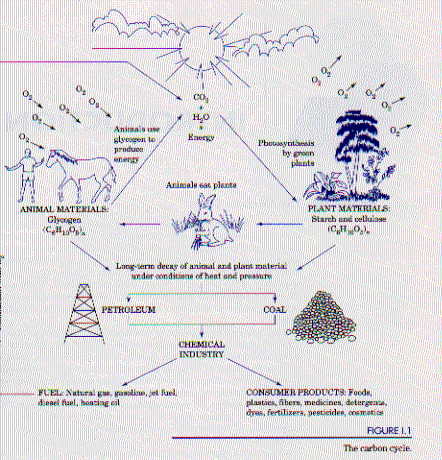
 The Carbon Cycle
Bonding
Sigma Bonds
This is the strongest bond, this bond holds and has no overlapping. In multiple bonds (double or triple bonds) this is the last bond to be broken.
Pi Bonds
This bond is a weaker bond than the sigma bonding. In multiple bonds this is bond that comes after the inital sigma bond (like the second or third bond). The electrons in this bond are found in a "cloud". This is an overlapping bond on both p orbitals, and this reduces the spX hybrid number (x usually is 3 in carbon but with 1 pi bond it is 2... get it?), but well get into that later!
Valence Electrons
Holes in the valence shell cause bonds to form.
Carbon-4, Nitrogen-3, Oxygen-2, Hydrogen-1, so on and so forth. All these holes in the electron shell make the atom unstable and that's how we get bonding.
Hybrids
This really deserves one of those recycling pics, but it dosen't. Hybrids are exactly what they sound like, a whole lot of trouble. (lol)
Aliphite Hydrocarbons
Alkanes
-sp3 hybrid, 109.5 degree bond angle, all sigma bonds.
-saturated hydrocarbon
-general formula CnH2n+2
-examples of these are:
Methane (CH4) a gas
Ethane (C2H6) a gas
Propane (C3H8) a gas
Butane (C4H10) a liquid, but w/o pressure it's a gas
Pentane (C5H12) liquid
Hexane (C6H14) liquid
Heptane (C7H16) liquid
Octane (C8H18) liquid
Nonane (C9H20) liquid
Decane (C10H22) liquid
Alkenes
-carbons with double bond: sp2 hybrid, 120 degree bond angle, 2 sigma and 1 sigma/pi bond
-one unit of unsaturation
-general formula CnH2n
-examle of this is:
Ethene (C2H4) a gas
Propene (C3H6) a gas
Butene (C4H8) a liquid, but w/o pressure it's a gas
Pentene (C5H10) liquid
Hexene (C6H12) liquid
Heptene (C7H14) liquid
Octene (C8H16) liquid
Nonene (C9H18) liquid
Decene (C10H20) liquid
Alkynes
-carbons with triple bond: sp hybrid, 180 degree bond angle, 1 sigma ans 1 sigma/double pi bond
-have 2 units of unsaturation
-general formula CnH2n-2
-example of this is:
Ethyne (C2H2) a gas
Propyne (C3H4) a gas
Butyne (C4H6) a liquid, but w/o pressure it's a gas
Pentyne (C5H8) liquid
Hexyne (C6H10) liquid
Heptyne (C7H12) liquid
Octyne (C8H14) liquid
Nonyne (C9H16) liquid
Decyne (C10H18) liquid
Alicyclic Hydrocarbons
Cycloalkanes
-bond angles follow geometery
-one unit of unsaturation
-general formula CnH2n
-examples
Cyclopropane (C3H6) 60 degree bond angles, very unstable
Cyclobutane (C4H8) 90 degree bond angles, more stable than cyclopropane, still unstable
Cyclopentane (C5H10) 108 degree bond angles, is stable
Cyclohexane (C6H12) 120 degree bond angle, very stable, two comformations chair and boat
Cycloalkenes
-bond angles vary, but they follow geometry
-two units of unsaturation
-general formula CnH2n-2
-examples
Cyclobutene (C4H6) 90 degree bond angles, more stable than cyclopropane, still unstable
Cyclopentene (C5H8) 108 degree bond angles, is stable
Cyclohexene (C6H10) 120 degree bond angle, very stable
Cycloalkynes
-large bond angles
-three units of unsaturation
-general formula CnH2n-4
-examples
Cyclooctyne (C8H12)
Aromatic Hydrocarbons
Aromatics
-a six carbon principal ring
-three double bonds that form a pi cloud
-give smells to the world
-examples
Benzene (C6H6)
Naphthalene (C10H8)
Anthracene (C14H10)
Phenanthrene (C14H10)
Functional Groups
Alcohol
has an OH group ,hydroxide
first step to oxidation
Aldehyde
has one double bonded oxygen
second step of oxidation
Carboxylic Acid
formula COOH
has one double bonded oxygen and one OH group
Third step of oxidation
Ketone
formula R-CO-R, R is another hydrocarbon
Oxygen is double bonded
Ether
formula R-O-R, R is another hydrocarbon
Amine
formula R-N
Anything can bond to Nitrogen, up to two bonds
Nomenclature
IUPAC Nomenclature
IUPAC nomenclature is supposed to be a simple thing to do but there are something that throw people off. Here's how to do it!
1) Count the longest chain of carbons in the hydrocarbon.
2) Then Identify any functional groups.
3) Then number the carbons so you get the lowest number.
Here's when the problem comes in, You have to give priority to ceartin groups. The order is as follows
Alcohol
Alkene, or Alkyne
Halide, or Alkyl group
4) Then you put it together!
Examples will be put up here soon as I figure out how to edit these examples I've made.
Organic Reactions
Subsitution
In a subsitution reaction, the atoms are replaced, like a switch from Hydrogen to A functional group.
There are two mechanisms for this process, Sn1 and Sn2.
Sn1 is the mechanism that has a carbocation, involves free radiacls, and the process that has intermediates.
Sn2 is a concerted process, involves back side attack, and has no intermediates.
Elimination
In an elimination reaction, the atoms are removed from the moleclue. This results in a multiple bond.
There are two mechanisms for this E1, and E2.
E1 is the mechanism that has a carbocation, involves free radiacls, and the process that has intermediates.
E2 is a concerted process, involves back side attack, and has no intermediates.
Addition
An addition reaction is the converse of an elimination reaction. Addition reactions break multiple bonds.