DREAM RUN:
The overall global economic slowdown notwithstanding, the Indian IT software and services industry is maintaining a steady pace of growth and keeping its place as the spearhead of India’s export attack.
Like old wine, the Indian IT software and services industry has matured, become more refined and moved up the value chain in terms of solutions offered to customers. The customers, from all parts of the globe, have meanwhile continued to flock to India’s corporates for help with their software needs. Major corporations are continuing to rely on Indian software companies for both legacy and new technology solutions. The wide span of the country’s expertise across myriad technologies and platforms has provided the Indian software engine with awesome power to deal with any kind of IT requirement. The enormous base of skilled manpower — India’s PhDs and computer science graduates — is the envy of virtually every country, and in fact a major draw for global customers.
What is it then that has enabled Indian software companies to make the global market their playing ground? Phiroz Vandrevala, Chairman, NASSCOM analyzes the growth of the Indian software industry along with its implications for the global market.
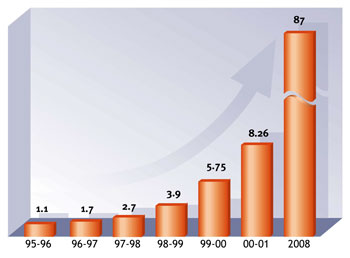
The year 2000-01 was yet another winner for the Indian software and services majors who continued to hold fort in the world markets. The industry grew at a heady 55 percent, proving skeptics wrong and convincing them that there was much more depth to the software industry than expected.
Despite the prevailing global economic downturn, the Indian software and services industry is convinced it will be able to achieve the ambitious targets it has set for itself. The NASSCOM-McKinsey Study 1999 which has furnished a goal of $50 billion of software exports by 2008 has not been revised or scaled down by Indian software majors.
Further cause for cheer has come from international business intelligence and advisory leader Gartner Inc., which recently declared through a study that despite layoffs and cutbacks among numerous IT vendors, many organizations are increasing their IT budgets in 2001. The survey, covering over 589 organizations worldwide, has shown that 56 percent of respondents plan to spend more on IT in 2001 than they did in 2000.

" THE INFORMATION TECHNOLOGY INDUSTRY OF INDIA IS FLOURISHING AT NEW HEIGHTS WITH HIGH QUALITY STANDARDS AND PROFESSIONAL MANPOWER."
|
India IT Software and Services Industry US$ billion
Source: NASSCOM |
HIGH
GROWTH:
Bolstered with such a significant, technically sound resource base, the
software industry has grown unimpeded. With a compounded annual growth rate
of more than 50% between 1992 and 2001, the Indian software sector has
expanded almost twice as quickly as the world-leading U.S. software industry
did during the same period, although from a smaller base.
India’s software industry statistics illustrate the massive strides achieved
by this sector and the opportunities the future holds. According to
NASSCOM’s estimates for the fiscal year 2000-01, the country’s software
industry is worth $8.26 billion, up from $100 million ten years ago. A study
conducted by renowned consultancy firm McKinsey and Co., for NASSCOM, has
proven why India is becoming the off-shore software development out-sourcer’s
destination of choice. According to the NASSCOM-McKinsey study, the Indian
software industry is expected to gross US$50 billion in exports in 2008!
This is based on an average growth rate of 35 percent per year. The industry
is well placed to achieve this target.
Positive
Outlook:
India’s software and services industry has and will continue to remain in
the driver’s seat of the country’s IT sector. India’s success in the
software arena is attributed to the software industry’s knowledge and
expertise in cutting edge technologies and skilled manpower base. Both these
strengths are likely to contribute towards the industry’s future growth. In
fact, India’s prowess in emerging technologies is also helping the software
and services industry obtain new customers, even in the face of a
debilitating U.S. economy slowdown. There is only one way that the Indian
software industry is headed and that is up. The coming years will only
reiterate this trend.
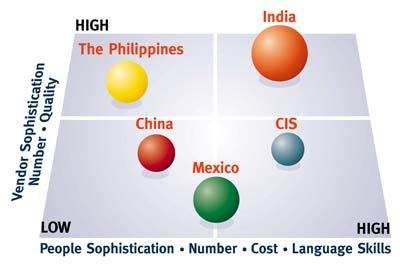
India is Best positioned for cross
border IT services
Source : NASSCOM-McKinsey Study 1999
|
Quality
The demand for Indian skilled manpower is also on the rise among countries outside of the U.S. According to Stepstone, the largest career portal in Europe, major opportunities are emerging for Indian talent from within the European Union. By 2003, in fact, Stepstone says there will be around 1.6 million unfilled jobs in the EU. Germany alone accounts for about half of the vacancies—400,000. France has recently announced over 100,000 openings in the public sector alone. Austria has over 30,000 vacancies, and Norway is offering over 30,000 jobs. Since most of the European companies are looking to leverage India’s skills in the IT sector, Indian companies are increasingly expanding their presence in Europe. In the year 2000-01, Europe accounted for over 24 percent of India’s software export destination.
Quality: The Magic Mantra Outsourcing software requirements depends mostly on quality of services, and quality has continued to remain a prime edge for Indian software companies. According to the NASSCOM survey, the Indian software industry continued to win recognition for its quality in software development over the last year. Out of the top 400 companies, more than 250 have already acquired ISO 9000 certifications. However, it is in the SEI CMM (Software Engineering Institution Capability Maturity Model) Level 5 segment that the real accolades have come India’s way. Out of the 54 companies in the world that acquired SEI CMM Level 5 certification, 27 companies are located in India.
|
Software Industry Thrives
It has emerged that although companies have cut back on their hardware purchases, they continue to spend on services and personnel. This study brings cheer and hope to the Indian software industry, which is more than geared up to continue its dream run. India is also upbeat about its software export prospects because of some of the key developments that have taken place during 2000-01. The statistics speak for themselves:
-
In 2000-01 the Indian software and services industry grossed an annual revenue of US$8.26 billion. The industry registered an overall growth of 55 percent during 2000-01, up from US$5.7 billion in 1999-2000. Software exports grossed a total of US$6.2 billion in this period.
-
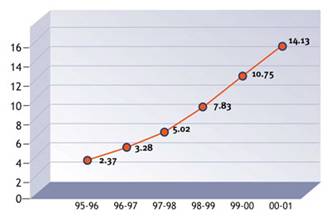
Software and services exports accounted for a very healthy 14 percent of India’s total exports of US$44 billion during 2000-01.
-
One out of every four global giants outsourced their “mission critical software requirements” to India.
-
Not only has there been an exponential growth, but the industry has also moved up the value chain. India’s software saga, which began with staffing, moved its way up to software development, then integration, and now centers around top-of-the-line business consulting projects.
-
Contrary to popular belief, over the last few months, many US companies showed increased interest in the Indian software industry. Global majors such as DuPont and Deutsche Bank announced an increase in their outsourcing projects.
-
Quality remained a hallmark of the Indian software industry, with more and more companies gaining SEI CMM (Software Engineering Institute Capability Maturity Model) Level 5 certifications.
-
India’s English-speaking scientific man-power, in terms of numerical strength alone, ranks second only to the United States.
India stands tall today among global contemporaries in the software market, it’s name having become synonymous with expertise in this discipline. A World Bank- funded study has confirmed that foreign vendors rated India as their top choice for software outsourcing. The list of these companies is as long as it is illustrious. It includes General Motors, British Airways, Wal-Mart, Coke, General Electric, Ford, Sony, Nokia, Siemens, United Airlines, Pepsi, Boeing and Citibank.
Indian software companies are increasingly providing sophisticated solutions for e-commerce, e-banking, CRM, SCM, telecom software, mobile internet, WAP, network integration, application development, robotics, embedded software, microelectronics design and software engineering among others.
E-commerce, Remote Processing:
Taking the Front Seat
India’s strengths in the software market also lie in its pursuit of new opportunities. In fact, two key segments that are expected to open up over the next few years for India are e-commerce and remote processing. Opportunities in e-commerce software solutions are emerging as a major area of growth in the Indian IT software and services industry. A recent study undertaken by The Boston Consulting Group for NASSCOM clearly stated that India can earn revenues of US$9 billion from e-business solutions by 2005.
IT-Enabled Services, or “Remote Processing”, has emerged as the next major driver of the technology services industry. With competitive telecommunication costs, well developed infrastructure and a huge pool of English-speaking and computer-literate graduate manpower, India rates higher than many other countries as a hub for IT-enabled services. Call centers and business process outsourcing is emerging as the next wave of growth in India. The McKinsey study indicated that India will earn $18 billion in revenues through these services and create additional employment of one million jobs. Already companies like GE Caps, British Airways, Swissair, American Express and British Telecom are using Indian companies for these services.
India's Silicon Valley
While the industry has been growing at above average growth rates, software development activity is not confined to a few cities in India. Software development hotspots, such as Bangalore, Hyderabad, Mumbai, Pune, Chennai, Calcutta, Delhi-Noida-Gurgaon belt, Vadodara, Bhubaneswar, Ahmedabad, Goa, Chandigarh, Trivandrum are all developing quickly. They boast state-of-the-art software facilities and the presence of a large number of overseas vendors. A large part of India’s success in the software sector is due to the crucial role played by the State of Karnataka in promoting and providing a boost to IT. Karnataka has emerged as the computer capital and center of high-tech industries, especially software. Bangalore has for long been known as India’s answer to Silicon Valley, and this is the city where most large software companies have set up shop and operate out of state-of-the-art facilities. The Government of Karnataka has also been extremely positive about the software and services marketplace and has helped create the relevant telecom and policy infrastructure conducive to the growth of this sector.
|
Software Export as a percentage of India’s Total Export
Source: NASSCOM
|
Conclusion
The dynamic industrial policy declared in 1996, with comprehensive packages of incentives and concessions, has ensured a productive ground for various industries. The hardware and software industries have now brought about a revolution of sorts under these schemes. Various institutions and computer training centers have contributed to the large number of trained and talented professionals.
The City of Bangalore has positioned itself to help market the software industry. This is also why Bangalore has been playing host to international-class conferences, workshops and exhibitions devoted to the software cause.
In
fact, the “Technopolis” of India will be holding one of the largest IT
events this
year, for the fourth consecutive time — Bangalore IT.COM 2001, Conference
and Tradeshow.
Under
one sprawling banner, over a short but intensive span of five days,
Bangalore will see over 500 IT and Telecom giants from all over the world.
There will be over 75,000 business visitors, plus corporate buyers, decision
makers, visionaries and technology gurus converging from key international
markets across the U.S., Europe, India and Southeast Asia. This year’s
Bangalore IT.COM will also feature a unique “Global Buyer-Seller Meet”, a
forum for generating business leads, structured networking and pre-fixed
meetings for international and domestic outsourcing partners.
In addition, the visitors can experience Bangalore’s hi-tech climate. The city has the highest number of engineering colleges in the world, almost 50 percent of the world’s SEI CMM Level 5 companies, COPC/ISO recognized Customer Interaction Centers, and over 103 R&D Institutions. It is, in fact, home to GE’s biggest R&D Center outside the U.S.—the Jack Welch Technology Center, which hires over 200 PhDs/scientists every month! To top it all, Bangalore has just been ranked the fourth best “Global hub of technological innovation” by none other than the United Nations.


