Religion
in Postindustrial America: The Problem of Secularization - 300
A
Paradigm of Christian Symbolism
Changes
Introduced by the Protestant Movement
Some
Aspects of the Contemporary Situation
THE PRESENT PAPER is in some respects a sequel to “The 'Gift of
Life' and Its Reciprocation," which appeared in the Autumn 1972 issue of Social
Research.1 I begin with
the presentation and explication of a schematic
paradigm of the symbolic structure of medieval Christianity, indicating
the principal modifications that must be introduced to accommodate the
development of Protestantism. I then
turn to two major developments of the post-Reformation era: the process
sometimes called secularization, and
that which has led to the ecumenical movement
of recent times. Within the framework
of these two developments, I briefly discuss two phenomena that do not fit into
what has traditionally been called religion: civil
religion and Marxian socialism,
which may be called a secularized religion. Finally, I consider the current religious
situation, with special reference to the United States, and the appearance of
what must be called post-Marxian
themes in certain dissident social and cultural movements in the United States.
1 Talcott Parsons,
Renee C. Fox, and Victor M. Ljdz, “The Gift of Life' and Its
Reciprocation," Social Research, XXXIX (Autumn 1972), 367-415.
Chapter 12 of this volume. See also
Talcott Parsons, “Belief, Unbelief, and Disbelief," in Rocco Caporale and
Antonio Grumelli, eds., The Culture of Unbelief (Berkeley University of
California Press, 1971), pp. 207-245.
Chapter 11 of this volume.
From Social Research, vol. 41 (Summer 1974),
pp.193-225. Used by permission. Social Research is published by the
Graduate Faculty of the New School for Social Research.
 301 -
302
301 -
302
A Paradigm of Christian Symbolism
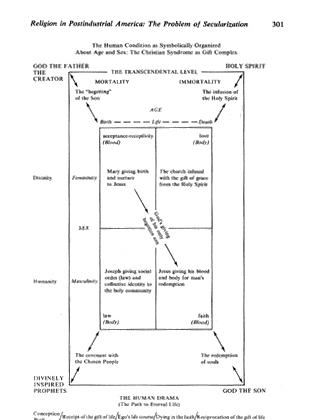
The figure on page 301 represents the main structure of Christian
symbolism as found in the medieval Roman Catholic Church. It reflects some of the ideas put forward in
"The 'Gift of Life' and Its Reciprocation," in which my colleagues
and I sought to explicate some aspects of the meaning of death in the Western
religious tradition. We there adopted
the concept of life as a gift, and
utilized ideas of gift-giving and gift-exchange formulated a generation ago by
Marcel Mauss.2 The
formulation of the paradigm was greatly facilitated by certain writings of
Edmund Leach and Kenneth Burke as well as by the original biblical texts.3
The figure
presents the two-level system of
Christian symbolism: the temporal and the
transcendental, or the secular and the sacred. In the figure, the inner rectangle, designated "The Human
Level," is organized about two reference concept
pairs. First is the one
that has figured so prominently in anthropological and sociological thinking,
namely, sex
and age. It should be
remembered that I am peaking in symbolic terms, though in some cases the
symbolic figures are referred to in canonical documents with quite definite sex
identity and sometimes with generation identity. In this respect the category of sex
is relatively straightforward. For what
social scientists have called age, I have substituted the life course as a whole with
special reference to its beginning and its end, birth and death. The symbolization, then, has to do with
certain relations between the cultural conceptions of what it means to be born
and what it means to die.4
The second
reference concept pair is taken from the symbolization of kinship relations
as analyzed by David Schneider. The
most obvious of these symbols is blood,
as habitually used in the expression "blood relationship." It is striking that in perhaps the most
intimate relation of kinship, that of mother and child, a common bloodstream is not physiologically shared. Nevertheless, blood has become a primary
symbol of this type of relatedness. The
other concept that Schneider uses is that of relationship in law, organized not about blood but about what
is in some sense a contract. The
prototypical empirical kinship case is the relation of the parties in a
marriage.
In religion as in
kinship, the symbol blood plays a central part. This is true in many religious traditions
but particularly in Christianity, where the blood
of Christ is symbolized by the wine
in the central Christian ritual, the eucharist. The other primary component of the eucharist, the bread, symbolizes the body of Christ. In "The 'Gift of Life,' " my
colleagues and I argued that body as a
symbol is very closely related to a relation of law
in Schneider's sense, and indeed this turns up in a variety of cultural
traditions other than the American.
2
Marcel Mauss, The Gift, translated by Ian Cunnison (Glencoe, Ill.: Free
Press, 1954).
3 See Edmund Leach, Genesis as Myth and Other
Essays (London: Jonathan Cape, 1969), and Kenneth Burke, The Rhetoric of
Religion (Boston: Beacon Press, 1961).
4
Cf. Matilda W. Riley, Marilyn Johnson, and Ann Foner, eds., Aging and
Society, Vol. III: A Sociology of Age Stratification (New York: Russell
Sage Foundation, 1972).
5 David M. Schneider, American Kinship: A
Cultural Account (Englewood Cliffs, N.J.: Prentice-Hall, 1968).
303
I
have structured the inner rectangle to yield a fourfold table, the two dichotomized dimensions of which are (in the vertical axis) femininity and masculinity,
and (in the
horizontal axis) birth and death - that is, the
old categories of sex and age in the appropriate modifications as just
explained. In New Testament tradition, three
of the four cells are related to symbolic individuals, and they are related to
each other and to other human beings through a gift relationship. The fourth I think of as symbolizing
the church, which, in the words of
the eucharist, constitutes the mystical body of Christ. The two left cells are what Leach would call the "sociological" parents of
Jesus, of whom, in the religiously symbolic sense, clearly the more important
is Mary, the “Mother of God."
Leach, however, aptly refers to Joseph as Jesus' “sociological"
father. Symbolically, the figure of
Joseph seems to represent continuity between the Christian group and the Jewish
community within which Christianity arose.
Thus in the gospel according to Matthew, there is an elaborate genealogy
which traces Joseph's descent from the patriarchs and prophets and strongly
asserts his belonging - and therefore his sociological son Jesus' belonging -
to the “House of David." This in
turn we may associate with the continuity in some sense of the Jewish law,
despite the profound alteration of the meaning of that law by Jesus and
Paul.
It
will be noted that Mary is depicted as giving
birth and nurture to Jesus. Jesus
himself, then, having been given birth by a human mother, in his sacrificial
death on the cross is symbolized as giving his blood and body for man's
redemption. Finally, the church is
conceived as infused with the gift of grace from the Holy Spirit.
Whereas
the vertical axis of the inner rectangle is conceived in terms of the sex dichotomy, the horizontal axis is concerned with a dichotomized version
of the age variable,
focusing on the two extreme points of the life course, birth and death. From this point of view, it is highly
symbolic that in a certain sense the founding act of Christianity was Jesus'
sacrificial death. The church, then
particularly in the Catholic tradition, was conceived as the agency through
which the transcending of death and the achievement of eternal life could come
about.
The other two
primary reference symbols - namely, blood
and body - are depicted as
characterizing the diagonals of
the inner rectangle. Blood is involved not only in Jesus’ sacrifice
but also in his relation as blood child to Mary. It therefore symbolizes both a religious event and a terrestrial
kinship. The other diagonal axis is associated with the symbol of body, but Interestingly
in both cases not specifically an individual's body but corporate bodies. If my interpretation is correct, the
relatively secular community that has been sanctified through its relation to the
heritage of Israel is a necessary substratum for the religion. This, in turn, is related to the church as
the mystical body of Christ with all its well known meanings. Here the gift theme appears again in the
concept of grace as the instrument of
human salvation.
The
outer rectangle in the figure is designated "The Transcendental
Level." At three of its
corners I have placed the three persons of the Trinity. The concept of God the Father, which is
placed at the upper
left corner, gained a new meaning in Christianity in contrast to Judaism
through the symbolic act of God's "begetting"
a son, Jesus, through the human woman Mary.
This act of begetting is quite different from that of creation as
portrayed in Genesis. God created Adam and Eve, but he begat Jesus.
Among other things, begetting
symbolizes the continuity of the human species, which began with
an act of creation.
The
second main act of God in the drama of salvation was the "giving of his
only begotten son" for the redemption of mankind. The upper right
corner
represents the concept of the Holy Spirit, which has a special relationship to
the church and the gift of grace. The lower right corner is the locus of God the Son, the personal agent of redemption.
The
lower left corner does not involve a person of the Trinity
but rather the Christian inheritance from the Jewish tradition. I have focused it about the divinely
inspired patriarchs and prophets, notably Moses and David, as establishing a
particularly sanctified human community, the "Chosen People." It will be remembered that the concept of
the covenant, which was central to the Old Testament, was carried over into
Christianity in various forms and is particularly important in the Puritan
branch of Protestantism.
Finally, at the bottom of the figure, outside either rectangle, is a schematic notation about the human
drama that I have labeled "The Path to Eternal Life." The duality is present in the spiritual
conception of Jesus and his actual physical birth. Jesus, standing in a certain symbolic sense for mankind, was by
that set of circumstances the receiver of what I have called the gift of
life. According to Mauss, the
acceptance of a gift calls for its reciprocation. Part of that reciprocation is living
a religiously acceptable life, the consummation of which is dying in the
faith, which completes the reciprocation of the gift.
The
paradigm omits reference to two
particularly important features of the Catholic system. The first is the
sacraments. Besides the
eucharist, already mentioned, the church instituted several other sacraments,
notably penance, baptism, marriage, and extreme unction. The sacraments were considered to be
consequences of the gift of grace coming to the church through Jesus' sacrifice
and through the Holy Spirit. The church
claimed a monopoly of the legitimate use of the sacraments. It became its policy, contrary to practices
of early Christianity, that the sacraments could be
administered only by ordained priests deriving their
authority through apostolic succession from St. Peter, whose direct successor
as the head of the church was the bishop of Rome, the pope.
305
A
second important feature omitted from the paradigm is the religious order, whose members took vows
of perpetual devotion to the religious life.
Although in early Christianity there were individual anchorites,
collective monasticism did not develop until the third century. Members of the religious orders, the regular clergy, were the true “upper
class" of the church, with - to pursue the metaphor - the secular clergy serving as a kind of
middle class and the laity constituting, religiously speaking, the unprivileged
"masses."
There
has been a remarkable stability in the main Catholic pattern down to the
present day. Mention should be made,
however, of two important developments.
After the outbreak of the Reformation, which will be discussed
presently, the Catholic Church reacted by tightening discipline, particularly
over the clergy, and by more strictly defining the sacramental system. For the laity it insisted on full doctrinal
conformity and maintenance of prescribed religious practices. The spirit of this Counter Reformation is embodied in the Society of Jesus, founded by St. Ignatius
Loyola in 1540. From the start, the Jesuits were militant servants of the papacy
rather than monks absorbed in devotional exercises.
The second important development is a much more recent one. In a sense, the main pattern of the Counter Reformation endured into the present century: only a century ago, in 1870, Pius IX promulgated the doctrine of papal infallibility. The recent period, however, has seen increased participation of the Roman Catholic Church in what has come to be called the ecumenical movement. The brief papacy of John XXIII and the Second Vatican Council precipitated a critical situation within the church. For example, there has been since then a vastly increased demand for the termination of the requirement of celibacy for the secular clergy, and there have been many resignations from the priesthood over this issue.
continued ...