action theory & the human condition
IV – THE HUMAN CONDITION - 325
15 – A Paradigm of the Human Condition - 352
Fast forward: Introduction
è
The Main Outline of the Paradigm è
The
Metatheoretical Framework è
The
Structural Paradigm Elaborated è
Media of
Interchange, Categories of Orientation, and Standards of Evaluation
è
Mediated Interchange Sets
è
Structural Coordinates of Living Systems: The
Articulation of Action and Human Biology è
About AT & the HC
è
I.
Introduction (go to top)
THE PRESENT CHAPTER takes up formally the task of working
out an outline analysis of the system we have, in various introductory
discussions, called that of the human condition. It is hardly necessary to reiterate that this
chapter is meant to he primarily a theoretical attempt rather than an addition
to the voluminous philosophical and in the humanistic sense critical
literature. In
other words, it is meant to be strictly comparable to previous attempts to
conceptualize the social system and the general system of action and to
articulate them.
For the present purpose it is essential to say something about the
intellectual background of this venture. In the course of the development of the
theory of action there has, as long as I have been involved with it, never been
any lack of awareness that what came to be called the general system of action
does not stand alone among the objects of cognitive understanding with which
human investigation is occupied. In particular, there have been two classes of
objects which, it became increasingly clear, in some sense stood on the
boundaries of the system of action. Since the concepts of boundary definition and
boundary maintenance had become crucial to the theory, there did not seem to be
any logical reason why the same order of conceptualization should not be
attempted at and beyond such boundaries, as had proved to he so important to
analysis within the system of action, especially in analytically discriminating
the primary subsystems of the latter from each other (e.g., social and cultural
systems).
353
One of these two salient boundaries of action is that vis-a'-vis living
organisms. The
status of this boundary had been a major concern of mine even before I became
committed to a career in social science. A kind of theoretical jolt, however, occurred
when, as noted in the General Introduction, Charles Lidz and Victor Lidz
submitted to me their essay on what they called the "behavioral system," with its proposal that this term should
he substituted for my term "behavioral organism,"
defined as the adaptive subsystem of the general system of action.1 They made a cogent case, which persuaded me
that the organism as an analytical category should be entirely excluded from the
system of action - except, of course, for zones of Interpenetration - and that
the system of cognitive organization at symbolic levels should be treated as an
essential part of action.
This development necessitated a thoroughgoing reconsideration of the
boundary between action and the organic world. We were of course very much aware that most
psychologists had refused to make much of the distinction, many of them defining
psychology simply as the study of "the behavior of organisms." We, on the other
hand, had come more and more clearly to draw an essential line that, following
Durkheim, Weber, Freud, Piaget, G. H. Mead, and others, emphasizes the
distinctiveness of the involvement of symbolic processes in what in other
respects could quite correctly be called human "behavior." In this connection I
consider Freud's insistence on the distinction between "organic" and "psychic"
(discussed in Chapter 4 of this volume) exceedingly important.
354
There can be no question of the enormous importance, for the
understanding of human action, of its interrelations with organic systems. In turn, these
interrelations cannot be understood without theoretical understanding of the
organic side, just as the human
implications, for example, of organic evolution, cannot be adequately grasped without a corresponding understanding
of the action system. Indeed, it may be
said that less harm has been done by social scientists "biologizing" action
phenomena directly than by their failure to attempt the requisite theoretical
understanding of the organic level as well as that of action, with behavior
standing in between.
At any rate, in the period leading up to my memorandum of the summer of
1974 a great deal of attention was paid, as has already been recounted, to
biological theory.
The resulting better understanding of biology, including some of its more
recent developments, paved the way for the attempt to include both the organic
and the action level in a single, at least partly integrated, conceptual scheme,
a "theory of living systems." A very general paradigm such as that
presented in this chapter can of course develop only a broad outline of the
interrelation we have in mind. The view we hold, however, is that any
serious and competent contribution to this problem is better than its simple
neglect.2
The second major boundary of the system of
action, which has concerned me and many other sociologists and cultural
theorists, lies, cybernetically speaking, in the other direction. Since The Structure of Social Action I have been cognizant of
these problems, but earlier I adopted the relatively cautious policy of
referring to it in terms of a residual category, namely, cognitively as
"nonempirical."
From the beginning, however, I meant this formula to mark off my own
position quite decisively from a positivistic position that implies that only
empirical science is a source of valid understanding of the human
condition. I
think it fair to say that on such positivistic premises Weber's sociology of
religion 4 would not make sense.
2 An essentially programmatic statement
on this point that I wrote with A. Hunter Dupree in “The Relations between
Biological and Socio-Cultural Theory," which appears in Talcott Parsons, Social Systems and the Evolution of Action Theory (New
York: Free Press, 1977), chap. 5.
3 Talcott Parsons, The Structure of Social Action (1937; reprint ed., New
York: Free Press, 1949).
4 Max Weber, The Sociology of
Religion, transi. by E. Fischoff (Boston: Beacon, 1963; first published in
German in 1922); idem, see also The Religion of India:
The Sociology of Hinduism and Buddhism, trans. and ed. Hans H. Gerth and Don
Martindale (New York: Free Press, 1958; first published in German in 1916-1917);
idem, The Religions of China: Confucianism and
Taoism, transl. and ed. by H. H. Gerth (New York: Free Press, 1951; first
published in German in 1915); and idem, Ancient
Judaism, transl. and ed. by H. H. Gerth and D. Martindale (New York: Free
Press, 1952; first published in German in 1917-1919).
355
In gradually working toward giving some coherent structure to this
residual category I have been especially influenced by repeated revisits to
Weber's work.
The crucial problem was that: in his extensive discussions of what he
called the "problems of meaning," Weber stressed a diversity of "orientations"
that have been adopted in different religious systems in response to such
problems.
Various interpreters of Weber have contended that these variations were
for Weber essentially random, but the better I came to know Weber's work, the
less acceptable was this interpretation. As relevant considerations I may point to two
positions Weber strongly stressed.5 The first was the contention that original Calvinism and early Buddhism can be treated as polar opposities of
each other in the range of variations of possibly meaningful religious
orientations.
The second was the significance he attributed
to the two dichotomies he used for characterizing types of orientation - on the
one hand, that between asceticism and mysticism and, on the other, that
between "innerworldly" and
"otherworldly" orientations. The last two dichotomies can easily generate
a fourfold table. At any rate, such considerations convinced me that Weber was
feeling his way toward a structural classification of types of religious
orientations and that had he lived a few more years he would very likely have
promulgated one (Weber died at age fifty-six).
Besides this type of mulling over of some of the implications of Weber's
position, a decisive influence on my thinking in this area was a revisit to Kant
that was stimulated by discussions of the Pennsylvania group. Thus, though Kant
was skeptical of what is meant by "metaphysics," one could certainly interpret
his position in the following way. In The Critique of
Pure Reason, Kant clearly did not treat space and time or the categories of understanding as
being themselves in the ordinary, empirical sense objects of knowledge, as
phenomena, but rather held them to constitute what in his sense was a
"transcendental" framework in terms of which empirical knowledge is made
possible.4 He used essentially the same kind of
reasoning in The Critique of Practical Reason 7 and in The Critique of
Judgment,8 attempting to abstract out in these two spheres, as well,
the transcendental framework of "assumptions," or whatever they are called, by
virtue of which valid judgments are possible. It may be noted that in the first of these
contexts Kant, unlike Hume,9 did not ask whether valid empirical
knowledge is possible but stated that we have valid knowledge and, given this
fact, the question is how
is this possible?
5 Weber, Sociology of
Religion.
6 Immanuel Kant, The Critique of Pure Reason, trans. N. K. Smith (New
York: Macmillan, 1929; first published in German in 1781).
7 Immanuel Kant, The Critique of Practical Reason, trans. and ed. L. W.
Beck (Chicago: University of Chicago Press, 1950; first published in German in
1788).
8 Immanuel Kant, The Critique of Judgment, tran9. I. C. Meredith
(Oxford: Clarendon, 1964; first published in German 1790).
9 David Hume, A
Treatise of Human Nature, ed. L. A. Selby-Bigge (Oxford: Clarendon, 1958;
first published in 1739-1740).
356
Kant clearly thought in terms of dual levels: the sense data of empirical
knowledge and the categories of the understanding; the "problems" of practical
ethics and the "categorical imperative"; esthetic "experience" and the canons of
judgment.
There seems to be a striking parallel between his version of duality and
the linguist's "deep structures" and "surface structures," the biologist's
"genotypes" and "phenotypes", the cyberneticist's "high on information" and
"high on energy," and indeed the sociologist's "values," or "institutional
patterns," and "interests." We therefore suggest that the first term in
each of these pairs be used to designate a metastructure, which is
not as such a property of the phenomena (also Kant's term) under consideration
but is rather an a priori set of conditions without
which the phenomena in question could not be conceived in an orderly
manner. We
consider that this point of view is not open to the traditional objections
usually implied in the term "metaphysical." The fact that Weber was thoroughly steeped in
Kantian thought helps, in this regard, to make Weber's ideas intelligible.
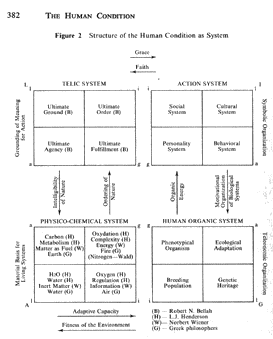
In the context, above all, of the idea of cybernetic hierarchy, which has
become increasingly salient in this line of theorizing, it has seemed
appropriate to designate the "system" that is beyond the boundary of the action
system in this direction as the telic system of the human condition. In using this
modification of the Aristotelian term "teleology," which has been so thoroughly
excoriated by the partisans of positivistic views, we have been particularly
encouraged by the related use of such modifications by two eminent scientists of contiguous generations. The first is the physiologist Lawrence J. Henderson, who in
his notable book The Order of Nature took the view
that the Aristotelian problem, if it may be called such, could not be expunged
from the thinking of modern science.10 The second is the
contemporary biologist Ernst Mayr, who for his own purposes introduced another
modification, teleonymy,11 which
clearly belongs in the same linguistic family. Subsequently, we will have more to say about
both Henderson's and Mayr's conceptions.
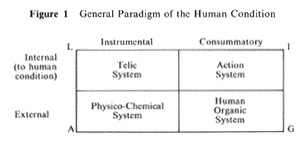
Clearly, we think of the telic system, standing as it does in our
treatment in a relation of cybernetic superordination to the action system, as
having to do especially with religion. It is primarily in the religious context that
throughout so much of cultural history belief in some kind of "reality" of the
nonempirical world has figured prominently. With full recognition of the philosophical
difficulties of defining the nature of that reality we wish to affirm our
sharing the age-old belief in its existence.
For many purposes, of course, it is not necessary to go beyond this; we
can content ourselves with the bare statement that "something is there." But for some of our
purposes this statement of self-denial will not suffice.
10 Lawrence J. Henderson, The Order
of Nature: An Essay (Cambridge, Mass.: Harvard University Press, 1917).
11 Ernst Mayr, “Teleological and
Teleonomic: A New Analysis," in Marx Wartovsky (ed.), Method and Metaphysics: Methodological and Historical
Essays in the Natural and Social Sciences (Leiden: E. J. Brill, 1974),
pp.78-104.
This consideration is linked with the fact, just outlined,
that at least for Kant the existence of the meta-reality must be taken into consideration in
positively structured ways. Kantian epistemology without giving content
to the categories would surely be a poor thing, as would Chomsky's linguistics
12 be, if he insisted that the existence of deep
structures must be assumed but that nothing more can be said of them. We thus wish to
contend both that the assumption of this meta-world must be assumed notably with respect to
religion and that the attempt must be made, in the course of theoretical work,
to give it relevant specific content. What this content is to be will depend on the
exigencies of theory construction as their relevance to the problems
develops.
The reader will have noted that we have so far dealt with two of the broad traditional areas of scientific
theorizing, the organic world and the world of action, and with the
nonempirical, telic world, as we call it. But what of that which is usually called the
"physical" world?
Some would not distinguish the physical from the organic world or vice
versa, but not such prominent biologists as Henderson,13 Mayr,14 or
Luria.15 I think the physical realm must be treated as
a world in its own right, differentiated from the organic, or from the
"biosphere" as it is often called. Furthermore, the physical world is clearly
part of the human condition in that it constitutes an essential component of the
environment of man, as both organism and actor. Indeed, man himself is in one principal aspect a
physico-chemical system and this aspect is in certain respects continuous with
the others.
In attempting to clarify the status of the physical world, notably in
relation to the organic, I have found Henderson's two small and rather early
books, The Fitness of the Environment (1912) and The Order of Nature (1917), especially helpful.16 Henderson made clear in the latter book that
he considered that we must presume that a "teleological" aspect, as he phrased
it, must be taken into account in theoretical treatment of even the physical
world; thus, the very popular idea of "mechanism" is not by itself
adequate.
Henderson rested his view above all on the conception, which he
elaborated at considerable length, that one of the principal properties of the
physical world is order. Another word he used frequently – one nearly
synonymous with order - was organization.17 I shall not pursue
Henderson's argument here but shall assume that it represents a scientifically
respectable point of view the acceptance of which does not vitiate
the thought of a nonspecialist in physical science.
12 Noam Chomsky, Language and
Mind (New York: Harcourt. Brace, 1968).
13 Henderson, Order of Nature.
14 Ernst Mayr, Populations, Species, and Evolution (Cambridge, Mass.:
Harvard University Press, 1970).
15 Salvador Edward Luria, Life: The
Unfinished Experiment (New York: Scribner's, 1973).
16 Lawrence J. Henderson, The Fitness of
the Environment: An Inquiry into the Biological Significance of the Properties
of Matter (New York: Macmillan, 1913); and idem, Order
of Nature.
17 It seems reasonable to relate
Henderson's contention here to a famous statement by Albert Einstein to the
effect that “the eternal mystery of the world is its comprehensibility" (Out of
My Later Years [Westport, Conn.: Greenwood Press], p.61).
360
In The Fitness of the Environment, Henderson
discussed those features of the physico-chemical environment that are especially
important as conditions on which living organisms depend. These include the
temperatures on the surface of the earth; the atmosphere, with its composition
of gases; the prominence of water, with its special properties; and above all
the circulation of both air and water and the continual interchanges between
them, based on the solubility in water of the gases of the atmosphere.18 Within this set of conditions then, Henderson
especially emphasized the importance for life of the plenitude and accessibility
of three chemical elements; hydrogen, oxygen, and carbon.19 Their importance lies in the high degree to
which these elements can enter numerous complex combinations, producing
exceedingly varied compounds with diverse properties, which are “emergent"
relative to simpler compounds. These elements include all the constituents
of water, and in the form of free oxygen and of carbon dioxide, represent the
most important components of the atmosphere to life.
It is not fortuitous that hydrogen, oxygen, and carbon are the prime
concern of so-called organic chemistry. Henderson argued that they make a special
order of complexity possible, which at the biochemical level is one of the
especially important features of living organisms.
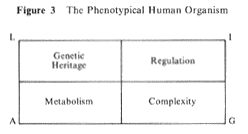
It is of great interest here that Henderson discussed two other primary
properties of organisms besides complexity. The first, metabolism, is related to the three elements in that
the basic chemical process of metabolism is oxydation, which requires carbon and
other substances that, in combining with oxygen produce organically usable
energy. The
other substances that are important are to a high degree organic compounds. The
second additional property he discussed was regulation, which relates to the fact that the
equilibrium that is maintained through metabolic processes of interchange with
the environment is not itself the same as the equilibrium of the environmental
system but is unique to the organism. This distinctiveness can be maintained only
if the organism possesses regulatory
mechanisms that operate in particular ways.
It seems significant that Henderson as a physiologist was concerned
primarily with the individual organism. Perhaps it is for this reason that he did not
include a fourth distinctive property of living systems, namely, ordered
patterning and transmission of a genetic heritage. If this property is
added to the three Henderson discussed, the basis seems to be given of a very
direct comparison, in functional terms, between the organic and the action
“world" as we have been calling them. More of that later.
The main relevance of Henderson's analysis to the present discussion,
however, is that his account established a basis for treating the physical world
not as something altogether foreign to the worlds of organic life and of action
but as something maintaining relatively clear and specific relations to
them.
18 As I wrote this chapter (summer 1977), the public was
being newly alerted to the importance of these conditions by the landing of the
Viking nodule on Mars and the interest of scientists in whether that planet
possesses the necessary conditions for even elementary (microbiotic) life.
19 It was known even when Henderson wrote The Fitness of the Environment (1913) that the table of the chemical elements applied to the physical universe as a whole not just to the earth or solar system. In his Introduction to Lawrence J. Henderson, The Fitness of the Environment (Boston: Beacon, 1958), George Wald suggested, without explanation, that a fourth element, nitrogen, should be added to Henderson's three.
continued ...