Evolution
1. Define the following terms and give an example of each.
a. adaptation Inherited trait (anatomical structure, physiological process, or behavioral trait) that improves an organism's chance of survival and reproduction in a particular environment. beaks of Darwin's finches.b. competition two organisms compete for the same resource. two male birds compete for the same territory.
c. evolution change. development of antibiotic resistance in a population of bacteria
d. fossil preserved evidence of life long past. dinosaur bones embedded in rock.
e. natural selection change within a species. peppered moths.
f. variation differences in a population. hair color, eye color, skin color, height.
2. What are the four parts of Darwin's theory of natural selection?
Many organisms overproduce.Not all offspring survive.
Individuals in a population are different from each other (shows variation).
Different genetic traits are inherited from parents and passed to offspring.
3. How can mutations cause variations in a population? change in gene could cause a helpful trait (such as antibiotic resistance) to be passed on to offspring
4. Why did the population of peppered moths in England become darker in color during the Industrial Revolution? soot settled on the bark of trees, which made light moths more visible to predators. darker moths had a selective advantage and were able to survive and reproduce.
5. In order to mate, two organisms must be of the same species.
Taxonomy and Classification
6. Define the following terms.
a. taxonomy science of classificationb. binomial nomenclature two name naming system
c. scientific name Genus species (two part name of each type of organism)
7. List the seven classification groupings (taxa) from the largest to smallest.
Kingdom Phylum Class Order Family Genus Species
8. Be able to use a dichotomous key.
9. List the five kingdoms and give three characteristics of each. give three examples of members of each kingdom.
Monera prokaryotic, unicellular, autotrophic or heterotrophic, Salmonella, E. coli, StreptococcusProtista eukaryotic, unicellular, autotrophic (algae) or heterotrophic (protozoans), amoeba, paramecium, euglena
Fungi eukaryotic, multicellular, saprophytic, mushrooms, puffballs, yeast
Plantae eukaryotic, multicellular, autotrophic, mosses, ferns, pines
Animalia eukaryotic, multicellular, heterotrophic, dogs, frogs, slugs
10. Write the scientific name for a human. Homo sapiens
11. Distinguish between invertebrates and vertebrates. invertebrates are animals that have no backbone such as sponges and worms. vertebrates are animals with a backbone such as fish and frogs.
Viruses
12. What are two things that make up the structure of viruses? made of genetic material (DNA or RNA) and proteins
13. What is a vaccine? deadened or weakened viruses that produce an immune response to prevent infection
14. List three viral infections common to humans. flu, measles, cold
Monera
15. Describe the characteristics of bacteria. unicellular; prokaryotic (no nucleus); one chromosome; very small
16. What are three common shapes of bacteria? coccus (round); bacillus (rod); spirillum (spiral) What are the three growth patterns of bacteria? diplo (pairs); strepto (chains); staphylo (clusters)
Protista
17. What are the two characteristics common to most algae? contain chlorophyll; unicellular
18. Give three examples of protists. amoeba, paramecium, euglena
19. What are the two major groups of protists? protozoa; algae
Fungi
20. What are three characteristics of fungi? eukaryotic, multicellular, saprophytic
21. Name three examples of fungi. mushroom, puffball, mold
22. Name three ways fungi are important. decomposers, food, disease
Plants
23. Define the following terms.
a. angiosperm flowering plants; produce covered seeds and fruitsb. gymnosperm produce naked seeds; include conifers
c. xylem plant tissue that transports water
d. phloem plant tissue that transports food
24. How do plants get energy? photosynthesis
25. Compare and contrast monocots and dicots. monocots: plants with one seed leaf; parallel leaf venation; flower parts in threes; fibrous roots. dicots: plants with two seed leaves; net leaf venation; flower parts in fours or fives; tap roots.
26. What are the functions of a leaf? photosynthesis
27. What are the functions of a root? conduction, storage, absorption, anchorage
Systems: Digestion and Nutrition
28. What is digestion? the process of breaking complex organic molecules into simpler molecules
29. How do autotrophs and heterotrophs differ? autotrophs make their own carbohydrates; heterotrophs depend on other organisms for energy. Give examples of each. autotrophs: plants, algae; heterotrophs: fungi, animals
30. Describe the parts of the human digestive tract. What are the functions of each organ? mouth (begins mechanical digestion); pharynx (passage from mouth to esophagus); esophagus(tube leading to stomach); stomach (sac that holds food; some chemical digestion); small intestine (site of most digestion and absorption); large intestine (site of water reabsorption; fomration of solid waste); rectum (straight tube leading to outside); anus (opening to outside)
31. Distinguish between chemical digestion and physical digestion. Give examples of each. chemical digestion: breakdown of macromolecules into building blocks (proteins to amino acids; carbohydrates to monosaccharides; lipids to fatty acids, glycerol) physical (mechanical) digestion: breakdown of food into smaller pieces (by chewing or grinding)
32. What is a one-way digestive tract? has two openings, mouth and anus.
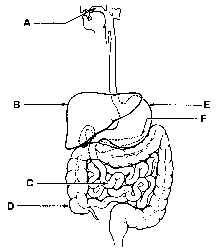
33. Label the diagram of the human digestive tract.
a. mouthb. liver
c. small intestine
d. large intestine
e. stomach
f. pancreas
Systems: Transport and Immunity
34. Explain the differences among simple diffusion, open circulatory systems and closed circulatory systems. Give examples of organisms with each type of circulatory pattern.
diffusion: movement of materials from cell to cell. porifera, cnidaria.open circulatory system: blood leaves open-ended vessels and bathes organs. insects; mollusks
closed circulatory system: blood remains in vessels. earthworms; vertebrates
35. Distinguish between endotherms and ectotherms. endotherms maintain their body temperature with their own mechanisms. examples: birds, mammals. ectotherms use environmental factors to maintain their body temperature. examples: fish, amphibians, reptiles.
36. Compare and contrast the three major types of blood vessels.
arteries: muscular; pulsate; usually carry oxygenated blood; take blood away from the heart to the body.veins: thinner walls; do not pulsate; contain valves; usually carry deoxygenated blood; take blood back to the heart from the body.
capillaries: functional unit of the circulatory system; walls are one cell layer thick; where transfer of gases, nutrients, and wastes occurs; connect arteries and veins.
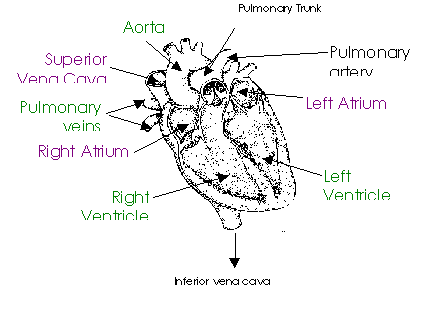
37. Describe the pathway of blood through a human heart. Begin with deoxygenated blood. vena cava -> right atrium -> right ventricle -> pulmonary arteries -> lungs -> pulmonary veins -> left atrium -> left ventricle -> aorta -> body -> vena cava
38. What is the universal blood donor? type O What is the universal recipient? type AB
39. What is the body's first and second line of defense against nonspecific invaders? first line of defense: mechanical barriers, such as skin and mucus; chemical barriers, such as enzymes in the stomach. second line of defense: inflammatory response (redness, swelling, etc.)
Systems: Gas Exchange and Excretion
40. What structure do plants use to exchange gases? stomata in leaves. What is transpiration? evaporation of water from the leaves
41. What are three different structures animals use to exchange gases? Give examples of each.
skin: earthworms, frogs.gills: mollusks; fish.
lungs: reptiles, birds, mammals.
42. Describe the pathway of air through the human respiratory tract. nose -> nasal cavity -> pharynx -> larynx -> trachea -> bronchi -> bronchioles -> alveoli -> capillaries
43. What is hemoglobin? a respiratory pigment in mammalian red blood cells that transports oxygen
44. Name three structures used by animals to get rid of waste.
flame cells (planaria). nephridia (earthworms; mollusks). malpighian tubules (arachnids; insects). green glands (crustacea). kidneys (vertebrates)
45. Label the parts of the urinary tract. Draw an arrow tracing the path of urine from the kidneys to the outside.
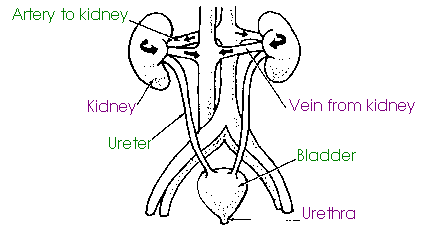
46. What are two functions of the kidneys? excrete metabolic waste (urea, water, salts); maintain osmotic balance of blood
47. What is a nephron? functional unit of the kidney; microscopic structure that produces urine.
Systems: Chemical and Nervous Control
48. Compare and contrast the nervous and endocrine systems of humans. nervous system produces quick responses to stimuli using neurons and neurotransmitters. endocrine system maintains long-term responses using hormones. both maintain homeostasis and function in communication, coordination, and integration.
49. What is cephalization? the concentration of nervous tissue in the head region. flatworms are the first animal to show cephalization.
50. What is the central nervous system? brain and spinal cord
51. List and describe the parts of the eye.
a. cornea clear covering that protects the eyeb. pupil opening in the eye that allows light in
c. iris colored portion of the eye
d. lens focuses light on the retina
e. retina membrane of photoreceptors in the back of the eye. contains rods, which see dim light, and cones, which see colored light.
52. What is the olfactory nerve? perceives odors; found on the nose.
53. Label the organs of the endocrine system.
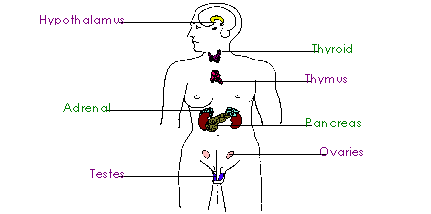
54. What is a hormone? chemical messenger. Distinguish between steroid and protein hormones. steroid hormones are lipids and can pass into the cell. sex hormones are an example. protein hormones are made from amino acids and attach to the outside of the cell, such as insulin.
55. What is a tropism? response of a plant to the environment (such as turning toward light or gravity)
Systems: Movement
56. Describe the four major types of joints and their movements.
immovable (fixed) joints: allow little to no movement; sutures of the skull.gliding joints: allow sliding movements; vertebrae of spine; ankle; wrist.
hinge joints: allow movement in one plane (bend and straighten a joint); elbow; knee.
ball and socket joint: allow movement in all directions (circular movements); shoulder; hip.
57. Compare and contrast endoskeletons and exoskeletons. endoskeletons: found inside body tissues; protect some internal organs. exoskeletons: found outside body tissues.
58. Describe advantages and disadvantages of each. endoskeleton: grow with organism; do not limit size or movement. do not protect outer body tissues, some organs; do not prevent dehydration. exoskeleton: protect internal organs; prevent dehydration. do not grow with organism; heavy; limit size and movement.
59. Describe the three types of muscles found in vertebrates.
smooth muscle: involuntary control; no striations; found in hollow organs, such as the stomach.skeletal muscle: voluntary control; striations (stripes); attached to bones by tendons; allow movement of the skeleton.
cardiac muscle: involuntary control; striations; found only in the heart.
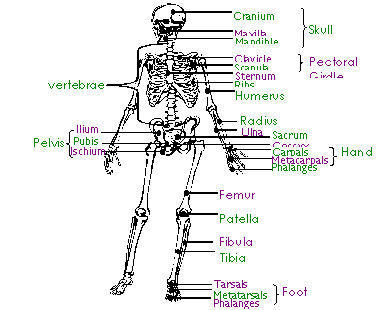
60. Label the bones in the human skeleton.
Systems: Reproduction
61. Distinguish between sexual and asexual reproduction. asexual reproduction involves one parent; sexual reproduction involves two parents.
62. What are female gametes? eggs Male gametes? sperm. Where are these gametes produced in humans? eggs are produced in ovaries; sperm are produced in testes
63. What structure does an angiosperm use to reproduce? flowers
64. Distinguish between a monocot and a dicot. monocots: plants with one seed leaf; parallel leaf venation; flower parts in threes; fibrous roots. dicots: plants with two seed leaves; net leaf venation; flower parts in fours or fives; tap roots.
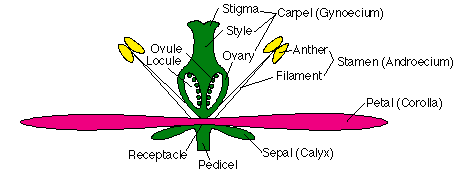
65. Draw and label the parts of a flower. Identify the parts and describe what they do.
pistil: female part of the flower. made of stigma (receives pollen), style (connects to ovary), and ovary (contains egg)
stamen: male part of the flower. made of anther (pollen sac) and filament (stalk supporting anther)
petal: colored portion that attracts pollinators
sepals: green leafy structures that protect flower bud.
receptacle: swollen part of stem that holds flower parts.
66. What is a seed? protected plant embryo and food supply
67. What is a fruit? ripened ovary; covers seeds of angiosperms
68. Define the following terms.
a. alternation of generations reproductive life cycle of plants and algae.b. budding asexual reproduction in which a new organism forms on the side of the parent then breaks off.
c. regeneration asexual reproduction in which part of an organism grows back to make another whole organism.
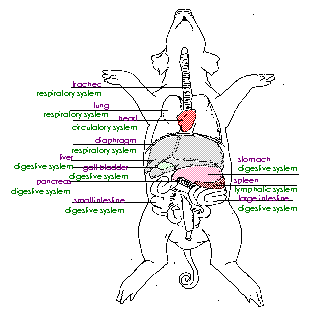
Label the diagram of the pig with the names of each organ. Then identify what system each organ belongs to.