Phillipsburg, Quebec, Canada
JOJ 1NO
450-248-3227 Call for wholesale inquiries.
450-248-2956
Visit our photo page to see our products by clicking on Yahoo Photos to the left under LINKS . THEN CLICK UNFILED.
THE ARTISTS
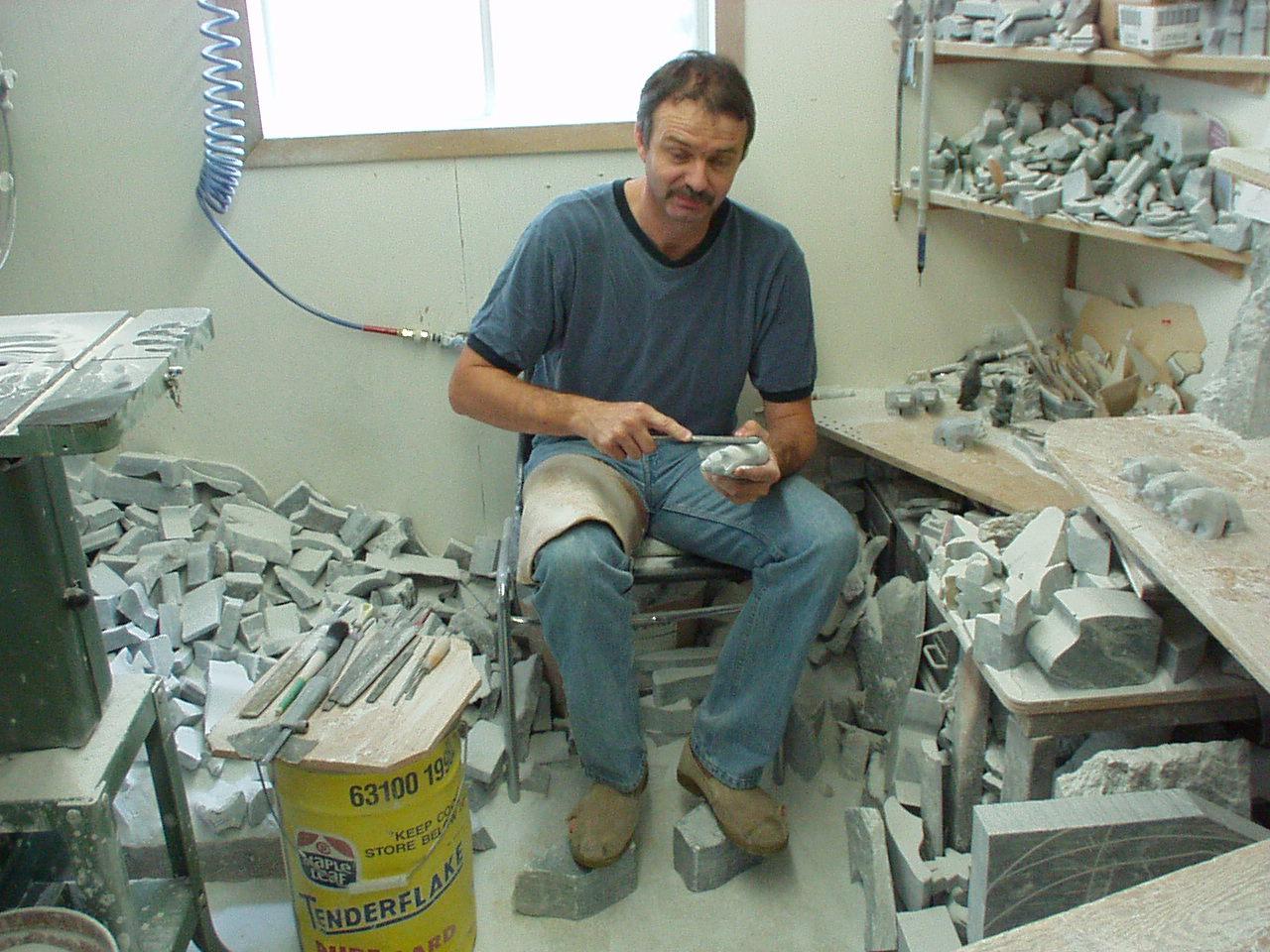
Ross and Mark Parkinson are Canadian artists specializing in soapstone sculpture. A father and son team, they live and work in Phillipsburg, Quebec, a small town near the American border.
Mark, the elder, initially sculpted in wood but switched to soapstone in the early 1970' . In 1977 a piece of his work was presented to Her Majesty Queen Elizabeth II. The sculpture, titled "Fun and Games" , was presented to her visit to Canada on the occasion of her 25th Jubilee. It is presently on display in Buckingham Palace.
Ross, who has been sculpting for 18 years, began his career in the early teens. While attending high school he apprenticed part time with his father. Before long Ross was exhibiting exceptional carving skills and subsequently took his place by his father' side. In 1983 Prime Minister Pierre Elliot Trudeau presented one of Ross' sculptures, a large bear, to her Royal Highness the Princess Diana . On the same occasion a large plaque of a bear,also carved by Ross was presented to His Royal Highness, the Prince Charles.
Together they call themselves the Parkinson Family and with Marks wife Betty often helping out, it truly is a family business. Today the Parkinsons' work may be found in collections worldwide.
THE STONE
The stone of choice for the Parkinson Family is quarried in the Eastern Townships of Quebec not far from their studio. The stone is so suitable for carving, it is often shipped to the arctic to be carved by the Inuit and shipped south again.
These quarries are located in a belt of rocks which extend from Newfoundland to the Gulf of Mexico as part of the Appalachian Mountains. Rocks associated with this belt are also found in Scandinavia. These rocks initially formed deep beneath the floor of an ocean similar to our present day Atlantic Ocean. They were then metamorphosed (transformed) into soapstone and subsequently forced upwards to form the Appalachian Mountains when North America collided with Europe and Africa 450 million years ago. Since then, erosion has exposed the rock on the surface thereby allowing it to be quarried.
The stone is often referred to as "Steatite"consisting of the minerals talc, chlorite, serpentine, and magnetite. Occasionally small crystals of pyrite and chalcoprite (foolsgold) are visible as well as thin needles of a mineral called " �ctinolite" .
Occasionally, the Parkinsons use Brazillian soapstone. The composition and texture of this stone places it in the category of "Steatite" however the tropical climate of Brazil has caused the iron in the stone to oxidize thereby changing the overall color of the stone from dark green or black to brown or gold.
THE SCULPTURES....
Both Mark and Ross Parkinson have always had an appreciation for Canadian wildlife and their work reflects this. In addition,their fascination with the arctic and the northern native cultures who live there is often expressed in their sculptures depicting Inuit scenes. In such sculptures they are not attempting to portray mythological ideas or beliefs nor are they attempting to copy Inuit art. Instead, they depict a purely Canadian impression of the northern people including their joys and hardships as well as their way of life.
Studio
| Add your text here |