|
|
|
The following history of the founding and early years of Park Central Presbyterian Church was originally given as a speech presented at a luncheon given as part of the celebration of the Church Sesquicentennial by Joan Deppa, Associate Professor, S.I. Newhouse School of Public Communications, Syracuse University, in 1996.
*****************
When and where do we begin the history of Park Central Presbyterian Church? If we could go back 150 years from today, we would find that a group of people had already been meeting for several months. Think for a moment what those times were like. In England, a young Queen Victoria had been on the throne only a few years. President Polk, a Presbyterian, was in the White House. Just the previous year, the United States had annexed Texas and Mexico soon severed relations. And in January of 1846, American troops were sent to occupy disputed territory. For those who thought slavery was evil - including many of the people who would found Park Church - the gathering clouds of war had a special significance. They saw the efforts to expand American territory as a plot to increase the area where slavery was permitted. That was not the only issue that concerned the people who on March 31st came together in the white frame meeting house of First Presbyterian Church. But it was an important one.
As Catherine Covert details in her book, The Founding of Park Central Church and Society, abolitionists had received a somewhat chilly reception at First Presbyterian, and in 1837 had been chastised from the pulpit for holding an anti-slavery meeting on the Sabbath. A group split from there the following year to form the First Congregational Church, which had been vehemently abolitionist, and known to abolitionists as the "Cradle of Liberty." Those who opposed the abolition of slavery often stormed its meetings and threw spoiled vegetables and rotten eggs at its speakers. It had problems with its church governance, however, and Second Presbyterian Church was formed in 1844 by members who split from First Presbyterian and the First Congregational churches. And the remaining members of the First Congregational Church, left without a pastor, called another Presbyterian, who tried unsuccessfully to take them all back into the Onondaga Presbytery. So the group that came together on March 31st included members from three churches: Second Presbyterian, a few from First Presbyterian, and the members of First Congregational who had voted to join the presbytery. They had a great deal to discuss that evening in March, but the outcome of that meeting sounds familiar: They agreed to meet the next week, and they appointed a committee.
Now the whole issue of slavery and Park Church is so thorny that you can find at least one book on the sites of Syracuse that tells you that it was pro-slavery. That is far from true. Again, as Catherine Covert's history tells us, its founders elected to become Presbyterian and part of the Synod of Genesee, which in August of 1846 approved the action of the General Assembly of the New School in condemning the awful system of oppression that was slavery. It also, she notes, went on record as "discountenancing the decisive measures of the anti-abolitionists."
By the time the would-be founders met the next time on April 7, they had identified 80 individuals who were willing to join if enough money could be raised to build a church. So another committee set out to look for a lot, come up with a cost estimate for the church and set a goal for what we today might call a "capital campaign."
|
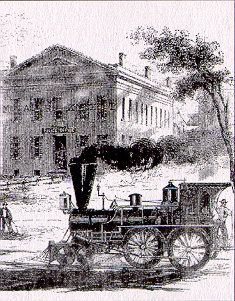
On May 13, Congress declared war on Mexico and approximately six weeks later, on a Sunday morning, June 28, the first worship service was held - at the Market Hall. That structure was only a few months old; Syracuse itself was still only a village. The market stalls were on the first floor, a meeting hall on the second. Preaching twice on that day was the Reverend C. Gold Lee, who had been unanimously invited to act as "stated supply" for the new church. He would serve just a year in that capacity, but the young man hired to direct what was described by a newspaper reporter as "a fine choir" was to become a fixture of the young church in its formative years. He was Joseph Allen, who not only gave singing lessons but also was a local businessman. By the time the earliest City Directory came out, he and a partner were running a music shop on Salina Street.
In August, the Sabbath School was organized. So by Christmas Eve, 1846, when the Presbytery of Onondaga met, some 70 people had taken letters of dismissal from other churches so that they could join. And at that meeting 39 of them were present and were admitted as the first members of the new church. The next important date was December 30th, when 16 men and one woman met to form the Park Church Society. If you wonder why that was necessary, you need look no further than our own church governance. Three elders had been installed at the presbytery meeting; six men were elected trustees at the formative meeting of the society. The one woman, Lois Whitemore, was not allowed to vote that night, but she apparently sat through the meeting. But her active interest may have signaled to the men of the church that women could be party to the church's business. And when time came for the church to elect a pastor to succeed Mr. Lee, the men decided that the women should be allowed to vote.
|
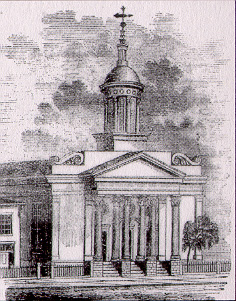
Construction of the church took most of 1847, and on February 3rd, 1848, the congregation held its first worship service in its new home. Most of you will have seen the wood engraving of that building. But a clearer picture of its place in the community can be seen from the panorama of Syracuse from hills where sheep grazed - and where college students now roam. This view actually dates from four years later, 1852, at a time when Syracuse was thriving. These were tense years for the new church. Clues about how perilous they were come from the allotment of pews. Initially, the notices were of pews for sale. Then they changed to advertisements of pews for rent. The crisis came in 1855, when the sheriff presided at a sale at Park Church and its furnishings went under the hammer. Fortunately, three church members bought them and then rented them back to the trustees. Which brings us to David Hotchkiss, viewed as the savior of the "church on the other side of the park." He bought the mortgage in 1855 and transferred it to a new organization, "Park Presbytery Society." However, it was the next reorganization, which came three years later, tha was the hardest for the congregation to accept. As Catherine Covert records, by this time it was determined in its antislavery views. Yet the help came from Old School Presbyterians, who had been tainted by their tolerance of slavery.
Despite its troubles, Park Church was hardly a grim place. The record that comes down to us is of a lively congregation that looked to the church both for faith and fellowship. Beginning with New Year's Eve 1846, the women of the church arranged social events to raise money. On that night they sold fancywork, what we would call handicrafts, and provided "refreshments in abundance" accompanied by a concert of the choir and assorted quartets and volunteers. That event alone made $250, a considerable sum in those days. Later the women of the church would come up with a variety of fund-and-fun raisers, a strawberry festival, and an early celebration featuring that novel idea of a Christmas tree�
The young people of the church were also renowned from the earliest days for the programs, celebrations and picnic outings. For a while I was mystified about who all these young people could be. And then I discovered a drawing that identified the building next door as Park Institute. What was Park Institute? Even the people helping me at the Onondaga Historical Association were puzzled. By looking at a map and plate numbers, they were able to pull out the appropriate folders. Park Institute was what they called in those days a ladies seminary. And Joseph Allen, the enterprising choir director at Park Church, taught voice to some of the young ladies enrolled there. It faced on Fayette Street, as did a number of other ladies seminaries and educational institutions for young men as well. Syracuse was already an educational center, and apparently Park Church served many of the students as a temporary church home. That, in fact, may help to explain how the church could be full and still face financial difficulties. Like students of any age, these young people would not have had a lot of money to fill the collection plates.
The children attending Park Church came from the families of the members, but many of them also were sent by parents who did not regularly attend. So we find announcements in December 1861 of a Sunday School festival in which there was to be a tree covered with gifts for 200 Sabbath School children. The tree was lit with wax candles. You might be interested to know that the pastor, Mr. Fillmore, was given two gifts, a hat and a pair of skates.
It is important to take note of that date. For several months, the nation had been locked in the grim conflict called the Civil War. We do not know what the sermons of those times addressed, but we do know that the church provided diversions for its congregation and through its Sabbath School, to many from the neighborhood. In fact, slightly less than two months after the firing on Fort Sumter, Park Church took possession of its first organ.
In 1864, the church had to be closed for a time for repairs, and in then 1867, it experienced an event that will sound all too familiar to many of us. Shortly after 6 p.m. in the evening, smoke was seen coming from the church. The fire was in the rear portion of the basement and had run up between the plastering, burned through the floor and into the body of the church. The newspaper account tells us, "An alarm was sounded and the firemen rallied promptly, steamer No. 2 taking position at a hydrant at the corner of Mulberry and Onondaga streets. By the time a stream of water was brought to bear on the flames they had communicated to the pews in the church, destroying several of them. The fire was soon extinguished, but not before quite a hole had been burned in the floor and the ceiling below badly damaged. The melodeon in the basement was destroyed and the organ badly blistered from the heat." But the trustees had prepared well for such emergencies: Both the building and the relatively new organ were well insured. The church took two actions that also remind us of the more recent fire in our own sanctuary: They publicly thanked the firemen by taking out an ad in the newspaper, and they refurbished the sanctuary to make it even more comfortable and inviting. In fact, the cushioned sofas that they used for pews were much discussed in contemporary press accounts.
It was apparently in that same year that Park Church started a new Sunday School class. For at least the next four years, a small group of freed slaves attended and were given lessons not only from the Bible, but help in learning how to read. So far, I've not been able to learn their names or what happened to them. But a newspaper account from 1869 tells of an event in which one of the young men brought "a most exquisitely arranged bouquet, to be given to the lady who is guiding these beginners." Turning to the audience in a mellow, clear, sonorous voice, he repeated a verse from Ephesians: "Knowing that whatsoever good thing any man doeth, the same shall he receive of the Lord, whether he be bound or free."
Two years later, the great event in the life of the church was the arrival of a 2500-pound bell to hang in the steeple. It was the gift of David Hotchkiss, the same man who came to the rescue of the church in its time of financial need. Contemporary accounts show that he was an especially beloved member of the church, but it is important to know that this was for more than his generosity in helping to save the church or in giving the great bell that still summons us to Park Central. When you read contemporary accounts of social events connected with the church, the name David Hotchkiss often comes up. It seems that he was often called on for recitations, and at Park Central, such recitations often involved more than a little humor.
|
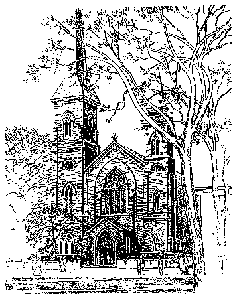
Rev. Edward Thurber, who arrived at Park Church in 1870, is another of those faces from our past that we might misread as stern and humorless. That, too, would be a mistake. He was to serve the church for the next 18 years, and it was under his leadership that our present church was built in 1872 - and the debt paid in full six years later�An event marked with what he called a "jollification meeting." The move from the old church was accomplished with a mixture of emotion. And as part of the services, they read the 26th Psalm. That had provided the text of the sermon preached on the very first service at the smaller church on the other side of the park: "Lord, I have loved the habitation of thy house, and the place where thine honor dwelleth." And Rev. Thurber's sermon had a message that still seems pertinent 121 years later that a church should not be judged by its wealth or by its members, but by its spirituality.